Active Dental Implants: What Are They?
The world of dental implants has a vocabulary that can be confusing. You will hear terms like “endosseous implant,” “osseointegrated implant,” and “immediate load implant.” One term that occasionally surfaces in marketing or clinical discussion is “active dental implants.” This phrase does not refer to a specific, standalone category of implant, like a titanium or zirconia implant. It refers to a design philosophy and a biomechanical characteristic of the implant fixture’s thread design.
This article provides a clear, technically accurate explanation of what “active dental implants” means in the context of modern implant dentistry. You will learn about the engineering concept of active versus passive threading, the clinical advantages this design offers, the specific scenarios where it is used, and how it fits into the overall goal of achieving primary implant stability.
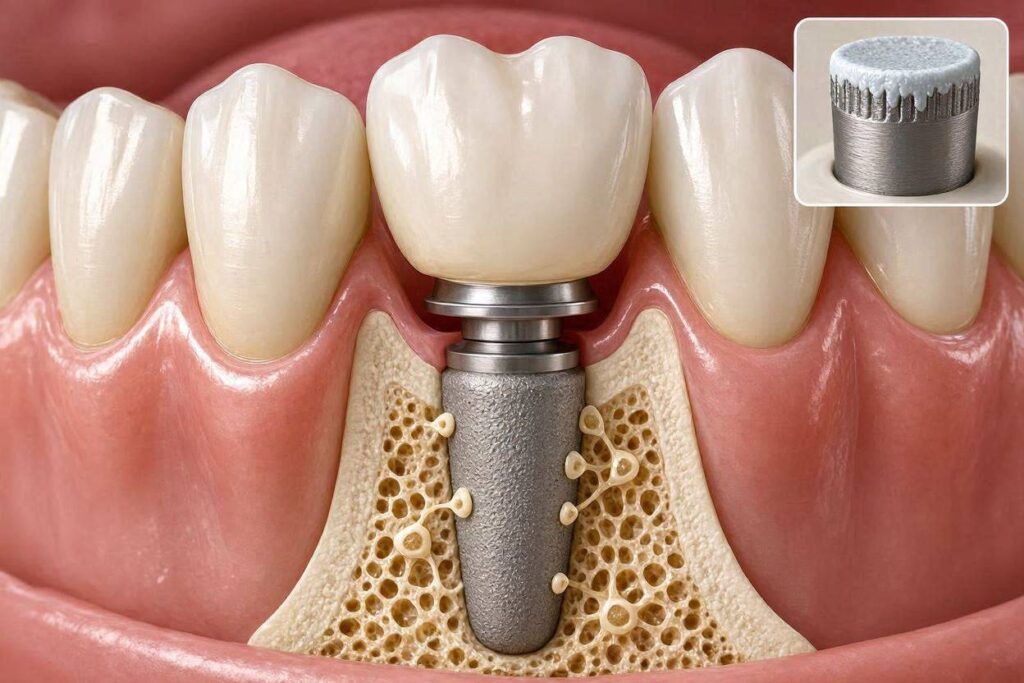
The Core Concept: Active vs. Passive Implant Threads
To understand what an active dental implant is, you must first understand that the screw threads on an implant are not all the same. They are engineered with specific geometries to interact with the bone in different ways. The terms “active” and “passive” describe the functional relationship between the implant threads and the surrounding bone tissue.
Passive (or Non-Compressing) Thread Design
In a passive implant thread design, the implant is essentially a screw that finds its path into a pre-tapped, precisely prepared channel in the bone. The threads of the implant follow passively into the grooves that the surgical drill and a bone tap have already created. The implant does not significantly compress the bone beyond the boundaries of this prepared osteotomy as it is seated. The primary stability comes from the precise fit of the threaded body within this carefully machined channel. The surgical protocol for a fully passive implant often includes a final step of using a bone tap, a tool that cuts the exact thread pattern into the bone before the implant is placed.
Active (or Self-Tapping, Self-Compressing) Thread Design
An active dental implant has a specific thread design that is sharp, aggressive, and intended to cut its own path or compress the bone during insertion. The implant itself acts as the final instrument. The surgical drill creates a channel that is intentionally slightly narrower in diameter than the implant’s overall thread span, particularly in the apical (deepest) portion. When the active implant is driven into this undersized channel, its sharp threads bite into the virgin bone, cutting or condensing it laterally. This creates a powerful mechanical wedging effect, significantly increasing the implant’s initial stability, known as primary stability.
The “active” action is the implant’s thread engaging and compressing the bone as it is torqued into its final position. This is not a passive following of a pre-cut path; it is an active, mechanical compaction.
The Engineering and Biomechanical Advantage
The primary clinical goal of an active implant design is to maximize primary stability. Primary stability is the mechanical lock of the implant in the bone at the moment of surgical placement, before any biological healing (osseointegration) has occurred. High primary stability is the absence of micro-movement.
This is critically important for two reasons. First, bone is a living tissue that will not grow onto a moving surface. If an implant is loose at the time of placement, the healing process will create a soft tissue scar capsule instead of a rigid bone-to-titanium fusion. The implant will fail. Second, high primary stability is the prerequisite for immediate loading. If a surgeon can achieve a high insertion torque value—often clinically set at 35 Ncm (Newton centimeters) or greater—with an active implant, the implant is mechanically solid enough to support a temporary crown on the same day. The active, bone-compressing thread design is a primary tool for achieving this.
The Cutting Flute
Active implants often feature a cutting flute, which is a sharp, vertical groove or notch at the apical end of the implant. The purpose of this flute is to clear the bone chips and debris created as the implant cuts its own path, preventing excessive compressive pressure that could lead to bone cell death.
Clinical Applications for Active Implants
Surgeons choose active implant designs for specific clinical situations where dense or stable initial anchorage is required.
Soft Bone (Type IV Bone)
Ironically, one of the most important applications is in soft, low-density bone, such as the posterior maxilla (upper back jaw). In soft bone, a passive implant might not achieve enough friction to be stable. An active implant with an aggressive, bone-condensing thread profile is used with a deliberately undersized final drill. This compacts the soft bone laterally, densifying the immediate surrounding bone and creating the mechanical grip that would otherwise be impossible. This technique is sometimes called “undersized drilling” or the “osteotome technique.”
Dense Bone (Type I Bone)
In very dense, cortical bone like the anterior mandible (front lower jaw), an aggressive, active cutting thread is needed to cut into the hard bone rather than pushing it. Without a cutting design, the high insertion torque in dense bone could cause compressive necrosis, where the pressure kills the bone cells at the interface. An active cutting implant relieves this stress by cutting a clean path.
Immediate Load Protocols
As discussed, any case where the surgeon plans to place a temporary tooth on the implant on the day of surgery requires a design that will deliver very high primary stability. Active-thread implants are the standard choice for these protocols.
Active vs. Aggressive: A Note on Terminology
Some implant manufacturers market specific product lines using the word “Active” as a brand name or a design characteristic. It is not a universal, regulated term. One company’s “active” implant might be another company’s “standard” implant. What matters is not the marketing term, but the specific thread geometry, the presence of cutting flutes, and the surgical protocol recommended by the manufacturer for that specific implant design. The surgeon selects the implant based on the drilling sequence, the bone density, and the required primary stability for the individual case.
Conclusion
An “active dental implant” is one with a self-tapping or bone-compressing thread design that actively engages and compacts the bone during insertion, as opposed to following a fully pre-tapped, passive channel. The clinical advantage of this design is the achievement of high primary mechanical stability, which is essential for successful osseointegration, particularly in soft bone, and is the prerequisite for immediate loading protocols where a temporary tooth is placed on the same day. It is an engineering concept, not a distinct material, and is a fundamental tool in a surgeon’s armamentarium for managing varying bone quality.
FAQ
1. Is an active implant made of a different material?
No. Active implants are made of the same biocompatible materials, typically titanium alloy, as passive implants. The difference is solely in the macro-design of the threads.
2. What is the main clinical reason to use an active implant?
To achieve high primary stability, which is the strong mechanical lock in the bone at the time of surgery. This is crucial for healing and for placing a temporary tooth on the same day.
3. How does an active implant work in soft bone?
In soft bone, the implant acts as a bone condenser. The surgeon drills a slightly smaller hole, and the active threads compress the soft bone laterally to create a denser, more stable mechanical lock.
4. Does an active implant increase the risk of bone damage?
If used improperly with a poor surgical technique, an overly aggressive insertion torque can cause bone cell death at the interface. A skilled surgeon manages this by using the correct drill sequence and torque control.
5. Are all dental implants either purely active or passive?
It is a spectrum. Many modern implants feature a hybrid design with a passive coronal (top) portion and an aggressive apical (bottom) cutting portion to gain both ideal stability and stress distribution.
Additional Resource
For a comprehensive scientific overview of implant macro-design, thread geometry, and the biomechanical principles of primary stability, visit the research and education portal of the Academy of Osseointegration (AO).