All-On-4 Dental Implants in Culver City
Losing multiple teeth can feel overwhelming. You might feel self-conscious when you laugh. You might struggle to eat your favorite foods. Perhaps you are tired of dealing with messy dentures that slip and click.
There is good news. You do not have to live like that forever.
Modern dentistry offers a powerful solution: All-On-4 dental implants. For residents of Culver City and the surrounding Los Angeles area, this procedure has changed thousands of lives. It offers a fixed, permanent set of teeth that look, feel, and function like natural ones.
This guide walks you through everything you need to know. We will cover how the procedure works, what it costs, how to find the right dentist, and what to expect during recovery. Let’s get your smile back.
What Are All-On-4 Dental Implants?
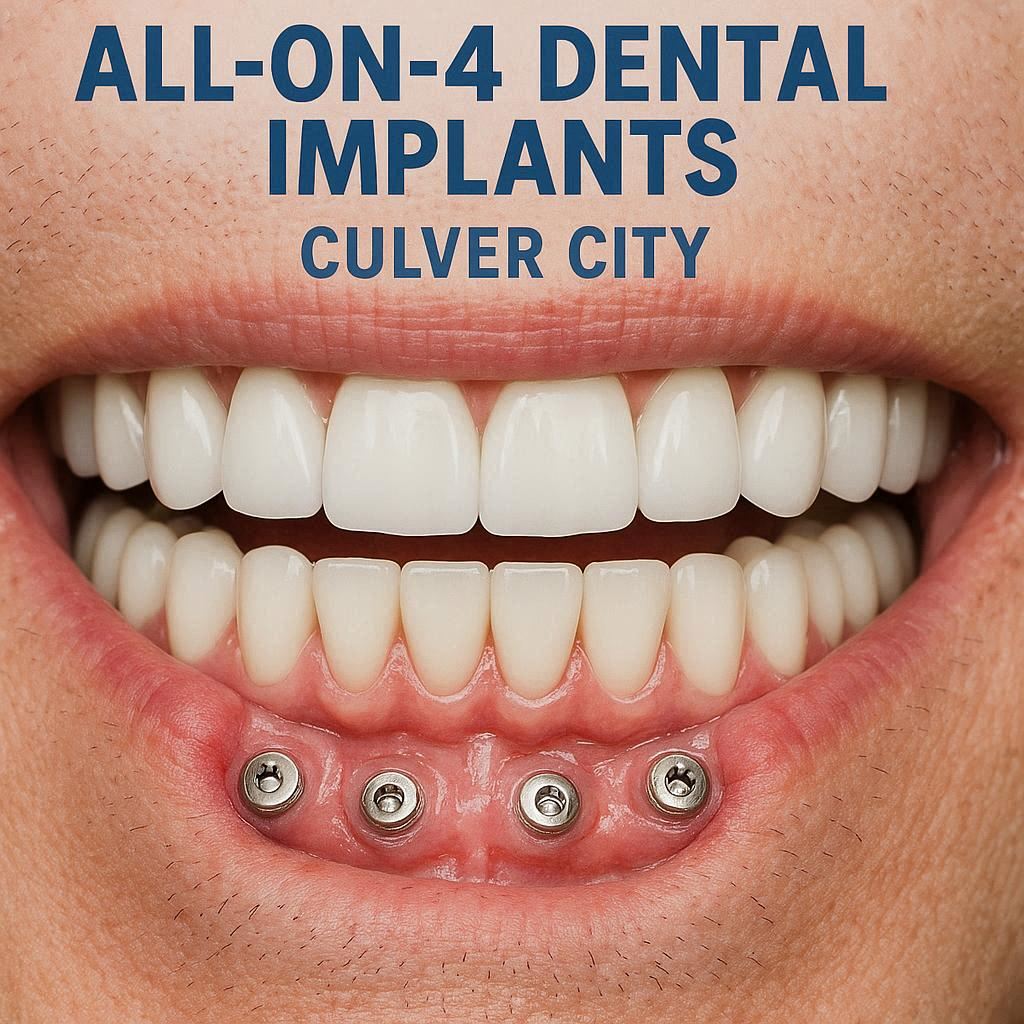
The name explains a lot. “All-On-4” means all of your teeth are supported on just four dental implants.
Think of it like building a sturdy table. A traditional table needs four strong legs to hold the top. Your new smile needs four titanium posts (the legs) placed into your jawbone. These posts hold a full arch of prosthetic teeth (the tabletop).
Here is what makes this technique special:
- You only need four implants per jaw. Traditional methods often require six to eight implants.
- The two back implants are angled. This avoids weak bone areas and maximizes support. It often eliminates the need for bone grafting.
- You get temporary teeth on the same day. You never walk out without a smile.
Important Note: All-On-4 is designed for people who are missing all or most of their teeth in one jaw (upper or lower) or both jaws.
All-On-4 vs. Traditional Dentures: A Quick Comparison
Many Culver City residents wear traditional dentures. But dentures sit on the gums. Implants fuse with the bone. The difference in quality of life is massive.
| Feature | Traditional Dentures | All-On-4 Implants |
|---|---|---|
| Stability | Move and slip. Adhesive required. | Fixed in place. Never move. |
| Eating | Avoid hard, sticky, or crunchy foods. | Eat steak, apples, corn on the cob. |
| Taste | Palate is covered (upper denture). | Open palate. Taste food normally. |
| Bone Health | Accelerates bone loss in the jaw. | Preserves bone. Stimulates growth. |
| Speech | Can click or slip, causing lisping. | Natural speech. No worries. |
| Daily Routine | Remove nightly. Soak in cleaner. | Brush and floss like natural teeth. |
| Longevity | Replace every 5–7 years. | Can last 20+ years or a lifetime. |
Who Is a Good Candidate for All-On-4 in Culver City?
Most adults with significant tooth loss are candidates. However, a local dentist must perform a specific exam to be sure.
Ideal candidates usually:
- Have failing teeth, severe decay, or advanced gum disease.
- Are missing most of their natural teeth.
- Wear dentures and hate them.
- Have sufficient jawbone density (though less is needed than traditional implants).
- Do not smoke heavily (smoking reduces success rates).
- Are healthy enough for a minor surgical procedure.
What if you have bone loss?
Historically, bone loss meant you could not get implants. The All-On-4 technique changed that. By placing the rear implants at a 30- to 45-degree angle, dentists avoid areas of low bone. Many patients who were told “no” in the past are now approved.
Reader Note: Only a CBCT (3D X-ray) scan can confirm your bone levels. Do not self-diagnose. Visit a Culver City implant specialist for a real answer.
The Step-by-Step All-On-4 Procedure in Culver City
Understanding the process removes fear. Here is exactly what happens, from the first phone call to your final smile.
Step 1: The Comprehensive Consultation (Day 1)
You meet with an implant dentist. They take digital X-rays and a 3D CT scan of your jaw. They review your medical history. Together, you discuss your goals.
The dentist uses special software to plan the exact position of each implant. This planning happens before you ever sit in the surgical chair.
Step 2: Preparation and Extractions (Surgery Day)
If you have failing teeth, the dentist removes them. This is painless because you are under anesthesia (local anesthetic, IV sedation, or general anesthesia).
Step 3: Implant Placement
The dentist makes small incisions in your gums. They drill precise holes into your jawbone. They place the four titanium implants. The two front implants go in straight. The two back implants go in at an angle.
This surgery takes about 2 to 3 hours per arch.
Step 4: Attaching the Temporary Bridge
Right away, the dentist attaches a temporary set of teeth to the implants. These teeth are made of acrylic or resin. They look decent, but they are not the final product. Their job is to protect the healing implants and give you a functional smile immediately.
You leave the office that same day with new, non-removable teeth.
Step 5: Healing (Osseointegration)
For the next 4 to 6 months, your bone grows around the implants. This process is called osseointegration. It locks the implants in place like roots.
During this time, you eat a soft-food diet. You avoid chewing directly on the temporary teeth. This is the most important phase for long-term success.
Step 6: Final Teeth Placement
Once healing is complete, the dentist removes the temporary bridge. They take impressions for your permanent teeth. These are made from stronger materials like zirconia or acrylic-reinforced with metal.
Your permanent set is screwed onto the implants. They are beautiful, natural-looking, and incredibly strong.
Benefits of Choosing All-On-4 in Culver City
Why do locals choose this procedure over other options? The benefits go beyond just having teeth.
1. You smile with confidence again.
No more hiding your mouth. No more avoiding photos. Your new smile looks completely natural.
2. You eat what you want.
Imagine biting into a crisp apple. Imagine enjoying a steak dinner. All-On-4 restores about 80–90% of your natural biting force.
3. You preserve your face shape.
When teeth are missing, the jawbone shrinks. The lower part of the face collapses. This creates a “witch’s chin” or sunken look. Implants stop bone loss. Your face stays full and youthful.
4. You save money and time.
Yes, the upfront cost is higher than dentures. But over 20 years, dentures require relines, adhesives, and replacements. All-On-4 requires zero adhesive and lasts much longer.
5. You recover faster.
With only four implants, you have less swelling, less pain, and faster healing compared to placing eight or ten implants.
How Much Do All-On-4 Dental Implants Cost in Culver City?
Let’s talk numbers. Prices vary widely based on the dentist’s experience, the materials used, and whether you need extractions.
Here is a realistic price range for Culver City (Los Angeles County pricing):
| Procedure | Low End | Average | High End |
|---|---|---|---|
| Single Arch (upper or lower) | $15,000 | $24,000 | $30,000+ |
| Full Mouth (both arches) | $28,000 | $45,000 | $60,000+ |
These prices typically include:
- Consultation and CT scan.
- Extractions of existing teeth.
- Surgery and anesthesia.
- Four implants per arch.
- Temporary fixed bridge.
- Permanent final teeth.
Hidden costs to ask about:
- Bone grafting (rare for All-On-4, but possible).
- Sinus lift (for upper jaw if bone is very thin).
- Maintenance visits (usually covered by insurance or low cost).
- Warranty (some clinics offer 5–10 years on teeth).
Money-Saving Tip: Many Culver City dental offices offer in-house financing or work with third-party lenders like CareCredit, Proceed Finance, or LendingClub. Some practices offer a “per-arch” package price. Always ask for a written estimate.
Does Insurance Cover All-On-4?
It depends on your plan. Most traditional dental insurance caps out at 1,500–2,000 per year. That barely touches the cost.
However, you can use your insurance for parts of the procedure, such as:
- Extractions.
- Diagnostic X-rays.
- Anesthesia.
Check your medical insurance. Some medical plans cover dental implants if tooth loss results from an accident, injury, or medical condition (like oral cancer).
Medicare generally does not cover dental implants. Medical (Medi-Cal in California) typically covers extractions and dentures, but rarely implants for adults.
Finding the Best All-On-4 Provider in Culver City
Not all dentists place implants. You need a specialist. Here is who to look for:
- Oral Surgeon: Focuses on surgery. Often works with a restorative dentist for the teeth.
- Periodontist: Gum and bone specialist.
- Prosthodontist: Advanced training in replacing teeth. Often the best choice for the entire procedure.
Questions to ask before choosing a dentist:
- *How many All-On-4 cases have you completed?* (Look for 100+ cases.)
- Can I see before-and-after photos of your patients?
- What brand of implants do you use? (Nobel Biocare and Straumann are top brands.)
- Who makes the final teeth? In-house or a dental lab?
- Do you provide a written warranty?
- What happens if an implant fails? Do you replace it for free?
Local options near Culver City:
You have excellent choices within a 5-mile radius, including:
- Downtown Culver City: Several general dentists with implant training.
- Fox Hills: Specialty prosthodontic practices.
- Marina del Rey: High-end implant centers with in-house labs.
- Playa Vista: Newer clinics with modern 3D technology.
Always schedule 2–3 consultations before deciding. Prices and treatment plans vary significantly.
Recovery, Healing, and Aftercare
The first week after surgery is the most intense. Here is a realistic timeline.
Days 1–3:
- Swelling and bruising are normal.
- Eat only cold, soft foods: smoothies, yogurt, pudding, protein shakes.
- Use ice packs (20 minutes on, 20 off).
- Take prescribed pain medication or ibuprofen.
- Sleep with your head elevated.
Days 4–7:
- Swelling peaks then starts to go down.
- Switch to warm soft foods: mashed potatoes, scrambled eggs, soup, oatmeal.
- Rinse gently with warm salt water (do not spit hard).
- Brush the temporary teeth carefully with a soft brush.
Weeks 2–6:
- Most swelling and pain are gone.
- Continue soft-food diet.
- Avoid chewing on the front temporary teeth.
- Do not smoke, use straws, or eat hard foods.
Months 4–6 (Healing Completion):
- You feel normal.
- Your temporary teeth may feel loose. This is normal before the swap.
- Final impressions are taken.
After the final teeth placement:
You treat them like real teeth.
- Brush twice daily.
- Floss under the bridge using super floss or a water flosser (Waterpik).
- Visit your dentist every 6 months for checkups.
- Avoid chewing ice, hard candy, or pens.
Success Rate: All-On-4 has a documented success rate of 97–98% after 10 years when placed by an experienced clinician and maintained properly.
Common Fears and Myths (Debunked)
Let’s clear up some rumors circulating in Culver City.
Myth 1: “It hurts a lot.”
Truth: You are asleep or sedated during surgery. Post-op pain is less than a tooth extraction. Most patients rate it a 2–4 out of 10. Over-the-counter pain relievers usually work.
Myth 2: “I am too old for implants.”
Truth: Age is not a barrier. Dentists have placed All-On-4 in patients in their 80s and 90s. Health is more important than age.
Myth 3: “The teeth look fake.”
Truth: Modern materials look incredibly natural. Your dentist custom-shades each tooth. No one will know they are implants unless you tell them.
Myth 4: “Dentures are cheaper, so they are better.”
Truth: Dentures are cheaper today. But over 10 years, the cost of adhesives, relines, replacements, and treating bone loss often exceeds the cost of implants. Cheaper upfront is not cheaper long-term.
Realistic Risks and Complications
Honesty is important. All-On-4 is extremely safe, but no surgery is risk-free.
Possible risks include:
- Implant failure (2–3% chance). An implant does not fuse with the bone. It is usually replaced for free under warranty.
- Infection (rare with proper antibiotics and oral hygiene).
- Nerve damage (very rare with 3D-guided surgery). This could cause temporary numbness in the lip or chin.
- Sinus issues (only for upper jaw implants if they protrude into sinus cavity).
- Fracture of temporary teeth (avoid hard foods).
Choose an experienced dentist. Follow all post-op instructions. These risks drop significantly.
Lifestyle After All-On-4: What Really Changes
Patients often tell us they forgot what normal felt like. Here is what your new life looks like.
Morning routine:
You wake up. You brush your teeth. That is it. No soaking. No adhesive. No gagging on a denture.
Eating out:
You order a Caesar salad. You eat the croutons. You bite into a burger. You never think about your teeth moving.
Travel:
No carrying denture cleaner. No worrying about losing your teeth in a hotel sink.
Kissing and intimacy:
No clicking sounds. No adhesive taste. No embarrassment.
Public speaking:
You speak clearly. No lisping. No fear of teeth flying out.
Financing and Payment Options in Culver City
Many people assume they cannot afford this procedure. Do not assume. Ask.
Here are real ways Culver City residents pay for All-On-4:
- In-house membership plans. Some dental offices offer 20% off for members.
- Dental savings plans (not insurance). You pay an annual fee and get discounted rates.
- CareCredit (0% interest for 12–24 months if paid in full).
- Medical credit cards like Alphaeon or PatientFi.
- Health Savings Account (HSA) or Flexible Spending Account (FSA). Pre-tax dollars.
- 401(k) loan (borrow from yourself, but be careful).
- Home equity line of credit (HELOC). Low interest, tax-deductible often.
Warning: Avoid clinics that quote you $7,000 for “All-On-4.” That is likely not true All-On-4 with fixed temporary teeth. It may be implant-supported dentures that snap on and off (overdentures). Read the fine print.
How to Prepare for Your All-On-4 Surgery
Being prepared reduces stress and speeds healing.
One week before surgery:
- Stop taking blood thinners (aspirin, ibuprofen, fish oil, vitamin E) after doctor approval.
- Arrange for a ride home (you cannot drive after IV sedation).
- Buy soft foods: yogurt, applesauce, protein powder, instant mashed potatoes, soup broth.
- Fill prescriptions for pain medication and antibiotics.
Day before surgery:
- Eat a good dinner (you may not eat for 8 hours before surgery).
- Do not drink alcohol.
- Wash your face and brush your teeth well.
Day of surgery:
- Wear loose, comfortable clothes with short sleeves.
- Do not wear contact lenses, jewelry, or makeup.
- Bring a phone charger and a small pillow for the car ride home.
Maintaining Your All-On-4 Implants for Life
These implants can last decades. But you must maintain them.
Daily cleaning routine (5 minutes):
- Brush the teeth like normal (2 minutes).
- Use a water flosser between the gums and bridge (2 minutes).
- Use super floss under the bridge (1 minute).
Professional maintenance (every 6 months):
- Your dentist removes the teeth (yes, they are screw-retained, so they come off).
- The dentist cleans the implants and checks for loosening screws.
- They polish your teeth and screw them back on.
Signs something is wrong (call your dentist):
- One tooth feels loose.
- You see a visible screw hole (the cap fell out).
- You feel pain when biting.
- Gums bleed heavily or swell.
All-On-4 vs. Other Implant Options
You have choices. Here is how All-On-4 compares.
| Option | Number of Implants | Fixed? | Removable? | Typical Cost (per arch) |
|---|---|---|---|---|
| All-On-4 | 4 | Yes (screwed in) | No (only dentist removes) | $24,000 |
| All-On-6 | 6 | Yes | No | $30,000+ |
| Snap-on Denture (Overdenture) | 2–4 | No | Yes (you remove nightly) | 12,000–18,000 |
| Traditional Denture | 0 | No | Yes | 2,000–5,000 |
Which is best?
- Snap-on denture works if you want lower cost and don’t mind removing them.
- All-On-4 is best for most people: fixed, affordable, and fast healing.
- All-On-6 is for patients with very dense bone who want extra redundancy. Usually unnecessary.
A Realistic Day in the Life (Patient Story)
Meet “David,” a 58-year-old Culver City resident. He wore dentures for 12 years. He hated them.
Before:
- Skipped lunch with colleagues because eating in public was embarrassing.
- Rinsed his denture in restaurant bathrooms.
- Had sores on his gums constantly.
- Stopped smiling in family photos.
After All-On-4 (6 months later):
- Eats ribs with his hands.
- Laughs loudly without covering his mouth.
- Traveled to Italy and ate pasta and bread without fear.
- Says, “I wish I did this ten years ago. I forgot what confidence felt like.”
This is not magic. It is modern dentistry.
Frequently Asked Questions (FAQ)
Q: How long do All-On-4 implants last?
The titanium implants last a lifetime if maintained. The prosthetic teeth last 10–20 years before needing replacement due to normal wear.
Q: Can I get All-On-4 if I have gum disease?
Yes, but your dentist must treat the gum disease first. Active infection must be eliminated before implant placement.
Q: Is the procedure done in one day?
The surgery and temporary teeth happen in one day. The final teeth come 4–6 months later.
Q: Will I be awake during surgery?
Most patients choose IV sedation. You are technically awake but deeply relaxed and you will not remember the procedure. General anesthesia (fully asleep) is also available.
Q: Can All-On-4 fail?
Yes, in about 2–3% of cases. Smoking, uncontrolled diabetes, and poor oral hygiene increase failure risk.
Q: How do I clean under the bridge?
Use a water flosser (Waterpik) on a low setting. Use super floss with a stiff end to thread under the bridge.
Q: Will my face change shape?
Yes, for the better. Implants preserve your jawbone, so your lower face stays full. You will look younger.
Q: Can I get All-On-4 on the NHS or Medicare?
No. In the US, it is a private-pay procedure.
Additional Resources
For further reading and to verify the information in this guide, visit the following trusted source:
American Academy of Implant Dentistry (AAID) – Patient Education
This official resource explains implant types, how to choose a dentist, and answers common patient questions.
Conclusion
All-On-4 dental implants in Culver City offer a permanent, life-changing solution for anyone tired of missing teeth or uncomfortable dentures. You get a fixed smile in one day, eat normally again, and preserve your facial structure for years to come. While the upfront cost is significant, the long-term value, confidence, and quality of life make it one of the best investments in your health.
Disclaimer: This article is for informational purposes only and does not constitute medical or dental advice. Always consult with a licensed dental professional in Culver City for a proper diagnosis and treatment plan. Individual results vary.