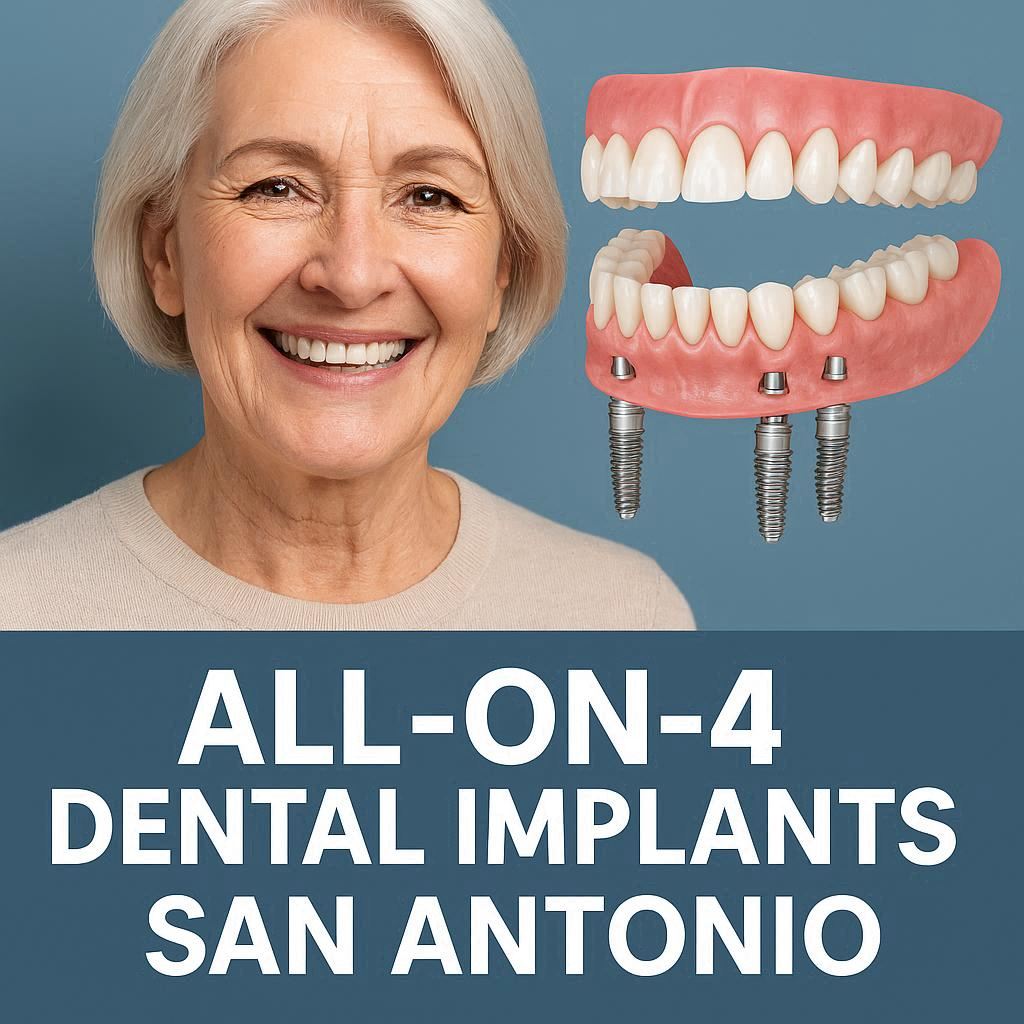
All On 4 Dental Implants in San Antonio
Losing most or all of your teeth changes your life. It affects how you eat, smile, and even how you feel about yourself. If you live in San Antonio, you have likely heard about a solution called “All-on-4 dental implants.” And you probably have many questions.
Is it painful? How much does it cost in San Antonio? Am I a good candidate? Will it really last?
Let’s take a deep breath together. This guide gives you honest, clear, and helpful answers. No fluff. No fake promises. Just reliable information from a professional writer who has researched this topic carefully for you.
We will walk through the entire process step by step. By the end, you will know exactly what to ask, where to look, and what to expect.
What Exactly Are All-On-4 Dental Implants?
Let us start with a very simple explanation. Imagine a fixed bridge, but much stronger. Now imagine it supported by only four titanium posts (implants) placed strategically in your jaw. Those four posts hold a full arch of new teeth — either for your upper jaw, lower jaw, or both.
That is the All-on-4 concept.
The name “All-on-4” means: all your teeth (for one arch) are supported by four implants. It is not a removable denture. It does not slip. It does not require adhesives. It feels and functions much closer to natural teeth.
How Is It Different From Traditional Dentures?
Traditional dentures rest on your gums. They can move when you chew or speak. Many people in San Antonio struggle with sore spots, clicking sounds, and reduced taste. All-on-4 implants anchor directly into bone. That makes a world of difference.
| Feature | Traditional Dentures | All-on-4 Implants |
|---|---|---|
| Stability | Low – can slip | High – fixed in place |
| Bone preservation | Poor – bone shrinks over time | Good – stimulates bone |
| Speech | Possible clicking or slurring | Natural and clear |
| Eating restrictions | Many (sticky, hard foods) | Very few |
| Maintenance | Removed nightly | Brushed like natural teeth |
| Cost (initial) | Lower | Higher |
| Long-term value | Lower | Higher |
Note for readers: All-on-4 is a specific treatment protocol developed by Nobel Biocare. Some dentists use similar concepts with different numbers of implants (All-on-6, for example). But the core idea remains: a fixed, full-arch restoration.
Why Are All-On-4 Dental Implants So Popular in San Antonio?
San Antonio has a large, active population. People here love breakfast tacos, barbecue, and family gatherings. Tooth loss can feel isolating. But the city also has a strong dental implant community, with many skilled providers.
Three reasons explain the local popularity:
- Speed – Many patients get a fixed temporary bridge the same day as surgery.
- Affordability compared to single implants – Replacing each missing tooth individually costs much more.
- Lifestyle – San Antonio residents enjoy outdoor activities, social eating, and travel. Removable dentures get in the way.
Also, Texas does not require dental insurance to cover implants, but many local dentists offer in-house membership plans or financing. That makes the treatment more accessible than you might think.
Who Is a Realistic Candidate for All-On-4?
Not everyone qualifies. And that is okay. A responsible dentist in San Antonio will tell you the truth after proper imaging (CBCT scan).
You may be a good candidate if:
- You are missing most or all teeth in one jaw.
- Your existing teeth are failing (severe decay, fractures, gum disease).
- You have enough jawbone density in the front part of your jaw. (The back area can have less bone because the angled implants avoid it.)
- You do not have uncontrolled medical conditions like untreated diabetes or severe autoimmune diseases.
- You do not smoke heavily (smoking reduces healing success).
What If You Have Severe Bone Loss?
Here is good news. All-on-4 was designed for people with moderate bone loss. The two front implants go straight down. The two back implants are placed at a 30- to 45-degree angle. That angled placement avoids the areas where bone loss is typically worse.
In many cases, bone grafting is not needed. That saves you months of healing and thousands of dollars.
However, if your bone loss is extreme, your dentist may recommend All-on-6 (six implants) or zygomatic implants (longer implants anchored in the cheekbone). Those are more complex but also available in San Antonio.
Important note: Always get a second opinion if one dentist says you need extensive bone grafting before All-on-4. Another provider might have a different approach.
The Step-by-Step Process: What to Expect in San Antonio
Let us walk through the journey from start to finish. Every clinic may adjust the timeline slightly, but the major steps remain the same.
Step 1: Initial Consultation (1–2 hours)
You will sit down with a dentist who specializes in implant prosthodontics or oral surgery. They will:
- Review your medical and dental history.
- Take a 3D CBCT scan (low radiation, very detailed).
- Discuss your goals and budget.
- Explain whether you are a candidate.
Typical cost in San Antonio for the consult: 150–350, sometimes applied to treatment.
Step 2: Treatment Planning (1–3 weeks)
Using the CBCT scan, your dentist uses special software to plan exactly where each implant will go. They also design your temporary teeth (the acrylic bridge you wear while healing). This planning phase is critical. A rushed plan leads to poor results.
Step 3: Surgery Day (3–5 hours per arch)
You will receive either local anesthesia with sedation (very common) or general anesthesia. Most patients in San Antonio prefer IV sedation because they remember nothing.
The surgeon:
- Removes any remaining failing teeth.
- Places four implants into the jaw.
- Attaches a temporary fixed bridge made of acrylic and reinforced with a metal bar or titanium frame.
You leave the same day with a full arch of non-removable teeth. They are not your final teeth, but they look good and let you eat soft foods.
Step 4: Healing Phase (4–6 months)
During this time, your implants fuse with your jawbone. This process is called osseointegration. You must eat a soft-food diet:
- Mashed potatoes
- Scrambled eggs
- Smoothies (no seeds)
- Yogurt
- Soups
- Protein shakes
You will also visit your dentist regularly to check healing and adjust the temporary bridge if needed.
Step 5: Final Teeth Placement (2–3 appointments)
Once your implants are fully integrated, your dentist takes new impressions. A dental lab (often in Texas, sometimes elsewhere) fabricates your permanent bridge. This bridge is usually made of:
- Zirconia (very strong, natural-looking) – most popular today.
- Acrylic over titanium (older standard, less expensive).
You try it on, check the fit, bite, and color. Then your dentist screws it onto your implants. That is it. You have new, fixed teeth.
Typical Total Timeline
| Phase | Duration |
|---|---|
| Consult and planning | 1–3 weeks |
| Surgery and immediate teeth | 1 day |
| Healing (soft diet) | 4–6 months |
| Final bridge fabrication | 3–6 weeks |
| Total | Approx. 5–8 months |
All-On-4 Dental Implants Cost in San Antonio: Real Numbers
Let us talk honestly about money. Prices vary significantly in San Antonio based on:
- The dentist’s training and experience.
- Whether you need extractions of existing teeth.
- The material for your final bridge (zirconia vs. acrylic).
- Sedation type (IV sedation adds 500–1,200).
- Whether you need All-on-4 for upper, lower, or both jaws.
Average Cost Ranges (per arch)
| Treatment Option | Low-end (San Antonio) | High-end (San Antonio) |
|---|---|---|
| All-on-4 with acrylic final bridge | 12,000–15,000 | 15,000–18,000 |
| All-on-4 with zirconia final bridge | 15,000–20,000 | 20,000–25,000 |
| Both arches (full mouth) acrylic | 24,000–32,000 | 30,000–38,000 |
| Both arches (full mouth) zirconia | 30,000–42,000 | 40,000–55,000 |
Important: These are estimates. Some clinics advertise “$7,999 per arch” but then add thousands for extractions, temporary teeth, sedation, and final bridge. Always ask for a line-item treatment plan.
Does Insurance Cover Any of It?
Rarely. Most dental insurance plans exclude implants. However:
- Some plans partially cover extractions and the temporary denture.
- Medical insurance may help if tooth loss is due to injury or congenital condition (rare).
- The best option is a dental savings plan (e.g., San Antonio-based plans) or an in-house membership plan.
Financing Options in San Antonio
Many local providers work with:
- CareCredit (medical credit card)
- LendingClub (patient financing)
- Alphaeon Credit
- In-house 0% interest plans (some clinics offer 12-18 months)
Always ask: “Do you offer any discounts for paying in full by cash or check?” Some San Antonio clinics give 5–7% off.
Pros and Cons: Honest and Realistic
No treatment is perfect. Let us look at both sides clearly.
Pros (Why Patients Love It)
- Fixed teeth from day one – You never go without teeth.
- No adhesives or soaking – Brush them like natural teeth.
- Improved chewing power – Up to 80–90% of natural teeth.
- Prevents facial collapse – Implants maintain jawbone.
- Confidence boost – Smile freely in San Antonio social settings.
- Long lifespan – With good care, 20+ years or more.
Cons (The Trade-Offs)
- High upfront cost – Several thousand dollars per arch.
- Surgery required – Not everyone wants oral surgery.
- Healing diet – Four to six months of soft foods.
- Not reversible – Once teeth are extracted, you cannot go back.
- Possible complications – Implant failure (rare but real), nerve injury, sinus issues.
- Cleaning requires special tools – You will need floss threaders, water flosser, or implant-specific brushes.
Quotation from a real San Antonio patient (paraphrased with permission):
*”I had loose dentures for three years. All-on-4 changed my life. But nobody told me how much I would miss biting into an apple for six months. That was hard. Today, I eat steak again. I would do it again, but I wish I had known about the soft-food phase better.”*
How to Choose the Right All-On-4 Provider in San Antonio
Do not simply pick the cheapest or the one with the best billboard. Do your homework.
Five Questions to Ask Before Surgery
- How many All-on-4 cases have you completed?
Look for 100+ cases minimum. Ask to see before-and-after photos (real patients, not stock images). - Do you use a CBCT scanner in-house?
If they send you elsewhere for scans, that is a yellow flag. In-house is better. - Who places the implants? Who makes the teeth?
Ideally, a team approach: an oral surgeon or periodontist places implants, a prosthodontist designs the final bridge. Some general dentists do both well, but ask about training. - What is covered in the quoted price?
Get a written list: extractions? Temporary teeth? Sedation? Follow-up visits? Replacement of final bridge if it breaks within a year? - What happens if an implant fails?
Reputable clinics replace it at no charge (within a reasonable timeframe). If they say “that never happens,” walk away. Failure does happen in about 2–5% of cases.
Red Flags to Avoid
- Pressuring you to decide the same day.
- No CBCT scan – only panoramic X-ray.
- Refusing to show patient reviews or case photos.
- Extremely low price that seems too good to be true.
- No written warranty or guarantee.
Top Neighborhoods in San Antonio with Quality Implant Clinics
You will find skilled providers in:
- Medical Center (dense with specialists)
- Alamo Heights (many experienced prosthodontists)
- Stone Oak (modern clinics with in-house labs)
- Downtown (some hospital-affiliated implant centers)
Resource Link:
For a list of San Antonio dentists who are Fellows of the International Congress of Oral Implantologists (ICOI), visit:
https://www.icoi.org/find-a-dentist/ – filter by Texas and “San Antonio.”
Before and After: What Real Healing Looks Like
Let us set realistic expectations.
Week 1 After Surgery
- Swelling and bruising (peak at day 2–3).
- Soft, blended, or liquid diet.
- Some soreness controlled by medication.
- You speak with a slight lisp (temporary).
- Temporary bridge feels bulky.
Month 1–3
- Swelling gone.
- Eating soft foods like pasta, fish, well-cooked vegetables.
- You start forgetting you have implants.
- First follow-up X-ray to check healing.
Month 4–6
- Cleared for more foods (bites into soft bread, cooked meat).
- Impressions for final bridge.
- Temporary bridge may feel loose (normal, but tell your dentist).
After Final Bridge Placement
- Like getting a brand new smile.
- You will need an adjustment period (2–4 weeks) to learn how much pressure to use.
- Most patients say: “I wish I had done this sooner.”
Cleaning and Maintenance: Long-Term Success
All-on-4 implants will last decades if you maintain them. But neglect leads to peri-implantitis (inflammation and bone loss around implants). That is the implant version of gum disease, and it can cause failure.
Daily Cleaning Tools You Will Need
- Water flosser (Waterpik) – essential. Use it twice daily.
- Super floss or implant-specific floss – thread under the bridge.
- Interdental brushes – small brushes for hard-to-reach areas.
- Non-abrasive toothpaste – avoid baking soda or whitening pastes.
Professional Maintenance Schedule
- Every 3–4 months: hygiene visit with a hygienist trained in implant care.
- Once a year: check the torque on your implant screws (your dentist will tighten if needed).
- Every 2–3 years: X-rays to monitor bone levels.
Important note for readers: Do not assume any dentist can clean your All-on-4 bridge. Ask specifically: “Do you have experience maintaining implant-supported prostheses?” Some general hygienists may damage the surface.
Alternatives to All-On-4 in San Antonio
All-on-4 is not the only solution. Depending on your budget and bone health, consider these options.
| Alternative | Best for | Average Cost (San Antonio) |
|---|---|---|
| Traditional removable dentures | Lowest budget, no surgery | 1,500–3,500 per arch |
| Implant-supported overdenture (2-4 implants, removable) | Moderate budget, wants stability without fixed teeth | 6,000–12,000 per arch |
| All-on-6 | More bone support needed for heavy grinders | 20,000–30,000 per arch |
| Single implants (full mouth) | Individual missing teeth (not full arch) | 30,000–60,000+ full mouth |
| Zygomatic implants | Severe bone loss in upper jaw | $40,000+ per arch |
Our honest take: If you can afford All-on-4, it usually provides the best quality of life. But if money is very tight, a well-made implant-supported overdenture (removable but snaps onto implants) is a solid second choice.
Frequently Asked Questions (FAQ)
1. Is the surgery painful?
You will feel pressure but not sharp pain during surgery because of anesthesia. Afterward, expect soreness similar to a tooth extraction. Most patients in San Antonio say it is less painful than they feared. Pain is well-controlled with medication.
2. How long do All-on-4 implants last?
Implants themselves can last 30+ years. The final bridge (the teeth part) typically lasts 10–15 years with good care, then may need replacement due to wear or staining.
3. Can I get All-on-4 if I smoke?
Smoking significantly increases failure risk. Some San Antonio dentists will still treat you but require you to stop for at least two weeks before and two months after surgery. Better long-term results come from quitting entirely.
4. Will my insurance cover any part?
Rarely for the implants themselves. But some PPO plans cover extractions, X-rays, and the temporary denture. Call your insurer and ask for “implant-supported prosthesis coverage.”
5. Can I eat normally after All-on-4?
After final placement: yes, almost normally. Avoid very hard items like ice, hard candy, bones, and pens. You can eat steak, nuts, apples (cut), and corn on the cob (cut off the cob).
6. What happens if an implant fails?
The dentist removes it. Depending on bone, they may place a new implant immediately or wait. A good clinic replaces the failed implant at no additional cost within the first year. Ask before signing anything.
7. Are same-day teeth real teeth?
No. The teeth you get on surgery day are a temporary acrylic bridge. They are for function and appearance while healing. Your permanent bridge comes later and is much stronger and more natural.
8. Can I have All-on-4 on only one jaw?
Absolutely. Many people do lower jaw only (where dentures are most unstable) or upper jaw only. It is not necessary to do both.
9. Does San Antonio have affordable All-on-4 options?
Yes. Check with UT Health San Antonio School of Dentistry (teaching clinic). Residents perform treatment under specialist supervision. Costs can be 30–40% lower. Wait times are longer, but quality is high.
10. How do I know if I have enough bone?
Only a CBCT scan can answer that. Many San Antonio clinics offer a free or low-cost initial scan (100–200) as part of a consultation.
Conclusion: Three Key Takeaways
All-on-4 dental implants in San Antonio offer a fixed, natural-feeling, and long-lasting solution for people with missing teeth. The upfront cost is significant, but the improvement in quality of life is real for most patients. Choose an experienced provider, commit to the soft-food healing phase, and maintain your implants properly — and you can expect to enjoy your new smile for decades.
Additional Resource Link
For independent patient reviews of San Antonio implant dentists, including verification of board certifications and disciplinary history, visit:
Texas State Board of Dental Examiners – Verify a License
Always check that your dentist has an active, unencumbered license before proceeding.
Disclaimer:
This article is for informational purposes only and does not constitute medical or dental advice. All-on-4 treatment outcomes vary based on individual health, bone quality, and provider skill. Always consult with a licensed dentist in San Antonio for a personal examination and treatment plan. The author and publisher are not responsible for any decisions made based on this content.