Are Dental Implants And Dentures Interchangeable?
In the world of tooth replacement, two terms dominate the conversation: dentures and dental implants. Many people use these words as if they mean the same thing. They see them as two different flavors of the same solution.
But are they interchangeable?
The short answer is no. Dental implants and dentures are fundamentally different technologies. They operate on different principles, they feel different, they cost different amounts, and they serve different purposes. One is a surgical procedure involving bone integration; the other is a removable prosthetic resting on the gums.
While they both aim to solve the problem of missing teeth, calling them interchangeable is like calling a bicycle and a motorcycle interchangeable. They both get you down the road, but they do it very differently.
This guide will clarify the critical differences between these two treatments. We will explain why one cannot simply be “swapped” for the other and help you understand which solution—or which combination of both—is right for your mouth.
Defining the Terms: What Is What?
To understand why they are not interchangeable, we must first define them precisely.
What Is a Denture?
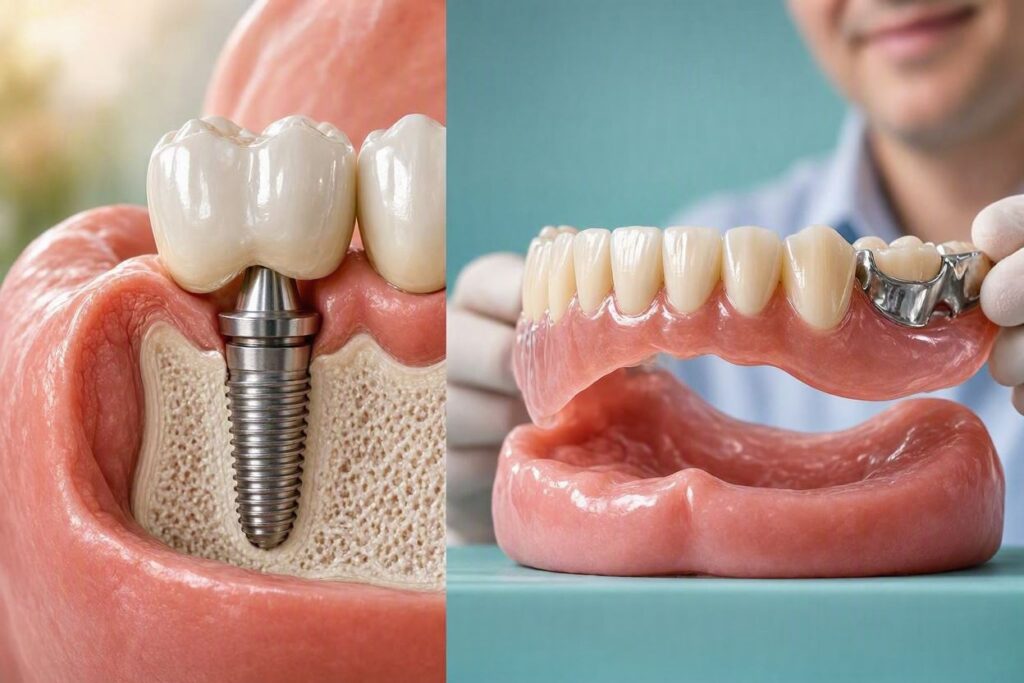
A denture is a removable appliance. It is a set of artificial teeth set into a pink, acrylic base designed to look like gums. It sits on top of your natural gum tissue.
- Full Denture: Replaces all teeth in an arch (top or bottom).
- Partial Denture: Replaces some teeth and clasps onto remaining natural teeth.
Key characteristic: It relies on the soft tissue and remaining teeth for support. It is not anchored to the bone.
What Is a Dental Implant?
A dental implant is a surgical component. It is a titanium or zirconia post that is inserted into the jawbone. The bone grows around it, fusing it in place.
Key characteristic: It replaces the root of the tooth. It provides a foundation on which a crown, bridge, or denture can be placed. It is anchored to the bone, not the gums.
The Fundamental Differences
Let’s break down why these two options cannot be used interchangeably in a treatment plan.
1. The Mechanism of Support
This is the biggest distinction.
- A denture distributes its force onto the gums. When you chew, the denture presses down on the soft tissue.
- An implant distributes its force into the bone. When you chew, the force travels down the implant into the jawbone, just like a natural tooth.
Why this matters: You cannot put a standard denture on a dental implant without modifying it. A standard denture is flat underneath. An implant requires a special attachment mechanism.
2. The “Combination” Hybrid
There is a third option that confuses people. It is called an Implant Retained Denture (or overdenture).
This is where the two technologies meet. You take a denture, and you add special “snaps” (locator attachments) to it. These snaps clip onto the implants.
- Is this interchangeable?
Not exactly. You cannot take an old, existing standard denture and just glue snaps to it. The denture must be specially fabricated to house the metal housings and the clips. However, sometimes an existing denture can be retrofitted if it is in good condition.
3. The Biological Impact
This is the area where the terms “interchangeable” becomes dangerous. They are not biologically interchangeable because they affect your health differently.
- A Denture: Without teeth, the jawbone begins to shrink (resorb). A denture sits on this shrinking bone. In fact, the pressure of the denture can accelerate bone loss. The bone melts away, and the denture becomes loose.
- An Implant: The implant stimulates the bone. It prevents the bone from shrinking. It maintains your facial structure.
If a doctor says, “We can just remove your teeth and give you a denture,” they are proposing a treatment that leads to bone loss. If they say, “We will place implants to support that denture,” they are proposing a treatment that preserves the bone. The outcomes are not interchangeable.
Can You Switch Between the Two?
This is a common scenario. A patient has been wearing dentures for years. They are tired of them slipping. They ask: “Can I just convert my dentures to implants?”
The answer is: Maybe, but it takes time and money.
The Transition (Denture to Implants)
If you have a traditional denture and you want implants:
- You must have surgery to place the implants.
- You must wait for healing (3-6 months).
- Your old denture might need to be modified (relined with new attachments) to snap onto the implants, or you will need a brand-new denture.
The Verdict: You can upgrade, but you cannot do it instantly. The implants are new, and the denture must be adapted.
The Transition (Implants to Denture)
If a dental implant fails and cannot be replaced, or if you have a fixed bridge (screwed in) and it must be removed permanently:
- The dentist removes the restoration.
- You are now missing teeth.
- You will need a traditional denture to replace them.
The Verdict: You can go backward, but it is a significant downgrade in comfort and function. Once you have experienced the stability of implants, most patients find going back to a traditional denture almost unthinkable.
Why “Interchangeable” Is a Marketing Trap
Sometimes, dentists or advertisers use the terms loosely to make a procedure sound simpler or cheaper. Beware of the phrase “Dental Implant Dentures.”
This usually means a denture supported by implants, not a traditional denture. It is important to clarify this before you agree to treatment.
Questions to ask your dentist:
- “Is this a fixed bridge, or is it removable?”
- “Does it rest on my gums, or is it held exclusively by the implants?”
- “Will it cover the roof of my mouth?”
These three questions will immediately clarify what type of restoration you are paying for.
A Comparison Table for Clarity
| Feature | Traditional Denture | Implant Retained Denture (Snap-On) | Fixed Implant Bridge (All-on-4) |
|---|---|---|---|
| Removable? | Yes | Yes | No |
| Support System | Gums only | Gums + Implants | Implants only |
| Bone Preservation | None | Good | Best |
| Stability | Low | Medium | High |
| Palate Coverage | Yes | Usually Yes | No |
| Cost | Low | Medium | High |
The Verdict
Are dental implants and dentures interchangeable?
No. A denture is a piece of plastic that replaces the gums and teeth. An implant is a piece of metal that replaces the root. They are partners, not substitutes.
You would not ask if a tire is interchangeable with a wheel. You need both for the car to drive. Similarly, you often need both implants and a denture to restore a mouth.
The confusion arises because they are both used to solve the same basic problem: missing teeth. But the way they solve that problem—and the long-term consequences for your health—are worlds apart.
If you are missing teeth, your goal should not be to choose between “a denture” and “an implant.” Your goal should be to choose the best solution to restore your ability to eat and smile. Sometimes that solution is a simple denture. Sometimes it is a single implant. Sometimes it is a combination of both.
Work with a qualified prosthodontist or dentist to understand the mechanics. Do not assume that because they both sit in your mouth, they work the same way.
Frequently Asked Questions
Q: Can I wear my old dentures after getting implants?
A: No. Once the implants are placed, your old denture will not fit over them. You will need a temporary denture that has been adjusted to accommodate the implants while you heal.
Q: Is an implant always better than a denture?
A: In terms of function and bone preservation, yes. However, it is also more expensive and involves surgery. If a patient is elderly, frail, or unable to undergo surgery, a traditional denture might be the only safe option.
Q: Can a single dental implant replace a partial denture?
A: Absolutely. In many cases, replacing one or two missing teeth with individual implants is much more comfortable and functional than wearing a removable partial denture that clasps onto your healthy teeth.
Q: Do I need one implant for every missing tooth?
A: Not necessarily. You can use 4 implants to support a full set of teeth on the bottom. You can use 2 implants to stabilize a loose lower denture. The number of implants depends on the strength of the bone and the type of restoration.
Additional Resource:
For a visual explanation of the differences between these treatments, visit the American Dental Association’s patient education portal: https://www.mouthhealthy.org/.