Are Dental Implants Cemented Into Place?
If you are considering replacing a missing tooth, you have likely heard about dental implants. They are hailed as the gold standard of tooth replacement—strong, permanent, and natural-looking. But when you hear about the process, you might picture a dentist with a wrench, screwing a tooth into your jawbone. Or, you might wonder if they use some kind of super glue to keep it from falling out.
The mechanics of how a dental implant stays in your mouth are fascinating, and understanding them can help ease your anxiety about the procedure. The short answer is that dental implants are both screwed and cemented, depending on which part of the implant you are talking about.
This guide will break down the anatomy of a dental implant, explain exactly how each piece is connected, and clarify why this system is so incredibly strong and reliable.
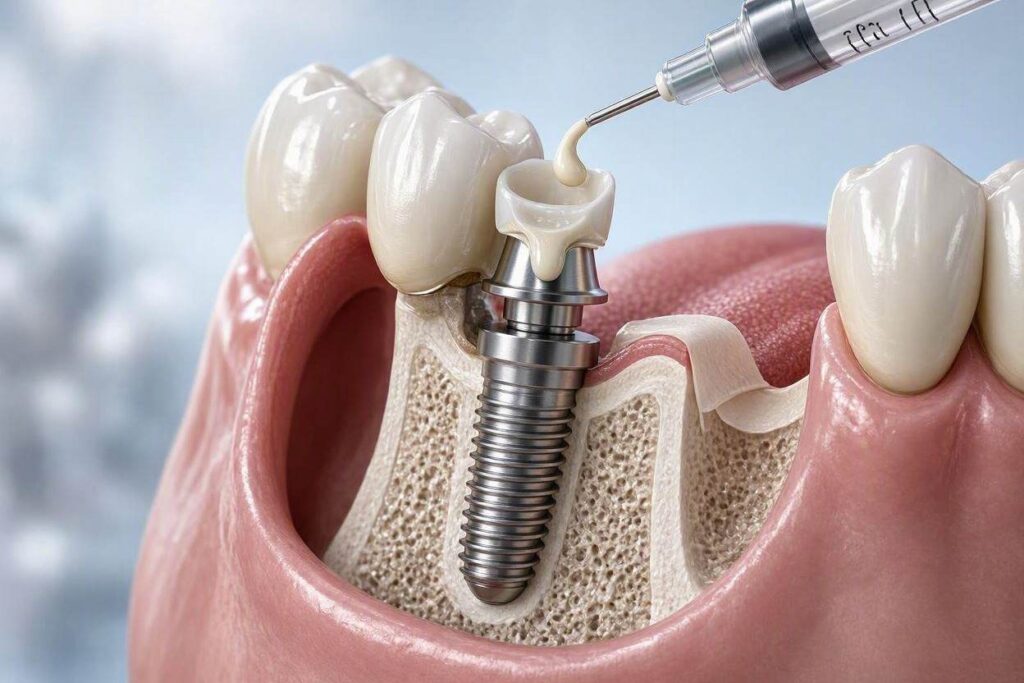
The Anatomy of a Dental Implant: Three Distinct Parts
A common misconception is that a dental implant is a single piece of metal. In reality, a standard dental implant is a three-part system. Each part is connected using different methods—one is screwed, and one is cemented (or screwed). Let’s look at the components.
1. The Implant Fixture (The “Screw”)
This is the part that is placed into your jawbone. It looks like a small, threaded cylinder, similar to a high-tech wood screw or a hollow bolt. It is typically made of titanium or zirconia, materials that are biocompatible. This piece is not “glued” into the bone. It is surgically placed, and the threads physically engage with the bone. Over time, the bone grows into the microscopic surface of the implant in a process called osseointegration. This is what makes the implant feel like a natural root.
2. The Abutment (The “Connector”)
Once the implant fixture has fused with the bone, a small connector piece is attached to the top of it. This piece is called the abutment. It sticks out slightly above the gum line. The abutment is usually screwed into the implant fixture using a tiny screw. The dentist torques this screw to a specific tightness to ensure it stays put.
3. The Prosthesis (The “Crown”)
This is the visible part—the fake tooth. This is the white, tooth-shaped piece that you see when someone smiles. This is the part that connects to the abutment.
The Big Question: Cemented vs. Screw-Retained Crowns
When it comes to attaching the visible crown to the abutment, there are two distinct methods used by dentists. Both are valid, and the choice depends on the clinical situation.
Method 1: Cement-Retained Implants
This is the traditional and most common method. It works very similarly to how a standard dental crown is attached to a natural tooth.
- How it works: The abutment is screwed onto the implant fixture. The crown is then fitted over the abutment and held in place with dental cement (a special adhesive).
- Pros:
- Aesthetics: Since there is no screw hole on the top of the tooth, the crown looks seamless and perfect.
- Easier Fabrication: It is often easier for the dental lab to make a cement-retained crown.
- Passive Fit: It is forgiving for slight angle differences in the implant placement.
- Cons:
- Retrievability: If the crown chips or the abutment loosens, it is very difficult to remove the crown without cutting it off. The dentist cannot simply access a screw hole.
- Cement Leakage: If excess cement is not cleaned perfectly from under the gum line, it can cause inflammation and bone loss around the implant (peri-implantitis).
Method 2: Screw-Retained Implants
This method is becoming increasingly popular, especially with modern digital dentistry.
- How it works: The crown is fabricated in the lab with a small hole on the top (or back) of it. The crown is connected to the abutment (or directly to the implant) with a titanium screw. The dentist places the crown, tightens the screw, and then fills the access hole with a tooth-colored composite filling material.
- Pros:
- Retrievability: This is the biggest advantage. If the crown breaks or needs repair, the dentist simply removes the filling to access the screw, unscrews the crown, and fixes it. No damage is done.
- No Cement: This eliminates the risk of cement-induced gum inflammation.
- Better for Tight Spaces: If there is limited room to clean excess cement, a screw-retained design is safer.
- Cons:
- Aesthetics: The access hole can sometimes be a weak point or slightly visible, though skilled dentists hide it well on the biting surface.
- Precision Required: The implant must be placed in exactly the right position and angle for the screw hole to be in an acceptable location (like the center of the biting surface, not the front of the tooth).
How is the Implant “Screwed” into the Bone?
Let’s clarify the surgical part, as this is what scares most patients. The phrase “screwed into the bone” sounds violent, but the reality is a precise surgical procedure.
- Drilling: The oral surgeon or periodontist uses a series of precise drills to create a small hole in the jawbone. The bone is not “cracked” or “forced.”
- Placement: The threaded implant fixture is then gently twisted into this prepared hole. The threads engage with the bone immediately, providing primary stability (like a screw in wood).
- Healing: Over the next 3 to 6 months, the bone cells grow and attach directly to the surface of the titanium. This is osseointegration. It is this biological bond that makes the implant so strong—it is not just mechanical friction, but a fusion of bone to metal.
Once healing is complete, the implant is so solid that you can chew on it just like a natural tooth. You cannot “unscrew” it by chewing or grinding your teeth. The bone holds it as tightly as it holds a natural tooth root.
Can You Feel the Implant? Does It Feel Different?
Patients who have had dental implants placed often report that it feels exactly like having a natural tooth. Once the crown is placed, you do not feel the screw or the abutment.
However, there is one key difference between an implant and a natural tooth: shock absorption.
A natural tooth has a ligament (the periodontal ligament) that surrounds the root. This ligament acts like a shock absorber. It allows the tooth to flex slightly when you bite down hard.
A dental implant does not have this ligament. It is fused directly to the bone. Therefore, when you bite down, you feel the force directly in the bone. While this feels slightly different, your brain adapts quickly, and most patients do not notice it after a few weeks.
What Happens if a Cemented Crown Comes Loose?
If you have a cement-retained implant crown and it feels loose, it is usually one of two problems:
- The cement failed: The crown came off the abutment, but the abutment is still securely screwed into the implant.
- The abutment screw loosened: The entire assembly (crown and abutment) is moving.
If the crown is simply loose but not off, you must see your dentist immediately. Do not wiggle it with your tongue or fingers, as this can damage the abutment. The dentist will take an X-ray to see what is moving. If the abutment screw is loose, they can often remove the crown (or use a special access hole) to re-tighten it. This is a simple fix.
Why Cement is Used at All
If screws are so great, why do we use cement at all? The answer is aesthetics and complexity.
Imagine an implant placed in the front of your mouth. If the dentist uses a screw-retained crown, the screw hole must go somewhere. If the implant is angled slightly forward, the screw hole might be on the face of the tooth. Filling a hole on the front of a front tooth with composite looks bad and will stain.
In these front teeth cases, a cement-retained crown is superior. The dentist can angle the abutment to correct the path of the crown, and the crown itself has no hole. It looks perfect. The dentist just has to be extremely careful to remove every trace of cement from under the gum.
The “Screwless” Implant Myth
You might have seen advertisements for “screwless” or “no-screw” implants. This is often marketing language for standard implants where the crown is cemented, or for “one-piece” implants.
A one-piece implant has the abutment built directly into the fixture. The dentist places the implant, and the top sticks out of the gum immediately. There is no separate abutment screw. The crown is then cemented onto this one-piece post. While this eliminates the abutment screw, it is less versatile and not suitable for all cases. The “screw” in the bone is still there.
Conclusion
Dental implants are a sophisticated system where different parts are connected differently. The implant post is physically screwed into the jawbone, where it fuses with the bone over time. The visible crown is typically cemented onto a connector (abutment), or it is screwed onto it with a small access hole. Both methods are highly successful, and the choice depends on achieving the best combination of strength, gum health, and a beautiful, natural appearance.
Frequently Asked Questions (FAQ)
1. Can a dental implant come loose if I eat hard food?
Once the implant has fused with the bone (osseointegration), it is incredibly strong. Chewing on ice or very hard candy is more likely to break the crown or your natural teeth than to loosen the implant post. However, if you grind your teeth (bruxism), you can put excessive force on the abutment screw, which can loosen over time. This is why dentists often prescribe a night guard for implant patients.
2. Is the cement used for implants the same as regular glue?
No. Dental cement is a specialized medical adhesive. For implants, dentists often use “resin cements” or “glass ionomer cements.” These are designed to be strong but also biocompatible with gum tissue.
3. How do dentists clean the cement out from under the gum?
This is a critical step. After seating the crown, the dentist uses dental floss and specialized scalers to trace around the edges of the crown under the gum line to remove any residual cement. X-rays are often taken to confirm that no cement is left behind.
4. If I have a screw-retained crown, will the filling in the hole fall out?
The composite filling used to plug the screw access hole is a standard filling material. It can stain or wear down over time, and it might occasionally chip or fall out. If it does, it is a simple, inexpensive fix for a dentist to replace it. The crown itself is still solidly attached.
5. Do I need to remove my implant crown to clean it?
No. The implant crown is “permanent.” It does not come out for cleaning like a denture. You clean it exactly like a natural tooth—by brushing and flossing. You do not need special tools to “unscrew” it. In fact, you should never try to remove it yourself.