Can Invisalign Go Around Teeth Implants?
You are considering Invisalign to straighten your smile. You have one or more dental implants, those permanently fixed replacement teeth that have served you well. A practical, mechanical question forms in your mind: can the clear plastic aligners, which fit tightly over every tooth, actually go around a dental implant? Will the aligner tray fit over the implant crown? Will it push on it, loosen it, or damage it?
The answer is a reassuring yes. Invisalign can go around dental implants, and it does so safely, predictably, and without harming the implant. The aligners are custom-fabricated to fit passively over the implant crown, applying no moving force to it. The implant remains a silent, immovable anchor point while the natural teeth around it are gently guided into their correct positions. This article explains the mechanics of how Invisalign coexists with dental implants, the role of the implant in the treatment plan, and the critical planning sequence that makes this coexistence successful.
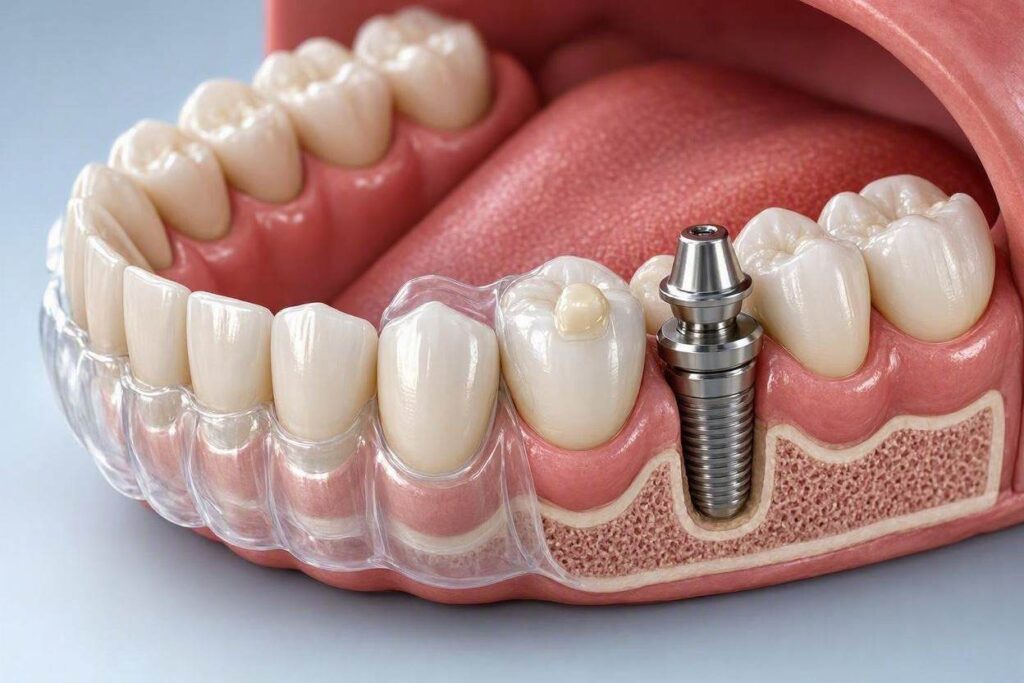
The Passive Fit: How the Aligner Treats an Implant Crown
An Invisalign aligner is a custom-made, thermoformed plastic tray that fits snugly over your teeth. Each tray in the series is slightly different, designed to apply controlled, gentle forces to specific teeth to move them through the bone. The aligner is fabricated from a highly accurate digital 3D scan of your entire mouth.
When your mouth has a dental implant, the intraoral scanner captures the exact three-dimensional shape, size, and position of the implant crown, just as it captures the shape of your natural teeth. The restorative dentist or orthodontist then designates the implant crown in the treatment planning software, ClinCheck, as a “non-moving” or “fixed” tooth. This is a digital command that tells the software: do not plan any movement for this tooth. The final position of the implant crown is identical to its starting position.
The series of aligners is then manufactured. Each aligner tray has a precisely shaped recess that matches the implant crown in its fixed position. Because the implant crown is not moving, this recess remains in the exact same location in every single aligner tray in the series. When you insert the aligner, it fits passively over the implant crown, like a perfectly tailored glove over a hand that is not moving. The aligner applies no active orthodontic force to the implant. It simply encapsulates it. The natural teeth, whose recesses in the aligner trays do change incrementally, are the only teeth that feel pressure. The implant crown is a silent, stable passenger on the journey.
The Implant as an Anchor: A Fixed Landmark in a Shifting Landscape
Because an osseointegrated dental implant is immovable—rigidly fused to the jawbone with no periodontal ligament to allow biological movement—it serves a unique and valuable function in an Invisalign case. It is an absolute, fixed reference point.
The orthodontist designs the movement of your natural teeth relative to this fixed implant. If the teeth next to the implant have drifted and created a small gap, the aligners can be programmed to push those natural teeth closed against the stable implant crown. If the teeth on the other side of the arch need to be moved to correct crowding or spacing, the implant serves as a solid, unmoving anchor that helps define the final, symmetrical arch form.
The implant crown provides a stable, known dimension. The orthodontist knows that this tooth will not move. They can plan the final positions of the natural teeth with absolute confidence that the implant will remain exactly where it was planned to be. This predictability is an asset, not a hindrance. The case becomes an exercise in moving natural teeth to harmonize with a fixed prosthetic landmark.
The Critical Sequencing Problem: A Badly Placed Implant
The ability of Invisalign to work successfully around an implant depends entirely on one pre-existing condition: the implant must be in a reasonably correct, prosthetically acceptable position. The aligner cannot move it. If the implant was placed years ago in a position that is now aesthetically or functionally problematic—too far forward, too far back, rotated, or angled incorrectly—Invisalign cannot fix it.
The orthodontist can straighten all the natural teeth, but the poorly positioned implant crown will remain a fixed, unchangeable outlier in the final smile. The result may be a straight arch with one tooth that looks obviously out of alignment. This is a frustrating clinical scenario because the implant is perfectly healthy and integrated, but its position is a permanent aesthetic compromise. In such cases, the only solutions are to accept the imperfection, to attempt to mask it with a new, creatively shaped implant crown (which can only compensate so much for a severe positional error), or to have the implant surgically removed and replaced in a more ideal position after the orthodontics are complete. This is a costly and invasive corrective process. It powerfully underscores why all implant placements should be prosthetically driven and orthodontically aware, even if the patient has no immediate plans for orthodontic treatment.
The Preferred Sequence: Invisalign First, Implant Second
As we discussed in Article 25, the most common and biologically sound scenario is the one where the implant has not yet been placed. The patient has a missing tooth and crooked teeth. The standard of care sequence is to complete the Invisalign treatment first.
The orthodontic aligners are used to move the natural teeth into their ideal, straight positions. The precise, final dimension of the missing tooth space is created. The roots of the teeth adjacent to the space are diverged to create a proper, parallel edentulous ridge. The space is no longer just a gap. It is a carefully planned window with the correct mesial-distal width, buccal-lingual depth, and occlusal clearance.
The patient is then retained in this final position. A retainer is made. A new 3D CBCT scan is taken. The implant surgeon now reviews the scan and places the dental implant into the exact center of this orthodontically created, ideal space. The implant crown is then fabricated to fit seamlessly into the perfectly aligned arch. The sequence is logical, predictable, and avoids the trap of trying to work around a poorly positioned pre-existing implant. Invisalign creates the perfect site; the implant fills it.
Conclusion
Invisalign can safely and effectively go around dental implants. The aligners are custom-designed to fit passively over the fixed implant crown, applying no force to it, while moving the natural teeth relative to that stable anchor. The success of this approach depends entirely on the pre-existing implant being in a good position. The preferred and most predictable treatment sequence is to complete Invisalign first, creating the ideal space for the missing tooth, and then place the dental implant second into that perfect, orthodontically determined window.
Frequently Asked Questions
Will the Invisalign aligner put pressure on my implant and loosen it?
No. The aligner is designed to fit passively over the implant crown. It applies no active orthodontic force to the implant. A properly osseointegrated implant is so rigidly fused to the bone that even if a light force were applied, it would not move. The force would have to be traumatic to damage the bone-implant interface, and Invisalign forces are precisely calibrated to be gentle and physiological for natural teeth, not traumatic for implants.
Can I get Invisalign if I have multiple dental implants?
Yes. Patients with multiple implants can successfully undergo Invisalign treatment. Each implant crown is designated as a fixed, non-moving tooth in the digital treatment plan. The aligners are fabricated to fit passively over all the implants. The natural teeth are moved relative to this stable, multi-point fixed framework.
What happens if I need a new implant crown after Invisalign is finished?
After Invisalign treatment is complete, if the implant crown is old, stained, or no longer matches the newly aligned natural teeth aesthetically, a new implant crown can be fabricated. The implant post is still in its fixed position. The restorative dentist takes a new scan and designs a new crown that harmonizes with the new alignment and shade of the natural teeth. This is a purely restorative procedure, not an orthodontic one.
Additional Resource:
For further information on the relationship between orthodontic treatment and existing dental restorations, visit the American Association of Orthodontists’ patient education page: https://www.aaoinfo.org/blog/can-i-get-braces-if-i-have-crowns-or-fillings/