Can a Dental Implant Take One Day? Understanding Immediate Load Protocols
A patient walks into a dental office missing a front tooth, the result of a long-standing failed root canal. They have a wedding to attend in three days. Desperation and hope mingle in their voice: “Can you give me a tooth today?” The dentist nods and explains the concept of same-day dental implants. The patient’s anxiety shifts to cautious optimism.
Same-day dental implants, often marketed as “Teeth in a Day” or immediate load implants, represent one of the most significant advances in modern implant dentistry. But the promise of walking out with a functional tooth on the same day as implant placement comes with specific conditions, limitations, and risks that every patient must understand. This guide provides a thorough, honest exploration of immediate implant loading.
Defining the Concept: Immediate Loading
Traditional implant protocols required a waiting period of three to six months between implant placement and attachment of a tooth. The implant needed to heal and integrate into the bone undisturbed. Loading the implant with a tooth too early, the thinking went, would cause micromotion, fibrous encapsulation, and failure.
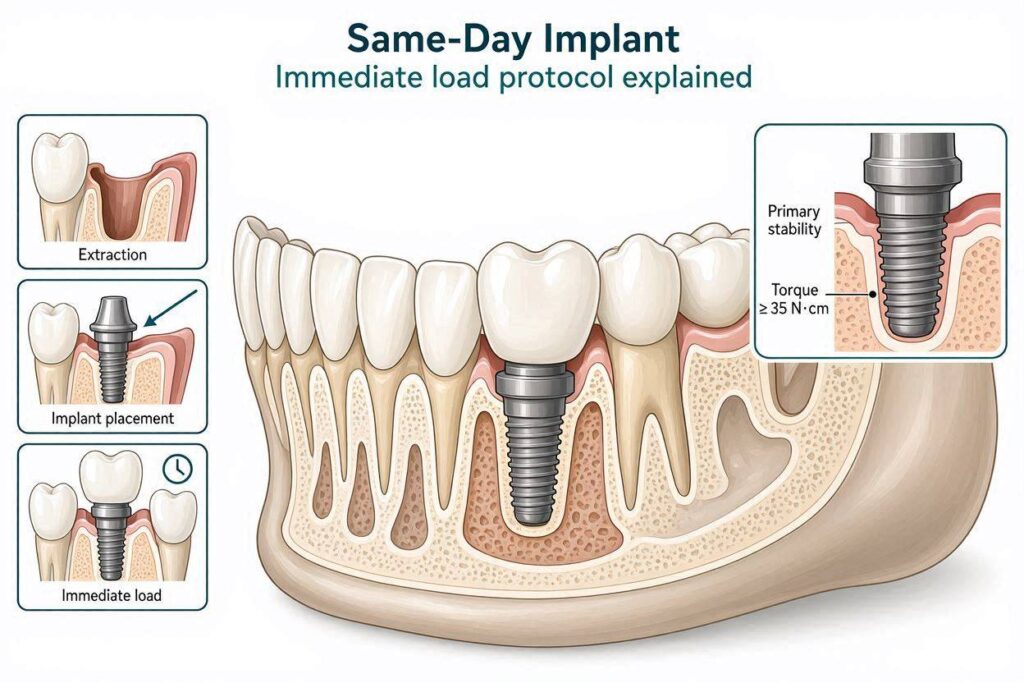
Immediate loading throws that timeline out the window. The dentist places the implant and attaches a provisional restoration on the same day. The tooth is functional, though often with restrictions. The implant heals while bearing some load.
What “One Day” Actually Means
The term “one day” refers to the surgical appointment. The patient arrives with a missing or failing tooth. They leave with an implant and a temporary tooth attached. The process from start to finish can take several hours, but it occurs in a single visit. The permanent, final crown comes later, typically after three to four months of healing.
Immediate Versus Early Versus Delayed Loading
- Immediate loading: Restoration attached within one week of implant placement, often the same day.
- Early loading: Restoration attached between one week and two months post-placement.
- Conventional or delayed loading: Restoration attached after a healing period of two to six months.
The same-day concept falls squarely into the immediate loading category.
The Science Behind Same-Day Implants
Why do some implants succeed with immediate loading while the traditional protocol demanded waiting?
Primary Stability: The Non-Negotiable Requirement
Primary stability is the mechanical engagement of the implant with bone at the time of placement. It is measured as insertion torque or using resonance frequency analysis. Without sufficient primary stability, immediate loading is contraindicated.
An implant must achieve an insertion torque of at least 30 to 35 Newton-centimeters, and ideally higher than 45 Ncm, to qualify for immediate loading. This high initial stability resists the micromotion that would otherwise disrupt the healing process. The bone clamps the implant tightly from the moment of placement.
Micromotion Thresholds
Research has established that micromotion above 150 microns at the bone-implant interface prevents osseointegration and favors fibrous encapsulation. An immediately loaded implant with sufficient primary stability experiences micromotion below this threshold, even when a patient chews gently. The stability protects the healing interface.
The Role of Implant Surface Technology
Modern implants feature roughened surfaces at the microscopic level. These surfaces, created by sandblasting, acid etching, or anodization, accelerate bone cell attachment and proliferation. Faster osseointegration supports the immediate loading concept. Older machined-surface implants required longer healing because bone attached more slowly.
Ideal Candidates for One-Day Implants
Not every patient qualifies. Selection criteria are stringent.
Adequate Bone Quality and Quantity
Dense, healthy bone in sufficient volume is essential. The posterior maxilla, with its thin, porous bone, is the most challenging site for immediate loading. The anterior mandible, with its dense cortical bone, is the most favorable. The dentist assesses bone quality using cone-beam computed tomography (CB-CT) preoperatively.
Single Tooth Replacement in the Esthetic Zone
The most predictable same-day implant scenario is replacing a single anterior tooth. The bone is often adequate. The esthetic demands are high, and a temporary crown immediately maintains the gum architecture and the patient’s smile.
Full-Arch Rehabilitation (All-on-Four Concept)
The most dramatic application of immediate loading is the full-arch fixed prosthesis. Patients with a hopeless dentition have four to six implants placed, and a full arch of temporary teeth is attached the same day. This approach, popularized by the All-on-Four treatment concept, transforms lives in hours.
Adequate Primary Stability Achieved Surgically
The surgeon must feel confident that the implant is solidly anchored. If the implant inserts with low torque, the plan must revert to a submerged or delayed loading protocol. The surgeon makes this call intraoperatively.
Patient Compliance and Understanding
The patient must be willing to follow a strict soft diet for the healing period, avoid any chewing on the provisional tooth, and attend follow-up appointments. Non-compliance dooms immediate loading to failure.
Contraindications to Same-Day Loading
Knowing when not to perform immediate loading is as important as knowing when to do it.
Poor Primary Stability
Insertion torque below 30 Ncm. The implant is not stable enough to withstand immediate loading forces. It must be submerged and allowed to heal undisturbed.
Compromised Bone Quality
Severely osteoporotic bone, previously irradiated jawbone, or bone with large marrow spaces does not provide the clamping force needed. Delayed loading is safer.
Bruxism and Heavy Parafunctional Habits
Patients who clench or grind their teeth generate forces far in excess of what an immediately loaded implant can safely withstand. Even with a night guard, the risk of overload-induced failure is high.
Multiple Adjacent Implants Loaded Simultaneously
Splinting multiple implants together with a provisional bridge distributes forces and improves stability, but the risk of failure increases compared to loading a single implant.
Active Infection at the Site
If the tooth being extracted has an acute abscess, the surgeon may delay implant placement entirely or place the implant but bury it without loading, allowing the infection to resolve first.
Uncontrolled Systemic Conditions
Uncontrolled diabetes, immunosuppression, or heavy smoking impair healing and osseointegration. Immediate loading in these patients carries a significantly higher failure risk.
The One-Day Implant Procedure Step by Step
Understanding the workflow demystifies the process.
Preoperative Planning and CB-CT Imaging
The dentist takes a cone-beam CT scan. They measure the available bone in three dimensions. They virtually place the implant in software, selecting the exact diameter and length. They design a surgical guide that will direct the drills precisely into the planned position.
Tooth Extraction and Immediate Implant Placement
If a failing tooth is still present, the dentist extracts it atraumatically, preserving as much bone as possible. They thoroughly debride the socket. They immediately place the implant into the extraction socket, a concept known as immediate implant placement. The implant often engages bone beyond the socket apex for primary stability.
Verification of Primary Stability
The surgeon measures insertion torque. A minimum of 35 Ncm is typically required. Some use a resonance frequency analysis device to obtain an Implant Stability Quotient (ISQ). An ISQ above 60 to 65 supports immediate loading.
Abutment Selection and Provisional Crown Fabrication
An abutment is attached to the implant. The dentist either uses a prefabricated provisional crown adjusted chairside or fabricates one using a preoperative digital scan and CAD/CAM technology. The provisional crown is cemented or screwed onto the abutment.
Occlusal Adjustment
The most critical step. The provisional crown must have no contact with the opposing teeth in maximum intercuspation and during excursive movements. It serves an esthetic and space-maintaining function, not a chewing function. Any occlusal contact transmits force that could cause micromotion and failure.
Postoperative Instructions
The patient receives strict instructions: a soft, non-chewing diet for six to eight weeks. No biting into apples, no tearing bread, no chewing gum. The provisional tooth is for smiling, not eating. The patient uses an antimicrobial mouth rinse. They avoid brushing the surgical site directly for the first week.
The Provisional Crown: Temporary but Crucial
The tooth the patient walks out with on day one is provisional, not final.
Material Choices
Provisional crowns are typically made of acrylic or composite resin. These materials are softer than final ceramic crowns and can be easily adjusted. They are strong enough for limited function but will wear, stain, or chip over months.
Esthetic Expectations
The provisional crown provides immediate esthetics. Its shape, size, and color should approximate the final restoration. It sculpts the gum tissue, guiding it to heal into a natural contour. This soft tissue sculpting is one of the major advantages of immediate loading.
Limitations and Care
The provisional crown is attached with temporary cement or a screw. It can loosen. If it does, the patient must return to the dentist immediately. Leaving it loose allows forces to transmit unpredictably to the implant. The provisional cannot be treated like a real tooth. It is a placeholder and a healing guide.
Table: Same-Day Implant Versus Traditional Protocol
| Feature | Same-Day (Immediate Load) | Traditional (Delayed Load) |
|---|---|---|
| Timeline to teeth | Immediate provisional crown | 3-6 months healing, then crown |
| Number of surgeries | Often one surgery | Two surgeries (implant placement, then uncover and crown) |
| Need for temporary removable appliance | None | May need a flipper or partial denture |
| Esthetics during healing | Immediate | Delayed, may have a gap |
| Soft tissue sculpting | Provisional guides tissue | Healing abutment guides tissue |
| Risk of failure | Slightly higher | Lower |
| Candidate requirements | Strict criteria (high primary stability, good bone) | Broader candidacy |
| Cost | Similar to traditional overall, may have additional lab fee | Similar total cost, spread over more time |
| Dietary restrictions | Strict soft diet for weeks | Normal diet after crown, soft diet during healing |
The Healing Process Under Immediate Load
What happens biologically while the provisional crown sits in the mouth?
The First Weeks
Blood clots around the implant. Inflammatory cells arrive. Angiogenesis, the formation of new blood vessels, begins. Osteoblasts, the bone-forming cells, migrate to the implant surface. The provisional crown remains non-functional, transmitting no load. The implant experiences only the extremely low forces from lip and tongue movements and from the patient’s heartbeat transmitted through the bone.
Weeks Four to Eight
Bone matrix deposits on the implant surface. The bone-implant contact increases. The implant stability may temporarily dip as the initial mechanical stability gives way to biological stability, a phenomenon known as the stability dip. The provisional crown still bears no functional load.
Weeks Eight to Twelve
Osseointegration is well advanced. The implant stability quotient rises. The dentist may adjust the provisional crown to allow light occlusal contact. The patient gradually introduces soft chewing on the implant.
Months Three to Six
The implant is fully integrated. The dentist takes final impressions. The permanent crown is fabricated and delivered. The implant can now bear full functional load.
Risks and Complications of Immediate Loading
Honest discussion of risks respects patient autonomy.
Implant Failure
The most concerning risk. If micromotion exceeds the threshold, fibrous tissue encapsulates the implant instead of bone. The implant becomes mobile and must be removed. Failure rates for immediate loading in well-selected cases are low, in the range of 2-5%, but slightly higher than delayed loading protocols.
Provisional Crown Fracture
Acrylic provisionals can fracture if the patient chews on them. Fracture does not directly harm the implant but leaves it unloaded and may cause soft tissue irritation.
Abutment Screw Loosening
The screw that attaches the provisional crown can loosen. This is a minor complication resolved by retightening, but it indicates micromovement that could be detrimental if unrecognized.
Esthetic Compromise
If the provisional crown is not contoured ideally, the gum tissue heals in a less optimal shape. The final crown may not achieve ideal esthetics. Soft tissue grafting may be required.
Bite Issues
If the provisional crown is inadvertently left in occlusal contact, the patient may experience discomfort, or the implant may be overloaded. Diligent adjustment at placement and follow-up prevents this.
Full-Arch Same-Day Implants: A Special Case
The All-on-Four or All-on-Six concept deserves separate discussion.
The Concept
Patients with a full arch of missing or hopeless teeth receive four to six implants. Two anterior implants are placed axially. Two posterior implants are tilted to avoid the maxillary sinus or inferior alveolar nerve and to increase the anteroposterior spread. A full-arch provisional acrylic bridge is attached the same day.
Advantages Over Single Tooth Same-Day
Splinting multiple implants together with a rigid provisional bridge creates a mechanically stable unit. The forces are distributed across all implants. This splinting protects individual implants from overload. The success rates for full-arch immediate loading are exceptionally high, above 95% in many studies.
The Conversion Process
The patient wears the provisional fixed bridge for three to six months. During this time, they experience the feel and function of fixed teeth. The bridge is constructed at a reduced vertical dimension to avoid overload. After healing, the final prosthesis, often a titanium framework with ceramic teeth or zirconia, is delivered.
Who Should Not Pursue Same-Day Implants?
Despite the appeal, some patients should choose a traditional protocol.
Patients with Severe Bone Deficiencies Requiring Major Grafting
If major bone grafting is needed simultaneously with implant placement, the implant will not achieve primary stability in native bone. The graft must heal first. A staged approach is mandatory.
Patients Who Cannot Tolerate Surgical Risk
The same-day implant surgery is longer than a simple extraction. Medically compromised patients may be better served by a shorter surgery and a delayed loading approach.
Patients Unwilling to Comply with Postoperative Restrictions
If a patient insists on chewing normally immediately, they are not a candidate for immediate loading. The protocol demands discipline.
Smokers
Heavy smoking impairs healing and osseointegration. While some clinicians will perform immediate loading in light smokers, many consider smoking a contraindication. Smoking cessation counseling should be part of the pretreatment discussion.
The Dentist’s Decision-Making Process Intraoperatively
The most critical moment for same-day loading occurs during surgery.
The Go/No-Go Decision
The surgeon drills the osteotomy, places the implant, and measures insertion torque. If the torque is 50 Ncm, the plan proceeds. If it is 25 Ncm, the surgeon must make a difficult call. The best surgeons have the discipline to abort the immediate loading plan and bury the implant under the gum. They explain to the patient that bone quality was less favorable than expected, and a traditional healing period will improve the chance of success. This intraoperative flexibility protects patients.
The Role of the Surgical Guide
A well-designed surgical guide based on CB-CT data increases the likelihood of achieving the planned implant position and primary stability. It does not guarantee it. Bone density can vary even within a jaw.
The Cost of Same-Day Dental Implants
Patients pay for convenience, technology, and expertise.
Components of the Fee
The fee typically includes the CB-CT scan, the surgical guide fabrication, the implant and abutment, the provisional crown, and all surgical and restorative appointments leading to final crown delivery. The final crown may be billed separately or included in a global fee.
Comparison to Traditional Protocol Costs
The total cost of same-day and traditional protocols is often similar for the same tooth site. The same-day approach may have additional laboratory fees for the provisional crown fabrication, especially if CAD/CAM is used. Some practices charge a premium for the convenience and technology.
Insurance Coverage
Dental insurance typically covers a portion of the implant or crown, regardless of whether it is same-day or traditional. The provisional crown may be considered part of the implant procedure and not separately reimbursed. Patients should obtain a detailed pretreatment estimate.
Conclusion
A dental implant can indeed take one day when the patient meets strict criteria including good bone quality, high primary stability at surgery, and a commitment to a non-functional soft diet during healing. The immediate provisional crown provides esthetics, maintains gum architecture, and spares the patient a removable temporary appliance. However, the approach carries slightly higher risk than traditional delayed loading and demands surgical precision and patient discipline. Full-arch same-day rehabilitation offers the most dramatic transformation with high success rates due to implant splinting. The decision rests on careful patient selection and honest communication about benefits, risks, and responsibilities.
Frequently Asked Questions
Can I eat normally with a same-day implant?
No. You must follow a strict soft diet and avoid chewing on the provisional crown for six to eight weeks. The tooth is for smiling and maintaining space, not for function.
How long does the same-day implant procedure take?
The surgical and restorative appointment typically lasts two to four hours for a single tooth, longer for a full arch. The time depends on the complexity.
Is the same-day tooth my permanent crown?
No. It is a provisional crown made of acrylic or composite. You will receive a final ceramic crown after three to six months of healing.
What happens if the same-day implant fails?
If the implant fails to integrate, it becomes mobile and must be removed. The site is allowed to heal and is often bone grafted. A new implant can be placed after several months.
Does same-day implant placement hurt more?
The procedure is performed under local anesthesia, so you should feel no pain during surgery. Postoperative discomfort is similar to traditional implant surgery and is managed with pain medication.
Additional Resources
Academy of Osseointegration – Immediate Loading
https://www.osseo.org
Professional and patient information on dental implant procedures, including immediate loading protocols and success factors.