Can You Unscrew a Dental Implant? Understanding Retrievability and Maintenance
A patient sits in the dental chair, a decade after their implant was placed. The crown feels loose. A strange taste lingers near the back of the mouth. The mind races: Is the implant failing? Can the dentist simply unscrew it like a bolt and replace it? The answer is more nuanced than a simple yes or no. Dental implants are designed for permanence, yet retrievability exists as a deliberate feature of modern implant systems.
This guide explores the mechanical, biological, and clinical realities of unscrewing a dental implant. We examine when removal is possible, when it is necessary, the techniques involved, the risks and benefits, and what patients and clinicians should understand about this procedure. The information draws on established implant dentistry principles and clinical practice.
The Fundamental Design of a Dental Implant
To understand unscrewing, one must first understand the components and their connections.
The Three Core Components
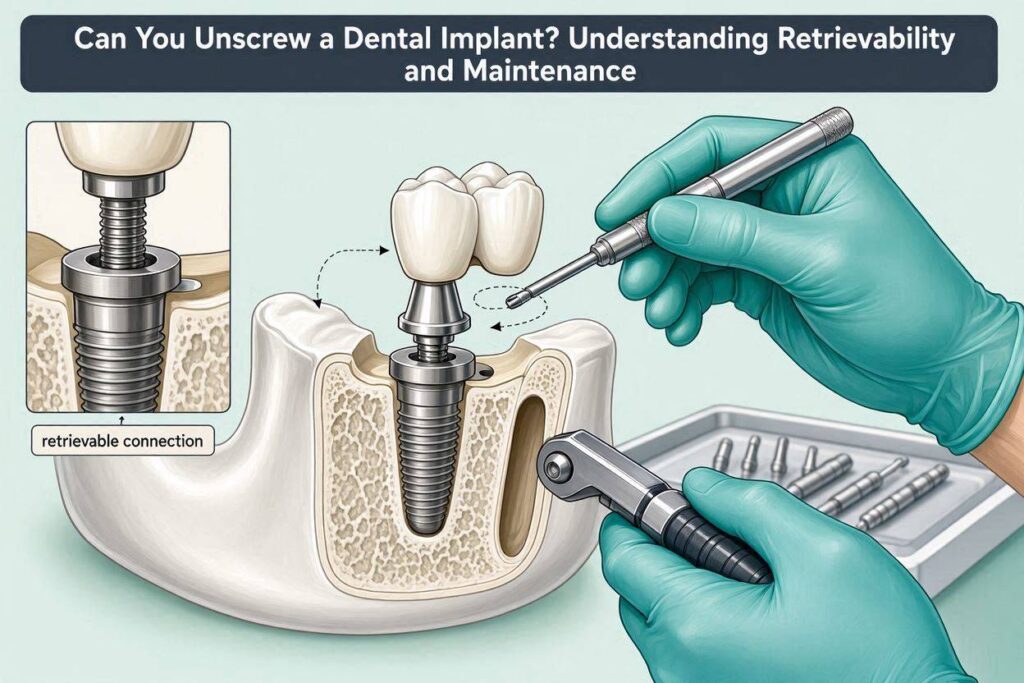
A dental implant restoration typically consists of three parts. The implant fixture itself is a titanium or zirconia screw-shaped cylinder surgically placed into the jawbone. The abutment is a connector piece that attaches to the implant fixture and protrudes through the gum. The crown is the visible tooth-like restoration cemented or screwed onto the abutment.
The Screw-Retained Connection
The implant fixture has an internal threaded chamber at its top. The abutment connects to the fixture via an abutment screw. This screw passes through the abutment and engages the internal threads of the implant. Tightened to a precise torque, usually between 15 and 35 Newton-centimeters depending on the system, this screw creates a stable, mechanically locked connection.
Osseointegration: The Biological Bond
The implant fixture does not simply screw into bone like a wood screw into a board. It achieves osseointegration, a direct structural and functional connection between living bone and the implant surface. The bone grows tightly against the microscopically roughened titanium surface. This is a biological bond, not a mechanical thread engagement. Removing an integrated implant requires breaking this bond.
Can You Simply Unscrew the Implant Fixture?
This is the core question. The answer depends on whether the fixture has achieved osseointegration.
An Integrated Implant Cannot Be Unscrewed
Once osseointegration has occurred, the bone clamps the implant tightly. The threads of the implant are embedded in living bone. Turning the implant fixture with a wrench or driver would not simply unscrew it. It would fracture the bone or the implant itself. The torque required to break the osseointegration far exceeds the insertion torque. Attempting to unscrew an integrated implant without proper preparation causes trauma, bone loss, and likely implant fracture.
A Non-Integrated or Failed Implant Can Sometimes Be Unscrewed
If the implant has failed to integrate, meaning a fibrous capsule has formed around it instead of bone, it may be mobile. A mobile failed implant can often be unscrewed or simply lifted out with minimal force. This is the closest scenario to “unscrewing” a dental implant. The lack of bone attachment allows reverse torque to remove the fixture relatively atraumatically.
The Reverse Torque Technique for Implant Removal
When a clinician needs to remove a failed but partially integrated or ailing implant, they may use a reverse torque technique. They apply a controlled counterclockwise turning force using a special removal tool or ratchet. The goal is to break the residual bone-implant contact without removing excessive bone. This technique works best for implants with limited osseointegration. Implants with robust integration will not yield to reverse torque and require a different approach.
Clinical Scenarios Requiring Implant Removal
Why would anyone need to remove a dental implant? Several situations justify the procedure.
Early Implant Failure
Within the first weeks to months after placement, an implant may fail to integrate. Signs include persistent pain, mobility, and radiographic radiolucency around the implant. Infection during healing, compromised blood supply, or excessive surgical trauma can cause early failure. The implant must be removed, the site allowed to heal, and a new implant placed later after determining the cause of failure.
Late Implant Failure
An implant that served well for years can fail due to peri-implantitis, an inflammatory condition similar to gum disease around natural teeth. Progressive bone loss eventually compromises support. Overload from clenching or grinding can also cause late failure. When significant bone loss destabilizes the implant, removal becomes necessary.
Implant Fracture
A rare but catastrophic event. The implant fixture itself fractures, usually at the neck where it meets the bone crest. This can happen due to metal fatigue, excessive occlusal forces, or a manufacturing defect. A fractured implant cannot be salvaged and must be removed entirely.
Malpositioned Implant
An implant placed too close to a nerve, too angled for proper restoration, or in an esthetically unacceptable position may need removal. This is a difficult conversation, as the implant may be perfectly integrated but clinically useless or harmful. Removal of a well-integrated, malpositioned implant is a challenging surgical procedure.
Need for Different Implant System
In rare cases, a patient may need the implant removed to place a different type or size of implant, especially if the original system is no longer available for prosthetic components.
The Actual Procedure for Removing an Integrated Implant
Unscrewing is not an option. What happens instead?
The Surgical Approach
The dentist or surgeon administers local anesthesia. A full-thickness flap is elevated to expose the implant and surrounding bone. The goal is to remove the implant with as little bone loss as possible.
Troughing with Piezoelectric or Rotary Instruments
The surgeon uses a piezoelectric surgical unit or a fine diamond bur under copious irrigation. They create a small trough around the coronal portion of the implant, carefully cutting the bone-implant interface. This releases the implant from its osseointegrated bond without removing excessive healthy bone. The surgeon works circumferentially around the implant.
Application of Reverse Torque
Once sufficient bone is released, the surgeon engages the implant’s internal connection with a removal tool or driver. They apply controlled reverse torque. If the implant turns, it unscrews from the remaining bone. If it does not turn, more bone troughing is required.
Trephine Bur Use for Difficult Cases
For implants that resist removal, a trephine bur, a hollow cylindrical drill, is used. The trephine cuts around the implant, removing a thin collar of bone along with the implant. This technique sacrifices more bone but ensures complete implant removal. Bone grafting may be needed immediately to preserve the ridge for future implant placement.
Socket Debridement and Grafting
After implant removal, the surgeon thoroughly debrides the socket, removing any granulation tissue or infected material. Bone graft material is often placed into the defect to preserve ridge dimensions. The flap is sutured closed. Healing proceeds over several months before a new implant can be considered.
Retrievability of the Abutment and Crown: A Different Story
While the fixture is firmly integrated, the abutment and crown are designed to be retrievable.
Unscrewing the Abutment Screw
The abutment screw is tightened to a specific torque but is designed to be removed. If the crown is screw-retained, the dentist simply removes the filling material covering the screw access hole, engages the screw head with a driver, and unscrews it. This retrieves the crown and abutment without damaging the implant fixture. This is a routine, non-surgical procedure done for crown replacement, abutment change, or access to the implant for evaluation.
Retrieving Cemented Crowns
If the crown is cemented onto the abutment, retrieval is more challenging. The dentist may need to cut the crown off or use special crown removal instruments. Sometimes the abutment screw can be accessed by drilling through the occlusal surface of the crown. This destroys the crown but preserves the abutment and implant.
Why Retrievability Matters
The ability to unscrew the abutment and crown is a design feature, not a failure. It allows for:
- Replacement of a worn or chipped crown without surgery.
- Management of a loose abutment screw by retightening or replacing it.
- Access to the implant platform to decontaminate it in cases of peri-implantitis treatment.
- Conversion from a single crown to a bridge abutment if adjacent teeth are lost.
Comparative Table: Unscrewing the Fixture Versus Unscrewing the Abutment
| Feature | Unscrewing the Implant Fixture | Unscrewing the Abutment/Crown |
|---|---|---|
| Feasibility | Only if failed or non-integrated | Routinely possible |
| Osseointegration status | Must be absent or surgically broken | Does not affect osseointegration |
| Surgical intervention | Requires surgery for integrated implants | Non-surgical, chairside procedure |
| Bone involvement | Bone removal or trephination | No bone involvement |
| Pain and recovery | Significant, similar to extraction | Minimal, no recovery time |
| Goal | Remove failed or problematic implant | Retrieve prosthesis for repair or evaluation |
| Frequency in practice | Uncommon | Common |
The Patient Experience of Implant Removal
Understanding what to expect reduces anxiety.
Before the Procedure
The dentist takes radiographs, often a cone-beam CT scan, to assess the implant’s position, the amount of surrounding bone, and proximity to vital structures like the inferior alveolar nerve or maxillary sinus. They discuss the reason for removal, the technique, the need for bone grafting, and the timeline for replacement.
During the Procedure
Local anesthesia ensures comfort. The patient feels pressure and vibration from the piezoelectric instrument but no sharp pain. The procedure takes 30 to 90 minutes depending on complexity. The surgeon’s controlled, meticulous movements reflect the desire to preserve bone.
After the Procedure
Postoperative discomfort resembles that of a tooth extraction or implant placement. Swelling, mild bleeding, and bruising are normal. The surgeon prescribes pain medication, antibiotics if indicated, and an antimicrobial mouth rinse. A soft diet is recommended for several days. Sutures dissolve or are removed after one to two weeks.
The Waiting Period
Bone grafting requires a healing period of three to six months before a new implant can be placed. This waiting is difficult for patients who want a tooth replacement immediately. Temporary removable appliances can fill the gap esthetically.
The Critical Distinction Between Failure and Normal Retrieval
Patients often conflate two very different clinical situations.
The Loose Abutment: An Easy Fix
A patient calls the office saying, “My implant feels loose.” The dentist examines and finds the abutment screw has loosened. The implant fixture is still rock-solid in the bone. The fix is simple: unscrew the crown, clean the connection, replace or retighten the abutment screw to the correct torque, and seal the access hole. This is not implant failure. It is a minor mechanical complication.
The Loose Fixture: A True Failure
If the entire implant fixture moves, the osseointegration has been lost. This is a true failure. The implant must be removed. The patient and dentist must investigate why it failed. Was there untreated periodontal disease, uncontrolled diabetes, smoking, or occlusal overload? Addressing the cause is essential before placing a new implant.
“When my dentist said he could just unscrew it, I felt relief wash over me. It turned out the crown and abutment just needed retightening. The implant itself was perfectly fine.” – A patient describing a loose abutment episode.
Why Don’t Dentists Just Unscrew Failing Implants?
The question assumes a simplicity that biology does not permit.
The Fibrous Encapsulation Misconception
A failing implant does not simply sit in a smooth-walled socket waiting to be unscrewed. The surrounding bone may have partially resorbed, but residual osseointegration often persists in spots. Granulation tissue fills the defect. Simply turning the implant could strip the internal threads, fracture the implant, or cause uncontrolled bone damage. The controlled surgical approach, though more invasive, preserves bone for future reconstruction.
Avoiding Further Bone Damage
The prime directive of implant removal is ridge preservation. The surgeon wants to leave a site that can heal and accept a new implant predictably. Trephination removes a predictable amount of bone. Uncontrolled reverse torque can cause jagged bone fractures extending far beyond the implant site. Controlled surgery is far more conservative than brute-force unscrewing.
The Concept of “Sleeping” or Buried Implants
Some implants are placed and then intentionally buried under the gum to heal without loading. If the implant fails to integrate in this scenario, the surgeon uncovers it and finds a mobile fixture. In this case, it truly can be unscrewed or simply picked out with minimal force. The bone has formed a fibrous capsule, not an osseointegrated bond. This is one of the few situations where “unscrewing” is both feasible and atraumatic.
Technological Advances in Implant Retrieval
The industry has developed tools specifically for implant removal, acknowledging that it is sometimes necessary.
Reverse Torque Removal Kits
These kits contain drivers that fit specific implant internal connections. They attach to a ratchet wrench and apply controlled, measured reverse torque. The surgeon monitors the torque applied. If the implant does not move at a predetermined torque limit, they stop and proceed with bone troughing rather than risking implant fracture.
Piezoelectric Surgery
Piezoelectric units use ultrasonic vibrations to cut bone with extreme precision while sparing soft tissues like the sinus membrane or nerves. They have revolutionized implant removal by allowing the surgeon to trough around an implant with minimal damage to adjacent bone and vital structures.
Laser-Assisted Removal
Some clinicians use erbium lasers to ablate granulation tissue and even bone around a failing implant. The laser’s precision and hemostatic properties make it an adjunct to mechanical removal. It is not a primary removal tool for integrated implants but aids in site preparation.
Prevention: The Best Way to Avoid Removal
The conversation about unscrewing implants underscores the importance of preventing failure.
Proper Case Selection and Planning
Thorough medical history review, cone-beam CT imaging, and prosthetic-driven implant planning reduce the risk of malposition and early failure.
Meticulous Surgical Technique
Atraumatic preparation, avoidance of overheating the bone, and achieving primary stability within the recommended torque range set the stage for successful osseointegration.
Patient Maintenance and Compliance
Peri-implantitis is largely preventable with good oral hygiene, regular professional cleanings, and management of risk factors like smoking and diabetes. Patients who maintain their implants have a very low lifetime risk of needing removal.
Occlusal Protection
Night guards for bruxers protect implants from overload. Thoughtful occlusal design on the crown ensures forces are directed axially along the implant, avoiding damaging lateral loads.
What Happens After an Implant Is Removed?
The journey does not end with removal.
Site Healing and Ridge Augmentation
The surgeon fills the socket with bone graft material and covers it with a membrane. The site heals for four to six months. A cone-beam CT scan confirms adequate bone volume for a new implant.
Reimplantation
If the cause of failure is addressed, a new implant can be placed into the healed, grafted ridge. Success rates for reimplantation in properly managed sites are high, comparable to primary implant placement.
Alternative Tooth Replacement
If the patient opts not to have another implant, a fixed bridge or removable partial denture can replace the missing tooth. The removal of the implant does not preclude these options.
The Economics of Implant Removal and Replacement
Patients must understand the financial implications.
Cost of Removal
Surgical implant removal costs vary based on complexity, need for bone grafting, and geographic location. It can range from a few hundred to over a thousand dollars. Dental insurance may cover a portion if the removal is medically necessary.
Cost of Replacement
A new implant, abutment, and crown will incur a separate, full fee. The patient essentially pays twice for the same tooth site. This reality underscores the value of doing everything possible to maintain the original implant.
Exploring Warranty and Guarantee Programs
Some implant manufacturers offer guarantees that cover the cost of a replacement implant if the original fails. Some dental practices guarantee their work for a defined period. Patients should inquire about these policies before treatment begins.
Conclusion
You can unscrew the abutment and crown of a dental implant chairside, but unscrewing an integrated implant fixture from living bone is not a simple mechanical reversal. It requires a surgical procedure to release the osseointegrated bond, followed by bone grafting to preserve the ridge. True implant removal is reserved for failed, fractured, or hopelessly malpositioned implants. Prevention through meticulous planning, surgical care, and lifelong maintenance remains the best strategy to ensure the implant never needs to be unscrewed.
Frequently Asked Questions
Can a loose dental implant be tightened like a screw?
If the implant fixture itself is loose, it cannot be tightened. Mobility indicates loss of osseointegration, and the implant must be removed. If only the abutment screw is loose, the dentist can simply retighten it.
Does unscrewing a dental implant hurt?
Removing a failed non-integrated implant causes minimal discomfort. Removing an integrated implant requires surgery and local anesthesia. Postoperative discomfort is similar to an extraction.
How long does implant removal surgery take?
Depending on complexity, the procedure typically takes 30 to 90 minutes. Bone grafting may add some time.
Can a new implant be placed immediately after removal?
Usually not. The site needs to heal and often requires bone grafting. A waiting period of three to six months is standard before placing a new implant.
Is implant removal covered by insurance?
Medically necessary removal due to infection or fracture may be partially covered. Cosmetic or elective removal of a healthy but malpositioned implant is less likely to be covered. Check your specific plan.
Additional Resources
American Academy of Implant Dentistry – Dental Implant Complications
https://www.aaid.com/about/Press_Room/Dental_Implants_FAQ.html
A patient-friendly overview of implant complications and maintenance.