Can A Laptop Affect Dental Implant?
Questions about electromagnetic interference between electronic devices and medical implants are increasingly common in our technology-saturated world. Patients with dental implants may worry that everyday devices like laptops, smartphones, and tablets could somehow interfere with or damage their titanium tooth replacements. Understanding the physics involved provides reassuring answers.
A laptop cannot affect a dental implant in any meaningful way. Dental implants are passive titanium fixtures with no electronic components, circuitry, batteries, or moving parts. They are not susceptible to electromagnetic interference, cannot be heated by laptop radiation, and are not affected by the low-level electromagnetic fields generated by consumer electronics. The titanium in dental implants is biocompatible, non-ferromagnetic, and completely inert with respect to the types of energy emitted by laptops and similar devices.
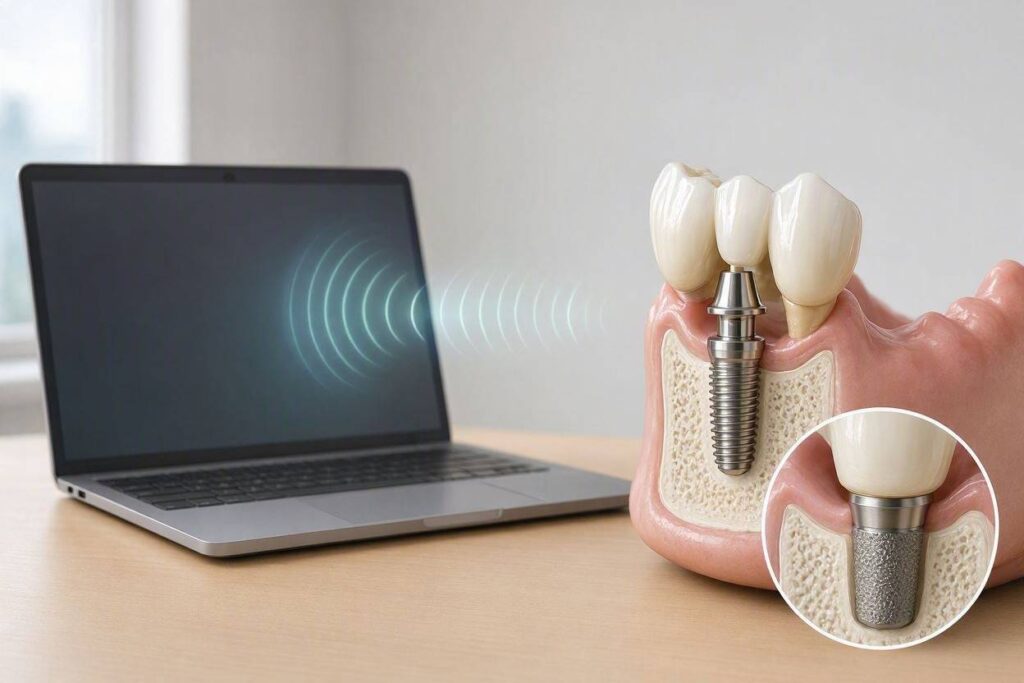
Understanding the Nature of Dental Implants
To appreciate why laptops pose no threat, one must understand what dental implants actually are and what they are not.
What Dental Implants Are
A dental implant is a threaded titanium post surgically placed into the jawbone to replace a missing tooth root. The implant fuses with the bone through osseointegration, a biological process where bone cells attach directly to the titanium oxide surface. Once integrated, the implant provides a stable foundation for a crown, bridge, or denture.
The implant itself contains no electronic components. It is a solid piece of biocompatible metal, essentially a specialized screw. There are no circuits, no batteries, no sensors, and no wires. The implant is entirely passive. It cannot receive signals, generate signals, or be influenced by external electromagnetic fields in any way that affects its function or safety.
What Dental Implants Are Not
Some patients confuse dental implants with other medical devices that do have electronic components. Cochlear implants, pacemakers, deep brain stimulators, and insulin pumps are active electronic devices that can potentially be affected by electromagnetic interference. Dental implants share nothing in common with these devices except the word “implant” in their name.
Similarly, dental implants are not like the RFID chips used for pet identification or the electronic implants discussed in speculative technology. They contain no information, store no data, and perform no active function beyond providing mechanical support.
Titanium and Magnetism
The titanium used in dental implants is non-ferromagnetic. It does not respond to magnetic fields. Unlike iron, nickel, or cobalt, titanium is not attracted to magnets and cannot be magnetized. This property is why dental implants are safe during MRI procedures, why they do not trigger metal detectors in airports, and why they cannot interact with the electromagnetic fields generated by laptops.
| Medical Device | Contains Electronics? | Susceptible to EMI? | Affected by Laptops? |
|---|---|---|---|
| Dental Implant | No | No | No |
| Pacemaker | Yes | Yes (historically) | Minimal with modern devices |
| Cochlear Implant | Yes | Yes | Possibly (follow manufacturer guidance) |
| Insulin Pump | Yes | Yes | Possibly (follow manufacturer guidance) |
| Joint Replacement | No | No | No |
| Metal Plate/Screw | No | No | No |
Electromagnetic Fields and Laptops
Understanding what laptops actually emit explains why interactions with dental implants are impossible.
What Laptops Emit
Laptop computers emit several types of energy, all at levels far too low to affect biological tissues or passive metal objects.
Radio Frequency Emissions:
Wi-Fi and Bluetooth antennas emit low-power radio waves. These emissions are in the range of 2.4-5 gigahertz with power output measured in milliwatts. Regulatory agencies worldwide limit electronic device emissions to levels demonstrated safe for human exposure. These radio waves pass harmlessly through tissue without causing heating or other effects at the power levels involved.
Extremely Low Frequency Electromagnetic Fields:
The electrical components in laptops generate weak electromagnetic fields at the frequencies of their internal oscillators and power supplies. These fields are orders of magnitude weaker than those encountered in everyday environments like power lines or household appliances.
Heat:
Laptops generate heat from their processors and batteries. This thermal energy can warm surfaces the laptop contacts, but the heat dissipates rapidly and cannot affect structures deep within the body like dental implants.
Light:
The laptop screen emits visible light. This light obviously has no interaction with structures inside the body.
Energy Levels and Safety Standards
The electromagnetic emissions from consumer electronics are regulated by agencies including the Federal Communications Commission in the United States and similar bodies internationally. These regulations limit emissions to levels far below those known to cause any biological effect.
The specific absorption rate (SAR), which measures how much radio frequency energy is absorbed by the body, is limited to 1.6 watts per kilogram in the United States. Laptops operate at fractions of these limits under normal use conditions.
To put this in perspective, the energy from a laptop is millions of times weaker than the energy levels used in medical diathermy devices that intentionally heat tissues for therapeutic purposes. Even those therapeutic devices cannot significantly heat metal implants because the body’s blood circulation efficiently dissipates any localized temperature changes.
Specific Concerns Addressed
Despite the physics clearly indicating no interaction, patients sometimes raise specific concerns worth addressing directly.
Could a Laptop Heat Up a Dental Implant?
The notion that a laptop could heat a dental implant like a microwave heats metal likely stems from misunderstandings about how electromagnetic energy interacts with matter.
Microwave ovens heat food using high-power radio waves (typically 600-1,200 watts) at a specific frequency (2.45 gigahertz) in an enclosed reflective cavity. This is fundamentally different from a laptop emitting fractions of a watt into open space.
Even if a laptop could generate sufficient energy to heat tissue (which it cannot), the implant is embedded in living bone surrounded by circulating blood. Blood flow is an extraordinarily efficient heat exchanger. Any tiny temperature change at the implant surface would be immediately dissipated by circulation. The implant cannot accumulate heat in the way a piece of metal sitting in open air might.
Clinical experience confirms this. Millions of dental implant patients have used laptops on their laps for decades with no reports of implant heating. Dental professionals place their hands near patients’ implants while using laptops for charting and imaging with no effects.
Could a Laptop Cause Implant Rejection or Failure?
Implant failure occurs through biological mechanisms: failed osseointegration, peri-implantitis, or mechanical overload. None of these processes is influenced by electromagnetic fields.
The biological environment around implants is governed by bacteria, the host immune response, and mechanical forces. Radio waves and electromagnetic fields at consumer electronic levels do not affect bacterial growth, inflammatory processes, or bone metabolism. The idea that a laptop could trigger implant rejection reflects a misunderstanding of what implant failure actually is.
Could a Laptop Interfere With Osseointegration?
Osseointegration is a biological healing process where bone cells attach to the titanium oxide surface. This process depends on surgical technique, bone quality, patient health status, and mechanical stability during healing. It does not involve electrical signaling that could be disrupted by external fields.
There is simply no mechanism by which the energy from a laptop could influence bone cell behavior, protein adsorption, or the complex cascade of molecular events that result in osseointegration.
Are There Any Documented Cases of Laptops Affecting Implants?
After decades of widespread laptop use and millions of dental implants placed, there are no documented cases in the medical or dental literature of a laptop affecting a dental implant in any way. The absence of such reports is not surprising given the physical impossibility of such an interaction.
Situations Where Electronics and Medical Devices Do Interact
While dental implants are immune, other medical devices do have documented interactions with electromagnetic sources that patients should understand.
Devices With Documented EMI Concerns
Cardiac Pacemakers and Implantable Cardioverter-Defibrillators:
Historically, these devices could be affected by strong electromagnetic fields. Modern devices are heavily shielded, but manufacturers still recommend keeping consumer electronics at least 6 inches from the device. This concern involves the pacemaker’s sensing and pacing electronics, not any mechanical component.
Cochlear Implants:
These devices have external processors that can experience interference from nearby electronics. The internal implant component is generally not affected.
Insulin Pumps and Continuous Glucose Monitors:
These devices use wireless communication that can theoretically be disrupted by strong interference sources, though modern devices are designed to be robust against typical environmental electromagnetic fields.
Neurostimulators:
Deep brain stimulators, spinal cord stimulators, and similar devices can be affected by strong electromagnetic fields and require specific precautions.
Dental implants share no characteristics with these active electronic devices. The concerns that apply to pacemakers and neurostimulators simply do not extend to passive titanium dental implants.
Practical Advice for Implant Patients
While laptops pose no threat, patients should focus on genuine factors that do affect implant success.
What Actually Affects Dental Implants
Rather than worrying about electronic devices, patients should focus on:
Oral Hygiene:
Meticulous daily cleaning is the single most important factor in long-term implant success. Plaque accumulation causes peri-implant disease that threatens the tissues supporting implants.
Smoking Cessation:
Smoking is one of the strongest risk factors for implant failure. Nicotine impairs healing and increases peri-implantitis risk dramatically.
Regular Professional Maintenance:
Professional cleanings and examinations every 3-6 months detect problems early when they are most treatable.
Managing Medical Conditions:
Diabetes control, medication management, and overall health optimization support implant success.
Protecting Against Mechanical Overload:
Nightguards for patients who grind their teeth prevent mechanical damage to implants and restorations.
When to Consult Your Implant Dentist
Contact your implant provider if you experience:
Bleeding, swelling, or pus around implants. Pain or discomfort. Changes in how the implant restoration feels. Mobility of the implant or restoration. Any concerns about your implant health.
These are the issues that genuinely affect implant success. Laptop use is not among them.
Frequently Asked Questions
Can my laptop’s Wi-Fi affect my dental implant?
No. Wi-Fi signals are low-power radio waves that cannot affect passive titanium implants in any way.
Should I avoid putting my laptop on my lap because of my implant?
Not because of your dental implant. Concerns about laptop heat affecting fertility or causing skin changes are separate issues unrelated to dental implants.
Can my smartphone affect my dental implant?
No. Smartphones emit similar types and levels of energy as laptops. They cannot affect dental implants.
Do I need to tell my dentist I use a laptop frequently?
Not in relation to your implant. There is no clinical relevance to laptop use for implant patients.
Can MRI machines affect dental implants?
Modern dental implants are MRI-compatible. The non-ferromagnetic titanium does not move or heat significantly in MRI fields. Always inform the MRI technologist about your implants.
Can airport security scanners affect dental implants?
No. Dental implants do not trigger metal detectors, and full-body scanners do not affect them.
Is there any electronic device that can damage dental implants?
No consumer electronic device generates energy levels sufficient to damage dental implants or surrounding tissues.
What should I actually worry about with my dental implant?
Focus on oral hygiene, smoking cessation if applicable, regular professional maintenance, and managing medical conditions that affect healing and tissue health.
Additional Resources
For more information about dental implant safety:
- American Academy of Implant Dentistry: www.aaid.com
- American College of Prosthodontists: www.gotoapro.org
- International Congress of Oral Implantologists: www.icoi.org
- FDA information on medical device electromagnetic compatibility: www.fda.gov