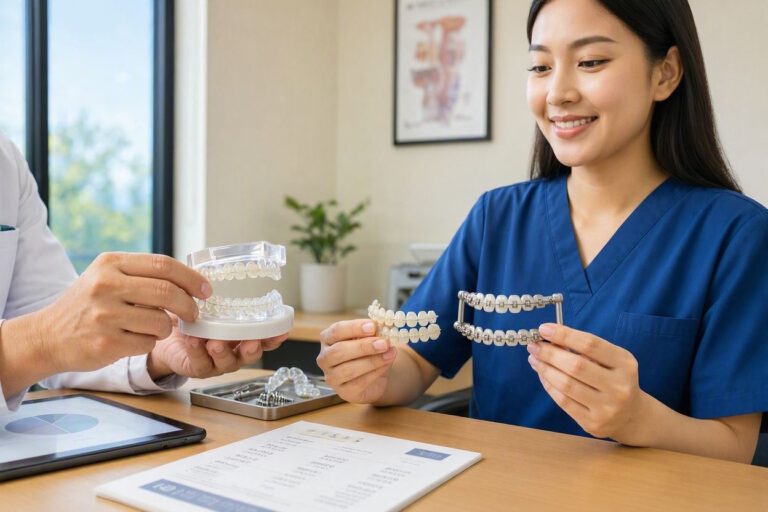
Can Braces Cause a Recessed Jaw?
You look in the mirror after getting your braces off. Your teeth are straight. Perfectly aligned. But something else catches your eye. Your chin seems smaller. Your jaw looks set back.
A wave of panic hits. Did the braces do this?
You are not alone. This question pops up often in online forums and dental anxiety conversations. The idea of metal brackets pulling your jaw backward sounds terrifying. But is there any truth to it?
Let me give you the short answer right away: Braces, by themselves, almost never cause a true recessed jaw.
However, there is a longer, more honest answer. Some orthodontic treatments, especially those involving extractions or certain types of headgear, can change your facial profile. This change might make your jaw appear less prominent.
But here is the key point. A recessed jaw (medically known as retrognathia) is usually a bone problem. Braces move teeth. Moving teeth is very different from moving your entire jawbone.
In this guide, we will walk through the science, the myths, and the real risks. We will look at when orthodontics helps jaw issues and when it might accidentally create a flatter profile. By the end, you will know exactly what questions to ask your orthodontist.
Let us clear the air once and for all.
Understanding Your Jaw: What Does “Recessed” Actually Mean?
Before we blame braces, we need to understand the geography of your face.
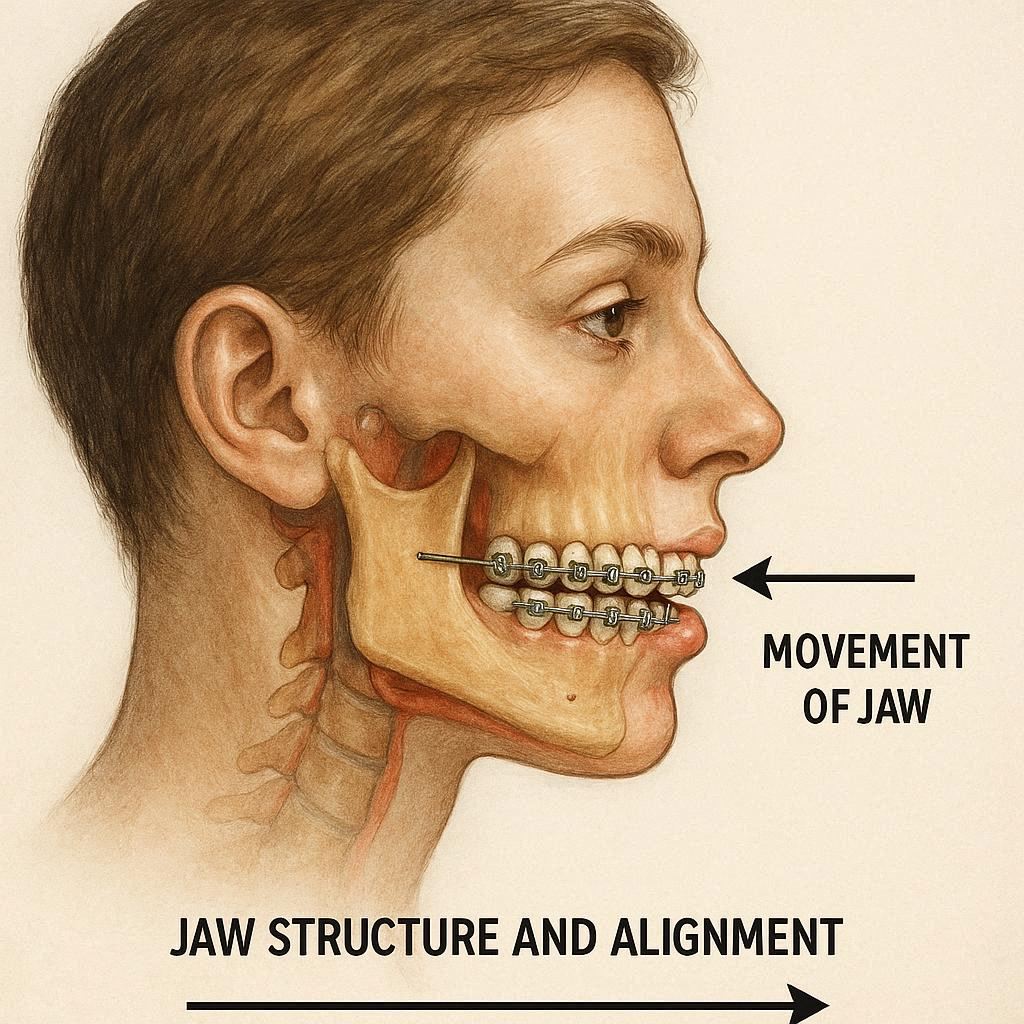
Your lower jaw is called the mandible. Your upper jaw is the maxilla. When someone has a recessed jaw, their mandible sits further back than it should. Often, this means the chin looks weak or slopes backward into the neck.
A true recessed jaw is a skeletal issue. It happens when the mandible itself is too short or positioned too far back in the skull joint (the temporomandibular joint, or TMJ).
Here is the crucial fact. Braces do not attach to the main body of your mandible. They attach to your teeth.
Think of your teeth as passengers on a bus. The bus is your jawbone. Braces can move the passengers around on the seats. But they cannot drive the bus into a different parking spot.
| Feature | Teeth Movement | Jaw Bone Movement |
|---|---|---|
| What moves? | Roots slide through bone | Entire bone structure shifts |
| Who controls it? | Braces, aligners, wires | Genetics, growth, surgery |
| Can braces do it? | Yes | No (not directly) |
| Time required | Months to years | Years of natural growth |
The Difference Between Skeletal and Dental Problems
This distinction changes everything.
- Skeletal problem: The jaw bone is too far back. This is usually genetic. You might have inherited your grandpa’s small chin.
- Dental problem: The teeth stick out (overjet) or tilt inward. This can make the chin look recessed even when the bone is fine.
Braces fix dental problems. They can pull protruding upper teeth backward. They can bring lower teeth forward. When this happens, your lips and chin area might look different. But your jawbone did not move.
Important note for readers: If your chin looked normal before braces and now looks recessed, the chances are high that you are seeing a change in soft tissue (lips and gums) or tooth angle, not a change in the bone itself.
The Real Relationship: Braces and Jaw Position
Let us get technical for one moment, but I will keep it simple.
Your orthodontist uses something called the occlusal plane. This is the imaginary line that runs through your bite. When braces change your bite, they can sometimes rotate your lower jaw slightly.
Think of a door hinge. If you change the angle of the door, the handle moves up or down. Similarly, if braces change how your teeth fit together, your mandible might rotate forward or backward slightly to find a comfortable bite.
Forward Rotation vs. Backward Rotation
- Forward rotation: The chin moves up and out. This makes the jaw look stronger.
- Backward rotation: The chin moves down and back. This can make the jaw look recessed.
Can braces cause backward rotation? In rare cases, yes. But here is the honest truth. Modern orthodontics usually tries to rotate the jaw forward for a better profile. Backward rotation is often considered a mistake or an outdated technique.
Most instances of “braces caused my recessed jaw” are actually cases where:
- The patient grew into their natural jaw shape during treatment.
- The braces fixed an overjet, making the chin seem smaller by comparison.
- The patient lost facial fat or aged during treatment.
What About Headgear and Extractions?
Now we arrive at the controversial part.
Old-school orthodontics (think 1970s and 1980s) used a lot of headgear. This device attached to braces and wrapped around the head or neck. It pulled the upper teeth backward. In growing children, headgear could actually restrain the growth of the upper jaw.
If you pull the upper jaw back, the lower jaw has nowhere to go. It can look recessed. But even here, the braces did not push the jaw back. The headgear influenced the growth of the upper jaw.
Today, most orthodontists use headgear very rarely. They prefer other methods.
Tooth extractions are another hot topic. Some patients believe that removing premolars and closing the gaps pulled their jaw backward.
Here is the reality. Extractions change the position of the front teeth. If an orthodontist closes extraction spaces by moving the front teeth backward, your lips will flatten. Your chin might look less prominent. But again, the jaw bone itself did not retreat. The teeth just changed their angle.
| Treatment | Effect on Jaw Bone | Effect on Appearance |
|---|---|---|
| Braces only | None | Minimal profile change |
| Braces + Headgear | May restrain upper jaw growth | Can make lower jaw look recessed |
| Braces + Extractions | None (only teeth move) | Can flatten lips and chin |
| Orthognathic surgery | Moves jaw bone | Significant profile change |
The Genetic Truth: Your Jaw Was Probably Always This Way
Let me share something many orthodontists wish they could say louder.
Most recessed jaws are genetic.
You were born with the blueprint for your face. Braces do not rewrite that blueprint. What often happens is that you notice your jaw alignment because your teeth are now straight. Before braces, your crooked teeth or large overjet distracted your eye. Once the teeth look perfect, you start examining other features.
Imagine cleaning a dirty window. Once the grime is gone, you notice the scratch on the glass. The scratch was always there. You just see it now.
The same happens with your face.
Growth and Timing
Braces are usually placed between ages 10 and 14. This is a peak time for jaw growth. A boy’s lower jaw can keep growing until age 18 or even 20. A girl’s jaw finishes a bit earlier.
If a child gets braces at 12 and then develops a recessed jaw by 16, the braces did not cause it. The child’s own growth pattern caused it. It just happened to occur during orthodontic treatment.
Correlation is not causation.
Quote from an orthodontist (paraphrased for clarity): “I have treated thousands of patients. Not once have I seen braces alone push a normal jaw into a recessed position. But I have seen hundreds of patients realize their natural jaw shape only after we straightened their teeth.”
When Can Orthodontics Make a Recessed Jaw Worse?
I promised you an honest guide. So here is the honest, uncomfortable part.
While braces do not cause recessed jaws, they can sometimes fail to prevent or expose a recessed jaw. In some cases, certain treatment plans can worsen the appearance of a weak chin.
Scenario One: Camouflage Treatment
Sometimes, a patient has a truly recessed lower jaw. The correct treatment would be jaw surgery (orthognathic surgery) to bring the bone forward. But the patient does not want surgery. So the orthodontist does “camouflage” treatment.
Camouflage means moving teeth to hide the bone problem. The orthodontist might pull upper teeth back and bring lower teeth forward. When the teeth meet, the bite looks normal. But the patient’s lower jaw stays recessed. In fact, tilting lower teeth forward can make the chin look even smaller.
The braces did not cause the recession. The recession was always there. But the braces failed to fix it, and the camouflage made the soft tissue look flatter.
Scenario Two: Excessive Retraction of Upper Teeth
Remember extractions? When an orthodontist extracts two upper premolars and pulls the front six teeth backward, the upper lip flattens. The nose and chin look more prominent by comparison. If your chin was already borderline weak, it will look weaker after retraction.
This is not jaw recession. This is lip and tooth recession. But to the untrained eye, it looks exactly like a recessed jaw.
Scenario Three: Clockwise Rotation of the Mandible
Earlier, I mentioned backward rotation. Some orthodontic mechanics, especially using elastics or bite blocks, can cause the lower jaw to rotate downward and backward. This opens the bite but also drops the chin backward. The result is a longer face and a less prominent chin.
This is rare with skilled orthodontists. But it can happen.
How to Know If Your Jaw Is Recessed (And If Braces Caused It)
Let us move from fear to action. How do you actually know what is going on with your own face?
The Simple Self-Check
Stand sideways in front of a mirror. Look at your profile. Draw an imaginary vertical line from the middle of your ear hole down to your shoulder.
Now look at your chin. Does it fall exactly on that line? Does it fall behind it?
- On the line: Normal jaw position.
- Slightly behind: Mild recession.
- Way behind (more than an inch): Significant recession.
Now, ask yourself these questions:
- Did I have this chin shape in childhood photos before braces?
- Did I change weight or age significantly during treatment?
- Did I have extractions and notice my lips flattening?
- Did my orthodontist mention surgery as an option?
If you had the same chin shape as a child, braces did not cause it. You just grew into your natural face.
The Orthodontic Exam
Your orthodontist can take a cephalometric X-ray. This is a side view of your skull. On this X-ray, they can trace the exact position of your upper and lower jaws. They can compare your numbers to average values.
This X-ray does not lie. It will show, with mathematical precision, if your jaw bone is recessed. It will also show if your teeth are tilted forward or backward.
If your jaw bone is recessed on the X-ray, you were born that way or grew that way. Braces did not move the bone.
| Question | Likely Answer |
|---|---|
| Did my jaw bone move backward? | No (almost impossible) |
| Did my teeth tilt backward? | Possibly |
| Did my lips and chin look flatter? | Yes, common with extractions |
| Is my jaw actually recessed? | Usually genetics, not braces |
What Really Causes a Recessed Jaw?
To fully answer “can braces cause a recessed jaw,” we need to look at the real causes.
1. Genetics (The Big One)
You inherit your facial structure from your parents. If your mother has a weak chin and your father has a strong nose, you might end up with a profile that looks recessed. This is not a disease. It is just variation.
2. Childhood Habits
Chronic mouth breathing, thumb sucking, and tongue thrusting can reshape the face over time. These habits push the tongue against the teeth and alter growth patterns. A child who breathes through their mouth for years often develops a longer, flatter face with a less prominent chin.
3. Trauma or Injury
A broken jaw that heals incorrectly can become recessed. This is rare but possible.
4. Temporomandibular Joint (TMJ) Disorders
Severe arthritis or damage to the jaw joints can cause the mandible to shrink or shift backward over time. This is progressive and has nothing to do with braces.
5. Natural Growth Patterns
Some people simply stop growing their lower jaw earlier than their upper jaw. Others have a rotated growth pattern from birth.
Notice what is missing from this list? Braces.
The Role of Elastics and Rubber Bands
Many patients wear rubber bands with braces. These elastics connect the upper and lower teeth. They create force to move the bite.
Can elastics pull your jaw backward?
No. Elastics pull on teeth. They do not attach to the jaw bone. However, elastics can tip the lower teeth backward or forward. They can also rotate the mandible slightly within the joint.
Here is the typical scenario. A patient with an overjet wears elastics from upper canines to lower molars. This pulls the upper teeth back and the lower teeth forward. The lower jaw might seat itself deeper into the TMJ. For a few weeks, the jaw might feel “set back.”
But once the elastics come off and the bite settles, the jaw returns to its natural position. Permanent change to the bone does not happen.
Important note for readers: If you feel like your jaw is stuck backward after elastics, talk to your orthodontist immediately. You might need a different elastic configuration or a bite adjustment. But remember, the feeling is usually temporary.
Can Invisalign Cause a Recessed Jaw?
The same question applies to clear aligners like Invisalign.
Invisalign moves teeth with plastic trays instead of metal brackets. But the biology is identical. Aligners move teeth through bone. They cannot shorten or shift your entire lower jaw.
However, Invisalign has one unique risk. Some aligner treatments use “rubber bands on precision cuts” to move the bite. The principles are exactly the same as braces. No jaw bone movement.
The only difference? Invisalign is often used for mild to moderate cases. Severe recessed jaws are rarely treated with aligners alone.
If anything, Invisalign is less likely to cause profile changes because it typically involves fewer extractions and less complex mechanics.
What About Surgery? The Real Fix for a Recessed Jaw
Let us flip the question. If braces cannot fix a truly recessed jaw, what can?
Orthognathic surgery (jaw surgery).
This is a major procedure. A surgeon cuts the lower jaw bone, moves it forward, and screws it into its new position. The result is a permanent change to the bone. The chin moves forward. The airway opens. The profile transforms.
Braces are always used with jaw surgery. You wear braces before surgery to align your teeth. Then you have surgery. Then you wear braces after surgery to fine-tune the bite.
In this context, braces are the helper. They prepare the teeth so the surgeon can move the bone.
If you have a recessed jaw and an orthodontist recommends braces without discussing surgery, ask why. You might be a candidate for camouflage treatment. Or your recession might be too mild for surgery.
Signs You Might Need Jaw Surgery (Not Just Braces)
- Your chin is more than 5-10mm behind the ideal line.
- You have trouble biting into food.
- You have sleep apnea or breathing issues.
- Your lower teeth hit your upper gum when you bite.
- An orthodontist took a cephalometric X-ray and told you that your jaw bones do not match.
If these sound like you, braces alone will not solve the problem. They might even make your profile look worse by retracting upper teeth.
Patient Stories: When It Looked Like Braces Caused Recession
Let me share composite stories based on real patient experiences. Names are changed. Lessons are real.
Sarah, Age 25
Sarah had braces from age 12 to 14. She had four premolars extracted. At age 25, she looked at her senior photos and felt her chin looked smaller. She blamed braces.
But when she found her childhood photos from age 10 (before braces), her chin looked exactly the same. The difference? At 12, she had a huge overjet. Her upper teeth stuck out. Her lips looked fuller. After extractions and retraction, her lips flattened. Her chin appeared weaker by contrast.
Verdict: Braces did not recess her jaw. They changed her soft tissue, exposing an existing weak chin.
Marcus, Age 32
Marcus had braces as a teenager without extractions. He remembers wearing headgear at night. Today, he has a recessed lower jaw and a small airway. He snores loudly.
His old orthodontist used headgear to pull his upper jaw back. This restrained the growth of his upper jaw while his lower jaw grew normally. The mismatch made his lower jaw look recessed.
Verdict: Headgear influenced jaw growth. The braces themselves did not cause recession, but the overall orthodontic treatment contributed.
Emma, Age 19
Emma finished braces six months ago. She immediately noticed her chin looked set back. She panicked and returned to her orthodontist. He took a new X-ray and compared it to her pre-treatment X-ray.
The X-rays showed no change in her jaw position. But Emma had lost 15 pounds during treatment due to stress. The weight loss reduced the fat under her chin and made her jaw look more angular and set back.
Verdict: Weight loss, not braces.
These stories share a common theme. Most “braces caused my recessed jaw” claims fall apart under objective measurement.
Protecting Yourself: Questions to Ask Your Orthodontist
If you are considering braces or currently wearing them, you have power. You can ask questions. A good orthodontist will welcome them.
Here is a script you can use:
Question 1: “Will my treatment plan include extraction of premolars? If so, how will that affect my lip support and chin profile?”
Question 2: “Are you planning to retract my upper front teeth? How many millimeters of retraction?”
Question 3: “Do I have a skeletal jaw discrepancy? If yes, are we doing camouflage or will I need surgery?”
Question 4: “Can I see a simulation of my predicted soft tissue profile after treatment?”
Question 5: “Will you use headgear or other growth modification devices?”
A skilled orthodontist will answer these clearly. If they get defensive or dismissive, consider a second opinion.
Red Flags to Watch For
- An orthodontist who says “extractions never change your face” (they can change your lips).
- An orthodontist who refuses to show you your X-rays.
- An orthodontist who recommends extracting teeth without discussing profile changes.
- An orthodontist who says braces can fix a severely recessed jaw without surgery.
Green Flags
- An orthodontist who shows you before and after photos of similar cases.
- An orthodontist who measures your face and takes profile photos.
- An orthodontist who refers you to a surgeon if your jaw is truly recessed.
- An orthodontist who says “braces move teeth, not jaw bones” honestly.
What If You Already Have a Recessed Jaw After Braces?
You finished treatment. You hate your profile. Now what?
First, do not panic. You have options.
Step One: Get Objective Evidence
Go to a different orthodontist or an oral surgeon. Ask for a cephalometric X-ray. Have them trace it. Ask for the hard numbers: SNA angle (upper jaw position) and SNB angle (lower jaw position).
Compare these numbers to normal ranges. If your SNB is low, your jaw is recessed. If it is normal, your problem is dental or soft tissue.
Step Two: Explore Treatment Options
For dental issues (teeth tilted back):
- You can sometimes reopen extraction spaces with braces again.
- You can use temporary anchorage devices (TADs) to move teeth forward.
- You can accept the profile and focus on the straight teeth.
For skeletal issues (true jaw recession):
- Jaw surgery is the gold standard.
- Genioplasty (chin surgery) can advance the chin bone without moving the whole jaw.
- Chin implants can improve appearance without moving bone.
- Filler injections (temporary) can add chin projection.
For soft tissue issues (flattened lips):
- Lip filler can restore volume.
- Fat grafting is another option.
- Sometimes, simply waiting and allowing your face to age restores balance.
Step Three: Get a Second Opinion (or Third)
Orthodontics is not one-size-fits-all. One orthodontist might see a problem. Another might see a normal variation. A third might offer a creative solution.
Do not settle for “you look fine” if you are unhappy. Your face matters.
The Importance of Growth and Age
Let us zoom out for a moment.
Your face changes throughout your life. The jaw continues to grow into your early twenties. Then, it slowly changes with age. The chin becomes more prominent relative to the rest of the face as facial fat decreases.
If you had braces at 14 and now at 30 you have a recessed jaw, the braces did not cause it. You simply finished growing into your adult face.
In fact, many people develop a more recessed appearance in their late teens and early twenties as their nose continues to grow. A larger nose makes a normal chin look smaller.
Here is a quick timeline:
- Age 10-12: Usually a flat, youthful profile. Nose is small.
- Age 14-16: Nose grows. Jaw may still be growing.
- Age 18-20: Most jaw growth finishes.
- Age 25+: Facial fat redistributes. Chin may look more or less prominent.
Braces usually happen right in the middle of this growth spurt. It is easy to blame the braces. But usually, it is just biology.
Scientific Studies: What the Research Says
I want to give you evidence, not just opinion. Here is what peer-reviewed studies have found.
Study One: Extractions and Profile Changes
A 2016 study in the American Journal of Orthodontics and Dentofacial Orthopedics looked at patients who had premolar extractions. It found that the lips retracted an average of 2-3mm. The chin position on X-ray did not change.
Conclusion: Extractions change lip position, not jaw position.
Study Two: Headgear and Jaw Growth
A long-term study from the University of North Carolina followed children who wore headgear. It found that headgear could restrain upper jaw growth by 1-2mm over two years. This could make the lower jaw look relatively recessed.
Conclusion: Headgear affects upper jaw growth, potentially creating a relative lower jaw recession.
Study Three: Braces Alone
A 2018 systematic review looked at patients treated with braces and no extractions or headgear. It found no significant change in jaw position. All changes were limited to tooth position and lip posture.
Conclusion: Braces alone do not cause jaw recession.
The scientific consensus is clear. Orthodontic treatment can change the soft tissue envelope of the face. It can change lip fullness and chin projection indirectly. But it does not move the jaw bone backward.
The Psychological Side: When You See Something Others Don’t
Let me address something sensitive.
Sometimes, a patient looks in the mirror and sees a recessed jaw that no one else sees. This is not imaginary. It is real to you. But it might be within the normal range of facial variation.
Body dysmorphic disorder (BDD) can affect how we see our faces. Up to 10% of orthodontic patients have some degree of BDD. You focus on a “flaw” that others do not notice.
I am not saying this is your situation. But it is worth considering.
If multiple orthodontists have told you your jaw is normal, and you still feel recessed, consider speaking to a therapist who specializes in body image. The problem might not be your bones. It might be how your brain processes what you see.
On the other hand, if you have clear X-ray evidence of recession, trust that. You are not crazy. The data is the data.
Prevention: How to Avoid Unwanted Profile Changes
If you are starting orthodontic treatment or helping your child start, you can take steps to avoid looking recessed later.
1. Seek an Orthodontist Who Does “Facial Growth” Planning
Not all orthodontists think about the face. Some only think about teeth. Ask potential orthodontists: “Do you plan treatment based on the face or just the bite?” The good ones will show you profile simulations.
2. Avoid Extractions Unless Absolutely Necessary
Many cases do not need extractions. If your orthodontist recommends removing teeth for crowding, ask about alternatives: expansion, distalization (moving teeth back as a group), or stripping teeth slightly.
If extractions are necessary, ask how many millimeters of retraction are planned. Less than 3mm of retraction usually has minimal profile impact. More than 6mm can flatten the face significantly.
3. Say No to Headgear (Unless You Understand Why)
Modern alternatives exist. Temporary anchorage devices (TADs) can move upper molars back without headgear. If your orthodontist recommends headgear, get a second opinion.
4. Monitor Your Child’s Profile During Treatment
Take profile photos every six months. Use the same distance and lighting. Compare them. If you see the chin moving back relative to the nose, ask questions immediately.
5. Consider an Airway-Focused Orthodontist
Some orthodontists prioritize breathing and posture. They avoid retracting teeth in ways that shrink the airway or push the tongue back. These providers are usually more aware of profile aesthetics.
Common Myths About Braces and Jaw Recession (Debunked)
Let me bust a few persistent myths.
Myth 1: Braces push the jaw into the neck.
Reality: Braces cannot push a bone through muscles and ligaments. The jaw joint is a hinge. Braces do not apply force to the hinge.
Myth 2: Elastics shrink your jaw.
Reality: Elastics feel strong, but they move teeth 0.1-0.5mm per month. They cannot compress the jaw bone.
Myth 3: Invisalign ruined my jawline.
Reality: Invisalign moves teeth with even gentler forces than braces. It has no unique mechanism to affect jaws.
Myth 4: My orthodontist lied and pulled my jaw back.
Reality: Orthodontists have no technique to pull a jaw back. Surgical hardware pulls jaws forward. There is no orthodontic appliance that pulls jaws backward.
Myth 5: Extractions cause jaw bone loss that leads to recession.
Reality: Extractions cause bone loss only in the tooth socket. The jaw bone itself remains. The mandible does not shrink from premolar extractions.
These myths persist because they are scary. But scary does not mean true.
The Link Between Recessed Jaw and Breathing
This section is important. A recessed jaw is not just about looks. It can affect your health.
A truly recessed lower jaw pushes the tongue backward. The tongue sits in the throat. This narrows the airway. The result can be sleep apnea, snoring, and daytime fatigue.
If you have both a recessed jaw and sleep problems, your jaw position matters for more than aesthetics.
Here is the connection to braces. Some orthodontists believe that retracting upper teeth (with extractions or otherwise) can also narrow the airway. This is controversial. Some studies show a small effect. Other studies show no effect.
What is not controversial: moving the lower jaw forward with surgery opens the airway dramatically. Moving upper teeth back does not help the airway. It might hurt it slightly.
If you have breathing issues, find an orthodontist who works with sleep specialists. They can measure your airway on your X-ray before and after treatment.
A Detailed Table: Causes vs. Contributing Factors in Jaw Recession
| Factor | Direct Cause? | Can Braces Influence This? | Notes |
|---|---|---|---|
| Genetics | Yes | No | Primary driver of jaw size and position |
| Childhood habits (thumb sucking) | Yes (if severe) | Indirect (braces fix dental damage) | Habits reshape bone over years |
| TMJ degeneration | Yes | No | Braces do not cause or stop arthritis |
| Trauma | Yes | No | Fractures alter bone alignment |
| Headgear use | No (restrains upper jaw) | Yes (orthodontist chooses headgear) | Can create relative lower jaw recession |
| Extraction retraction | No | Yes (orthodontist chooses extractions) | Changes lip profile, not jaw bone |
| Natural growth | Yes | No | Braces do not stop or start growth |
| Aging | Yes (soft tissue changes) | No | Skin and fat change, not bone |
What to Do If You Are Unhappy With Your Profile After Braces
Let me give you a practical action plan.
Month One: Document Everything
- Find old photos from before braces. Same angle (side profile). Same lighting if possible.
- Take new photos now.
- Get your pre-treatment and post-treatment X-rays from your orthodontist. You have a legal right to these records.
Month Two: Get Outside Opinions
- See a different orthodontist for a second opinion. Pay for a consultation.
- See an oral and maxillofacial surgeon. They specialize in jaw bones, not teeth.
- See a cosmetic dentist or facial plastic surgeon for an aesthetic perspective.
Month Three: Decide on a Path
If the consensus is mild or no recession:
- Consider counseling for body image concerns.
- Try temporary chin filler to see if more projection helps.
- Accept your face and move on.
If the consensus is moderate recession:
- Consider genioplasty (chin surgery). This is less invasive than full jaw surgery.
- Consider a chin implant.
- Consider sliding genioplasty with fat grafting.
If the consensus is severe recession:
- Consult with a jaw surgeon about orthognathic surgery.
- Ask about insurance coverage (sleep apnea often qualifies).
- Prepare for 12-18 months of treatment including braces again.
What Not To Do
- Do not seek “reverse orthodontics” from unqualified providers.
- Do not extract more teeth hoping to fix the profile.
- Do not wear rubber bands in a random pattern to “push your jaw forward.”
- Do not blame yourself for past treatment choices. You did the best you could with the information you had.
The Future: How Technology Is Changing Jaw and Tooth Movement
The orthodontic field is changing fast. New tools are making profile changes more predictable.
3D Facial Scanners
Instead of guessing how your face will change, orthodontists can now scan your face and simulate tooth movements. You can see a predicted profile before you start treatment.
Temporary Anchorage Devices (TADs)
These are tiny screws placed in the bone. They act as anchors. Instead of pulling teeth backward (which flattens the face), orthodontists can use TADs to move teeth forward or hold teeth in place while expanding the arch.
Surgical Orthodontics
More patients are choosing combined orthodontic and surgical treatment. Instead of hiding a recessed jaw with camouflage, they fix the bone. The results are more stable and more attractive.
AI Treatment Planning
Artificial intelligence can now predict soft tissue changes with surprising accuracy. Within five years, your orthodontist will likely show you a video of how your face will change during treatment.
If you are worried about braces causing a recessed jaw, these technologies are your friends. Find an orthodontist who uses them.
Conclusion (Three Lines)
Braces move teeth, not jaw bones, so they almost never cause a true recessed jaw. However, tooth extractions, headgear, or weight changes during treatment can make an existing weak chin look more noticeable. If you are worried, ask for a cephalometric X-ray to see the hard truth about your bone position.
Frequently Asked Questions (FAQ)
1. Can braces change your jawline shape?
Braces can change your lip position and chin projection slightly by moving teeth, but they cannot change the underlying jawbone shape. Your jawline is mostly determined by genetics.
2. Will my jaw go back to normal after braces?
If your jaw position changed due to tooth movement or elastics, it usually returns to its natural position within a few months of finishing treatment. True bone recession does not reverse on its own.
3. Can rubber bands cause jaw recession?
No. Rubber bands move teeth and can temporarily change how your jaw sits in its joint, but they cannot permanently move the jaw bone backward.
4. Do I need jaw surgery after braces?
Only if you have a moderate to severe skeletal discrepancy. Your orthodontist can measure this on an X-ray. If the lower jaw is more than 5mm behind the upper jaw, surgery is often recommended.
5. Can Invisalign cause a weak chin?
Invisalign moves teeth similarly to braces. It does not cause bone recession. However, over-retraction of upper teeth with Invisalign can flatten the lip and make the chin look weaker.
6. Why does my chin look smaller after braces?
Common reasons include: lip retraction from extractions, weight loss, natural aging, or simply noticing your chin more now that your teeth are straight.
7. How do I know if my jaw is recessed or my teeth are tilted?
A cephalometric X-ray. This is the only definitive way. Your orthodontist or oral surgeon can trace the X-ray and tell you exactly where your bone sits.
8. Can braces fix a recessed jaw without surgery?
No. Braces can camouflage a mild recessed jaw by moving teeth, but they cannot advance the bone. For true skeletal recession, surgery is required.
9. Are extraction cases more likely to cause a recessed look?
Yes, extraction cases with significant retraction (more than 4-5mm) often flatten the upper lip, which can make the chin appear less prominent. The jaw bone itself remains unchanged.
10. What is the best age to get braces to avoid jaw problems?
There is no “best age” to avoid recession because braces do not cause it. However, getting an early orthodontic evaluation (age 7-8) allows the orthodontist to guide growth if needed.
Additional Resource
For a deeper dive into the relationship between orthodontics, airway health, and facial development, visit the American Association of Orthodontists (AAO) website. Their patient education section includes videos on jaw surgery, growth guidance, and profile changes. You can also find a directory of board-certified orthodontists who use 3D imaging and facial planning.
👉 Link: https://www.aaoinfo.org/ (Look for “Patient Information” and “Jaw Surgery” topics)
Disclaimer
This article is for informational purposes only and does not constitute medical advice. Orthodontic treatment outcomes vary based on individual anatomy, growth patterns, and treatment plans. Always consult with a licensed orthodontist or oral and maxillofacial surgeon for a personal evaluation. The author and publisher are not responsible for any decisions made based on this content. Your face is unique, and so is your treatment.