Can An Adolescent Receive Dental Implants?
It is a heartbreaking moment for a parent when their teenager loses a permanent tooth. Whether it happens on the sports field, in a car accident, or due to a congenital condition where a tooth never developed, the loss is traumatic. The immediate question is often: “Can we just get an implant to fix it?”
The appeal is obvious. A dental implant is the gold standard for tooth replacement. It looks, feels, and functions like a natural tooth. You want the best for your child, and you don’t want them to go through their high school years with a gap in their smile.
However, the answer from a responsible dentist or oral surgeon is usually a firm “not yet.” Placing a dental implant in an adolescent whose jaw is still growing is a recipe for long-term disaster. This guide will explain why age matters, when the “right” time is, and what temporary solutions are available to protect your child’s smile in the meantime.
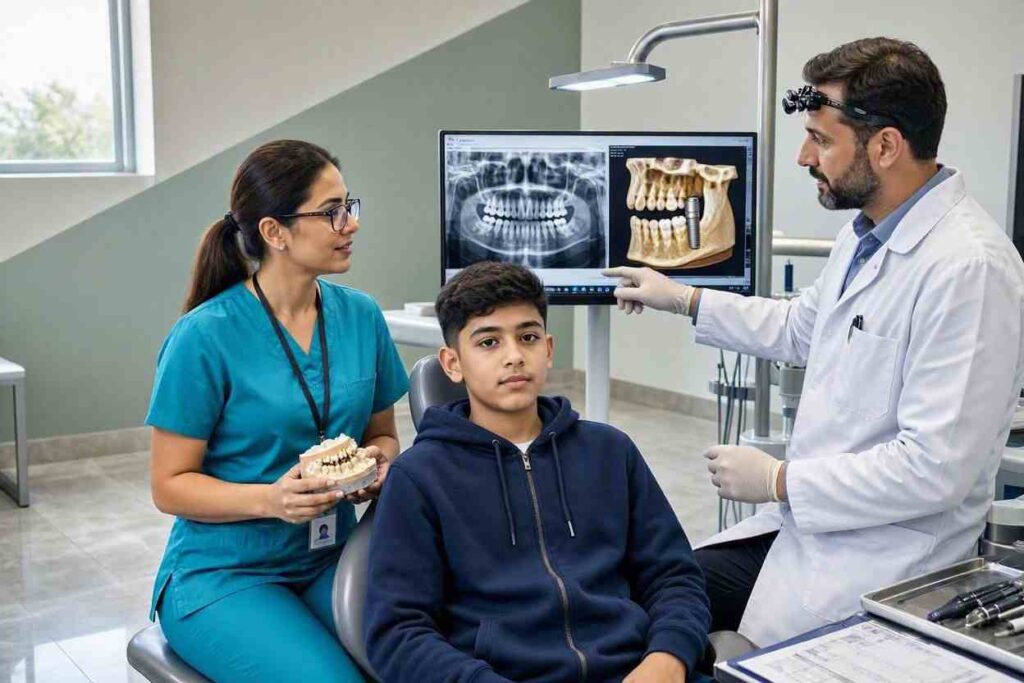
The Core Problem: The Growing Jaw
The primary reason adolescents generally cannot receive dental implants is rooted in biology: the jawbone is not finished growing.
Unlike a titanium implant, which is a rigid, fixed object, natural teeth have a periodontal ligament that allows them to move slightly. As a child grows into an adult, the jawbone lengthens and widens. The natural teeth move and drift within the bone to accommodate this growth.
If you place a dental implant into a growing jaw, the implant does not move. It is fused to the bone (osseointegration). It stays exactly where it was placed.
The Result: As the jaw grows around the static implant, the implant will eventually appear to “sink” or “submerge” below the level of the surrounding natural teeth. The neighboring teeth will continue to erupt and move, but the implant crown will stay put, looking shorter and out of alignment. This can ruin the aesthetics of the smile and create a functional bite problem that is very difficult to fix.
Imagine driving a metal fence post into the ground next to a growing tree. The tree grows taller and wider, but the fence post stays the same height. Eventually, the fence post looks short and misplaced. That is what happens to an implant in a growing child.
When Does Jaw Growth Stop?
This is the million-dollar question. There is no magic birthday where growth stops. However, dentists and orthodontists use specific indicators to determine “skeletal maturity.”
The Growth Spurt
Most significant jaw growth occurs during puberty. For girls, this growth spurt usually peaks around age 12-14 and slows significantly by age 16. For boys, the growth spurt is later, peaking around age 14-16 and slowing by age 18-20.
The “Rule of Thumb”
Because of this, the general guidelines in implant dentistry are:
- Girls: Wait until at least 17 or 18 years old.
- Boys: Wait until at least 18 to 21 years old (sometimes later).
The Scientific Test: The Hand-Wrist X-ray
To be sure, an orthodontist or oral surgeon might recommend a “hand-wrist X-ray” or a “cephalometric X-ray.” These images assess the growth plates in the bones. If the growth plates have fused, it indicates that skeletal growth is complete. This is the most accurate way to determine if an implant is safe.
The Congenital Exception: Missing Teeth (Hypodontia)
Some adolescents are considering implants not because of an accident, but because they were born without certain permanent teeth (a condition called hypodontia). This is most common with upper lateral incisors (the teeth next to the two front teeth) or premolars.
In these cases, the child has a baby tooth that either falls out or never had one, leaving a space. The dentist knows an implant is the best solution, but the same rule applies: you must wait for growth to stop.
The risk is the same. If the implant is placed too early, it will submerge as the adjacent teeth continue to erupt.
The Dangers of Placing Implants Too Early
If a well-meaning but careless dentist places an implant in a 15-year-old, the consequences can be lifelong.
- Aesthetic Failure: The implant crown will look “short” or “stuck” to the gum line while the surrounding teeth grow taller.
- Bone Loss: The bone around the submerged implant can resorb, weakening the foundation.
- Bite Problems: The misalignment can cause the patient to chew unevenly, leading to jaw pain or TMJ issues.
- Difficult Correction: Once the implant is integrated, it is very hard to move it. Correcting the problem often requires removing the implant (which involves removing bone around it), grafting the area, and starting over.
The “Bridge” Alternative for Teens
If an implant has to wait, what do you do about the gap in the meantime? There are several excellent temporary solutions that protect the space and the aesthetics until the child is old enough for surgery.
1. The “Maryland” Bridge (Resin-Bonded Bridge)
This is a fantastic option for teenagers. It is a false tooth (pontic) with small “wings” on the sides. These wings are bonded to the backs of the adjacent teeth with dental cement.
- Pros: It is minimally invasive (no drilling of the adjacent teeth). It looks good. It is relatively inexpensive.
- Cons: It can debond (fall off) occasionally and needs to be re-cemented.
2. A Removable “Flipper” or Essix Retainer
A flipper is a plastic denture-like appliance with a tooth attached. It rests on the gums. An Essix retainer is a clear plastic tray (like an Invisalign retainer) with a fake tooth built into it.
- Pros: Cheap, easy to make.
- Cons: It is removable, which can be embarrassing for a teen. It also doesn’t feel as solid as a fixed bridge.
3. Orthodontic Space Maintenance
If the teen is already getting braces, the orthodontist can use wires and springs to hold the space open perfectly until the child is ready for the implant. This is often the best scenario, as it ensures the space is the exact right size.
The Transition to Adulthood: The Ortho-Implant Teamwork
The ideal treatment plan for a young patient involves coordination between the orthodontist and the implant surgeon.
Phase 1: Braces (Age 13-16)
The orthodontist aligns all the teeth and uses springs or wires to open or maintain the correct amount of space for the future implant. This ensures the neighboring teeth don’t drift into the gap.
Phase 2: The Waiting Game (Age 16-19)
The patient wears a retainer (or a temporary bridge) to keep the space open while the jaw finishes growing. Growth is monitored with X-rays.
Phase 3: The Implant (Age 18+)
Once skeletal maturity is confirmed, the implant is placed. At this point, the patient is treated just like an adult, and the success rate is excellent.
Are There Any Cases Where an Adolescent Gets an Implant?
There is one rare exception where an implant might be considered in a younger patient: severe ectodermal dysplasia.
This is a genetic condition where a child is born with very few or no teeth at all. In these extreme cases, the lack of teeth affects nutrition, speech, and jaw development. In some specialized centers, implants are placed in very young children (sometimes as young as 7 or 8) to help support dentures. However, this is a highly specialized treatment for a severe medical condition, not a standard solution for a single missing tooth from trauma.
The Bottom Line: Patience is a Virtue
It is hard to tell a teenager they have to wait 3 or 4 years for a permanent tooth. But in the world of dental implants, patience guarantees success. Waiting for the jaw to stop growing ensures that the implant will look perfect and last a lifetime. Rushing the process risks a lifetime of aesthetic and functional problems.
Conclusion
While adolescents are generally not candidates for dental implants due to ongoing jaw growth, this is a “not yet” rather than a “no.” Placing an implant before skeletal maturity (around 17-18 for girls and 18-21 for boys) can lead to the implant appearing submerged as the jaw grows. Instead, dentists use temporary solutions like Maryland bridges or orthodontic space maintainers to protect the smile until the patient is old enough for a successful, permanent implant.
Frequently Asked Questions (FAQ)
1. My daughter is 16 and her bone scan shows she is done growing. Can she get an implant?
Maybe. Growth scans can be misleading. A hand-wrist X-ray is a good indicator, but facial growth (especially in the jaw) can continue even after the long bones have stopped growing. Most cautious surgeons still prefer to wait until at least age 17 for girls and 18 for boys, regardless of the bone scan.
2. What happens if my child just leaves the space empty until they are 18?
This is dangerous. The adjacent teeth will tip into the gap, and the opposing tooth will “super-erupt” (grow down or up into the space). This can make it impossible to place an implant later without orthodontic treatment to reopen the space. You must maintain the space with a retainer or bridge.
3. Is a dental bridge a bad option for a teenager?
A traditional bridge (which requires grinding down the adjacent teeth) is a bad option for a teenager because it destroys healthy enamel on young teeth. However, a Maryland bridge (bonded to the backs of the teeth) is an excellent, temporary, non-destructive option.
4. Can an adolescent get a zirconia implant instead of titanium?
The material of the implant doesn’t change the biology. The issue is the growing jawbone, not the material. A zirconia implant in a growing child would have the same “submerging” problem as a titanium one.
5. What if my child lost a baby tooth but there is no adult tooth under it?
This is the hypodontia scenario. The dentist will likely recommend keeping the baby tooth for as long as possible (even if it looks a bit small). Sometimes, the baby tooth can last for decades. If it eventually fails, the patient will likely be old enough for an implant.