Can Dentures Be Turned Into Implants?
Patients who have worn dentures for years often ask whether their existing dentures can be converted into dental implants. The question reflects a hope that the investment already made in dentures can be leveraged toward a more stable, functional solution. The short answer is that dentures cannot be turned into implants. However, existing dentures can often be retrofitted to connect to dental implants, transforming a conventional denture into an implant-retained overdenture. This article explains the distinction, the process of converting dentures to implant retention, the limitations of conversion, and when new prosthesis fabrication is the better choice.
Understanding the Terminology
Clarity about what each term means prevents misunderstanding.
What Dentures Are
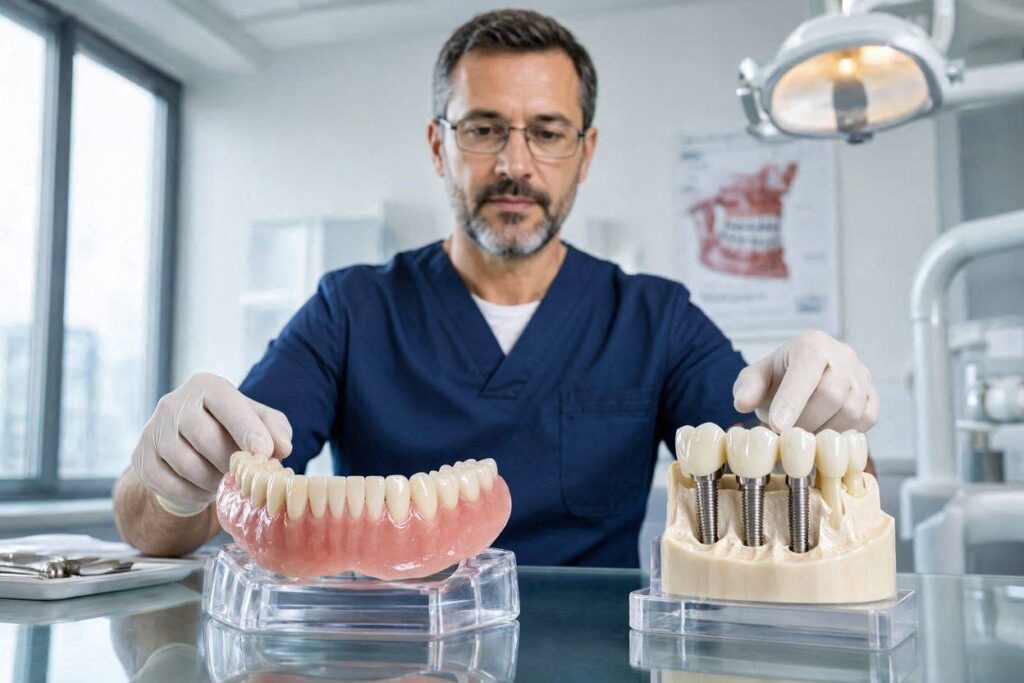
A denture is a removable prosthesis that replaces missing teeth and rests on the gum tissue and underlying bone. It is made of acrylic, often with a metal framework for partial dentures. Dentures have no root-like components. They are supported entirely by the oral soft tissues and remaining ridges.
What Dental Implants Are
A dental implant is a titanium or zirconia fixture surgically placed into the jawbone. It replaces the root of a missing tooth. The implant is a separate entity from the prosthesis that attaches to it.
The Relationship Between the Two
Dentures and implants are different things. A denture cannot become an implant any more than a shoe can become a foot. However, a denture can be modified to attach to implants. This conversion process retains the denture base and teeth while adding components that allow the prosthesis to snap onto implant abutments.
The Denture Conversion Process
Converting an existing denture to an implant-retained overdenture involves several steps.
Evaluation of the Existing Denture
The dentist must determine whether the existing denture is suitable for conversion. Several factors influence this decision.
The denture must be in good structural condition. It must not have cracks, significant wear, or weak areas. The acrylic base must have adequate thickness to accommodate the housings that will retain the attachment components. Thin, worn denture bases may fracture when housings are embedded.
The denture teeth should be in acceptable condition, not excessively worn or positioned in a way that would compromise the implant connection. The vertical dimension of occlusion, the relationship between the upper and lower jaws, should be correct. If the denture has lost vertical dimension due to tooth wear, a new prosthesis is indicated.
The denture must fit the tissues well enough to serve as a foundation for the conversion. A denture that is grossly ill-fitting, causing tissue irritation or requiring significant reline, may not be a good candidate.
The Surgical Phase
Implants are placed in the jawbone according to the treatment plan. For a mandibular overdenture, two implants in the anterior mandible between the mental foramina represent the minimum standard. For a maxillary overdenture, four or more implants are typically required.
After implant placement, a healing period of three to six months allows osseointegration. During this period, the patient continues wearing the existing denture, which is modified with a soft liner to accommodate healing abutments and prevent pressure on the implant sites.
Abutment Connection
After osseointegration is confirmed, the locator abutments or other attachment abutments are torqued to the implants. These abutments will serve as the male portion of the attachment system.
The Conversion Appointment
The conversion appointment transforms the existing denture into an implant overdenture. The dentist seats the denture over the abutments and marks the locations where the abutments contact the denture base. Recesses are created in the denture base to accommodate the metal housings and nylon inserts or other attachment components.
The housings are picked up using a chairside technique. The nylon inserts are placed on the abutments. The housings, filled with auto-polymerizing acrylic or other pickup material, are seated over the inserts. The denture is placed over the housings, and the patient bites into the established occlusion while the material sets. This process captures the housings in the correct position relative to the abutments.
After the material sets, the denture is removed with the housings now embedded in the denture base. Excess material is trimmed. The occlusion is verified. The patient is educated on insertion, removal, and care.
Limitations of Denture Conversion
Conversion is not always the best option, and patients should understand the limitations.
Aesthetic Limitations
The existing denture was fabricated to fit the patient’s appearance at some point in the past. Tissue changes, tooth wear, and evolving aesthetic expectations may mean the denture no longer provides the appearance the patient desires. Conversion retains the existing aesthetic, for better or worse.
Functional Limitations
The denture base, teeth, and occlusion were designed for a tissue-supported prosthesis. An implant-retained overdenture distributes forces differently. The existing denture may not be ideally designed for implant support. It may require significant modification or prove suboptimal in function despite successful conversion.
Longevity Concerns
An existing denture has already served for some period. Converting it adds the cost of the implant surgery and attachment components to a prosthesis with limited remaining lifespan. The denture may need replacement in a few years, requiring the housings to be incorporated into a new prosthesis. Patients must weigh whether investing in a conversion on a denture nearing the end of its useful life is financially prudent.
The Psychological Aspect
Some patients appreciate keeping their familiar denture. The teeth feel like their own. The conversion improves stability without the adjustment of a new prosthesis. Other patients prefer a fresh start with a new prosthesis designed specifically for implant support.
When a New Prosthesis is the Better Choice
In many cases, fabricating a new prosthesis designed from the start for implant retention provides superior outcomes.
Inadequate Existing Denture
If the existing denture is cracked, worn, ill-fitting, or aesthetically unacceptable, conversion is a poor investment. The patient would be adding the expense of implants and attachments to a failing foundation.
Need for Significant Design Changes
Implant overdentures benefit from design features that differ from conventional dentures. The denture base can be shaped to facilitate hygiene around the abutments. The tooth arrangement can be optimized for the new support system. The acrylic can be reinforced in areas subject to higher stress.
Desire for a Fixed Prosthesis
Some patients ultimately desire a fixed prosthesis rather than a removable overdenture. An existing denture cannot be converted to a fixed restoration. A completely new prosthesis is required.
Cost Comparison: Conversion vs. New Prosthesis
The cost implications of conversion versus new prosthesis fabrication vary.
Conversion Costs
Conversion adds the cost of the housing components, the pickup material, and the chairside time to the implant surgery fees. This is generally less expensive than fabricating an entirely new prosthesis. However, the existing denture’s limited remaining lifespan means the patient may pay for a new prosthesis in a few years regardless.
New Prosthesis Costs
A new implant overdenture involves the laboratory fees for complete denture fabrication plus the attachment components. This is more expensive initially than conversion. However, the new prosthesis is designed specifically for the implant system and the patient’s current oral anatomy, and it provides a known starting point for longevity.
Long-Term Value Analysis
If the existing denture has three to five years of useful life remaining, conversion may provide reasonable value. If the denture is near the end of its life, combining the implant surgery with a new prosthesis may be more economical in the long term, avoiding the need to pay for attachment components twice.
The Alternative: New Dentures from the Outset
Patients considering implants who also need new dentures can combine the processes.
Coordinated Treatment Planning
The dentist plans the implant positions and the new denture design simultaneously. The denture is fabricated with the housing positions anticipated. At the appropriate stage, the housings are incorporated precisely.
Advantages of the Coordinated Approach
The new denture is designed for implant retention from the beginning. The teeth are arranged optimally. The base is reinforced appropriately. The aesthetic outcome reflects the patient’s current preferences and facial characteristics. The patient receives a new smile and implant stability simultaneously.
Conclusion
Dentures cannot be turned into implants. The two are fundamentally different entities. However, an existing denture can often be converted into an implant-retained overdenture by modifying the denture base to incorporate attachment housings that snap onto implant abutments. This conversion process provides significantly improved stability over a conventional denture while preserving the familiar prosthesis. Conversion is appropriate when the existing denture is in good condition, fits well, and has adequate remaining lifespan. When the denture is worn, ill-fitting, or aesthetically outdated, fabricating a new prosthesis designed specifically for implant retention is the better investment. Patients should discuss the condition of their existing denture and their long-term goals with their dentist to determine the most appropriate approach.
Frequently Asked Questions
Can my old dentures be used with new implants?
Often yes, if the dentures are in good condition with adequate base thickness. The dentist evaluates the denture to determine suitability for conversion.
Is it cheaper to convert existing dentures than to get new ones?
Initially yes, but if the existing dentures need replacement in a few years, the combined cost of conversion plus eventual replacement may exceed the cost of a new implant overdenture from the start.
How long does a converted denture last?
The conversion itself does not extend the denture’s lifespan. The denture base and teeth will still age and wear. The attachment inserts require replacement every six to eighteen months.
Can a partial denture be converted to implant retention?
Yes, but the process is more complex. The partial denture’s metal framework must accommodate the attachment components. Sometimes a new partial denture designed for implant retention is preferable.
Additional Resource
For information on implant overdentures and denture conversion, visit the American College of Prosthodontists at www.gotoapro.org. The ACP provides resources on removable prosthodontics and implant dentistry.