Can Fosamax Loosen Dental Implants?
The relationship between bone health medications and dental surgery is one of the most critical conversations in modern implant dentistry. If you have been prescribed Fosamax (alendronate sodium) or any bisphosphonate drug, you might have heard a terrifying rumor: that these medications can cause your jawbone to die and your dental implants to fall out. This fear has led many patients to stop taking their prescribed medication without consulting their physician, a decision that can have far more dangerous consequences than the implant surgery itself. The question “Can Fosamax loosen dental implants?” deserves a nuanced, evidence-based answer that respects both your skeletal health and your dental aspirations.
The short answer is yes, bisphosphonates like Fosamax are associated with a risk of a serious jaw condition that can compromise dental implants, but this risk is far from universal. It is highly stratified based on the route of administration, the duration of therapy, and the type of dental procedure. For the vast majority of patients taking oral bisphosphonates for a short period, the risk of implant failure due to the drug is very low. For patients receiving high-dose intravenous bisphosphonates as part of cancer treatment, the risk is substantially higher, and elective implant surgery may be contraindicated. This article will guide you through the pharmacology of Fosamax, the mechanism of medication-related osteonecrosis of the jaw (MRONJ), the specific risk factors for implant failure, and the essential safety protocols that your dentist and physician must follow to protect you.
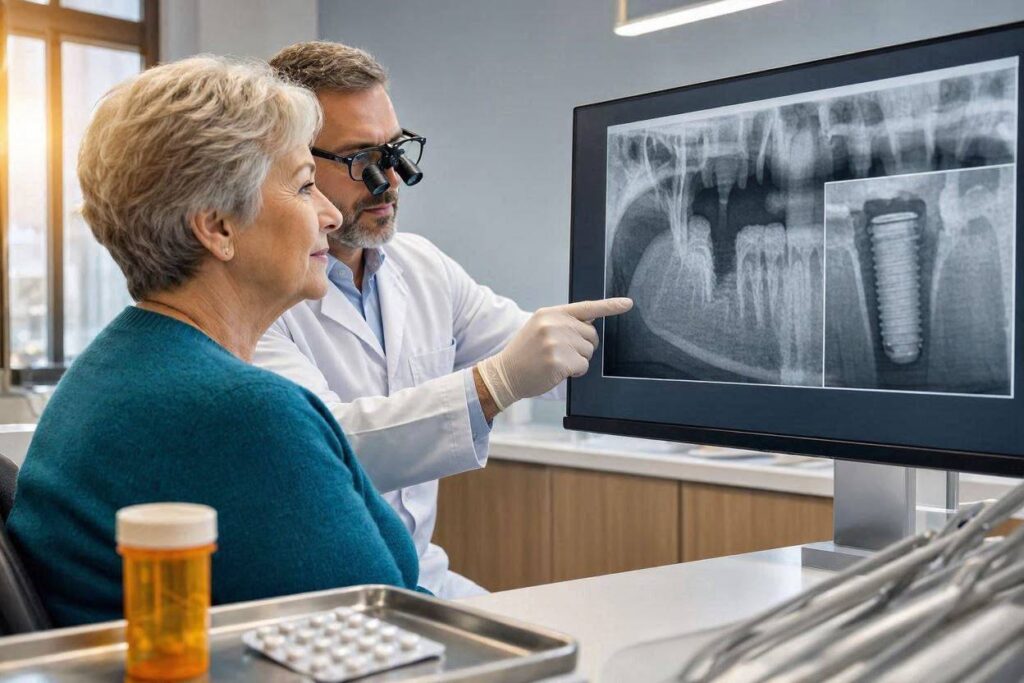
How Fosamax Works: The Bone Remodeling Cycle
To understand the risk, you must first understand the biology. Your skeleton is not a static scaffold. It is a dynamic, living tissue that is constantly being broken down and rebuilt. This process is called bone remodeling. Two types of cells are the main actors in this drama: osteoclasts and osteoblasts. Osteoclasts are the demolition crew. They resorb, or eat away, old or damaged bone. Osteoblasts are the construction crew. They lay down new, healthy bone matrix. The coordinated dance between these two cell types keeps your skeleton strong and repairs micro-damage from daily stress.
Fosamax belongs to a class of drugs called bisphosphonates. These drugs work by binding tightly to the bone mineral and, when ingested by osteoclasts during resorption, inducing apoptosis—programmed cell death. In simple terms, Fosamax shuts down the demolition crew. This is extremely effective at preventing bone loss in patients with osteoporosis or low bone density. The net effect is an increase in bone mineral density and a reduction in fracture risk. However, by suppressing the osteoclasts, the drug also suppresses the body’s ability to repair damaged bone, fight off bone infection, and respond to surgical trauma.
The half-life of bisphosphonates in bone is measured in years, not days. Once a dose of Fosamax is deposited in your skeleton, it can remain pharmacologically active for up to a decade after you stop taking the pill. This is a crucial fact. You cannot simply “pause” the medication for a month and expect the bone metabolism to normalize. The surgical risk is influenced by the total accumulated drug dose in your skeleton.
The Mechanism of Implant Failure: MRONJ and Suppressed Healing
The dental implant process relies on a robust biological response. When the implant is placed into the jawbone, the surgical trauma triggers an inflammatory cascade. The bone around the implant must initially resorb some micro-damage and then begin the process of osseointegration, where new bone is laid down directly onto the titanium surface. This requires a functioning team of osteoclasts and osteoblasts. If the osteoclasts are suppressed by Fosamax, the bone healing is blunted. The bone cannot remodel and renew itself around the implant threads.
The most feared complication is Medication-Related Osteonecrosis of the Jaw, or MRONJ. This is a condition where an area of the jawbone becomes exposed to the oral environment and does not heal for eight weeks or more. It can occur spontaneously, but it is most often triggered by a dental extraction, a dental implant procedure, or an ill-fitting denture that causes a mucosal injury. The soft tissue breaks down, the underlying bone is exposed, and because the bone metabolism is suppressed, the normal healing sequence fails. The bone becomes necrotic—it dies—and can become secondarily infected.
An implant placed in a patient with active MRONJ, or in a patient at high risk who develops MRONJ post-surgically, will not integrate. The implant will be surrounded by dead, non-bleeding bone. It will become loose, spin out, or be lost to infection. This is the direct pathway by which Fosamax, in vulnerable patients, can cause a dental implant to loosen and fail. The implant is not “rejected” by the body; the biological foundation into which it was placed has died due to a suppressed healing capacity.
Stratifying the Risk: Oral vs. Intravenous Bisphosphonates
The risk is not a single number. It is a gradient, and the route of administration is the most powerful predictor.
Oral Bisphosphonates (Fosamax, Actonel, Boniva)
These are the pills taken daily, weekly, or monthly for osteoporosis or osteopenia. The risk of developing MRONJ from oral bisphosphonate therapy is very low in the general population. The literature suggests an incidence of MRONJ in oral bisphosphonate users between 0.01 percent and 0.1 percent. For a dental implant specifically, the risk of failure or MRONJ in a patient who has been taking an oral bisphosphonate for less than three years and has no other risk factors is only slightly elevated above the baseline risk of implant failure in healthy patients. Many studies show no statistically significant difference in implant survival rates between short-term oral bisphosphonate users and controls.
However, the risk rises significantly with the duration of therapy. A patient who has been taking Fosamax for more than four or five years accumulates a substantial skeletal burden of the drug. The risk of MRONJ after an extraction or implant in these long-term users is higher, though still relatively low in absolute terms. The critical point is that the risk is sufficient to warrant a formal informed consent discussion and potential modification of the treatment plan.
Intravenous (IV) Bisphosphonates (Zometa, Aredia) and RANK-L Inhibitors (Prolia, Xgeva)
These are high-potency, intravenous infusions used to treat bone metastases from cancers like breast cancer, prostate cancer, and multiple myeloma, and to manage severe osteoporosis. These drugs are an entirely different risk universe. The incidence of MRONJ in cancer patients receiving IV bisphosphonates is between 1 percent and 10 percent, a risk several orders of magnitude higher than with oral pills. Elective dental implant placement is generally considered an absolute contraindication in patients actively receiving high-dose IV antiresorptive therapy for cancer. The risk of jaw necrosis and implant failure is unacceptably high.
A newer class of drugs, the RANK-L inhibitors (Denosumab, brand name Prolia for osteoporosis, Xgeva for cancer), also suppress osteoclasts, but through a different receptor. They are not bisphosphonates, but they carry a similar, and arguably even higher, risk of MRONJ. A patient on Prolia who stops the medication will have a reversal of the antiresorptive effect much faster than a Fosamax patient, but during active therapy, the risk is very real.
The Drug Holiday Myth
A common piece of outdated advice was to put the patient on a “drug holiday” before implant surgery. The idea was that stopping Fosamax for three months would allow the bone to “wake up” and heal normally. Modern pharmacology has dismantled this myth. As we discussed, the half-life of alendronate in bone is approximately ten years. Stopping the drug for a few months does not remove the accumulated drug from the skeleton. The osteoclasts remain suppressed.
Current guidelines from the American Association of Oral and Maxillofacial Surgeons (AAOMS) do not generally support a drug holiday for patients on oral bisphosphonates, as the benefit of the short pause is unproven and the risk of fracture from stopping osteoporosis treatment is real. For patients on IV bisphosphonates or RANK-L inhibitors for cancer, the decision to pause therapy is a complex oncologic decision that must be made by the medical oncologist, not the dentist. A pause in cancer therapy to facilitate an elective cosmetic dental procedure is rarely justified.
Protocol for Dental Implants in Fosamax Patients
If you are taking Fosamax and need or want a dental implant, a strict protocol must be followed to minimize your risk. This is not a situation where you can walk into a chain implant clinic and get a same-day implant. You need a coordinated effort between your dentist or oral surgeon and your prescribing physician.
The first step is a comprehensive medical history. You must disclose the exact drug name, dosage, frequency, and duration of therapy. How long have you been taking Fosamax? A patient on their second year of treatment is a different risk profile than a patient on their tenth year. The surgeon will also screen for other risk factors that synergistically increase the risk of MRONJ. These include concurrent steroid therapy, diabetes, smoking, alcohol abuse, poor oral hygiene, and existing periodontal disease. A smoker with poorly controlled diabetes who has been on Fosamax for eight years is a very high-risk candidate for an implant.
The second step is a thorough oral examination and a 3D CBCT scan. The surgeon must rule out any pre-existing areas of exposed bone, any chronic low-grade infections, and any other dental disease that could complicate healing. The surgical technique must be as atraumatic as possible. The surgeon will use a flapless or minimal flap technique if possible, along with copious sterile saline irrigation to prevent overheating the bone. The implant must achieve high primary stability. Post-operatively, the surgeon will usually prescribe a course of antibiotics, such as amoxicillin or clindamycin, and an antimicrobial mouth rinse like chlorhexidine. The goal is to achieve a pristine, bacteria-free healing environment.
The patient must be meticulously followed up. A loose implant in a bisphosphonate patient is a red flag that must be evaluated immediately. If the implant shows signs of early failure, it is often removed before MRONJ can develop. Attempting to “rescue” a failing implant in a compromised bone environment can accelerate the bone necrosis.
Important Note: A simple blood test called the Serum CTX (C-terminal telopeptide) test was once thought to be a useful predictor of MRONJ risk by measuring bone turnover. Current evidence shows that while a very low CTX level may indicate heavily suppressed bone turnover, the test has limited predictive value for individual patient risk and is not a substitute for a comprehensive clinical risk assessment.
Alternatives to Implants for High-Risk Patients
If your risk profile for MRONJ is determined to be too high for a dental implant, you are not out of options. The standard of care for tooth replacement in a high-risk bisphosphonate patient is a traditional fixed bridge or a removable partial denture. These options do not involve an osteotomy in the jawbone and therefore do not carry the risk of triggering osteonecrosis.
A conventional bridge uses the adjacent teeth for support. It requires preparing those teeth for crowns, which is a trade-off. A removable denture is the least invasive option, but it is less comfortable and can cause soft tissue irritation, which, in a high-risk patient, could itself become a source of mucosal injury and a potential trigger for MRONJ. The denture must be carefully adjusted to avoid any pressure sores on the gum tissue.
The decision to forgo an implant is a conservative, risk-averse choice that prioritizes the avoidance of a catastrophic jaw necrosis event over the functional and aesthetic benefits of an implant. For a cancer patient on Zometa, this is almost always the correct decision. For a healthy osteoporosis patient on a short course of Fosamax, the risk calculus strongly favors the implant as a safe and predictable option.
Conclusion
Fosamax and other bisphosphonates can contribute to dental implant loosening and failure through a mechanism of suppressed bone turnover that, in vulnerable patients, leads to medication-related osteonecrosis of the jaw (MRONJ). The risk is remarkably low for short-term oral bisphosphonate users but climbs substantially for long-term users and becomes a major contraindication for those on high-dose intravenous cancer therapy. Safe implant treatment in these patients hinges on a thorough medication history, a collaborative medical-dental risk assessment, and an atraumatic surgical protocol with rigorous infection control.
FAQ
Can I stop taking Fosamax temporarily to get a dental implant?
A short drug holiday is no longer routinely recommended because Fosamax stays in your bone for years. Stopping the medication does not quickly reverse the drug’s effect and may expose you to fracture risk.
How long after stopping Fosamax is it safe to get an implant?
Because the drug’s half-life in bone is approximately ten years, the risk remains elevated for years after discontinuation. The duration of prior therapy is more important than the length of time since you stopped.
What are the signs of MRONJ around a dental implant?
Signs include an area of exposed, non-healing bone around the implant, pain, swelling, pus, a bad taste, or the implant feeling loose and spinning in the socket. These symptoms require immediate surgical evaluation.
Is Fosamax the only medication that causes this problem?
No. All bisphosphonates (Actonel, Boniva, Reclast) and RANK-L inhibitors (Prolia, Xgeva) carry a risk of MRONJ. Anti-angiogenic cancer drugs can also be a contributing factor.
Are top dental implants safe if I am taking Fosamax?
Yes, placing dental implants in the upper jaw requires an equally careful risk assessment. The mandible (lower jaw) has a statistically higher incidence of MRONJ than the maxilla, but both are at risk and require the same precautions.
Additional Resources
For detailed clinical guidelines on antiresorptive therapy and dental surgery, visit the American Association of Oral and Maxillofacial Surgeons: https://www.aaoms.org/