How Much Are Veneers Implants? Comparing Costs, Procedures, and Value
The pursuit of a perfect smile often leads to a crossroads in cosmetic dentistry where two powerful treatment philosophies collide: dental veneers and dental implants. A common question that arises in this landscape, one that reveals a fundamental confusion between two very different procedures, is “How much are veneers implants?” The phrasing itself is a clue that the patient is trying to compare the cost of a complete tooth replacement with the cost of a cosmetic tooth covering. While “veneers implants” is not a single dental product, the question makes perfect sense when you are staring at a smile in the mirror and wondering what path will give you the most value for your money.
This comprehensive guide will clear up the terminology and provide a definitive, side-by-side financial and clinical analysis of veneers versus implants. We will break down the cost of each procedure per tooth, explore the clinical scenarios where one is appropriate over the other, and discuss the long-term return on investment. If you have a healthy tooth that is discolored, chipped, or slightly crooked, a veneer is likely your solution. If you have a missing tooth or a tooth that is so broken it needs to be removed, an implant is the answer. The cost, the process, and the outcome are entirely different, and understanding these distinctions will empower you to have an intelligent, informed discussion with your dentist.
Defining the Terms: Veneer vs. Implant
Before we can discuss price, we must correct the terminology that merges these two treatments. A “veneer implant” does not exist. A veneer is placed on a natural tooth. An implant is a replacement for a missing natural tooth. Let us define each clearly.
A dental veneer is a thin, custom-made shell of porcelain or composite resin that is bonded to the front surface of a healthy, existing tooth. The tooth is prepared by removing a tiny amount of enamel (about 0.5 millimeters) from the front and edge of the tooth. The veneer is then bonded over this prepared surface, permanently changing the tooth’s color, shape, size, or alignment. Veneers are a cosmetic procedure. The tooth root and the majority of the tooth structure remain intact. The procedure is irreversible because of the enamel removal.
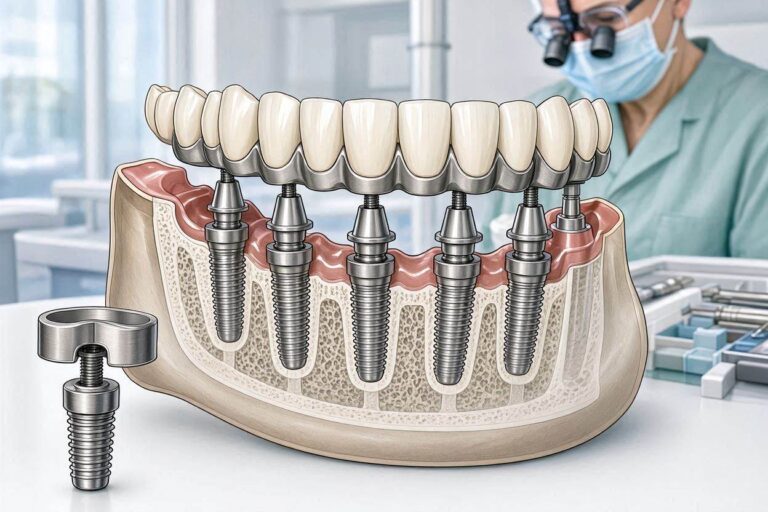
A dental implant is a surgical device. It is a titanium or zirconia screw that is placed into the jawbone to replace the root of a missing tooth. After the implant fuses to the bone, an abutment and a crown are attached to create a new, fully artificial tooth that stands alone, supported entirely by the implant. An implant does not touch the adjacent teeth. It is a functional and structural replacement for a lost tooth, not a cosmetic covering for a present one.
The confusion often arises because both procedures result in a beautiful, natural-looking tooth. A patient might look at a row of perfect front teeth and not know whether they are looking at ten individual crowns on implants or ten porcelain veneers on natural teeth. The aesthetic endpoint can be similar, but the biological starting point and the cost structure are completely different.
The Clinical Decision Tree: When to Use Which
The choice between a veneer and an implant is not a matter of preference; it is dictated by the condition of the existing tooth. Here is the clinical decision tree your dentist follows.
If your tooth is present, structurally sound, and has a healthy root but has cosmetic flaws like intrinsic staining, minor chips, wear, gaps, or slight misalignment, a veneer is the appropriate, conservative choice. You are enhancing a healthy tooth.
If your tooth is missing entirely, or if the remaining tooth structure is so decayed or fractured that it cannot support a filling or a crown, the tooth must be extracted and an implant is the appropriate choice. You are replacing a lost organ. A veneer cannot replace a missing tooth.
If your tooth is severely broken down but the root is healthy, a crown is the correct restoration. A crown is a cap that covers the entire tooth above the gum line. A veneer only covers the front. An implant is only for when the tooth cannot be saved at all.
Understanding this simple logic dismantles the “veneers versus implants” comparison for a single tooth. You do not choose between a veneer and an implant for the same tooth. The tooth’s condition chooses the treatment. The comparison becomes relevant when a patient is planning a full smile makeover and is considering multiple veneers on their existing teeth versus extracting those teeth and placing a full arch of implant-supported crowns. This is a massive decision with a staggering cost difference.
Cost Per Tooth: Veneers vs. Implants
Now, let us get to the numbers. The cost of a veneer and the cost of an implant are calculated on a per-tooth basis, and the difference is substantial.
The Cost of a Single Porcelain Veneer
A high-quality porcelain veneer, fabricated by a skilled ceramist and bonded by an expert cosmetic dentist, typically costs between $1,200 and $3,000 per tooth in the United States. The national average sits around $1,800. Composite resin veneers, which are sculpted directly onto the tooth by the dentist in a single visit, are less expensive, ranging from $400 to $1,500 per tooth. However, porcelain is the premium material of choice for its durability, stain resistance, and ability to mimic the light-handling properties of natural enamel.
This fee usually includes the consultation, the digital smile design, the tooth preparation, the temporary veneers, the laboratory fee for the custom porcelain, and the final bonding visit. Veneers are rarely done as a single unit. They are typically placed in sets of 2, 4, 6, 8, or 10 to create a harmonious smile line. A full set of 8 upper porcelain veneers, at $2,000 each, is a $16,000 investment in a smile.
The Cost of a Single Dental Implant
A single dental implant, as we have extensively covered, is a surgical and restorative procedure. The all-inclusive cost for a single implant, including the fixture, abutment, and crown, ranges from $3,000 to $6,000. If a tooth extraction and a bone graft are required, the total can easily reach $7,000 to $9,000. The implant cost is roughly double to triple the cost of a porcelain veneer on a per-tooth basis.
The reason for the cost difference is the complexity. A veneer is a cosmetic adhesive procedure on the external surface of a tooth. An implant is a sterile surgical procedure that enters the bone, requires months of healing, and then requires a complex prosthetic assembly. The implant replaces a missing organ; the veneer beautifies an existing one.
| Treatment | Indication | Average Cost Per Tooth (USA) | Longevity |
|---|---|---|---|
| Composite Veneer | Minor cosmetic flaws on a healthy tooth | $400 – $1,500 | 5 – 7 years |
| Porcelain Veneer | Moderate to major cosmetic flaws on a healthy tooth | $1,200 – $3,000 | 10 – 20 years |
| Dental Implant & Crown | Missing tooth or non-restorable tooth | $3,000 – $6,000 | 25 years to lifetime |
| Implant with Bone Graft | Missing tooth with bone loss | $4,500 – $9,000 | 25 years to lifetime |
This table illustrates the financial trade-off. The veneer is less expensive up front but has a shorter lifespan and requires the presence of a healthy natural tooth. The implant is far more expensive but replaces the entire tooth structure and can last a lifetime.
The Full-Mouth Comparison: Cosmetic Veneers vs. All-on-4 Implants
The most dramatic cost comparison occurs when a patient with failing or severely compromised teeth considers a full-mouth reconstruction. The two options on the table are often a full set of crowns and veneers on the natural teeth versus extracting all the teeth and placing a fixed full-arch implant bridge.
A full-mouth cosmetic restoration with 20 to 28 individual crowns and veneers, often called a “smile makeover,” can cost $40,000 to $80,000. This treatment preserves the natural tooth roots and the jawbone stimulation they provide. It is a monumental cosmetic and restorative undertaking, but it is built on the patient’s own biological foundation.
A full-arch “All-on-4” or “All-on-6” implant bridge, which replaces an entire jaw of missing or hopeless teeth, costs $25,000 to $50,000 per jaw. This involves removing all the teeth, placing 4 to 6 implants, and attaching a fixed, non-removable bridge of 12 to 14 teeth. The cost, per jaw, is often less than a full-mouth veneer and crown reconstruction. The trade-off is the loss of the natural teeth and the anatomical bone they preserve.
This is where the question “How much are veneers implants?” finds its real context. A patient who is told their teeth can be saved with $60,000 of restorative work might look at the $30,000 All-on-4 option and ask, “If the implant option is cheaper, why would I save my teeth?” The answer is biology. Natural teeth, even compromised ones, provide periodontal ligament feedback, maintain the jawbone through physiological loading, and have a sensory capacity that implants do not. Saving natural teeth is almost always the preferred biological path if it is reasonably achievable. However, if the teeth are a sinking ship—requiring retreatments, root canals, and constant repairs—the implant route may offer a more predictable, cost-effective long-term outcome.
The Value Proposition: Longevity and Maintenance
The sticker price is only the first chapter of the financial story. The second chapter is the cost of maintenance, repair, and eventual replacement over a lifetime.
A porcelain veneer is a durable restoration, but it is not impervious to damage. The porcelain can chip at the edge, especially if you grind your teeth at night without a nightguard. The bond between the veneer and the tooth can fail, allowing decay to creep under the margin. When a veneer fails, it usually must be replaced. You cannot simply “patch” a veneer. The replacement cost is the same as the original. A patient who gets veneers at age 30 will likely need at least one full replacement cycle by age 60, if not two. The lifetime cost of maintaining a set of 8 veneers can be $50,000 or more.
A dental implant, once successfully integrated, has an extremely high long-term survival rate. The implant fixture itself can last a lifetime. The prosthetic components—the crown and sometimes the abutment screw—are the parts that require maintenance. A screw might loosen and need retorquing (a simple, inexpensive visit). The porcelain crown may fracture or need replacement after 15 to 20 years. Replacing a crown on an implant does not involve surgery on the bone; it is a restorative procedure on the existing implant, costing $1,500 to $2,500. The implant fixture remains. This makes the long-term cost of the implant more predictable and, in some cases, lower than the repeated replacement of veneers and compromised natural teeth.
The other value factor is oral hygiene. A tooth with a veneer is still a natural tooth at the gum line. It can still get gum disease and decay at the margin. It requires flossing and meticulous hygiene. An implant-supported crown, if properly contoured and cleaned, is immune to dental decay. However, it is susceptible to peri-implantitis, a destructive gum infection around the implant. The maintenance of both veneers and implants requires an equal commitment to professional cleanings and home care. There is no “maintenance-free” option in dentistry.
The Risk of Choosing the Wrong Treatment
The most expensive outcome in cosmetic dentistry is choosing the wrong treatment due to a misunderstanding of the options. A patient who demands “veneers” to fix a severely broken, root-canal-treated molar will end up with a catastrophic failure. The veneer will not hold up to the biting forces on a back tooth. The tooth will fracture, and the entire investment in the veneer will be lost. The tooth will then need to be extracted and an implant placed anyway. The patient will have paid for a veneer, an extraction, and an implant, when the implant was the correct choice from day one.
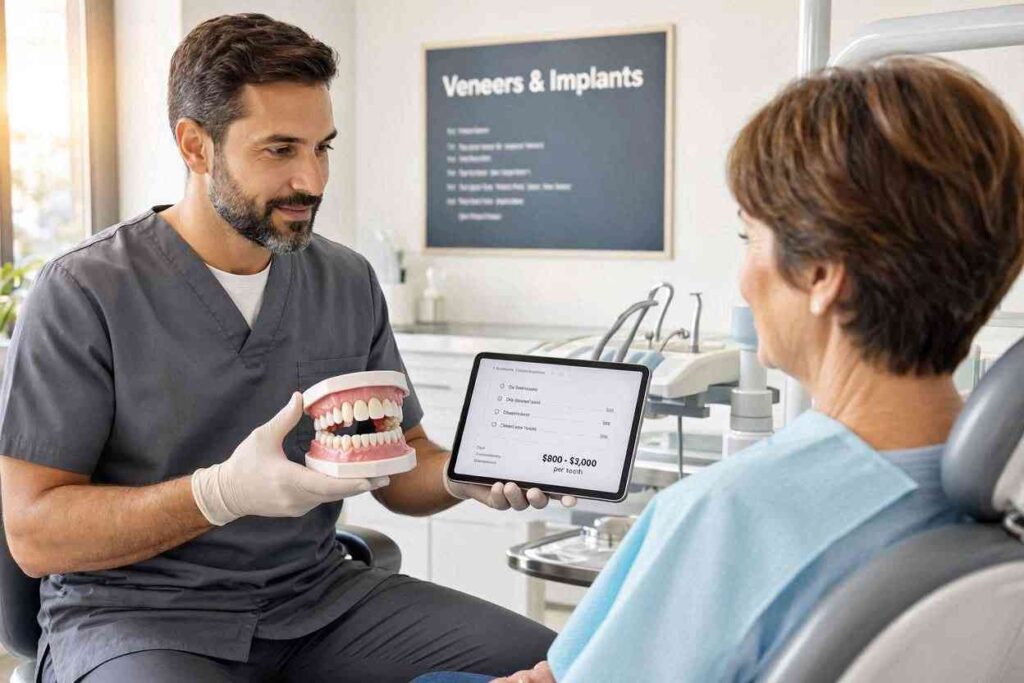
Conversely, a patient who is sold a full-mouth extraction and implant placement when their teeth were simply stained and slightly worn has lost their natural dentition for a problem that could have been solved with $15,000 of veneers. The remorse from an irreversible overtreatment is profound. This is why the diagnostic phase—the photographs, the X-rays, the CBCT scan, and the honest clinical consultation—is the most important part of the process. A dentist who takes the time to explain why one treatment is indicated over another, and who provides a clear, itemized cost comparison, is worth their weight in gold.
Conclusion
The term “veneers implants” is a misnomer that actually refers to two distinct paths: a cosmetic enhancement of healthy teeth with thin porcelain shells or a surgical replacement of missing teeth with titanium posts. Financially, a single porcelain veneer costs between $1,200 and $3,000, while a single dental implant and crown ranges from $3,000 to $9,000, with the implant being the more invasive, structural, and biologically complex solution. Choosing between them is not a matter of price shopping but of a correct diagnosis—saving natural teeth with veneers is conservative and aesthetic, while replacing lost teeth with implants is reconstructive and functionally essential.
FAQ
Can you put a veneer on a dental implant?
No. A veneer is bonded to natural tooth enamel. An implant is restored with a crown that is either cemented or screwed onto the abutment. The aesthetic porcelain is part of the crown, not a separate veneer.
Is a full set of veneers cheaper than dental implants?
Yes, by a significant margin. A full set of 8 to 10 porcelain veneers on healthy teeth costs $15,000 to $30,000. A full-arch implant bridge to replace all teeth costs $25,000 to $50,000 per jaw.
Do veneers last as long as dental implants?
No. Porcelain veneers typically last 10 to 20 years and then must be replaced. A dental implant fixture can last a lifetime, although the crown may need replacement every 15 to 25 years.
Why are dental implants so much more expensive than veneers?
Implants involve a surgical team, a titanium medical device, a 3D CT scan, and multiple months of healing. Veneers are an adhesive restorative procedure on an existing tooth, involving no surgery or bone healing.
Can I get veneers if I have one missing tooth?
You can get an implant for the missing tooth and veneers on the surrounding teeth to create a uniform smile. The veneers and the implant crown are matched in color and shape by the ceramist.
Additional Resources
To understand the standards of care for cosmetic and implant dentistry, visit the American Academy of Cosmetic Dentistry: https://aacd.com/