Can I Pay for Dental Implants with HSA?
You are planning for a dental implant, a significant investment in your health and quality of life, and you are looking for every available financial tool. A logical and powerful question arises: can I use my Health Savings Account, or HSA, to pay for this? The short and direct answer is yes, absolutely. Dental implants are a qualified medical expense under IRS rules. This guide will explain in plain, clear language exactly how you can use your HSA funds for dental implant treatment, what is covered, what documentation you need, and how to strategically maximize this tax-advantaged account. We will also cover related accounts like Flexible Spending Arrangements and Health Reimbursement Arrangements. This is your practical, step-by-step resource for funding your new smile with pre-tax dollars.
The IRS Rule: Dental Implants are a Qualified Medical Expense
The legal authority that makes this possible is Internal Revenue Service Publication 502, which defines the medical and dental expenses you can pay for with tax-free HSA funds. The publication explicitly states that you can include “amounts paid for dental treatment.” It specifically lists artificial teeth as a qualifying expense. A dental implant, which is a permanent replacement for a missing tooth root and its associated crown, falls squarely within this definition. It is not a cosmetic treatment for tax purposes when it replaces a missing tooth. It is a restorative medical treatment for a dental disease (edentulism).
This means every dollar you withdraw from your HSA to pay for your dental implant is exempt from federal income tax, and in almost all states, exempt from state income tax as well. If you are in a combined 25% marginal tax bracket, paying for a $5,000 implant with your HSA effectively saves you $1,250 in taxes. This is not a deduction; it is a complete tax exemption. No other savings vehicle offers this triple tax advantage: contributions are tax-deductible, growth is tax-free, and withdrawals for qualified medical expenses are tax-free. Understanding that your implant treatment is a qualified expense unlocks this powerful benefit.
What Specific Implant-Related Expenses are HSA-Eligible?
The HSA eligibility extends to the entire episode of care, not just the titanium implant post. You can use your HSA funds for every medically necessary component and service directly related to the implant treatment. This includes the initial specialist consultation and examination. It includes all the diagnostic imaging, and this is critical: the 3D Cone Beam Computed Tomography (CBCT) scan is a major and essential expense that is fully HSA-eligible. If a tooth needs to be extracted before the implant, the surgical extraction fee is eligible.
The bone graft and any associated membrane or biologics used to rebuild your jawbone are qualifying expenses. The surgical placement of the implant body itself is covered. The abutment, the connector piece, is covered. The implant crown, the visible porcelain tooth, is covered. Sedation anesthesia, whether IV sedation administered by an anesthesiologist or oral conscious sedation, is covered because it is a medical service necessary for the safe performance of the surgical procedure. Even travel expenses to and from your implant appointments are HSA-eligible at a defined medical mileage rate. The rule is: if the procedure is a medical treatment for a diagnosed dental condition, the costs are HSA-qualified.
The Crucial Difference: HSA vs. FSA for Dental Implants
Both HSAs and Flexible Spending Arrangements allow you to pay for dental implants with pre-tax dollars, but they function very differently, and this difference has major implications for your treatment timeline. An HSA is a true savings account. The funds roll over year after year indefinitely. There is no “use it or lose it” rule. You can contribute money to your HSA this year, next year, and the year after, and let it accumulate, tax-free, to pay for a planned implant procedure in the future. This makes an HSA a perfect strategic tool for a planned, significant expense like an implant.
An FSA is a spending account with a strict “use it or lose it” rule. You must generally spend the funds within the plan year, though some plans offer a grace period of up to 2.5 months or allow a $640 carryover into the next year. Because dental implant treatment is a phased process that takes months, you must plan your FSA spending carefully. You will need to time your procedure so the payment for each phase falls within the plan year or the grace period. With an FSA, the entire elected amount is available on day one of the plan year, which is a benefit. You can schedule your surgery in February, use the full FSA amount to pay for it, and repay the FSA through your payroll deductions over the rest of the year. But if you are planning treatment for next year, you must elect the correct amount during open enrollment this year. An HRA, a Health Reimbursement Arrangement, is entirely employer-funded, and the employer sets the rules on what is covered. You must check your specific HRA plan document to confirm dental implant coverage.
How to Pay and Document: The Debit Card and Receipt Rules
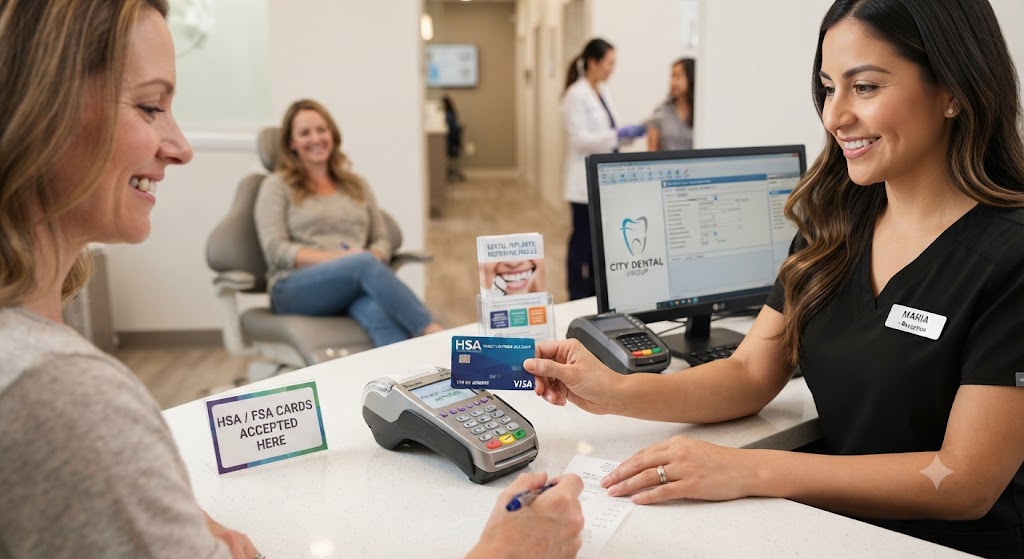
The most convenient way to use your HSA is with the debit card linked to your account. When you present this card at your dental office for a qualified expense, the transaction can proceed smoothly. However, the IRS holds you, the account holder, completely responsible for proving that every expense was a qualified medical expense. Your HSA administrator may flag a large, atypical charge and request documentation. You must keep a “receipt-substantiation file” for every implant-related payment.
The receipt from your dental office must contain specific information. It must show the name of the provider, the name of the patient, the date of service, a description of the service, and the amount paid. A credit card terminal receipt that simply says “Smith Dental – $2,500” is completely insufficient. You need the detailed, itemized treatment statement. A proper receipt says, “Patient: John Doe, Date: 05-15-2024, Service: Surgical placement of endosteal implant, tooth #30 (D6010), Amount: $2,500.” When you pay, ask the front desk for a detailed, procedure-coded paid receipt. Scan it or take a clear photo with your phone. Store it in a dedicated digital folder for that tax year. If you forget to use your HSA card and pay with cash or a personal credit card, do not worry. You can reimburse yourself from your HSA at any time, even years later, as long as the procedure occurred after your HSA was established. You simply transfer the money from your HSA to your checking account and keep the detailed receipt in your records. The HSA does not require pre-approval or a claim form; it is a self-reporting, self-substantiating system, and the burden of proof in an audit falls entirely on you.
A Practical Scenario: Strategically Funding an Implant with Your HSA
Let’s walk through a realistic scenario. Sarah in Dayton, Ohio, needs a single dental implant. Her dentist has given her an itemized treatment plan totaling $4,800 spread over 8 months. She has an HSA through her employer and contributes $300 per month. She currently has $1,200 in her account. She does not want to take out a loan.
Sarah’s strategy is simple. She will pay for the Phase 1 surgery—extraction and bone graft, costing $1,800—using her current HSA balance of $1,200 and the remaining $600 from her personal savings. She receives and files a detailed receipt. Over the next four months, she continues to contribute to her HSA. She then pays for Phase 2—implant placement, costing $1,500—directly with her HSA debit card, as the funds have now accumulated. She files her receipt. Four months later, she pays for the final restoration—the abutment and crown, costing $1,500—again with her HSA debit card. She has now paid for the entire $4,800 implant using $4,200 in tax-free HSA dollars, saving her over $1,000 in taxes, and only $600 in after-tax cash. She has no debt and has used her health savings account exactly as it was designed to be used.
Cosmetic vs. Medically Necessary: The Tax Line in the Sand
The HSA eligibility of an implant depends entirely on the purpose of the treatment. If the implant is replacing a tooth lost to disease, decay, or trauma, it is unequivocally a qualifying medical expense. The diagnosis codes (like K08.1, loss of teeth due to accident, extraction, or local periodontal disease) support this. However, if you have a perfectly healthy tooth and you wish to extract it and replace it with an implant purely because you believe the implant will look more cosmetically perfect, this is a cosmetic procedure. Cosmetic procedures are not HSA-eligible.
The IRS explicitly states that expenses for “unnecessary cosmetic surgery” are not qualified. The determination is based on medical necessity. If the tooth is structurally compromised, infected, or non-restorable, the extraction and implant are medically necessary. If the treatment is purely elective for aesthetic enhancement with no underlying disease, you are in a gray zone that an auditor could challenge. Your dentist’s clinical notes and the diagnosis they record on your chart are your protection. Always ensure your treatment plan clearly states the medical reason for the extraction and implant.
What About Travel Expenses for an Out-of-Town Implant Specialist?
If you live in a rural part of Ohio and must travel a significant distance to see an implant specialist in Columbus or Cleveland, or if you choose to travel to a specific center of excellence, those transportation costs can be paid with HSA funds. The IRS allows you to deduct the cost of transportation “primarily for and essential to medical care.” You can use the standard medical mileage rate for the use of your personal automobile. This rate changes annually, so check the current IRS figure. You can also pay for tolls and parking with your HSA. If an overnight stay is required because the surgery is early in the morning and you must travel the day before, the lodging cost (up to a specific limit per night) is also an eligible expense. Meals during the travel, however, are generally not eligible. You should keep a log of your mileage, dates of travel, and the purpose of the trip, along with any parking and toll receipts. This is a valuable but often overlooked way to extend your HSA dollars.
Conclusion
You can absolutely pay for your dental implant with your HSA, as the IRS defines the entire treatment process—from the diagnostic CBCT scan to the final crown—as a qualifying medical expense for a restorative dental treatment. Using your HSA provides a profound financial advantage, allowing you to pay with completely tax-free dollars and effectively saving you 20 to 40 percent compared to using after-tax cash. The key to a smooth experience is meticulous record-keeping, securing detailed, itemized paid receipts for every phase of treatment to substantiate the expense in the event of an IRS audit.
Frequently Asked Questions
Can I use my HSA to pay for my spouse’s or dependent’s dental implant?
Yes. You can use your HSA to pay for the qualified medical expenses of your spouse and any tax dependents, even if they are not covered under your health insurance plan. The implant treatment qualifies based on the patient’s need, not the account holder’s.
What if I have a Limited Purpose FSA? Can I use it for an implant?
No. A Limited Purpose FSA is specifically designed to pay for only dental and vision expenses, but only for preventive care. A dental implant is a restorative, non-preventive procedure and is not eligible under a Limited Purpose FSA. You would use your HSA for the implant and reserve your Limited Purpose FSA for cleanings, exams, and eyeglasses.
My HSA debit card was declined at the dentist. What do I do?
This can happen for administrative reasons, not because the expense is ineligible. Pay with an alternative method and then reimburse yourself from your HSA. Simply initiate an online transfer from your HSA to your personal checking account in the exact amount of the paid receipt. The transaction is tax-free, and you just need to keep the detailed receipt.
Is a dental discount plan that covers implants an HSA-eligible expense?
Yes. The IRS allows you to include amounts paid for membership in a medical or dental discount plan if the plan’s primary purpose is to provide its members with discounted access to medical or dental services. The membership fee is a separate, qualifying expense you can pay with your HSA.
Can I pay for an implant with my HSA if I am taking the funds out years after the procedure?
Absolutely. There is no time limit for reimbursing yourself from your HSA for a qualified medical expense, as long as the expense was incurred after your HSA was established. If you have a $5,000 implant procedure done today, pay for it out of pocket, and keep the receipt, you can reimburse yourself that $5,000 from your HSA 10 years from now, tax-free.
Additional Resource: Link
For the definitive, official IRS guidance on what qualifies as a medical and dental expense, you can read Publication 502 directly. Read IRS Publication 502