Can I Smoke And Get Dental Implants?
Smoking and dental implants represent one of the most significant conflicts in modern dentistry. Patients who smoke often desperately want or need dental implants but worry their habit disqualifies them from treatment. The relationship between smoking and implant success is complex, with research clearly demonstrating increased risks while also showing that smoking does not make implant treatment impossible under the right circumstances.
You can smoke and get dental implants, but smoking dramatically increases your risk of implant failure, complications during healing, and long-term problems around successfully integrated implants. The implant failure rate for smokers is two to three times higher than for non-smokers. Most implant surgeons strongly recommend quitting smoking before implant placement and continuing abstinence throughout the healing period. Some surgeons refuse to place implants in heavy smokers entirely.
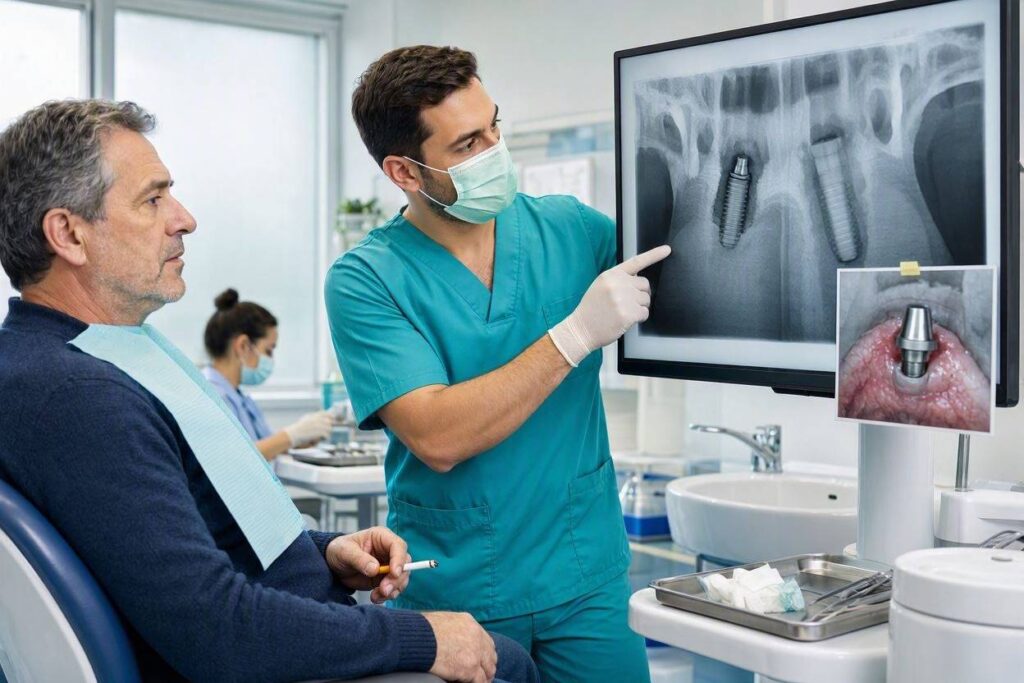
How Smoking Affects Dental Implant Success
Understanding the biological mechanisms by which smoking damages implant outcomes helps patients appreciate why smoking cessation is so strongly recommended.
The Biological Impact of Smoking on Oral Healing
Cigarette smoke contains over 4,000 chemical compounds, many of which directly impair the healing processes essential for implant integration.
Nicotine and Vasoconstriction:
Nicotine causes blood vessels to constrict, reducing blood flow to oral tissues by up to 70%. Implant healing depends on robust blood supply delivering oxygen, nutrients, and immune cells to the surgical site. Vasoconstriction starves healing tissues of these essential elements.
Carbon Monoxide and Oxygen Deprivation:
Carbon monoxide binds to hemoglobin 200 times more strongly than oxygen, reducing the blood’s oxygen-carrying capacity. Healing tissues require high oxygen levels for collagen synthesis, new blood vessel formation, and bone cell activity. Carbon monoxide effectively suffocates the healing process at the cellular level.
Impaired Immune Function:
Smoking suppresses multiple components of the immune system. Neutrophils and macrophages, the cells responsible for fighting infection and clearing debris, function less effectively in smokers. This immune suppression increases the risk of post-operative infection and impairs the body’s ability to maintain healthy tissues around implants long-term.
Reduced Bone Healing:
Nicotine directly inhibits osteoblast activity, the bone-forming cells essential for implant integration. Smokers demonstrate slower bone healing, reduced bone density, and impaired ability to form new bone around implant surfaces.
Heat and Chemical Irritation:
The physical act of smoking exposes oral tissues to heat and chemical irritants that damage delicate healing tissues and the specialized gum attachment that seals the implant against bacterial invasion.
Clinical Research on Smoking and Implant Failure
The research literature consistently demonstrates elevated implant failure rates among smokers.
A landmark systematic review published in the Journal of Clinical Periodontology analyzed multiple studies and found that smokers experienced implant failure rates of 15-20% compared to 5-8% for non-smokers. The risk was highest for implants placed in the upper jaw, where bone density is naturally lower and blood supply is more vulnerable to vasoconstriction.
More recent studies have confirmed these findings while identifying specific factors that modify risk. Heavy smokers (more than 10-20 cigarettes per day) face substantially higher failure rates than light smokers. Smokers who quit before implant surgery and remain abstinent through healing show failure rates approaching those of never-smokers.
“Smoking is the single most significant modifiable risk factor for dental implant failure. The evidence is so strong that many implant surgeons consider active smoking a relative contraindication to implant treatment, particularly in the upper jaw or when bone quality is already compromised.” — Journal of Oral Implantology
Implant Failure Risks for Smokers
The complications smokers face extend beyond simple implant loss to include a spectrum of healing problems.
Early Implant Failure
Early failure occurs before the implant is restored with a crown, during the initial healing and integration phase. Smokers experience early failure rates approximately three times higher than non-smokers.
Causes of Early Failure in Smokers:
Failed osseointegration: The implant never bonds adequately to bone. Post-operative infection: Impaired immune function allows bacterial contamination of the surgical site. Poor wound healing: Soft tissue breaks down over the implant, exposing it to the oral environment.
Late Implant Failure
Late failure occurs after successful integration and restoration, sometimes years after treatment. Smokers face elevated risk of late failure due to progressive bone loss around functioning implants.
Peri-Implantitis:
This inflammatory condition, analogous to periodontitis around natural teeth, destroys the bone supporting implants. Smoking is the strongest risk factor for peri-implantitis development and progression. Smokers develop peri-implantitis more frequently, more severely, and respond less favorably to treatment than non-smokers.
Studies report peri-implantitis rates of 15-30% in smokers compared to 5-10% in non-smokers over 5-10 year follow-up periods. The condition can progress painlessly until significant bone loss has occurred, at which point implant salvage becomes difficult or impossible.
Peri-Implant Mucositis:
Even without bone loss, smokers experience higher rates of soft tissue inflammation around implants. Bleeding, swelling, and discomfort occur more frequently and respond less predictably to treatment.
Aesthetic Complications
Smokers face specific aesthetic risks beyond implant survival alone.
Gum Recession:
Reduced blood supply impairs gum tissue health around implants. Smokers are more likely to experience gum recession that exposes implant components or creates visible dark margins, particularly in the aesthetic zone.
Staining and Discoloration:
Tobacco stains accumulate on implant crowns similarly to natural teeth. However, the staining may be more noticeable on implant restorations because porcelain does not respond to whitening treatments as natural teeth do.
Tissue Discoloration:
Chronic smoking can cause grayish discoloration of oral tissues. Around implants in visible areas, this tissue discoloration may compromise aesthetic outcomes.
Can Smokers Improve Their Implant Candidacy?
Smokers who cannot or will not quit entirely can take steps to reduce their risk profile.
Smoking Cessation Before Implant Surgery
The most effective strategy for improving implant outcomes is smoking cessation. The body begins recovering from smoking damage within hours of the last cigarette.
Timeline of Recovery After Smoking Cessation:
24 hours: Carbon monoxide clears from the bloodstream; oxygen levels normalize. 72 hours: Nicotine is eliminated from the body; blood vessel function improves. 2 weeks: Immune function begins recovering; wound healing capacity improves. 4 weeks: Significant improvement in oral tissue health and healing response. 8 weeks: Maximum improvement in surgical healing capacity.
Most implant surgeons recommend smoking cessation at least 2-4 weeks before implant surgery and continuation throughout the entire 3-6 month healing period. Longer cessation produces better outcomes.
Smoking Reduction Strategies
For patients unable to quit completely, reducing cigarette consumption still provides measurable benefit.
Reducing to fewer than 10 cigarettes per day lowers implant failure risk compared to heavier smoking. Eliminating smoking in the immediate pre- and post-operative period (2 weeks before and 2 weeks after surgery) provides disproportionate benefit, as the most critical healing occurs during this window.
However, reduction is not equivalent to cessation. Even light smoking impairs healing compared to complete abstinence. Patients should understand that reduction represents risk mitigation, not risk elimination.
Nicotine Replacement and Alternatives
Patients using nicotine replacement products should inform their implant surgeon. Nicotine gum, patches, and lozenges deliver nicotine without the additional toxins in cigarette smoke, but nicotine itself still causes vasoconstriction and impairs healing.
Vaping and e-cigarettes present unknown risks for implant treatment. The vapor contains nicotine and other chemicals whose effects on implant healing have not been adequately studied. Most implant surgeons recommend avoiding all nicotine products during the treatment period.
Protocol Modifications for Smokers
When treating smokers, implant surgeons may modify standard protocols to improve chances of success.
Extended Healing Periods
Traditional implant protocols allow 3-4 months of healing before loading in the lower jaw and 4-6 months in the upper jaw. For smokers, surgeons often extend these periods by 1-2 months to allow additional time for bone integration.
Implant Selection and Placement
Surgeons may select implants with surface treatments designed to enhance bone integration in compromised patients. Longer, wider implants maximize bone contact and mechanical stability. Placement in areas of denser bone is preferred when restorative goals allow.
Some surgeons recommend placing additional implants so that if one fails, the remaining implants can still support the planned restoration. This is particularly relevant for full-arch cases.
More Stringent Follow-Up Protocols
Smokers require more frequent professional maintenance after implant restoration. Rather than the standard 6-month recall, smokers benefit from 3-4 month professional cleanings and examinations to detect peri-implantitis at its earliest, most treatable stages.
The Surgeon’s Perspective: Why Some Refuse Smokers
Many implant surgeons decline to treat active smokers, particularly heavy smokers. Understanding their reasoning helps patients appreciate the clinical concerns.
Ethical Considerations
Implant surgeons face an ethical obligation to recommend treatments with reasonable chances of success. When a patient’s smoking habit reduces success probability below an acceptable threshold, the surgeon may legitimately decline to proceed.
This is not discrimination. It represents professional judgment about the appropriateness of a specific treatment for a specific patient at a specific time. The same surgeon who declines a heavy smoker for implants may happily provide treatment if the patient successfully quits smoking.
Medicolegal Concerns
In litigious healthcare environments, treating smokers for implants carries medicolegal risk. If complications develop and the patient claims inadequate informed consent about smoking-related risks, the surgeon faces potential liability. Some surgeons manage this risk through explicit informed consent documentation; others manage it by declining to treat active smokers entirely.
Alternative Treatment Options
Surgeons who decline implant treatment for smokers typically offer alternative tooth replacement options. Fixed bridges, removable partial dentures, or complete dentures may serve as acceptable alternatives with less dependence on surgical healing than implants.
Frequently Asked Questions
Will smoking one cigarette really affect my implant?
Even a single cigarette causes vasoconstriction lasting hours, reducing blood flow during the critical immediate healing period. Smoking during the first 72 hours after surgery is particularly damaging.
How long before implant surgery should I quit smoking?
Minimum 2 weeks before surgery is recommended. 4-8 weeks before provides significantly better healing capacity. Quitting permanently produces the best long-term outcomes.
Can I smoke after my implant has healed and the crown is placed?
The implant may survive, but long-term smoking dramatically increases peri-implantitis risk. Smokers face progressive bone loss around functioning implants that may lead to failure years after successful integration.
Do e-cigarettes and vaping affect implants?
The effects of vaping on implant healing are not well studied. Nicotine from any source impairs healing. Most surgeons recommend avoiding all nicotine products during treatment.
Will my dentist know if I smoke after implant surgery?
Smoking leaves visible signs in oral tissues that experienced clinicians readily recognize. Honest communication with your surgeon allows appropriate risk management. Concealing smoking status harms you, not the clinician.
Can I get a refund if my implant fails because I smoke?
Most implant consent forms specify that smoking increases failure risk and that failures in smokers are not the provider’s responsibility. Replacement implants typically cost additional fees.
Is one implant failure more expensive than quitting smoking?
An implant failure requiring removal, bone grafting, and replacement costs $3,000-$6,000+. Smoking cessation programs cost $0-$500 with insurance. The economic argument strongly favors quitting.
Additional Resources
For more information about smoking and dental implants:
- American Academy of Implant Dentistry: www.aaid.com
- American College of Prosthodontists: www.gotoapro.org
- Smokefree.gov: Free smoking cessation resources
- National Cancer Institute Smoking Quitline: 1-877-44U-QUIT