Can Loose Dental Implants Be Fixed?
You feel it the moment you bite down. A subtle but unmistakable movement. A sensation that was never there before, in the years since your dental implant was placed and restored. Your mind races through the possibilities. Did the crown come unglued? Did something break? Or, worst of all, is the implant itself coming loose in the bone? The discovery of mobility in what is supposed to be a permanently fixed tooth replacement triggers a wave of anxiety. The critical question, the one that will determine everything that follows, is: can this be fixed?
The answer depends entirely on what, precisely, is loose. The term “loose dental implant” is used by patients to describe three very different clinical situations, each with its own prognosis and treatment. A loose crown, where the restoration has debonded from the abutment, is the simplest to fix and carries no threat to the implant. A loose abutment screw, where the connector between the implant and the crown has lost its clamping force, is also routinely repairable. A loose implant, where the titanium post itself is mobile within the bone, is a catastrophic failure of osseointegration and cannot be fixed. The implant must be removed.
This guide provides a clear, clinically grounded framework for understanding implant mobility. We will walk through the three types of looseness, the diagnostic process that distinguishes them, and the specific repair procedures for each. We will also confront the hard reality of implant failure, explaining why a mobile implant is a terminal diagnosis and what the path forward looks like after removal. Understanding this distinction can save you from unnecessary panic when the fix is simple, and prepare you for the appropriate course of action when the situation is serious.
The Three Faces of Implant Mobility
When a patient reports a loose implant, the clinician immediately thinks in terms of a differential diagnosis: a systematic method of identifying the true cause by ruling out possibilities from simplest to most serious. The three primary possibilities are prosthetic looseness at the crown-abutment interface, mechanical looseness at the abutment-implant interface, and biological failure at the bone-implant interface. Each presents with slightly different symptoms and demands a different intervention.
Prosthetic looseness means the crown has separated from the abutment. This occurs with cemented crowns when the cement layer fractures, washes out, or never achieved an adequate bond. The patient may feel the crown moving independently. They may be able to feel a gap between the crown margin and the gum. In some cases, the crown may come off entirely, leaving the abutment exposed. The abutment itself and the implant in the bone remain perfectly stable. This is a minor restorative complication.
Mechanical looseness means the abutment screw, the threaded fastener that clamps the abutment to the implant body, has lost its preload and is loosening. The patient feels the entire crown and abutment unit moving as one piece. There may be a clicking sensation. The gum around the implant may be tender because the micro-movement irritates the soft tissue. The implant in the bone remains stable. This is a common mechanical complication, particularly in single-tooth posterior implants, and is routinely repairable.
Biological looseness means the implant itself is mobile within the bone. Osseointegration has been lost. The implant may be surrounded by a radiolucent halo on a radiograph, indicating bone loss. The patient may experience pain, a bad taste or odor, and visible gum recession exposing the implant threads. Mobility of the implant body is the definitive sign of failure. There is no repair. The implant must be surgically removed.
The Diagnostic Appointment: What the Dentist Evaluates
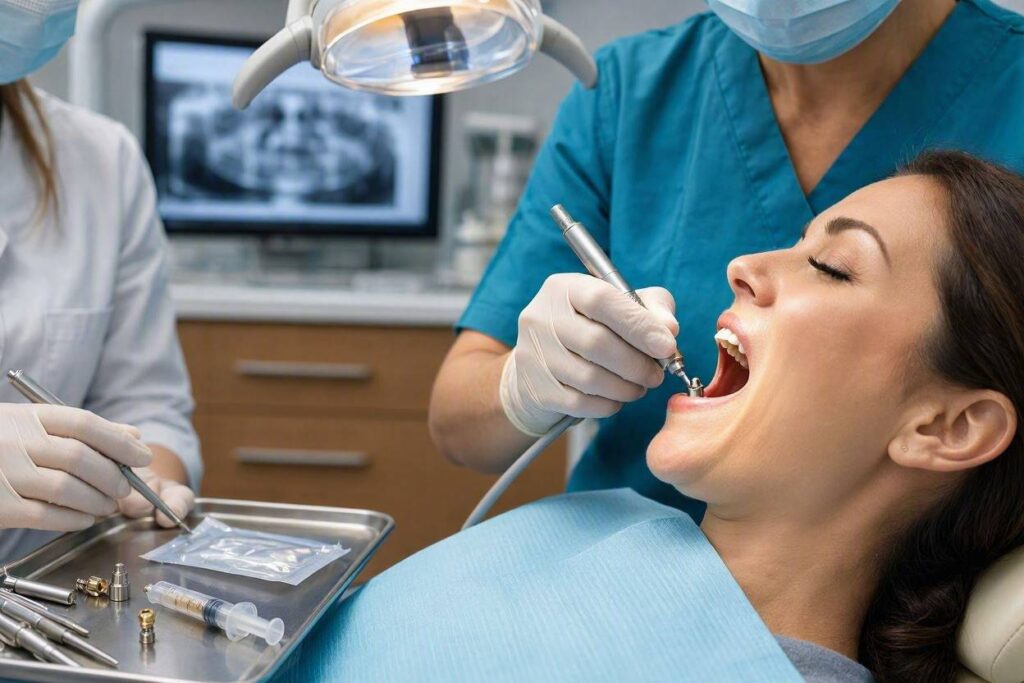
When you present with a loose-feeling implant, the dentist follows a structured diagnostic protocol. The first step is visual inspection. The dentist looks for a visible gap between the crown and the gum, exposed metal of the abutment, or any crack or fracture in the crown material. Magnification loupes and a bright dental light reveal details invisible to the naked eye.
The second step is palpation and percussion. The dentist uses the handles of two instruments to apply gentle, alternating lateral pressure to the crown. They feel for movement, listen for a clicking sound, and assess whether the movement is at the crown level, the abutment level, or deeper. A characteristic ringing sound when the implant is tapped, different from the duller sound of a natural tooth, indicates a healthy, osseointegrated implant. A dull thud or a mobile sensation indicates a problem.
The third step is radiographic evaluation. A periapical radiograph, an X-ray that shows the entire implant from tip to crown, is essential. The dentist examines the bone-implant interface for the dark halo of a radiolucency that indicates bone loss or fibrous encapsulation. They look for a gap between the abutment and the implant platform, which can indicate a loose screw even if the components appear to be seated. They check the bone levels around the implant threads and compare them to previous radiographs. A healthy implant shows bone in intimate contact with the implant surface, with stable bone levels over time.
Fixing the Loose Crown: Recementation
If the diagnosis is a debonded crown and the implant and abutment are stable, the fix is straightforward. The dentist removes the crown, if it has not already come off, and cleans the intaglio surface—the inside of the crown—and the abutment surface of all residual cement. The surfaces are inspected for damage. If the crown and abutment are intact, the crown is recemented with a definitive dental cement.
The choice of cement is clinically significant. Temporary cement allows for retrievability but is more likely to wash out and debond again. Permanent resin cement provides a stronger bond but makes future removal more difficult. Many implant dentists prefer a semi-permanent cement that balances retention with retrievability. The abutment and crown are isolated, dried, and the cement is applied sparingly. Excess cement is meticulously removed from the margin, as retained cement below the gum line is a known cause of peri-implantitis.
If the crown is fractured or the abutment is damaged, simple recementation is not possible. A new crown, and possibly a new abutment, must be fabricated. The implant remains healthy, and the restoration is replaced. This is a prosthetic replacement, not an implant salvage procedure.
Fixing the Loose Abutment Screw: Retightening
If the diagnosis is a loose abutment screw, the repair is performed through the screw access hole. The dentist locates the access hole on the biting surface or the lingual surface of the crown. The composite or acrylic filling material that seals the hole is removed, exposing the head of the abutment screw.
The dentist visually inspects the screw head for damage, such as a stripped hex socket. If the screw head is intact, the dentist engages the screw driver with the screw head and tightens it to the manufacturer’s specified torque value using a calibrated torque wrench. The torque value, typically 20 to 35 Newton-centimeters, is specific to the implant system and the screw material. Under-torquing leaves the joint vulnerable to future loosening. Over-torquing can strip the threads or, in the case of zirconia or gold screws, cause the screw to fracture.
If the screw is fractured, the repair becomes significantly more complex. The fractured fragment of the screw remains deep in the implant body, below the level of the abutment. Retrieving a fractured screw requires specialized kits with reverse-threaded extractors and ultrasonic vibration to loosen the fragment. The procedure is delicate and time-consuming. If the fragment cannot be retrieved, the implant may be rendered unrestorable. A new abutment screw is placed after the fragment is successfully removed, and the crown is retorqued.
After the screw is retightened to the specified torque, a new sealing material is placed in the access hole to protect the screw head from the oral environment. The occlusion is checked carefully. The dentist may adjust the biting surface to reduce the forces on the implant crown and prevent recurrent loosening. A patient who repeatedly loosens the abutment screw may need a night guard to protect against bruxism, or a redesign of the occlusion to distribute forces more favorably.
When Screw Loosening Becomes Recurrent
A single episode of abutment screw loosening that is corrected and does not recur is a minor mechanical event. Recurrent loosening, where the screw loosens again months after retightening, signals an underlying problem. The implant may be in a biomechanically unfavorable position, subjected to excessive lateral forces. The abutment-implant connection may be worn or damaged. The occlusion may be poorly designed, with the implant crown bearing a disproportionate share of the chewing load.
The dentist must investigate the cause of recurrent loosening. The abutment and the implant connection are inspected for wear, deformation, or damage. The occlusion is re-evaluated comprehensively, looking at how the teeth contact in centric occlusion and in all excursive movements. If the implant is overloaded, the occlusion is adjusted. If the abutment is damaged, it is replaced. If the implant connection is worn, the implant itself may be failing mechanically, even if it remains osseointegrated. In the most challenging cases, the crown and abutment are removed, the implant is evaluated, and a new custom abutment and crown are fabricated to redesign the load distribution.
The Loose Implant: When the Bone Interface Fails
True implant mobility, where the titanium post moves within the bone, is a terminal diagnosis. The bone-implant interface has been destroyed. No amount of tightening, recementing, or medication can restore osseointegration once it is lost. The implant must be removed.
The causes of implant mobility, as discussed in previous articles, include peri-implantitis, where bacterial infection progressively destroys the supporting bone; occlusal overload, where excessive chewing forces cause microfractures in the bone around the implant; and surgical failure, where the implant never achieved osseointegration in the first place. Regardless of the cause, the mobile implant is a foreign body in a failing site. It must be extracted to allow the site to heal and to prevent further bone destruction.
The removal of a mobile implant is often less traumatic than the removal of a well-integrated implant. Because the bone-implant interface has already been disrupted, the implant may unscrew with minimal resistance. The surgeon uses a ratchet or a retrieval tool to reverse-torque the implant out of the bone. If the implant is fractured or the remaining bone attachment requires cutting, a trephine drill or a piezoelectric surgical device is used. The goal is to remove the implant with minimal additional bone loss.
After removal, the site is thoroughly debrided. Granulation tissue, inflammatory tissue, and any residual fibers of the failed interface are curetted out. The bony defect is inspected. If the defect is large, a bone graft may be placed to preserve the ridge volume for future implant placement. The site heals for several months. After healing, the patient and surgeon reassess. A new implant may be planned, or the patient may transition to a different tooth replacement option.
⚠️ The Critical Warning Sign
Do not delay evaluation of a loose-feeling implant. A loose abutment screw left untreated can lead to screw fracture, a far more complex and costly repair. A loose implant, even if painless, is actively losing bone. The sooner the failing implant is removed, the more bone is preserved for future reconstruction. What starts as a minor annoyance can escalate into a major surgical problem if ignored.
Conclusion
The fixability of a loose dental implant depends entirely on the level of the mobility: a debonded crown is simply recemented, a loose abutment screw is retightened, but a mobile implant body represents a terminal failure of osseointegration and must be removed. Prompt professional evaluation at the first sign of movement is the most effective strategy for preserving the implant and minimizing the cost and complexity of repair. Distinguishing between these three clinical scenarios transforms a frightening symptom into a manageable treatment plan.
Frequently Asked Questions
Q: Can I tighten my loose implant crown myself?
A: No. You do not have the specialized torque wrench calibrated to the manufacturer’s specifications, and you cannot see the condition of the screw or the implant connection. Attempting to tighten the screw with a household tool can strip the screw head, fracture the screw, or damage the implant connection, turning a simple retightening into a complex salvage procedure. See your dentist immediately.
Q: How long can a loose abutment screw wait before being treated?
A: A loose abutment screw should be treated as soon as possible, ideally within days of noticing the mobility. The micro-movement of the loose components can cause wear of the implant-abutment connection, fatigue of the screw, and eventually screw fracture. A screw that could have been simply retightened today may fracture tomorrow, requiring a far more difficult and expensive retrieval procedure.
Q: Will a loose implant cause pain?
A: Not necessarily. A loose abutment screw may cause gum tenderness due to soft tissue irritation but is often painless. A failing implant may be painless in the early stages, which is why regular radiographic monitoring is essential. Pain, when it occurs, often signals an acute infection or advanced bone loss.
Q: After a failed implant is removed, how long must I wait before getting a new implant?
A: The waiting period depends on the size of the defect and whether a bone graft was placed. A small defect with no graft may heal in three to four months. A large defect with a significant bone graft may require six to nine months of healing before the site is ready for a new implant. The surgeon evaluates bone maturity with a CBCT scan before scheduling the new implant surgery.
Additional Resource:
For clinical information on implant complications, visit the Academy of Osseointegration: https://osseo.org/