Can Lower Dental Implants Be Relined?
You have a lower denture that snaps onto dental implants. For years, it has served you well, restoring your ability to chew and smile with confidence. Lately, however, something has changed. The denture feels loose. It rocks slightly when you chew. The once-snug fit against your gums has developed gaps. Food sneaks underneath. You recall that when you had traditional dentures years ago, the dentist periodically relined them to restore the fit. The question naturally arises: can this implant-supported lower denture be relined, or does the presence of the implants change the rules entirely?
The answer is yes, a removable implant-supported lower overdenture can be relined, and this procedure is a routine, expected part of the long-term maintenance of this type of restoration. The relining process restores the intimate fit between the denture base and the changing contours of your gum tissue and underlying bone. However, the presence of the implant attachments—the locator caps, the ball abutments, or the bar—adds complexity to the reline procedure that a conventional denture reline does not involve. The dentist must work around the attachments, ensuring that the reline material does not lock the denture onto the implants or interfere with the precision of the connection.
This guide explains everything you need to know about relining an implant-supported lower overdenture. We will distinguish between the different types of implant overdentures and how the attachment system affects the reline process. We will describe the chairside and laboratory reline procedures, the materials used, and the typical costs. We will also address the crucial distinction: a removable overdenture is relined, but a fixed, screw-retained implant bridge is not. The maintenance pathways for these two fundamentally different types of implant restorations diverge completely.
The Overdenture: A Removable Prosthesis on a Changing Foundation
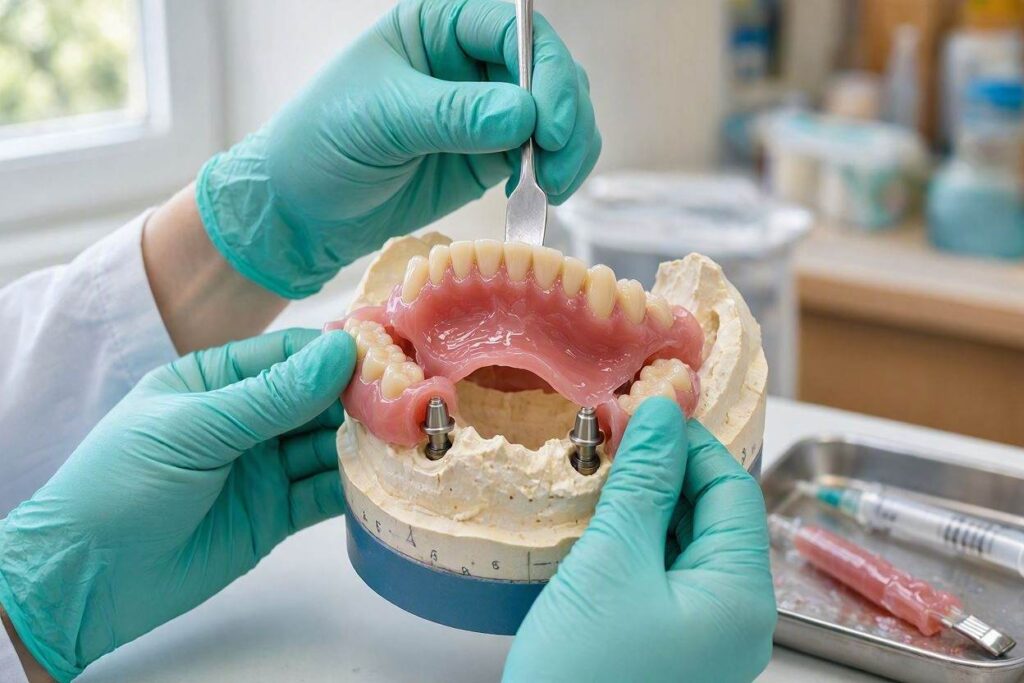
A lower implant overdenture is a removable prosthesis. The patient takes it out at night, cleans it, and re-inserts it in the morning. It is retained by attachments that connect to two, three, or four implants in the lower jaw. The most common attachment systems are locator abutments, which are small, low-profile connectors with a male nylon insert in the denture that snaps onto a female abutment on the implant, and bar attachments, where a custom-milled metal bar connects the implants and a clip mechanism in the denture engages the bar.
The denture base is typically fabricated from acrylic resin, the same material used for conventional dentures. It rests on the residual ridge, the bony and soft tissue foundation of the lower jaw. This foundation is not static. Bone resorbs slowly but continuously over the years after tooth extraction. The rate of resorption in the lower jaw, while slower with implants than with a conventional denture because the implants provide some stimulation to the bone, is not zero. The bone continues to remodel, and the overlying gum tissue changes in contour and thickness.
As the ridge resorbs, the denture base, which was fabricated to fit the ridge precisely at the time of delivery, gradually loses its intimate contact. Gaps develop between the denture and the tissue. The denture rocks on the ridge, pivoting on the implant attachments. The patient compensates by using more adhesive, but the underlying problem is the dimensional change of the foundation. Relining restores the fit by adding a new layer of acrylic to the tissue-bearing surface of the denture, filling the gaps and re-establishing a stable, retentive base.
The Reline Procedure: Chairside vs. Laboratory
There are two primary methods for relining an implant overdenture: the direct chairside reline and the indirect laboratory reline. The choice depends on the extent of the gap, the type of attachment, and the dentist’s preference.
The chairside reline uses a soft or hard reline material that is mixed and applied directly to the denture base in the mouth. The denture, with the attachments in place, is seated, and the patient bites down gently while the material sets. The material flows into the gaps and records the new tissue contours. The denture is removed, the excess material is trimmed, and the denture is polished. The chairside reline is faster and less expensive, typically completed in a single appointment. It works well for small to moderate gaps. The challenge with an implant overdenture is that the flowable reline material can encroach on the attachments, potentially entering the undercut of the locator abutment or flowing under the bar. The dentist must carefully block out the attachments with wax or a silicone barrier before applying the reline material to prevent the denture from locking onto the implants.
The laboratory reline is a more precise and durable procedure. The dentist takes an impression of the residual ridge with the denture itself serving as the impression tray. Reline impression material is placed in the denture base, and the denture is seated in the mouth. The patient bites down, and the material sets, capturing an accurate impression of the ridge and the relationship of the attachments. The denture is sent to a dental laboratory, where a technician pours a model, blocks out the attachments, and processes a new acrylic base onto the existing denture. The laboratory reline produces a denser, more dimensionally stable, and longer-lasting result. It is more expensive and requires the patient to be without the denture for several days. The dentist may provide a temporary soft liner or ask the patient to manage without the prosthesis briefly.
The Role of the Attachments During Relining
The implant attachments are the critical variable that distinguishes an implant overdenture reline from a conventional denture reline. The attachments must remain fully functional after the reline. The nylon locator inserts or the bar clips must still engage with the abutments or bar with the correct retention. The reline material must not alter the path of insertion or the seating of the denture.
Before the reline, the dentist evaluates the attachments. The nylon locator inserts wear over time and lose retention. A patient who complains of a loose denture may have a combined problem: ridge resorption causing a poor tissue fit, and worn locator inserts causing a loss of mechanical retention. The dentist must diagnose both components. Relining the denture will improve the tissue fit, but if the locator inserts are worn, the denture will still feel loose because the mechanical snap is weak. Often, the inserts are replaced at the same appointment as the reline. The inserts are inexpensive, typically $20 to $40 each, and their replacement adds little to the overall procedure cost.
For bar-retained overdentures, the bar clip or the metal housing embedded in the denture base can wear, fracture, or lose its spring tension. A reline may be an opportunity to replace the clip assembly. The laboratory reline procedure can incorporate a new clip into the processed acrylic base. A chairside reline cannot easily replace an embedded bar clip. The laboratory pathway is generally preferred for bar-retained overdentures because of the precision required.
Fixed Implant Bridges: Why They Cannot Be Relined
A fixed, screw-retained implant bridge, such as an All-on-4 restoration, is an entirely different type of prosthesis from a removable overdenture. The bridge is screwed directly into the implants. The patient does not remove it. The bridge does not rest on the gum tissue for support; it is supported entirely by the implants. The underside of the bridge, the intaglio surface, is designed to sit slightly off the gum tissue, creating a space that can be cleaned with a water flosser or specialized brushes.
This type of bridge cannot be relined in the conventional sense. There is no denture base to add material to. If the bridge develops gaps between the prosthesis and the gum tissue due to bone resorption, the gap is not addressed by relining. The gap is a consequence of the bone loss, and if it becomes aesthetically unacceptable or traps excessive food, the bridge itself must be replaced with a new prosthesis that re-establishes the proper contours.
The maintenance of a fixed implant bridge involves professional removal, cleaning of the implant surfaces and the intaglio of the bridge, and retightening of the screws. The bridge is a long-term but finite restoration with a service life of 10 to 20 years. At the end of its service life, it is replaced, not relined. The costs of replacement should be factored into the long-term financial plan for fixed implant restorations.
The Cost of Relining an Implant Overdenture
The cost of relining a lower implant overdenture varies based on the type of reline, the number of implants, the attachment system, and the geographic location of the dental practice. Relining an implant overdenture generally costs more than relining a conventional denture because of the additional time and skill required to manage the attachments.
A chairside reline for an implant overdenture typically ranges from $200 to $500 per arch. This includes the reline material, the block-out of the attachments, and the chair time. Replacement locator inserts, if needed, are additional, typically $20 to $40 per implant.
A laboratory reline typically ranges from $400 to $800 per arch. This includes the impression, the laboratory processing of the new acrylic base, and the delivery appointment. Replacement clips or locator inserts processed into the new base are additional laboratory charges. The laboratory reline provides a more durable and precise result and is generally recommended for overdentures with significant ridge resorption or bar attachments.
Dental insurance, including plans that cover implant services, may or may not cover relining. The procedure code for a reline of a complete denture is D5750 for a laboratory reline and D5730 for a chairside reline. These are classified as basic or major services depending on the plan. Some plans cover one reline per arch every two to five years. Others consider relining a maintenance procedure and do not cover it. A pre-treatment estimate, submitted to the insurer before the reline is performed, will provide the exact coverage determination.
When Relining Is Not Enough
A reline restores the tissue fit of an overdenture, but it cannot correct every problem. If the denture teeth are severely worn, the denture base is cracked or degraded, or the vertical dimension of occlusion—the bite height—has been lost due to years of tooth wear, a reline is a temporary patch on a failing prosthesis. The patient may need a complete replacement of the overdenture.
The decision to reline or replace depends on a thorough clinical evaluation. The dentist assesses the condition of the denture teeth, the integrity of the denture base, the fit of the attachments, and the health of the underlying tissues. A reline is a cost-effective solution when the denture base and teeth are in good condition and only the tissue fit has degraded. A replacement is indicated when the prosthesis has reached the end of its service life. A well-made implant overdenture can last 7 to 15 years, with periodic relines extending its functional life. At some point, the cumulative wear and the ongoing ridge resorption make replacement the more prudent investment.
Conclusion
A removable lower implant overdenture can and should be relined periodically to restore the fit against the ever-changing residual ridge, with the chairside or laboratory procedure carefully managed to preserve the function of the locator or bar attachments. Fixed screw-retained implant bridges cannot be relined and must eventually be replaced when the tissue gap becomes problematic. The need for a reline should be distinguished from the separate issue of worn attachment inserts, and a comprehensive evaluation will determine whether a reline alone or a complete denture replacement is the better long-term value.
Frequently Asked Questions
Q: How often does an implant overdenture need to be relined?
A: The frequency varies with the individual’s rate of bone resorption. On average, an implant overdenture may require a reline every two to five years. Some patients with minimal resorption may go longer. A patient with aggressive bone loss may need more frequent relines. Regular dental checkups allow the dentist to monitor the fit and recommend a reline when the gap becomes clinically significant.
Q: Can I reline my implant overdenture at home with a drugstore reline kit?
A: This is strongly discouraged. Over-the-counter soft reline kits are designed for temporary emergency use on conventional dentures. They are not formulated to work around implant attachments. The material can flow into the attachments, lock the denture onto the implants, or cause a chemical reaction with the nylon inserts. Attempting a home reline on an implant overdenture can damage the attachments and create a situation that is more expensive to repair than a professional reline.
Q: Will a reline change how my denture snaps onto the implants?
A: A properly performed reline should not change the retention of the attachments, assuming the inserts are in good condition. The reline material adds thickness to the tissue-bearing surface, which can slightly alter the vertical position of the denture. The dentist accounts for this by relieving the attachment housings slightly if needed. If the retention changes after a reline, the dentist can adjust the inserts or the denture base.
Q: Does Medicare or Medicaid cover implant overdenture relines?
A: Medicare does not cover dental procedures, including denture relines, unless they are part of a covered medical procedure such as jaw reconstruction. Medicaid adult dental coverage varies by state. States that cover dentures typically also cover relines, but with frequency limitations. Check your state’s Medicaid dental fee schedule for codes D5730 and D5750. If the state covers implants and overdentures, it likely covers relines, but this is a rare combination of benefits.
Additional Resource:
For patient education on implant overdenture care, visit the American College of Prosthodontists: https://www.gotoapro.org/