Can You Get Veneers With Implants?
The pursuit of a perfect smile often involves a combination of different cosmetic and restorative dental treatments. Two of the most popular options are dental veneers and dental implants. They are both powerful tools, but they serve very different purposes. This leads to a common and intelligent question: Can you get veneers with implants?
The short answer is yes, you can have both in your mouth, but you cannot put a traditional veneer on a dental implant. They are different restorations designed for different situations. Understanding this distinction is key to planning your smile makeover.
This guide will clarify the roles of veneers and implants, explain how they can work together in a comprehensive treatment plan, and explore the alternatives for covering an implant crown to match your other teeth.
Understanding the Tools: Veneers vs. Implants
To understand why you cannot put a veneer on an implant, you first need to understand what each one is designed to do.
What is a Dental Veneer?
A dental veneer is a thin, custom-made shell, almost always made of porcelain, that is designed to cover the front surface of a natural tooth. Think of it as a false fingernail for your tooth.
- Its Purpose: A veneer is a cosmetic solution. It changes the color, shape, size, or length of a tooth. It is used to fix issues like stains, chips, small gaps, or slightly crooked teeth.
- Its Foundation: A veneer requires a natural tooth structure underneath it. The dentist removes a very small amount of enamel (about half a millimeter) from the front of the tooth to make room for the veneer, which is then bonded to the tooth. The tooth root is still alive and healthy.
What is a Dental Implant Crown?
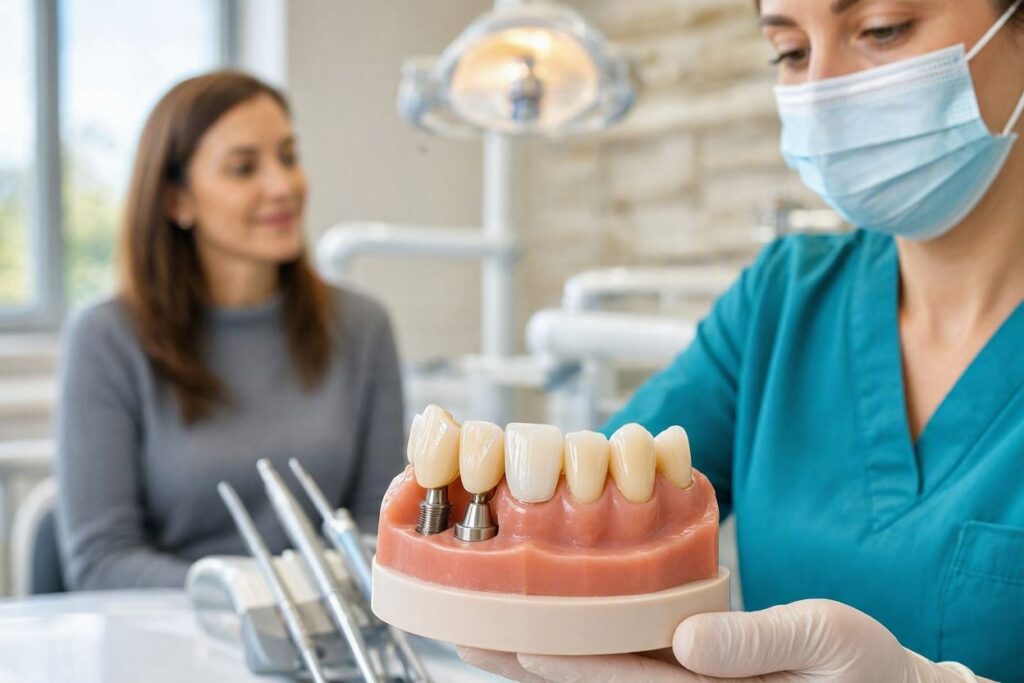
A dental implant replaces a missing tooth. The implant itself is a titanium post that goes into the bone. The part you see is called an implant crown.
- Its Purpose: An implant crown is a restorative solution. Its primary job is to replace a missing tooth and restore function (chewing) and aesthetics.
- Its Foundation: An implant crown is attached to an abutment, which is connected to the titanium implant in the bone. It does not sit on a natural tooth.
This is the fundamental difference. A veneer is a shell for an existing tooth. An implant crown is a replacement for a missing tooth. They are not interchangeable.
Why Can’t You Put a Veneer on an Implant?
The simple answer is that a veneer needs a tooth to stick to, and an implant crown is not a tooth.
There is no natural enamel to etch and bond the veneer to. The implant crown is a solid piece, typically made of porcelain or zirconia, that is designed to withstand the full force of chewing on its own. It is not a foundational structure; it is the final product.
Trying to bond a thin piece of porcelain to the front of an implant crown would create a weak, fragile structure that would likely fail. The interface would be a point of weakness, prone to chipping, staining, and fracture.
The Real Question: How Do Veneers and Implants Work Together?
While you cannot put a veneer on an implant, it is very common to have both veneers and implants in the same mouth as part of a larger smile makeover. This is where the treatment gets exciting.
Imagine a scenario where you have several teeth that are stained, worn, or misshapen, and you also have a missing tooth. A comprehensive treatment plan could involve:
- Dental Implant: To replace the missing tooth.
- Porcelain Veneers: Placed on the healthy, but aesthetically flawed, natural teeth surrounding the implant.
The goal is to create a seamless, uniform smile. The key to success here is the artistry of the dentist and the lab technician.
The Art of Matching
The biggest challenge in combining veneers and implant crowns is matching them perfectly. The veneers and the crown must look identical in color, translucency, shape, and texture. They must be indistinguishable from one another.
This is why the best time to get veneers is often after you have received your implant crown. Here is the ideal sequence for a combined treatment:
- Plan the Case: Your dentist will create a comprehensive plan using photos, X-rays, and digital smile design.
- Place the Implant: The implant is surgically placed and allowed to heal.
- Place the Implant Crown: Once the implant has integrated, the final crown is made and placed.
- Create the Veneers: Now, your dentist takes impressions and works with the lab to create veneers that are perfectly matched to the new implant crown. The lab can use the crown as a reference point for color and shape.
This sequence ensures the best possible match. If you get veneers first and then the implant, it can be more difficult to create a crown that perfectly matches the veneers.
Here is a table comparing the two restorations:
| Feature | Porcelain Veneer | Implant Crown |
|---|---|---|
| What It Treats | Aesthetics of an existing tooth. | A missing tooth. |
| Foundation | Natural tooth structure (enamel). | Titanium implant in the bone. |
| Function | Cosmetic enhancement. | Restorative replacement. |
| Can One Be Placed on the Other? | No. | No. (A veneer cannot go on a crown). |
| Commonality | Often used for “smile makeovers.” | Used for single or multiple tooth replacement. |
What Are the Alternatives for a Discolored or Misshapen Implant Crown?
What happens if you already have an implant crown, and years later, it starts to look dull, stained, or you simply don’t like its shape anymore? You cannot cover it with a veneer, so what can you do?
The answer is simple: you replace the crown.
An implant crown is not designed to be refinished. If the aesthetics are no longer acceptable, the best and usually only solution is to have a new crown made.
- For a Screw-Retained Crown: This is a simple process. The dentist can unscrew the old crown, take an impression, and have a new one made. The implant and abutment are not disturbed.
- For a Cemented Crown: The dentist will need to carefully cut and remove the old crown to avoid damaging the underlying abutment. A new impression is then taken, and a new crown is made.
Conclusion
To answer the question directly: No, you cannot get a traditional veneer on a dental implant. A veneer requires a natural tooth structure to bond to, while an implant crown is a standalone replacement tooth.
However, the concepts are not mutually exclusive. A beautiful, comprehensive smile makeover often involves using dental implants to replace missing teeth and porcelain veneers to enhance the surrounding natural teeth. The key to a stunning result is meticulous planning and the artistic skill to match the implant crowns and veneers seamlessly. If you are dreaming of a new smile, talk to a skilled cosmetic dentist about how these two powerful treatments can be combined to achieve your goals.
Frequently Asked Questions
Can you put a veneer on a dental bridge?
No, for the same reason you cannot put one on an implant crown. A bridge is a solid prosthetic. To change its appearance, you would need to replace the entire bridge. You can, however, get veneers on the natural teeth adjacent to a bridge to help it blend in better.
Is an implant crown more expensive than a veneer?
Yes, significantly. An implant crown involves the cost of the surgery to place the implant, the abutment, and the crown itself. A veneer is a less invasive procedure that only involves preparing a natural tooth and bonding a thin shell to it.
Can I whiten my implant crown with teeth whitening?
No. Teeth whitening products only work on natural tooth enamel. They will not change the color of porcelain or zirconia. If your natural teeth are yellowing and your crown is not, you can whiten your natural teeth and then have a new, lighter crown made to match.
How do I find a dentist who can match veneers and implants well?
Look for a dentist with advanced training in cosmetic and restorative dentistry, such as a prosthodontist or a member of the American Academy of Cosmetic Dentistry. Ask to see before-and-after photos of cases they have completed that involved both veneers and implants.
Additional Resource
For more information on the art and science of cosmetic dentistry, you can visit the American Academy of Cosmetic Dentistry’s patient education website: https://aacd.com/