Can You Have Partial Dental Implants?
The term “partial dental implants” appears frequently in patient searches and casual conversation about tooth replacement. However, the phrase can mean different things depending on context. Understanding what partial dental implants actually refer to helps patients communicate effectively with dental professionals and explore appropriate treatment options.
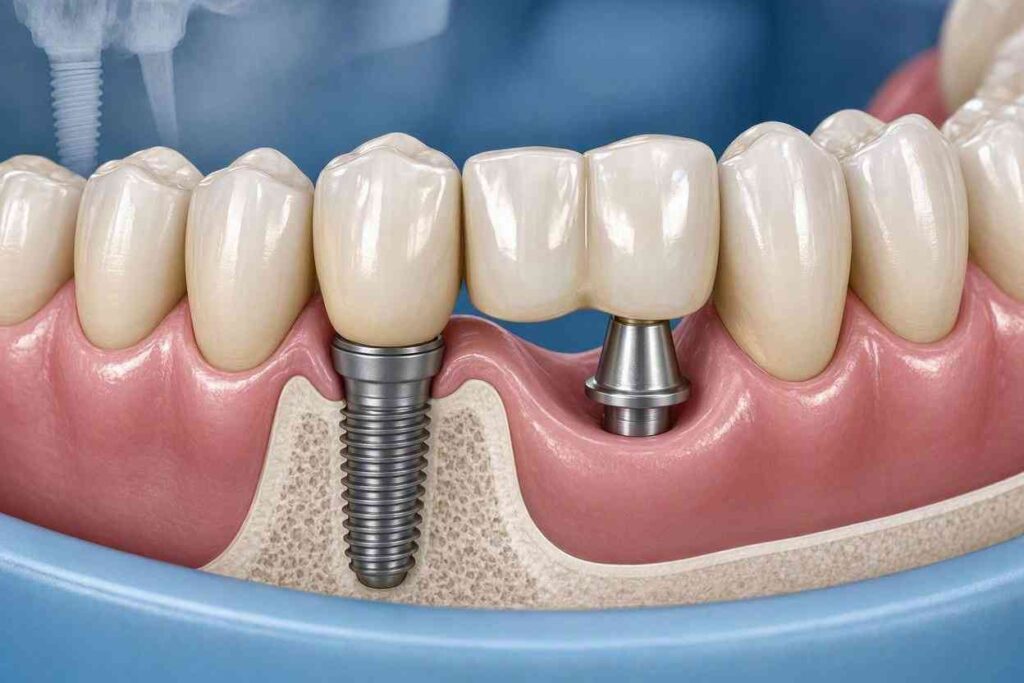
You can have partial dental implants in the sense that you can replace some, but not all, of your teeth with dental implants. This typically takes the form of implant-supported partial dentures, implant-supported bridges, or individual implants for specific missing teeth. The term “partial implant” sometimes refers to mini implants or shorter implants, but in standard dental terminology, there is no such thing as a partial implant post. The implant itself is a complete titanium fixture; it is the restoration that may be partial.
Understanding the Terminology
Clarifying what “partial dental implants” means in different contexts prevents confusion and helps patients make informed decisions.
What “Partial” Refers To
The word “partial” in relation to dental implants can describe:
The Extent of Tooth Replacement:
You are only replacing some of your teeth with implants, not having every tooth in your mouth replaced with individual implant-supported crowns. This is the most common usage and simply means partial tooth replacement using implants.
The Type of Prosthesis:
An implant-supported partial denture replaces multiple missing teeth in an arch where some natural teeth remain. This differs from a complete implant-supported denture that replaces all teeth.
The Implant Size:
Mini dental implants (MDIs) or short implants are sometimes colloquially called “partial implants” because they have smaller dimensions than standard implants. This is not a formal dental term.
What Does Not Exist:
There is no implant that is literally partial in the sense of being incomplete or temporary. All dental implants are complete fixtures designed for permanent placement. An implant is either placed and integrated or it is not; there is no “partial” placement.
Common Treatment Scenarios
When patients ask about partial dental implants, they typically mean one of several specific treatment approaches.
Individual Implants for Specific Missing Teeth:
One or more single-tooth implants replace specific missing teeth while natural teeth remain in other positions. This is the most common form of implant treatment and certainly qualifies as “partial” tooth replacement.
Implant-Supported Fixed Bridges:
Two or more implants support a bridge replacing multiple adjacent missing teeth. This approach replaces a segment of missing teeth while leaving natural teeth elsewhere in the arch.
Implant-Retained Partial Dentures:
Implants provide stability and retention for a removable partial denture. The partial denture replaces missing teeth, and the implants ensure it stays securely in place.
Implant-Supported Partial Dentures
This treatment combines traditional partial denture design with implant retention for dramatically improved stability and function.
How Implant-Retained Partial Dentures Work
A removable partial denture replaces multiple missing teeth in an arch where some natural teeth remain. Traditionally, these appliances rely on clasps that grip remaining teeth and rest on gum tissue. This mechanical retention is often inadequate, particularly for lower partial dentures.
Adding implants transforms the experience. One to three strategically placed implants provide secure attachment points for the partial denture. The denture snaps onto these implants using attachments (locators, ball attachments, or bars). The result is a partial denture that stays firmly in place during eating and speaking.
Candidate Requirements:
Sufficient bone for implant placement at strategic locations. Adequate space for implant attachments within the partial denture design. Commitment to maintaining both the implants and the removable prosthesis.
Cost of Implant-Retained Partial Dentures
Combining implants with a partial denture costs less than replacing every missing tooth with individual implants.
| Component | Cost Range |
|---|---|
| Diagnostic Workup and Planning | $300 – $800 |
| Implant Placement (1-3 implants) | $1,500 – $4,500 per implant |
| Implant Attachments | $400 – $800 per attachment |
| Partial Denture Fabrication | $1,500 – $3,500 |
| Total Estimated Range | $4,000 – $15,000+ |
The number of implants and the complexity of the partial denture determine where your case falls within this range. Compared to individual implants for every missing tooth (which might cost $25,000-$40,000+ for multiple teeth), the implant-retained partial denture offers significant savings.
Advantages Over Traditional Partial Dentures
Traditional removable partial dentures have several limitations that implant retention addresses.
Stability During Function:
Implant-retained partials do not shift or loosen during eating. Patients report dramatically improved ability to eat a wider variety of foods.
Preservation of Supporting Teeth:
Traditional partial denture clasps place stress on supporting natural teeth, potentially loosening them over time. Implant retention reduces or eliminates reliance on tooth support.
Reduced Bulk:
The metal framework of a traditional partial denture covers significant gum and palate area to distribute forces. Implant retention allows for reduced framework coverage, improving comfort and taste sensation.
Bone Preservation:
Implants stimulate the jawbone at their placement sites, reducing the bone resorption that occurs beneath traditional partial dentures.
Implant-Supported Fixed Bridges
Fixed bridges on implants replace segments of missing teeth without the removability of partial dentures.
Cantilever and Multi-Unit Bridges
When multiple adjacent teeth are missing, implants at either end of the gap can support a bridge that replaces all the missing teeth in between. This approach requires fewer implants than individual replacement of each tooth.
Example Configurations:
Two missing teeth replaced by a bridge on two implants. Three missing teeth replaced by a bridge on two implants (with a pontic suspended between them). Four or more missing teeth replaced by a bridge on three or more implants.
The bridge is cemented or screwed onto the implants and is not removable by the patient. This provides the most natural feel and function.
Cost Considerations for Implant Bridges
Implant-supported bridges reduce the per-tooth cost compared to individual implants.
| Configuration | Cost Range |
|---|---|
| Two Implants + Two-Unit Bridge | $8,000 – $16,000 |
| Two Implants + Three-Unit Bridge | $9,000 – $18,000 |
| Three Implants + Four-Unit Bridge | $13,000 – $24,000 |
| Four Implants + Full-Arch Bridge | $15,000 – $30,000 |
A bridge on two implants replacing three teeth might cost $14,000, or approximately $4,667 per replaced tooth. Individual implants for those three teeth might cost $15,000-$21,000, or $5,000-$7,000 per tooth. The bridge approach reduces cost while providing excellent function.
Mini Dental Implants for Partial Tooth Replacement
Mini dental implants represent a specific implant type sometimes used for partial tooth replacement, particularly for implant-retained dentures.
What Mini Implants Are
Mini dental implants have a diameter of less than 3mm, compared to 3.5-6mm for standard implants. They are placed using a less invasive technique, often without incisions or sutures. Mini implants can often be loaded immediately with the prosthesis.
Appropriate Uses for Mini Implants:
Retention of lower complete dentures. Retention of partial dentures. Temporary support during standard implant healing. Replacement of very small teeth (lower incisors, upper lateral incisors) where standard implant dimensions are excessive. Patients with inadequate bone for standard implants who cannot undergo grafting.
Limitations of Mini Implants:
Lower long-term survival rates than standard implants. Less resistance to fracture. Limited restorative options (typically only ball attachments, not screw-retained crowns). Not suitable for areas of high biting force. Considered by many specialists as a compromise rather than a first-line treatment.
Cost of Mini Implant Treatment
Mini implants cost less than standard implants, making them an attractive option for budget-conscious patients.
Mini Implant Cost Per Implant: $500 – $1,500
Standard Implant Cost Per Implant: $1,500 – $3,000
The lower cost reflects the simpler implant component, less invasive placement technique, and shorter treatment time. However, the cost savings must be weighed against potentially lower long-term success rates and limited restorative options.
Single Tooth Implants as Partial Tooth Replacement
Individual implants replacing single missing teeth represent the most common form of partial implant treatment.
Strategic Tooth Replacement
Not every missing tooth requires replacement. Some patients choose to replace only specific teeth with implants while leaving other spaces, particularly when the missing teeth are not visible or do not significantly affect function.
Common Scenarios:
Replacing a visible front tooth with an implant while leaving a missing back tooth untreated. Replacing teeth that affect chewing function while accepting spaces that do not. Phased treatment where the most important teeth are replaced first, with others to follow as budget allows.
Staged Full-Mouth Rehabilitation
Patients who need or want multiple implants but cannot afford them all at once can pursue staged treatment. The most critical teeth are replaced first. Additional implants are placed in subsequent treatment phases as finances permit.
This approach allows patients to begin the implant process and enjoy some benefits immediately while working toward complete treatment over time. Communication with the treatment team about long-term goals ensures that initial implant placement does not compromise future treatment phases.
Advantages of Partial Implant Treatment
Pursuing implants for some but not all missing teeth offers practical benefits.
Preservation of Strategic Teeth
Implants placed in key positions preserve bone and function without the need for full-mouth treatment. Strategic implant placement may be all that is needed to significantly improve quality of life.
Cost Management
Partial implant treatment costs less than full-arch or full-mouth treatment. Patients address their most pressing needs while managing their budget. Payment can be spread across months or years as treatment phases are completed.
Preservation of Natural Teeth
By replacing only missing teeth with implants, healthy natural teeth are preserved without the preparation required for bridges. Partial implant treatment allows the patient to retain their natural dentition while filling the gaps that affect function or aesthetics.
Frequently Asked Questions
What are partial dental implants?
The term typically refers to replacing some but not all teeth with implants, often using implant-supported partial dentures or implant bridges. There is no such thing as a literal partial implant post.
Can I get just one dental implant?
Yes. Single-tooth implants are the most common implant procedure, replacing one missing tooth while leaving other teeth alone.
Are mini implants considered partial implants?
Some people refer to mini implants as “partial” because of their smaller size. Mini implants are complete implants but with narrower diameters than standard implants.
Is an implant bridge cheaper than individual implants?
Yes. An implant-supported bridge costs less than individual implants for each missing tooth because fewer implants are needed and fewer individual crowns are fabricated.
Can I add more implants later?
In most cases, yes. Staged implant treatment allows you to place implants gradually as budget allows. Discuss your long-term plan with your dentist so initial implant placement accommodates future treatment.
How many implants do I need for a partial denture?
Typically 1-3 implants provide excellent retention for a partial denture, depending on the number and location of missing teeth.
Are implant-retained partial dentures removable?
Yes. The partial denture snaps onto the implants for secure retention but can be removed by the patient for cleaning.
Additional Resources
For more information about partial dental implant treatment:
- American College of Prosthodontists: www.gotoapro.org
- American Academy of Implant Dentistry: www.aaid.com
- American Dental Association: www.ada.org