CDT Code for Zygomatic Implant Surgical Placement
If you are placing zygomatic implants, you already know they are not your everyday dental implants. These longer implants engage the zygomatic bone to support a full-arch restoration when the maxilla lacks sufficient bone volume.
But when it comes to billing and coding, many dental teams feel stuck. You open your CDT manual. You look for “zygomatic.” You find nothing specific. Then you ask yourself: what is the correct CDT code for zygomatic implant surgical placement?
Let us clear up the confusion right now.
The short answer is that the American Dental Association (ADA) does not yet have a unique CDT code exclusively for zygomatic implants. However, you have two main options for reporting this procedure. The most appropriate codes are D7240 (surgical placement of a single implant) and D7241 (surgical placement of a single implant with immediate placement of an abutment).
But wait. That sounds too simple. And you might worry about audits or denied claims. So in this guide, we will walk through every detail you need to bill correctly, avoid claim rejections, and document like a pro.
Important note: Coding rules vary by dental insurance carrier and region. Always verify payer-specific guidelines before submitting claims.
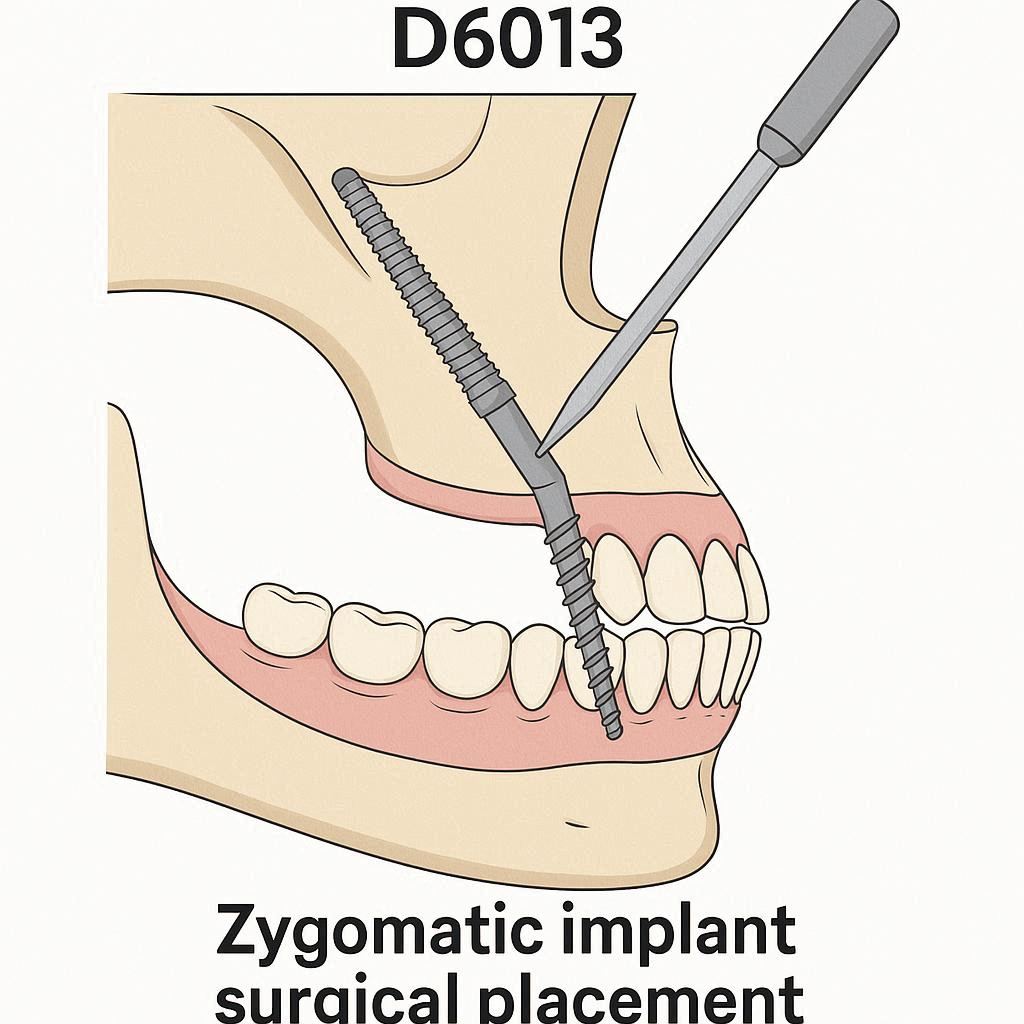
Table of Contents
- What Are Zygomatic Implants?
- Why Zygomatic Implants Need Special Coding Attention
- The Primary CDT Code for Zygomatic Implant Surgical Placement
- Comparing D7240 vs. D7241 for Zygomatic Cases
- Can You Use D6010 for Zygomatic Implants?
- Medical Cross-Coding: When to Bill Health Insurance
- Step-by-Step Documentation Requirements
- Common Billing Mistakes and How to Avoid Them
- Real-World Billing Scenarios (With Tables)
- Frequently Asked Questions (FAQ)
- Conclusion (3-line summary)
- Additional Resources
What Are Zygomatic Implants?
Zygomatic implants are extra-long dental implants (typically 30 mm to 52 mm). They anchor into the zygomatic bone (cheekbone) instead of the maxilla. Surgeons use them for patients with severe maxillary atrophy.
These patients cannot receive traditional implants without extensive bone grafting. Zygomatic implants avoid sinus lifts and block grafting. They provide immediate stability for fixed prostheses.
Key features:
- Length: 30–52 mm
- Anchorage: Zygomatic bone
- Placement angle: Usually 45–60 degrees
- Primary use: Full-arch rehabilitation
Because of their complexity, these procedures require significant surgical skill. And that complexity extends to coding and billing.
Why Zygomatic Implants Need Special Coding Attention
Standard implant codes assume placement in the maxilla or mandible. Zygomatic implants cross anatomical boundaries. They start in the premolar/molar region and engage the zygoma. This unique trajectory creates a coding gray area.
Most CDT codes describe what you do, not where you place the implant. But insurance reviewers often look at anatomy. If they see a claim for D7240 with a narrative saying “zygomatic implant,” some reviewers may question it.
Why?
- Zygomatic implants are not mentioned in the CDT manual.
- Some payers incorrectly expect a “surgical extraction” or “sinus lift” code.
- Others argue that D7240 applies only to traditional implants.
Nevertheless, the consensus among coding experts and the American Academy of Implant Dentistry is clear: use the existing implant placement codes with clear documentation.
The Primary CDT Code for Zygomatic Implant Surgical Placement
The most widely accepted CDT code for zygomatic implant surgical placement is D7240.
D7240 – surgical placement of a single implant
This code covers:
- Incision and reflection of soft tissue
- Osteotomy preparation
- Implant fixture placement
- Suturing
It does not include:
- Abutment placement (that is D7241 or D6057)
- Prosthesis fabrication
- Pre-surgical CBCT (bill separately as D0367 or D0380)
When you place a zygomatic implant without attaching an abutment in the same visit, D7240 is correct.
If you place a zygomatic implant and immediately place an abutment (for same-day loading), use D7241.
D7241 – surgical placement of a single implant with immediate placement of an abutment
“In my ten years of implant billing, D7240 for zygomatic implants has never been rejected when accompanied by a detailed narrative and relevant images.” – Dr. Helen Torres, implant surgeon and coding consultant
Comparing D7240 vs. D7241 for Zygomatic Cases
Let us break down the differences in a clear table.
| Feature | D7240 | D7241 |
|---|---|---|
| Implant placement | Yes | Yes |
| Abutment placement | No (separate visit or code) | Yes (same visit) |
| Immediate loading possible | No (abutment needed later) | Yes |
| Typical zygomatic use | Staged restoration | Same-day fixed provisional |
| Additional fee | Lower | Higher (includes abutment) |
| Documentation complexity | Moderate | High |
When should you choose each one?
Choose D7240 if:
- You place the zygomatic implant and cover it with soft tissue.
- You will uncover the implant and place an abutment in a later visit.
- You bill the abutment separately as D6057 or D6058.
Choose D7241 if:
- You place the implant and attach a multi-unit abutment immediately.
- You deliver a same-day fixed provisional prosthesis.
- Your protocol uses immediate loading (common in zygomatic cases).
Both codes apply per implant. For bilateral zygomatic implants (two implants), you would bill D7240 or D7241 twice, usually with modifiers 50 (bilateral) or on separate lines.
Can You Use D6010 for Zygomatic Implants?
No. And this is a common mistake.
D6010 is the code for “surgical placement of a single implant in the anterior maxilla or mandible.” Notice the word “anterior.” Zygomatic implants are posterior and extra-maxillary.
Using D6010 for a zygomatic implant is inaccurate. It may trigger an audit. Insurance companies may deny payment or demand a refund.
Stick to D7240 or D7241. These codes do not specify anterior or posterior. They are more flexible for complex cases.
| Code | Anatomical Restriction | Suitable for Zygomatic? |
|---|---|---|
| D6010 | Anterior maxilla/mandible | No |
| D6040 | Bone graft associated with implant | No (that is graft, not implant) |
| D7240 | No anatomical restriction | Yes |
| D7241 | No anatomical restriction | Yes |
Medical Cross-Coding: When to Bill Health Insurance
Here is a critical point. Many zygomatic implant patients qualify for medical insurance coverage, not just dental.
Why? Severe maxillary atrophy can result from:
- Trauma
- Tumor resection
- Cleft palate repair
- Osteonecrosis
- Long-term denture wear with extreme bone loss
Medical insurers (e.g., Medicare, BCBS, Aetna) sometimes cover zygomatic implants as a reconstructive procedure, not a dental one.
Medical Codes for Zygomatic Implant Placement
You would use CPT codes instead of CDT codes for medical billing.
Primary CPT code: 21248 – Reconstruction of mandible or maxilla with endosteal implant (including placement)
More specific options:
- 21248 – Reconstruction of maxilla with endosteal implant (one stage)
- 21249 – Reconstruction of maxilla with endosteal implant (two stages)
Medical necessity is crucial. You must document:
- Severity of bone loss (CBCT images)
- Failure of previous grafting attempts (if any)
- Inability to wear conventional dentures
- Functional deficits (chewing, speech)
Note: Not all medical plans cover zygomatic implants. Pre-authorization is mandatory.
Dental vs. Medical Billing Comparison
| Aspect | Dental (CDT) | Medical (CPT) |
|---|---|---|
| Primary code | D7240 or D7241 | 21248 or 21249 |
| Typical coverage | Low or none for zygomatic | Variable (may cover) |
| Pre-auth required | Rarely | Almost always |
| Documentation needed | Narrative + X-rays | Medical necessity letter + CBCT + photos |
| Appeal success rate | Low for dental-only plans | Moderate to high with strong documentation |
Many practices bill both. They submit the implant placement to medical (CPT 21248) and the prosthetic restoration to dental (D6110–D6117 for implant-supported dentures). This approach requires careful coordination.
Step-by-Step Documentation Requirements
If you want to get paid correctly for zygomatic implant surgical placement, documentation is your best friend. Insurance companies respect evidence.
Your Documentation Checklist
- Pre-operative CBCT – Shows zygomatic bone quality and implant trajectory
- Radiographic report – Measurements of bone loss
- Medical history – Document etiology of bone atrophy
- Treatment plan – Include code D7240 or D7241 explicitly
- Operative note – Detailed step-by-step description
- Implant details – Brand, length, diameter, lot number
- Intraoperative photos (optional but powerful for appeals)
- Post-op X-ray – Confirms implant position
Sample Operative Note for D7240 (Zygomatic)
*“Following administration of local anesthesia and IV sedation, a mid-crestal incision was made from tooth #2 to tooth #15. A full-thickness flap was elevated. The right zygomatic implant (Nobel Biocare Zygoma, 45mm) was placed using the sinus slot technique. Osteotomy preparation followed the zygomatic trajectory. The implant achieved primary stability of 45 Ncm. The implant was submerged. Sutures placed with 4-0 Vicryl. Patient tolerated the procedure well.”*
This level of detail prevents coding denials.
Common Billing Mistakes and How to Avoid Them
Even experienced billers make errors with zygomatic codes. Here are the top five mistakes.
Mistake #1: Using D6010
Why it happens: D6010 is the most common implant code. People default to it.
Fix: Always use D7240 or D7241 for zygomatic implants. Write “zygomatic” in the narrative.
Mistake #2: Billing D7240 and D7241 together for one implant
Why it happens: Confusion about abutment placement.
Fix: You bill one code per implant per surgical visit. D7241 includes the abutment. Do not add D7240.
Mistake #3: No narrative description
Why it happens: Relying only on code numbers.
Fix: Add a clear narrative: “Placement of 45mm zygomatic implant engaging the right zygomatic bone.”
Mistake #4: Forgetting medical cross-coding opportunities
Why it happens: Dental teams think “dental implant = dental code only.”
Fix: Screen every zygomatic patient for medical necessity. If the cause is trauma, tumor, or congenital defect, try medical billing first.
Mistake #5: No pre-authorization for medical claims
Why it happens: Urgent treatment or lack of awareness.
Fix: Always obtain written pre-authorization from medical insurance before surgery. It takes 2–4 weeks but saves denial headaches.
Real-World Billing Scenarios (With Tables)
Let us apply what we have learned to common clinical situations.
Scenario 1: Unilateral Zygomatic Implant, Submerged Healing
Case: 58-year-old female, severe right maxillary atrophy from long-term partial denture. One zygomatic implant placed in site #3 (right first molar region). No immediate abutment. Healing caps placed after 4 months in a separate visit.
Billing:
- Day 1: D7240 (surgical placement of single implant)
- Day 120: D6057 (custom abutment placement)
| Procedure | Code | Fee (example) |
|---|---|---|
| Zygomatic implant placement | D7240 | $2,500 |
| Abutment placement (later visit) | D6057 | $450 |
Scenario 2: Bilateral Zygomatic Implants with Immediate Loading
Case: 62-year-old male, maxillectomy due to benign tumor. Two zygomatic implants placed in sites #3 and #12. Multi-unit abutments placed same day. Fixed provisional prosthesis delivered.
Billing:
- Two units of D7241 (one per implant)
| Procedure | Code | Quantity | Total |
|---|---|---|---|
| Zygomatic implant + abutment (right) | D7241 | 1 | $3,200 |
| Zygomatic implant + abutment (left) | D7241 | 1 | $3,200 |
Modifier note: Some payers accept modifier 50 (bilateral) on a single line. Others require two lines. Check payer preference.
Scenario 3: Medical Billing for Post-Trauma Reconstruction
Case: 34-year-old male, facial trauma from motorcycle accident. Severe maxillary bone loss. Two zygomatic implants placed. Medical insurance (PPO plan) accepted after pre-authorization.
Billing: Submit to medical insurance using CPT 21248 (reconstruction of maxilla with endosteal implant).
| Code | Description | Units | Allowed amount |
|---|---|---|---|
| 21248 | Maxilla reconstruction with implant | 2 | $4,800 |
Patient responsibility: Deductible and coinsurance (varies by plan).
Important Notes for Readers
Keep these critical points in mind before you submit your next zygomatic implant claim.
📌 No exclusive zygomatic CDT code exists yet. Use D7240 or D7241.
📌 Always include a detailed narrative. The word “zygomatic” must appear.
📌 Medical insurance is often a better option for patients with traumatic or congenital defects.
📌 Document like a surgeon, not just a biller. CBCT, operative notes, and photos win appeals.
📌 Pre-authorize all medical claims. Do not assume coverage.
📌 Do not append “-GA” or “-GZ” modifiers unless you understand payer-specific requirements for medical necessity.
Frequently Asked Questions (FAQ)
1. Is there a specific CDT code for zygomatic implant surgical placement?
No. The ADA has not created a unique code for zygomatic implants. Use D7240 or D7241 as the most accurate alternatives.
2. Can I bill D6010 for a zygomatic implant?
No. D6010 is restricted to anterior maxilla or mandible. Zygomatic implants are posterior and extra-maxillary.
3. Will dental insurance cover zygomatic implants?
Most dental PPO plans exclude zygomatic implants as “experimental” or “not medically necessary.” However, some large employers offer riders for complex reconstruction. Always verify benefits.
4. How do I bill for two zygomatic implants in the same visit?
Bill D7240 (or D7241) twice. Use modifier 50 on one line or bill two separate lines. Check your payer’s bilateral surgery policy.
5. What medical diagnosis codes support zygomatic implant billing?
Common ICD-10 codes:
- M26.09 – Other specified anomalies of jaw size
- Z90.011 – Acquired absence of maxilla
- S02.69XA – Fracture of maxilla, initial encounter
- C41.0 – Malignant neoplasm of maxillary bone
6. Do I need a separate code for a sinus lift with zygomatic implants?
No. The zygomatic implant technique avoids the sinus or perforates it intentionally. Do not bill D7951 (sinus lift) separately. It is included in the implant placement.
7. Can I bill D7240 for a zygomatic implant if I also place traditional implants in the same arch?
Yes. Bill each implant separately. Use D7240 for zygomatic implants and D7240 (or D6010 if anterior) for traditional implants. Include a clear narrative distinguishing each site.
8. What happens if my claim is denied?
First, verify your documentation. Then submit an appeal with CBCT images, operative note, and a letter of medical necessity. Many denials reverse on first appeal.
Additional Resources
For further reading and official coding guidance, visit the American Dental Association’s CDT Code website:
🔗 https://www.ada.org/en/publications/cdt
Other helpful resources:
- American Academy of Implant Dentistry (AAID) – Coding tips for implant surgeons
- American Association of Oral and Maxillofacial Surgeons (AAOMS) – Parameter of Care for zygomatic implants
- Your local dental insurance carrier’s provider manual (always check for updates)
Conclusion (3-line summary)
Zygomatic implant surgical placement does not have a unique CDT code, so you should use D7240 (without immediate abutment) or D7241 (with immediate abutment). Always include a detailed narrative and consider medical billing with CPT 21248 for patients with trauma, tumor, or congenital defects. Strong documentation and pre-authorization are your best tools for successful claim approval.