The Real Cost of Dental Implants in Virginia: A Complete Guide for 2026
If you are missing one or more teeth, you have probably heard that dental implants are the gold standard for replacement. They look natural, feel secure, and can last a lifetime.
But there is one question that stops most people from moving forward: What is the real cost of dental implants in Virginia?
You might have seen wildly different numbers online. Some websites say $1,500 per implant. Others mention $6,000 or more. The truth is that both numbers can be correct, depending on your situation.
This guide gives you a clear, realistic, and honest breakdown of implant costs across Virginia. We will look at prices in Northern Virginia, Richmond, Virginia Beach, Roanoke, and rural areas. You will also learn about hidden fees, insurance options, and practical ways to save money without cutting corners on quality.
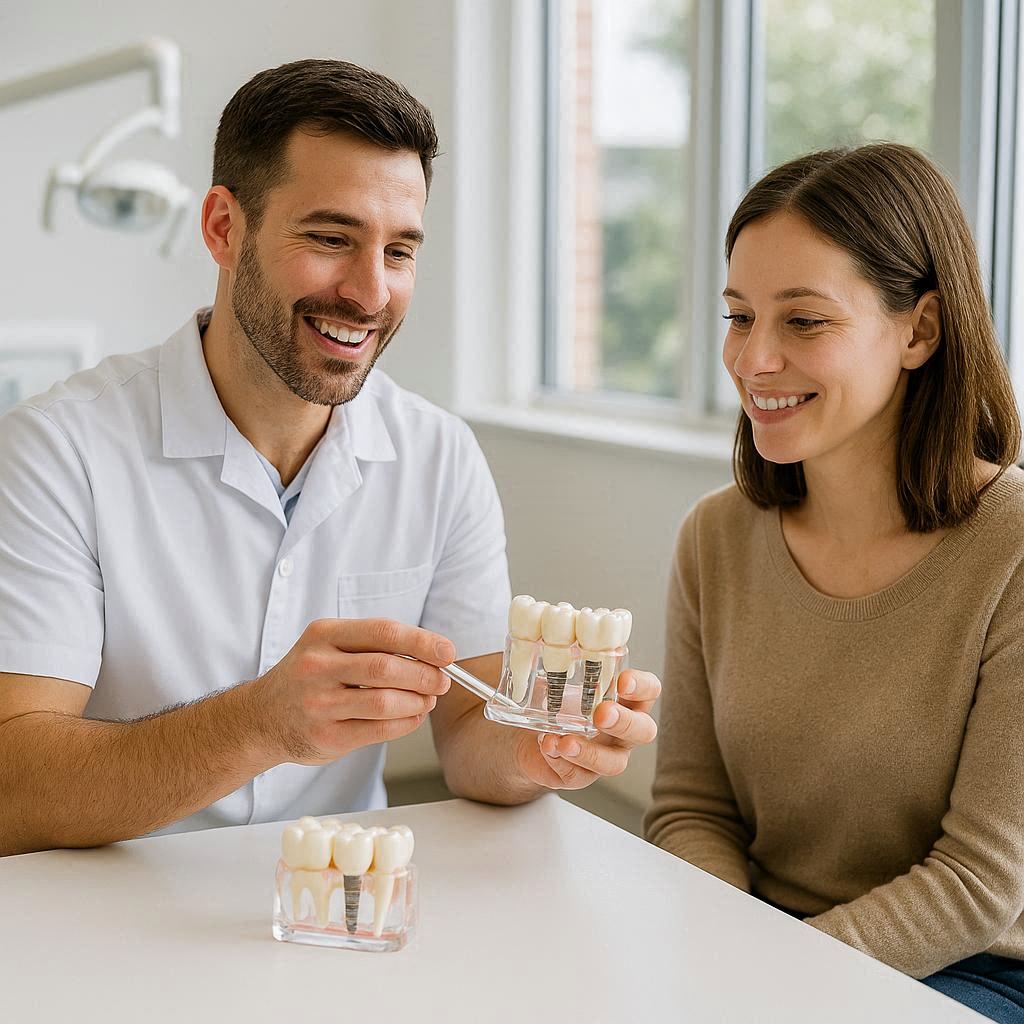
Why Dental Implant Costs Vary So Much in Virginia
Dental implants are not a single product. They are a medical procedure involving surgery, custom-made parts, and often multiple specialists. This is why the price range is so wide.
In Virginia, several key factors influence what you will actually pay.
Location within Virginia
A dental implant in Arlington or Alexandria will almost always cost more than the same procedure in Danville or Winchester. Northern Virginia has higher rents, higher staff salaries, and higher demand. Rural clinics often have lower overhead and can pass those savings to you.
The dentist’s training and experience
An oral surgeon or a periodontist (gum specialist) usually charges more than a general dentist who places implants. However, specialists also handle complex cases better. For a straightforward case with healthy bone, a skilled general dentist may be perfectly fine and more affordable.
The brand of the implant
Not all implants are the same. Premium brands like Straumann, Nobel Biocare, and Zimmer are more expensive. They have decades of research behind them. Some clinics use more affordable brands like Hiossen or Implant Direct. These can still be very reliable, but the price difference can be hundreds of dollars per implant.
Bone grafting and extractions
Many people do not realize that the quoted “implant price” often does not include preparing the site. If you have a tooth that needs to be pulled, that is an extra fee. If your jawbone is too thin or soft for an implant, you may need a bone graft. This can add $300 to $3,000 per site.
Type of restoration (crown, bridge, or denture)
The implant itself is the screw that goes into the bone. The part you see and chew with is called the abutment and crown. A single crown made of porcelain fused to metal is cheaper than a full-zirconia crown. For multiple implants supporting a bridge or denture, the prosthetic cost rises significantly.
Average Cost of Dental Implants in Virginia by Procedure Type
Let us look at real numbers. These are averages based on 2025-2026 data from dental clinics across Virginia, insurance claim records, and patient reports.
Important note: These prices do not include bone grafts, extractions, CT scans, or sedation. We will cover those separately.
| Procedure | Low-end estimate (rural VA) | Average cost (statewide) | High-end estimate (Northern VA) |
|---|---|---|---|
| Single implant (implant + abutment + crown) | $3,200 | $4,800 | $6,500 |
| Implant-supported bridge (3 units, 2 implants) | $6,500 | $9,000 | $12,000 |
| Implant-supported denture (lower or upper, 4 implants) | $12,000 | $16,000 | $22,000 |
| Full arch fixed bridge (All-on-4, per arch) | $15,000 | $20,000 | $28,000 |
| Full mouth implants (both arches, fixed) | $28,000 | $38,000 | $55,000 |
As you can see, the difference between a low-cost rural clinic and a premium Northern Virginia practice can be thousands of dollars. But lower price does not always mean lower quality. Some excellent clinics in places like Lynchburg or Staunton charge very fair prices.
Breaking Down the Hidden Costs: What Is Not Included
Many patients feel frustrated when they receive a final bill much higher than the advertised “implant special.” Let us demystify the extra fees.
Initial consultation and CT scan
Most clinics charge $150 to $350 for a comprehensive exam and a 3D CT scan. This scan is essential. It shows the dentist your bone density, nerve locations, and sinus position. You should never skip this step to save money.
Tooth extraction
If you still have a damaged tooth where the implant will go, removal costs $200 to $600 per tooth. Surgical extractions (impacted or broken teeth) cost more.
Bone grafting
This is the most common surprise fee. When a tooth is missing for months or years, the bone shrinks. A bone graft rebuilds that lost bone. Costs vary:
- Small socket graft after extraction: $300 – $800
- Larger graft using synthetic or donor bone: $800 – $2,000
- Major block graft from your own jaw: $2,500 – $4,000
Sinus lift
For upper back molars, the sinus cavity may be too close to the jawbone. A sinus lift raises the sinus floor and adds bone. This procedure adds $1,500 to $3,000 per side.
Sedation or anesthesia
Local anesthesia (numbing shots) is always included. But many patients want sedation for comfort. Options include:
- Oral sedative (pill): $150 – $300
- Nitrous oxide (laughing gas): $100 – $250 per hour
- IV sedation: $400 – $800 per hour
Temporary teeth
While your implant heals (3 to 6 months), you may want a temporary tooth for appearance. A removable flipper (partial denture) costs $300 to $800. A temporary fixed crown costs more.
Final crown material
The crown that goes on top of your implant comes in different materials:
- Porcelain fused to metal: most affordable, but metal may show at the gum line
- Lithium disilicate (e.g., E-max): excellent esthetics, mid-range price
- Zirconia: strongest, most natural looking, highest cost
Plan for a $300 to $800 difference between basic and premium crown materials.
Real Examples: What Patients Paid in Different Virginia Cities
Let us look at three realistic scenarios. These are based on actual patient experiences shared in dental forums and clinic reviews.
Scenario 1: Single implant in Richmond
Patient profile: Sarah, age 42. Missing a lower first molar. Healthy bone. No extraction needed.
- CT scan and consultation: $250
- Implant placement by general dentist: $1,800
- Healing period (4 months)
- Abutment and porcelain-fused-to-metal crown: $1,700
Total out-of-pocket: $3,750
Sarah’s dental insurance covered 30% of the crown and abutment but nothing for the implant surgery. She paid $2,950 after insurance.
Scenario 2: Two implants with bone graft in Northern Virginia
Patient profile: Mark, age 58. Missing two upper premolars for five years. Significant bone loss.
- Consultation and CT scan: $350
- Two extractions (old roots remaining): $500
- Bone graft for both sites: $1,600
- Two implants placed by periodontist: $4,400
- Healing (6 months)
- Two abutments and zirconia crowns: $2,800
Total: $9,650
Mark had no dental insurance. He used a clinic payment plan and paid $450 per month for 22 months.
Scenario 3: All-on-4 lower arch in Virginia Beach
Patient profile: James, age 67. Loose lower denture for years. Wants fixed teeth.
- Consultation, CT, and surgical guide: $850
- Four implants placed by oral surgeon: $6,000
- Bone grafting (mild deficiency): $1,200
- Temporary fixed bridge (healing phase): $1,500
- Final titanium-reinforced acrylic bridge: $7,500
Total: $17,050
James used a combination of CareCredit and savings. His Medicare (which does not cover implants) paid nothing. However, he saved compared to Northern VA prices, which often exceed $22,000 for the same procedure.
Does Insurance Cover Dental Implants in Virginia?
This is a sensitive topic because most dental insurance plans were not designed to cover implants. However, the situation is slowly improving.
Typical coverage reality
- Less than 15% of traditional dental plans cover any part of implant surgery.
- Many plans cover the crown (restoration) but not the implant fixture itself.
- If your tooth was extracted due to an accident, some medical insurance may contribute.
- Coverage is usually 30% to 50% for allowed procedures, with an annual maximum of $1,000 to $2,000.
How to check your insurance
Call your provider and ask these specific questions:
- Does my plan have a “missing tooth clause”? (If yes, they will not cover an implant for a tooth missing before the policy started.)
- Is the implant fixture covered, or just the crown?
- What is my annual maximum?
- Do I need a referral to a specialist?
Virginia Medicaid and implants
Virginia Medicaid (CoverVA) does not routinely cover dental implants for adults. Exceptions exist for medically necessary cases related to cancer surgery or congenital defects. For most low-income adults, implants remain out of reach under Medicaid. However, extractions and dentures are often covered.
Medical insurance possibilities
If you need implants because of a tumor, cyst, or traumatic facial injury, your medical insurance (not dental) may pay. Your oral surgeon’s office can help with a process called “medical necessity pre-authorization.”
Cheaper Alternatives to Dental Implants in Virginia
Not everyone is a candidate for implants. Some people have health conditions like uncontrolled diabetes or heavy smoking that make implants risky. Others simply cannot afford them right now.
Here are realistic alternatives with their pros and cons.
| Alternative | Average cost in Virginia | Durability | Best for |
|---|---|---|---|
| Removable partial denture | $700 – $1,800 | 5-8 years | Replacing several teeth on a budget |
| Full dentures (economy) | $800 – $2,000 | 5-7 years | Entire arch missing |
| Full dentures (premium) | $2,500 – $5,000 | 7-10 years | Better fit and appearance |
| Fixed bridge (traditional) | $2,500 – $5,000 per 3-unit | 10-15 years | One or two missing teeth with healthy adjacent teeth |
| Resin-bonded bridge (Maryland bridge) | $1,500 – $2,500 | 5-8 years | Front teeth with low bite force |
A traditional bridge is often the closest alternative to an implant. However, it requires shaving down healthy adjacent teeth. Many dentists now recommend saving those teeth and saving for an implant instead.
How to Find Affordable Dental Implants in Virginia Without Sacrificing Quality
You do not have to go to the most expensive clinic. But you should also never choose based on price alone. A failed implant costs more to fix than a properly done one from the start.
Dental schools in Virginia
Virginia has one excellent dental school that offers reduced fees:
Virginia Commonwealth University (VCU) School of Dentistry in Richmond
- Implant procedures performed by advanced students under specialist supervision.
- Prices are roughly 40% to 60% lower than private practices.
- A single implant might cost $1,800 to $2,500 total.
- Downside: Longer appointment times and more visits.
Nonprofit and sliding scale clinics
Some community health centers in Virginia offer dental care based on your income. While most do not place implants, they can perform extractions, bone grafts, and make dentures at low cost. Examples include:
- Greater Richmond Community Health Center
- Roanoke Community Health Center
- Eastern Shore Rural Health System
In-house membership plans
Many private Virginia dental offices now offer their own discount plans. You pay a flat yearly fee ($200 to $500) and receive 15% to 30% off all services, including implants. This is often better than traditional insurance for implants.
Ask clinics directly: Do you have an in-house membership or loyalty plan?
Travel within Virginia
Driving two hours can save you thousands. A patient living in McLean might pay $6,000 for a single implant. The same implant in Fredericksburg or Culpeper might cost $4,000. For full arch work, consider clinics in Roanoke, Lynchburg, or the Shenandoah Valley.
CareCredit and financing
CareCredit is the most widely accepted healthcare credit card. Many Virginia implant clinics offer 12 to 24 months of interest-free financing if you pay on time. Some also offer third-party loans through:
- LendingClub (patient solutions)
- Proceed Finance
- Alpine Bank (regional, offers dental loans)
Always read the terms. If you miss a payment, deferred interest can jump to 26% or more.
What to Look for in a Virginia Dental Implant Provider
Price matters, but skill matters more. Here is a simple checklist before you choose a clinic.
Credentials to verify
- Is the implant dentist a DDS or DMD? (Both are equivalent dental degrees.)
- Do they have advanced training in implantology? Look for AAID, ICOI, or ABOI certification.
- For complex cases, an oral surgeon or periodontist is safer.
Technology on site
Modern implant dentistry relies on technology that reduces risk. Ask if the clinic has:
- CBCT scanner (3D X-ray) – essential, not optional
- Intraoral scanner (digital impressions) – more comfortable and accurate
- Surgical guide (3D printed stent) – improves precision
Patient reviews with context
Read Google reviews and Yelp, but read carefully. One or two bad reviews about pain are normal. Multiple reviews about failed implants or hidden fees are red flags.
Guarantee or warranty
Some clinics offer a warranty on their implant work. For example:
- 1 to 3 years on the crown
- 5 to 10 years on the implant fixture
- Lifetime guarantee (rare; usually requires annual maintenance visits)
Do not assume a warranty exists. Ask for it in writing.
Step-by-Step: What to Expect During the Implant Process in Virginia
Knowing the timeline helps you plan your budget and schedule.
Visit 1: Consultation and planning (1 to 2 hours)
- CBCT scan and exam
- Treatment plan and written estimate
- Discussion of sedation options
- You receive a total cost breakdown
Visit 2: Surgery day (1 to 3 hours)
- Extractions if needed
- Bone grafting (if required)
- Implant placement
- Temporary tooth or healing abutment placed
Healing phase (3 to 6 months)
- You wait for the implant to fuse with your bone (osseointegration)
- Soft foods recommended for first week
- Normal eating resumes after 2 weeks, but avoid chewing directly on the implant site
Visit 3: Uncovering the implant (30 minutes)
- Minor procedure to expose the top of the implant
- A healing collar is placed
Visit 4: Impressions (1 hour)
- Digital or physical impressions taken
- The lab fabricates your custom crown or bridge
Visit 5: Final placement (1 hour)
- Your permanent crown or bridge is screwed or cemented onto the implant
- Bite is checked and adjusted
Total time from start to finish: 4 to 9 months for a single implant. Full arch cases may take 6 to 12 months.
Common Myths About Dental Implant Costs in Virginia
Let us clear up some misconceptions that keep people from even exploring implants.
Myth 1: “Implants are always $5,000+ per tooth.”
Reality: That is true for some Northern Virginia clinics. But in other parts of the state, you can find single implants for $3,200 to $3,800, especially with dental school or membership plan discounts.
Myth 2: “My insurance will cover it if my dentist says it is necessary.”
Reality: Dental insurance rarely cares about medical necessity for implants. They follow a contract. Many contracts explicitly exclude “implant services” regardless of need.
Myth 3: “I can just go to Mexico or Costa Rica for cheap implants.”
Reality: You can, and many people do. But if you have a complication (infection, implant failure, nerve damage), no Virginia dentist will take over that case for a low fee. Travel also adds hidden costs. For some, it works. For many, the risks outweigh savings.
Myth 4: “Once I pay for implants, I never pay again.”
Reality: Implants themselves do not decay, but the crown can chip or wear. The gum tissue around implants needs maintenance. You should see a dentist or hygienist every 6 to 12 months for implant-specific cleanings. Those cost $100 to $250 per visit.
Tips to Reduce Your Final Bill
Use these practical strategies to lower your costs without harming quality.
- Get three written estimates from different types of providers: a general dentist, a periodontist, and a dental school.
- Ask for a cash discount. Many Virginia clinics offer 5% to 10% off for payment in full by check or cash.
- Stage your treatment. Do one implant this year, another next year. This spreads costs and may fit your insurance annual maximum better.
- Combine with needed work. If you need a crown or filling anyway, having it done at the same clinic may qualify you for a multi-service discount.
- Use a health savings account (HSA) or flexible spending account (FSA). Implant expenses are qualified medical expenses. You pay with pre-tax dollars, effectively saving 20% to 30%.
Additional Resource
For an official, up-to-date list of licensed oral surgeons and implant dentists in Virginia, visit the Virginia Dental Association’s public find-a-dentist tool:
https://www.vadental.org/public/find-a-dentist
You can filter by location, specialty, and accepted insurance plans.
Frequently Asked Questions (FAQ)
1. What is the cheapest dental implant option in Virginia?
The cheapest safe option is typically the VCU School of Dentistry in Richmond. Prices there can be 40% to 60% lower than private practices. For private clinics, look in rural areas like Southside Virginia or the Shenandoah Valley.
2. Are dental implants painful?
Most patients report less pain than a tooth extraction. With local anesthesia, you feel pressure but not sharp pain. Post-surgery soreness is usually managed with over-the-counter ibuprofen or acetaminophen.
3. How long do dental implants last?
With good oral hygiene and regular dental visits, the implant fixture can last 30 years or a lifetime. The crown on top may need replacement after 10 to 15 years due to normal wear.
4. Can I get dental implants if I smoke?
Smoking significantly increases the risk of implant failure. Many Virginia dentists will still place implants if you smoke, but they will warn you. Quitting smoking for at least 2 weeks before and 2 months after surgery improves success rates.
5. What is the success rate for dental implants?
For healthy non-smokers with good bone density, the success rate is 95% to 98% over 10 years. Success rates are slightly lower for upper back teeth and for patients with uncontrolled diabetes or gum disease.
6. Does Medicare or Medicaid cover implants in Virginia?
Original Medicare does not cover dental implants. Medicare Advantage plans may offer limited dental benefits, but rarely for implants. Virginia Medicaid does not cover implants for routine tooth loss.
7. Can I finance dental implants with bad credit?
Yes, but options are more limited. Some clinics offer in-house payment plans without credit checks. You can also try Secured CareCredit (requires collateral) or a credit-builder loan from a local credit union.
8. How much are mini dental implants in Virginia?
Mini implants are smaller and sometimes cheaper ($1,500 to $2,500 per implant). However, they are less stable and not recommended for single tooth replacement. They work best for stabilizing loose dentures.
9. Why are All-on-4 implants so expensive?
All-on-4 involves four to six implants, a custom titanium bar, and a full arch of replacement teeth. The laboratory work alone often costs $5,000 to $10,000. You are also paying for advanced surgical planning and longer operating time.
10. What should I do if a Virginia dentist’s price seems too good to be true?
Trust your instinct. If a clinic advertises “single implants for $1,500 total,” read the fine print. That price often excludes the crown, abutment, and CT scan. Always ask for a total out-the-door estimate before scheduling surgery.
Conclusion
The cost of dental implants in Virginia ranges from around $3,200 for a simple single implant in a rural clinic to over $55,000 for full mouth reconstruction in Northern Virginia. Your final price depends on your location, bone health, choice of specialist, and whether you need extractions or grafts. Dental insurance rarely covers the full cost, but dental schools, membership plans, and CareCredit make treatment more accessible. Take your time, get multiple estimates, and prioritize long-term success over the lowest upfront price.
*Disclaimer: This article provides general cost estimates based on 2025-2026 data. Prices change and individual cases vary. Always obtain a written estimate from a licensed Virginia dentist before beginning treatment.*