D7956 Dental Code: A Complete, No-Nonsense Guide for Patients
If you have recently looked at a dental treatment plan and spotted the code “D7956,” you likely felt a mix of confusion and concern. You are not alone. Dental codes can look like a foreign language, and understanding what your dentist plans to do is the first step toward feeling in control of your oral health.
In this guide, we will walk you through everything you need to know about the D7956 dental code. We will avoid complex jargon and unrealistic promises. Instead, you will get a clear, honest, and practical explanation. By the end, you will know exactly what this procedure involves, why your dentist might recommend it, and how to handle the financial and insurance side of things.
What Exactly Is the D7956 Dental Code?
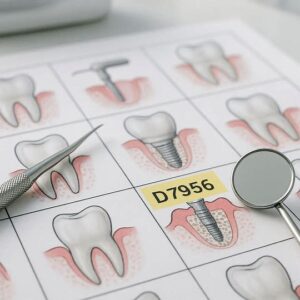
The D7956 dental code refers to a specific surgical procedure called a “bone graft to the maxillary tuberosity.” To put it simply, this is a procedure where a dentist or oral surgeon adds bone material to a specific area in the upper jaw—the rounded part of bone behind your last molar, near the sinus cavity.
This code is part of the Current Dental Terminology (CDT) code set, which is maintained by the American Dental Association (ADA). Dental professionals use these codes to communicate with each other and with insurance companies.
Why the Maxillary Tuberosity Matters
The maxillary tuberosity is a small but important area. It is the rounded end of the upper jawbone. It helps support your back teeth, especially your molars. When this area loses bone density, it can become difficult to place dental implants or even keep natural teeth stable.
A Simple Comparison
Think of the maxillary tuberosity as a shelf on a wall. Over time, that shelf can weaken or crumble. If you want to hang something heavy (like a dental implant), you first need to repair the shelf. That is exactly what the D7956 procedure does—it rebuilds that shelf.
When Does a Dentist Recommend the D7956 Procedure?
Your dentist will not suggest this procedure lightly. It is usually part of a larger treatment plan. Below are the most common scenarios where the D7956 code appears.
1. Preparation for Dental Implants
The most frequent reason for a D7956 bone graft is to prepare the upper jaw for one or more dental implants. Implants need a solid foundation. If the maxillary tuberosity is too thin or too weak, the implant will fail. The bone graft creates a sturdy base.
2. After Tooth Extraction
When you lose a back molar in the upper jaw, the bone in that area starts to resorb (shrink) over time. In some cases, the maxillary tuberosity becomes too soft or too small. A dentist may decide to graft bone here during the extraction appointment or in a separate surgery.
3. Treating Bone Defects
Some patients have natural bone defects. Others may have lost bone due to periodontal disease or trauma. If the defect is located in the maxillary tuberosity area, a D7956 graft can correct it.
4. Sinus Lift Alternatives
In some cases, a sinus lift is required for upper jaw implants. However, if the bone loss is only in the tuberosity area, a D7956 graft may be a less invasive alternative. Your dentist will explain which option suits your anatomy better.
What Happens During a D7956 Procedure?
Understanding the steps of the procedure can reduce anxiety. Below is a realistic walkthrough of what you can expect. Please remember that every patient is different. Your specific experience may vary slightly.
Step 1: Consultation and Imaging
Before any surgery, your dentist will take X-rays or a 3D cone beam CT scan. These images show the exact shape and density of your maxillary tuberosity. The dentist will also review your medical history to ensure you are a good candidate for bone grafting.
Step 2: Anesthesia
You will receive local anesthesia to numb the area. In some cases, if you feel anxious, your dentist may offer sedation options. You should feel no pain during the procedure.
Step 3: Incision and Exposure
The dentist makes a small incision in the gum tissue over the maxillary tuberosity. They gently lift the gum to expose the underlying bone.
Step 4: Preparing the Graft Site
The dentist cleans the area and removes any soft tissue or debris. They may roughen the bone surface slightly to encourage the graft to integrate.
Step 5: Placing the Bone Graft Material
This is the core of the D7956 code. The dentist places bone graft material into the defect area. The material can come from several sources (we will cover those in detail later). The dentist packs the material firmly into the shape of a healthy tuberosity.
Step 6: Covering the Graft
A membrane may be placed over the graft to protect it. Then, the dentist sutures (stitches) the gum tissue back into place.
Step 7: Healing
You will go home with aftercare instructions. The bone graft needs several months to fuse with your natural bone before you can receive an implant.
Important Note: The D7956 code specifically describes the graft to the maxillary tuberosity. If your dentist also needs to graft other areas of the jaw, they will use different codes (such as D7957 for sinus lifts or D7953 for bone replacement grafts). Do not hesitate to ask for an itemized breakdown.
Types of Bone Graft Materials Used
Not all bone grafts are the same. Your dentist will choose a material based on your health, the size of the defect, and your budget. Below is a table summarizing the common options.
| Material Type | Source | Advantages | Disadvantages |
|---|---|---|---|
| Autograft | Your own body (often from the chin or lower jaw) | Excellent healing potential; no disease transmission risk | Requires a second surgical site; more discomfort |
| Allograft | Human cadaver bone (processed and sterilized) | No second surgery; safe and widely used | Slightly slower integration than autograft |
| Xenograft | Animal bone (usually bovine/cow) | Affordable; good structure | Only the mineral scaffold remains; no living cells |
| Alloplast | Synthetic materials (calcium phosphates) | Predictable; no disease risk | May take longer to remodel into natural bone |
Your dentist will explain which material they recommend for your D7956 case. Do not be alarmed if they suggest allograft or xenograft. These materials are extremely safe, and millions of successful procedures use them every year.
Recovery Timeline: What to Expect After D7956
Healing from a bone graft takes patience. You will not see results overnight. Below is a realistic week-by-week and month-by-month guide.
First 24 to 48 Hours
-
Swelling and mild discomfort are normal.
-
You may experience slight bleeding.
-
Stick to cold foods and soft foods.
-
Do not rinse, spit, or use a straw.
-
Take any prescribed pain medication as directed.
Days 3 to 7
-
Swelling usually peaks around day two or three, then subsides.
-
You can switch to warm salt water rinses (gently).
-
Continue eating soft foods like yogurt, mashed potatoes, and smoothies.
-
Avoid chewing on the side of the graft.
Weeks 2 to 4
-
Most sutures will dissolve or be removed.
-
You can slowly return to normal eating, but avoid hard or crunchy foods near the graft.
-
You may still feel a small bump or ridge where the graft sits. This is normal.
Months 2 to 6 (The Integration Phase)
-
During this time, the graft material fuses with your natural bone.
-
You will not feel this happening.
-
Your dentist will take periodic X-rays to monitor progress.
Month 6 and Beyond
-
In most cases, the graft is ready for an implant.
-
Some patients may need more time—up to nine months.
-
Your dentist will confirm readiness with imaging.
Quotation from a practicing oral surgeon: “Patients often worry that the graft isn’t working because they can’t feel anything changing. But silence is good. Pain, swelling, or drainage are the real warning signs. Most D7956 grafts heal quietly and successfully.” — Dr. Elena R., DDS, MS
Does Insurance Cover the D7956 Dental Code?
This is where things get tricky. Dental insurance does not always cover bone grafting, especially if the insurance company considers it “not medically necessary.” However, there are situations where you can get partial or full coverage.
When Insurance Usually Covers D7956
-
The graft is needed to support a natural tooth that would otherwise be lost.
-
The bone loss is caused by trauma (accident or injury).
-
The procedure is part of periodontal therapy for bone defects from gum disease.
When Insurance Typically Denies D7956
-
The graft is solely for a dental implant. Most plans exclude implant-related grafting.
-
The plan has a missing tooth clause (they will not pay for any service related to a tooth that was missing before the policy started).
-
The graft is considered cosmetic or elective.
Tips for Maximizing Your Insurance Benefits
-
Ask for a pre-determination. Your dentist can send the treatment plan to your insurance company before you commit. They will tell you exactly how much (if anything) they will pay.
-
Check your medical insurance. Some bone grafts qualify under medical policies if the bone loss is due to a medical condition or trauma. You may be able to file a claim with both.
-
Appeal denials. If your insurance denies the claim, ask for a written explanation. Sometimes a letter from your dentist can overturn the decision.
How Much Does the D7956 Procedure Cost Out of Pocket?
If you are paying without insurance, the cost of a D7956 bone graft to the maxillary tuberosity varies widely. Prices depend on your geographic location, the dentist’s experience, the graft material used, and whether any additional procedures are performed at the same time.
Typical Price Ranges in the United States
| Practice Type | Cost Estimate (per site) |
|---|---|
| General dentist (in-network) | $600 – $1,200 |
| Periodontist | $1,000 – $1,800 |
| Oral surgeon | $1,200 – $2,500 |
| Dental school clinic | $300 – $700 |
These figures usually include the graft material, local anesthesia, and basic follow-up. They do not include sedation, CT scans, or the eventual dental implant.
Ways to Manage the Cost
-
Dental discount plans can reduce fees by 15% to 30%.
-
CareCredit and similar healthcare credit cards offer interest-free payment plans if paid within 6 to 12 months.
-
Dental schools provide significantly lower prices. The work is supervised by experienced faculty.
-
HSAs and FSAs (Health Savings Accounts and Flexible Spending Accounts) can cover bone grafts. Check with your plan administrator.
Risks and Complications: An Honest Look
No surgical procedure is without risk. However, the D7956 bone graft is generally very safe when performed by a qualified professional. Below are the potential complications, along with their approximate frequencies.
Common (Occur in 5–15% of cases)
-
Swelling and bruising that lasts longer than a week.
-
Minor bleeding that resolves with pressure.
-
Suture irritation (the stitches feel scratchy or uncomfortable).
Uncommon (1–5% of cases)
-
Infection at the graft site. Signs include increasing pain, foul taste, or pus.
-
Graft exposure (the gum tissue recedes, exposing the graft material).
-
Nerve irritation causing temporary numbness in the cheek or upper lip.
Rare (Less than 1% of cases)
-
Complete graft failure where the body rejects or resorbs all the graft material.
-
Chronic pain syndrome.
-
Sinus complications if the graft is placed very close to the sinus floor.
How to Reduce Your Risk
-
Choose an experienced provider. Ask how many D7956 grafts they perform each year.
-
Follow all aftercare instructions precisely.
-
Do not smoke. Smoking drastically increases graft failure rates (up to 40% higher).
-
Keep your follow-up appointments. Early detection of problems leads to simple solutions.
D7956 vs. Other Bone Graft Codes: A Comparison Table
Patients often confuse the D7956 code with other grafting codes. This table clarifies the differences.
| CDT Code | Procedure Name | Location in Mouth | Primary Purpose |
|---|---|---|---|
| D7956 | Bone graft to maxillary tuberosity | Upper jaw, behind last molar | Rebuild bone for implants or tooth support |
| D7957 | Sinus lift with bone graft | Sinus floor (upper molars/premolars) | Increase vertical bone height for implants |
| D7953 | Bone replacement graft for ridge preservation | Any extraction socket | Prevent bone loss after tooth removal |
| D7950 | Osseous surgery (flap procedure) | Any jaw area | Reshape bone and treat gum disease |
| D7951 | Sinus augmentation via lateral window | Sinus cavity | Large-volume bone grafting for implants |
If you see multiple codes on your treatment plan, ask your dentist to explain each one. It is perfectly reasonable to request a “code-by-code” breakdown.
Alternatives to the D7956 Procedure
A bone graft is not always your only option. Depending on your specific situation, you may consider one of these alternatives.
1. Short Dental Implants
Short implants are designed for patients with limited bone height. They do not require as much bone depth as standard implants. In some cases, you can place a short implant without grafting the tuberosity.
Pros: No graft; faster treatment.
Cons: Not suitable for all bite forces; limited availability.
2. Removable Partial Denture
If you are missing a tooth in the area, you could choose a removable partial denture instead of an implant. This option avoids surgery entirely.
Pros: Low cost; non-invasive.
Cons: Less comfortable; can accelerate bone loss over time.
3. No Treatment
You can also choose to do nothing. However, if bone loss continues, adjacent teeth may become loose. You may also lose the option for an implant later if the bone worsens.
Pros: No cost or recovery time.
Cons: Progressive bone loss; eventual tooth loss.
4. Orthodontic Extrusion
In very specific cases, an orthodontist can slowly pull a tooth downward (extrusion) to stimulate new bone formation. This is rare for the tuberosity area and usually only works for single teeth.
Your dentist should present all viable alternatives before scheduling a D7956 procedure. If they do not, ask directly: “Are there any non-grafting options for my case?”
How to Choose a Dentist for Your D7956 Bone Graft
Not all dentists perform bone grafting. The maxillary tuberosity is a delicate area, close to the sinus and major blood vessels. Choosing the right provider matters.
Questions to Ask Before Booking
-
How many D7956 procedures have you performed in the last 12 months? (Look for an answer above 10–20 cases.)
-
What graft material do you recommend for me and why?
-
Do you use a membrane to cover the graft?
-
What is your graft success rate? (A good answer is 90% or higher.)
-
How do you manage complications if they arise?
Credentials to Look For
-
Periodontist (specialist in gum and bone health)
-
Oral and maxillofacial surgeon (specialist in surgical procedures)
-
Prosthodontist with advanced surgical training
General dentists can perform D7956 grafts, but they should have additional continuing education in surgical bone grafting. Do not hesitate to ask about their training.
Red Flags
-
The dentist pressures you to decide the same day.
-
They cannot explain why you need a graft instead of an alternative.
-
They offer a price that seems “too good to be true” (e.g., $200 for a full graft).
-
They have no before-and-after photos or patient testimonials.
Realistic Success Rates and Long-Term Outlook
You deserve honest numbers. The D7956 bone graft procedure enjoys high success rates when performed correctly and when patients follow aftercare guidelines.
-
One-year success rate: 92% to 98% (graft integrates and remains stable)
-
Five-year success rate for subsequent implants: 85% to 95% (implants placed into healed grafts)
-
Ten-year success rate: 80% to 90% (varies by patient health and oral hygiene)
These rates are slightly lower than grafts placed in other areas of the jaw (like the front of the lower jaw), but they are still considered excellent by dental standards.
Factors That Improve Your Success
-
Non-smoker
-
No uncontrolled diabetes
-
Excellent oral hygiene
-
No history of radiation therapy to the head or neck
-
Young to middle age (bone heals faster)
Factors That Reduce Success
-
Smoking (even one or two cigarettes per day)
-
Poorly controlled diabetes (A1c above 7.5)
-
Clenching or grinding (bruxism) that puts pressure on the graft
-
Active gum disease
-
Osteoporosis medications (bisphosphonates)
Important Note: Be completely honest with your dentist about your medical history. Some medications (like Fosamax or Boniva) can seriously interfere with bone healing. Your dentist may need to coordinate with your physician before proceeding.
Frequently Asked Questions (FAQ)
1. Is the D7956 procedure painful?
Most patients report mild to moderate discomfort for the first two to three days. Over-the-counter pain relievers like ibuprofen usually manage the pain well. The procedure itself is painless due to local anesthesia.
2. How long does the D7956 graft take to heal?
The soft tissue heals in about two weeks. The bone graft fully integrates in four to nine months. You cannot place an implant until the bone is ready.
3. Can I go back to work the next day?
Yes, for desk jobs. You may have some swelling, but most patients return to normal activities after 24 to 48 hours. Avoid heavy lifting or strenuous exercise for one week.
4. Will my face look different after the graft?
No. The maxillary tuberosity is deep inside your mouth. There will be no visible change to your facial appearance.
5. What happens if the graft fails?
Your dentist may remove the failed graft material. After healing (usually three months), they can attempt a second graft with a different material or technique. Failure does not mean future grafts will fail.
6. Does insurance cover D7956 if I already have a missing tooth?
Typically, no. Most dental plans exclude grafting for teeth that were missing before the policy began. Always check your specific plan language.
7. Can I have a D7956 graft and a sinus lift at the same time?
Yes, in some cases. Your dentist may combine both codes if the bone loss affects both the tuberosity and the sinus floor. This is more complex and has a longer recovery time.
8. How do I know if I need a D7956 graft?
Only a clinical exam and X-rays can determine that. If your dentist recommends this code, ask to see the imaging. They should point out the specific area of bone deficiency.
Helpful Resources
For additional reading and verification of the information in this guide, we recommend the following trusted sources:
-
American Dental Association (ADA) CDT Code Book – The official guide to all dental codes. You can purchase or view excerpts at ada.org.
-
American Academy of Periodontology (perio.org) – Offers patient education materials on bone grafting and gum health.
-
ClinicalTrials.gov – Search for ongoing studies on maxillary tuberosity bone grafts if you are interested in research opportunities.
Disclaimer: This article is for informational purposes only and does not constitute medical or dental advice. Always consult with a licensed dental professional for diagnosis and treatment. Individual results vary. Do not use this information to self-diagnose or avoid professional care.
Conclusion
The D7956 dental code represents a bone graft to the maxillary tuberosity, a procedure commonly used to prepare the upper jaw for dental implants or to stabilize natural teeth. It is a safe, predictable surgery with high success rates when performed by an experienced provider. By understanding the costs, recovery timeline, insurance nuances, and alternatives, you can make an informed decision that aligns with your health goals and budget.
Final checklist before your D7956 procedure:
-
Get a second opinion if unsure.
-
Request a pre-determination from insurance.
-
Ask about all graft material options.
-
Review the written aftercare plan.
-
Confirm the total out-of-pocket cost.