
Dental Implant Nerve Damage Treatment
If you are reading this, you might be searching for answers. You might feel a strange tingling in your lip, a numbness that won’t go away, or a sharp pain after a dental implant procedure. First, take a deep breath. You are not alone, and there is hope.
Nerve damage is a rare but serious complication of dental implant surgery. The good news is that many cases heal on their own or improve significantly with the right care. This guide is here to walk you through everything you need to know. We will look at the signs, the treatment options, and the realistic outcomes.
Let’s get started on the path to understanding your body and finding relief.
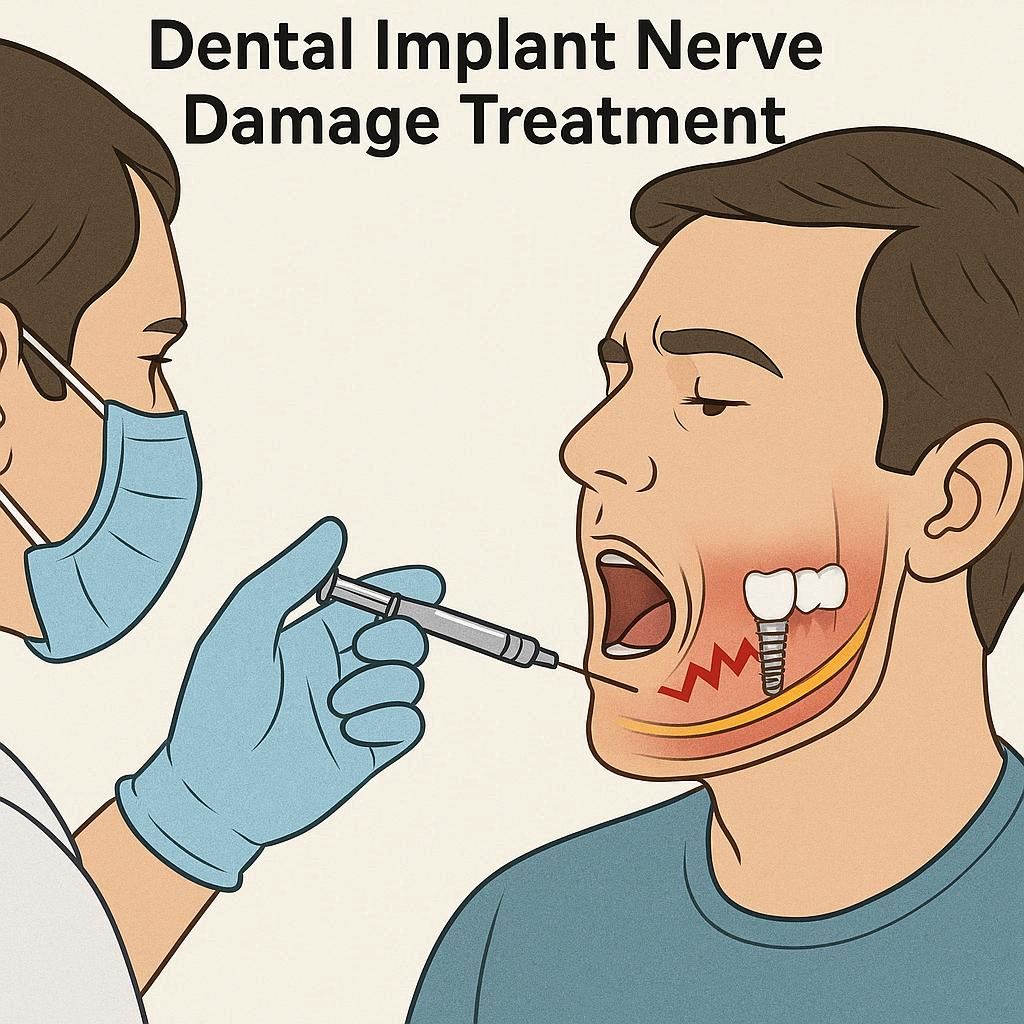
What Exactly Happens When a Nerve Gets Injured?
To understand treatment, you first need to understand the problem. Two main nerves in your lower jaw are at risk: the Inferior Alveolar Nerve (IAN) and the Mental Nerve.
- The Inferior Alveolar Nerve: Runs through the lower jawbone. It gives feeling to your lower teeth, chin, and lower lip.
- The Mental Nerve: A branch of the IAN. It specifically supplies sensation to the skin of your chin and the mucous membrane of your lower lip.
When a dental implant is placed too close to these nerves, or directly into them, the nerve gets compressed, bruised, or severed.
Levels of Nerve Injury
Doctors usually classify nerve injuries into three types. Knowing which type you have helps predict your recovery.
| Type of Injury | What It Means | Recovery Potential |
|---|---|---|
| Neuropraxia | The nerve is bruised or stretched. It is not cut. | Excellent. Usually heals fully within a few weeks or months. |
| Axonotmesis | The inner nerve fibers are damaged, but the outer sheath is intact. | Good. Recovery is possible, but it is slow (months to a year). |
| Neurotmesis | The nerve is totally cut or severed. | Poor. Permanent numbness is likely. Surgery may help, but full recovery is rare. |
Important Note: Most cases of implant-related nerve issues are Neuropraxia. That means your body has a very good chance of fixing itself with a little help.
Recognizing the Symptoms: Listen to Your Body
You cannot treat what you do not understand. Symptoms usually appear immediately after the anesthetic wears off. Sometimes, they appear weeks later as swelling increases.
Here are the most common signs of nerve involvement:
- Numbness: A complete loss of feeling in your lower lip, chin, or gum on the side of the implant.
- Paresthesia: A burning sensation, pins and needles, or a “crawling skin” feeling.
- Dysesthesia: An unpleasant, often painful sensation triggered by normal things like touch or cold air.
- Loss of function: Difficulty drinking without spilling, drooling while sleeping, or biting your lip without realizing it.
- Changes in taste: A metallic taste or reduced taste on that side of the tongue (though this is rarer).
When to See a Specialist Immediately
Do not wait for weeks if you have severe symptoms. You should see an oral surgeon or a neurologist immediately if:
- You have complete numbness after 10 days.
- You have uncontrollable pain or burning.
- You cannot close your mouth or chew properly.
The First 48 Hours: What to Do Right Now
What you do in the first two days matters a lot. Here is a practical action plan.
1. Rule out the anesthetic.
Sometimes, patients panic over a numb lip that is simply from the local anesthesia. If the numbness lasts longer than 5–6 hours, it is likely not the anesthetic. But wait 24 hours before concluding.
2. Contact your dentist.
Call the professional who placed the implant. Be calm but specific. Say: “I had an implant placed [X days ago]. My lower lip is still completely numb, and I feel a burning sensation.” A good dentist will take this seriously and schedule an immediate follow-up.
3. Start an inflammation journal.
Write down your symptoms every day. Rate the numbness on a scale of 1 to 10 (10 being no feeling at all). This record is gold for your specialist.
4. Do not remove the implant yourself.
Some patients think removing the metal will solve the problem. Only a surgeon should decide if the implant needs to come out. Removing it too early can cause more scarring.
Diagnostic Tests: How Doctors Confirm the Problem
Before you start treatment, your doctor needs a map of the damage. You will likely undergo one or more of these tests.
1. Cone Beam CT Scan (CBCT)
This is the gold standard. A CBCT gives a 3D image of your jawbone and the nerve canal. The doctor can see exactly where the implant is in relation to the nerve.
What they look for:
- The implant tip penetrating the mandibular canal.
- The implant pushing the nerve to the side.
- The distance between the implant and the nerve.
2. Neurosensory Testing (NST)
These are clinical tests. They sound strange, but they are painless. The doctor will touch your lip with different tools to see what you feel.
- Static light touch: Do you feel a cotton swab?
- Brush stroke direction: Can you tell which way a brush moves?
- Two-point discrimination: Can you feel one point or two points touching your skin?
- Thermal testing: Do you feel cold and warm differently?
3. MRI (Magnetic Resonance Imaging)
An MRI is less common, but it is very useful. It shows the soft tissue of the nerve itself. An MRI can reveal if the nerve is swollen, torn, or surrounded by scar tissue.
A Note from a Specialist: “A CBCT tells you where the bone is. An MRI tells you the health of the nerve. For complex cases, you need both.”
Non-Surgical Treatment: The Conservative Approach
Most nerve injuries do not require a second surgery. Your body has an amazing ability to heal, but it needs the right environment. Non-surgical treatment is usually the first step for 3 to 6 months.
Medication Management
Pain from nerve damage is different from normal pain. Normal painkillers like ibuprofen may not work well. You might need specific nerve pain medications.
| Medication Type | Examples | What It Does |
|---|---|---|
| Corticosteroids | Prednisone (short course) | Reduces swelling around the nerve. Best used in the first 2 weeks. |
| Neuropathic agents | Gabapentin, Pregabalin (Lyrica) | Calms overactive nerve signals. Reduces burning and tingling. |
| Tricyclic antidepressants | Nortriptyline, Amitriptyline | Helps with chronic nerve pain and improves sleep. |
| Vitamins | B-Complex (B12, B6, B1) | Supports nerve repair and myelin sheath health. |
Important: Never take these without a prescription. A neurologist or oral surgeon must guide the dosage.
Physical Therapy for Your Face
Yes, your facial nerves need physical therapy too. A specialist called a “physical therapist” or “speech pathologist” can teach you exercises.
- Mirror feedback therapy: Watching your face in a mirror while you try to move your lip.
- Sensory re-education: Touching different textures (cotton, sandpaper, silk) to your numb lip to retrain the brain.
- Stimulation exercises: Gentle tapping and vibration to wake up the nerve.
Low-Level Laser Therapy (LLLT)
This is a painless, non-invasive treatment. A cold laser is applied to the skin over the injured nerve. The light energy is thought to reduce inflammation and speed up cell repair. Many patients report feeling improvement after 6–12 sessions.
Self-Care at Home
You are not helpless. Here is what you can do at home to support your healing.
- Gentle massage: Use your fingertip to gently rub the numb area for 2 minutes, three times a day.
- Protection: Be very careful with hot liquids and sharp foods. You might burn or cut yourself without feeling it.
- Avoid pressure: Do not sleep on that side of your face.
- Quit smoking: Nicotine tightens blood vessels. This reduces blood flow to the nerve. Healing will be much slower if you smoke.
Surgical Treatment: When Surgery Is the Answer
Surgery is not the first option. It is usually considered if:
- There is zero improvement after 3 to 6 months.
- The CBCT clearly shows the implant compressing the nerve.
- You have severe, disabling pain (neuroma).
There are two main surgical procedures.
1. Implant Removal
This is the simplest surgical option. The surgeon re-opens the site and unscrews the implant.
What to expect:
- The procedure is done under local anesthesia.
- The hole in the bone is left to heal.
- Sometimes, a bone graft is placed to fill the void.
Will it fix the nerve?
- If the nerve was only compressed (not cut), removing the pressure often leads to gradual recovery over months.
- If the nerve was cut, removal alone does not reconnect the fibers.
2. Nerve Repair or Reconstruction
This is a highly specialized microsurgery. An oral surgeon who sub-specializes in microneurosurgery performs it.
The surgeon opens the gum, finds the two ends of the injured nerve, and:
- Direct neurorrhaphy: Sews the two ends together with tiny stitches (thinner than a human hair).
- Nerve graft: Takes a nerve from another part of your body (often your leg or the side of your neck) and uses it as a bridge to connect the gap.
Recovery from nerve surgery:
- You will stay in the hospital for 1–2 days.
- Recovery is slow (12–18 months).
- Sensation returns in a specific order: pain, then cold, then touch, then heat.
- Do not expect perfection. The goal is to convert “dangerous numbness” into “functional sensation.”
The Role of Time: Realistic Recovery Timelines
Healing a nerve is not like healing a cut on your finger. It is slow. The nerve grows back at a rate of about 1 millimeter per day.
Here is a realistic timeline for different scenarios.
Scenario A: Mild Bruising (Neuropraxia)
- Week 1: No change. You feel frustrated.
- *Month 1-3:* You notice tingling or “pins and needles.” This is good. It means the nerve is waking up.
- Month 6: Most sensation returns. You might have a small numb spot the size of a pencil eraser.
- Result: Usually excellent.
Scenario B: Moderate Damage (Axonotmesis)
- *Month 1-3:* No feeling. You might feel hopeless.
- Month 6: First signs of tingling appear.
- Month 12: Blunt touch returns (you feel pressure, but not light touch).
- Month 18: Most function returns, but the lip may feel “different” forever.
- Result: Good to fair.
Scenario C: Severe Damage (Neurotmesis – Cut Nerve)
- Without surgery: Permanent numbness. The lip will never feel normal.
- With microsurgery: At month 12–18, you might gain protective sensation (you can feel a hot spoon). But fine touch usually does not return.
- Result: Fair to poor, but better than nothing.
A realistic promise: Most patients do not return to “100% normal.” But most patients return to a life where they do not think about their lip every single day.
Pain Management: Living with Chronic Nerve Pain
What if the numbness turns into pain? This is called Neuropathic Pain. It is real, and it is exhausting. Here is how to manage it without losing your mind.
The Pain Scale for Nerves
Normal pain is sharp or dull. Nerve pain is different. It is often described as:
- Electric shocks
- Burning acid
- A thousand tiny needles
- A constant cold sensation
Treatment Options for Chronic Neuropathic Pain
- Topical Medications: Lidocaine patches or creams. Capsaicin cream (derived from chili peppers) can confuse the pain signals.
- Oral Medications: As listed earlier (Gabapentin, Pregabalin, Amitriptyline). Finding the right dose takes time. Be patient.
- Cognitive Behavioral Therapy (CBT): This is not “in your head.” CBT teaches you how to reframe your pain. It reduces the emotional suffering attached to the physical sensation.
- Acupuncture: Some patients find real relief. It may stimulate natural painkillers (endorphins) in the body.
Preventing Nerve Damage: What You Must Know Before Any Implant
Prevention is always better than treatment. If you are reading this before getting an implant, or for a future implant on the other side, save these rules.
The Critical Safety Zones
| Jaw | Area at Risk | Safe Zone |
|---|---|---|
| Lower Jaw (Mandible) | Mandibular canal (contains IAN) | Stay at least 2mm above the canal. |
| Lower Jaw (Front) | Mental foramen (hole for mental nerve) | Place implants mesial (toward the midline) to the foramen. |
| Upper Jaw (Maxilla) | Maxillary sinus (rare nerve issues) | Nerve risk is low, but sinus perforation is common. |
5 Questions to Ask Your Surgeon Before Surgery
- “Do you use a CBCT scan for every implant case?” (Answer should be YES).
- “What is the distance between my nerve canal and the planned implant site?”
- “Do you use surgical guides (3D printed stents) for placement?”
- “How many implants have you placed in the lower jaw this year?”
- “What is your protocol if a patient wakes up with numbness?”
The Role of 3D Guided Surgery
Modern technology is a game-changer. A CBCT scan is uploaded to software. The surgeon plans the implant digitally. Then, a 3D-printed guide is made.
This guide fits over your teeth. It only allows the drill to go exactly where it is supposed to go. Studies show that guided surgery reduces nerve injuries by over 80%.
If your surgeon does not use guided surgery for lower jaw implants, consider finding a different surgeon.
The Emotional Impact: You Are Not Crazy
We need to talk about the hidden part of nerve damage: your mental health.
Living with a numb or painful lip is strange. It affects your confidence. You might avoid kissing. You might feel food falling off your fork without knowing it. You might feel isolated because no one can “see” your injury.
This is a real trauma.
How to Cope Emotionally
- Find a support group. Search online for “trigeminal nerve injury support.” You will find hundreds of people who share your exact story.
- Be honest with your family. Tell them: “My face feels weird. It is exhausting. I need you to believe me.”
- Therapy. Look for a therapist who specializes in chronic pain or medical trauma.
- Celebrate small wins. Did you feel a cold drink on your lip for the first time in six months? That is a victory. Celebrate it.
Legal and Financial Considerations
This is a delicate topic. But it is a necessary one.
Medical vs. Dental Insurance
- Dental insurance usually covers the implant but not the complication.
- Medical insurance often covers nerve repair surgery, medications, and physical therapy. Why? Because a nerve injury is a medical problem, not a dental hygiene problem.
- Action: File the claim with your medical insurance first. Use the correct diagnosis code (nerve injury, not failed implant).
Was It Malpractice?
Not every bad outcome is malpractice. Nerves are hidden. Even the best surgeon with a perfect CBCT scan can cause a bruise. That is a “known risk.”
Malpractice usually requires:
- Negligence: The surgeon placed the implant in an obviously wrong location (e.g., the CBCT showed the nerve, but they ignored it).
- Lack of informed consent: They did not warn you about nerve risk before surgery.
If you want to explore this, speak to a lawyer who specializes in dental malpractice. Do not sign any waivers from your dentist before speaking to a lawyer.
Recovery Aids and Tools: Practical List
Here is a shopping list of items that will make your life easier during recovery.
- Insulated mug with a lid: Prevents spills if you cannot feel your lip.
- Baby spoon: Smaller and softer than metal spoons. Protects your lip from impact.
- Mirrors: A small hand mirror to check for food or drool.
- Lip balm with a flavor (e.g., mint): The flavor gives sensory feedback. It reminds you that your lip exists.
- Straws (metal or silicone): Helps you drink without using lip sensation.
- Soft food cookbook: Chewing is hard when you cannot feel the food.
Summary Table: Treatment Options at a Glance
| Treatment | Best For | Timeframe | Success Rate |
|---|---|---|---|
| Observation & Vitamins | Mild numbness (neuropraxia) | 3 months | 85-90% |
| Medication (Gabapentin) | Burning pain, tingling | 6-12 months | 70% (pain reduction) |
| Laser Therapy | Speed up healing | 6-12 sessions | Mixed evidence; low risk |
| Implant Removal | Compression injury | Immediate relief of pressure | 60-70% improvement |
| Nerve Microsurgery | Cut nerve (neurotmesis) | 12-18 months recovery | 30-80% (depends on gap size) |
A Complete 7-Step Action Plan
If you are dealing with this right now, here is your blueprint.
Step 1 (Day 1-7): Document symptoms. Call your dentist. Request a CBCT scan. Start Vitamin B complex.
Step 2 (Week 2-4): Get a referral to an oral surgeon (different from the one who placed the implant). Get a second opinion.
Step 3 (Month 1-3): Start conservative treatment. Medications, gentle massage, and laser therapy if available.
Step 4 (Month 3): Repeat neurosensory testing. Is there any improvement? If yes, continue conservative care. If no improvement at all, discuss surgery.
Step 5 (Month 4-6): Make a surgical decision if needed. Do not wait longer than 8 months for nerve repair surgery. After 12 months, scar tissue makes repair very difficult.
Step 6 (Month 6+): Accept the new normal. Work on sensory re-education. Focus on protection (preventing burns/cuts).
Step 7 (Ongoing): Join a support group. Talk to a therapist. Your mental health is part of your medical recovery.
Frequently Asked Questions (FAQ)
Q1: How long should I wait before seeking treatment for dental implant nerve damage?
A: Do not panic on day one. Wait 10 days. If there is zero improvement (no tingling, no change) after 10 days, see a specialist. If you have severe burning pain, see someone immediately.
Q2: Can a damaged nerve heal on its own without any treatment?
A: Yes, absolutely. If the nerve is only bruised (neuropraxia), it will likely heal in 3-6 months. Your body is very smart. The treatment simply helps the process.
Q3: Is it safe to remove the dental implant?
A: Yes, removal is safe. It is a minor surgical procedure. However, removal alone does not guarantee nerve recovery. The nerve heals because the pressure is gone, not because the metal is gone.
Q4: Will I ever feel my lip normally again?
A: “Normally” is a difficult word. Many patients regain protective sensation (knowing when something is hot or sharp). Few patients regain the same light touch they had before. Most patients return to a comfortable, functional level.
Q5: How much does nerve microsurgery cost?
A: Costs vary widely. In the United States, expect $5,000 to $15,000 for the surgery alone. Hospital fees are extra. This is why you should fight to get medical insurance to cover it as a neurosurgical procedure.
Q6: Are there any new treatments on the horizon?
A: Yes. Researchers are studying stem cell therapy and nerve growth factors. These are not standard treatments yet. They are available only in clinical trials. Ask a university hospital about current studies.
Additional Resources
For more reliable and up-to-date information, we trust the American Association of Oral and Maxillofacial Surgeons (AAOMS) . Their patient education section offers detailed brochures on nerve injuries and treatment.
👉 Click here to visit the official AAOMS patient resource page (External link – opens in a new tab)
Conclusion
Dental implant nerve damage is scary, but it is not a life sentence. To summarize the article in three lines: Most cases heal with time and conservative care. Surgery exists for severe injuries but offers functional improvement, not perfection. Your best tools are early diagnosis, a specialist you trust, and patience—because nerves heal at their own slow, steady pace.
You have the knowledge now. Use it to advocate for yourself. Be patient with your body. And remember: a strange feeling in your lip does not define you. You are still you. Healing begins today.
Disclaimer: This article is for informational purposes only and does not constitute medical advice. Every case of nerve damage is unique. Always consult with a licensed oral surgeon, neurologist, or medical professional for a personal diagnosis and treatment plan. The author and publisher are not liable for any actions taken based on this content.


