Can You Get Braces With Dental Implants
If you have invested time and money into dental implants, the last thing you want is bad news. So, when an orthodontist suggests straightening your other teeth, a natural worry appears: Will braces ruin my implants?
It is a fair question. Implants are not like natural teeth. They do not have ligaments. They do not move. But your other teeth do move. This creates a unique challenge.
Here is the honest truth: Yes, you can often get braces with dental implants, but not in the way you might think. You cannot move an implant with braces. However, you can move the teeth around the implant.
This article walks you through exactly how that works. You will learn the risks, the special techniques orthodontists use, and when you should simply avoid braces altogether. No fluff. No fake promises. Just useful information.
Understanding the Fundamental Difference: Implants vs. Natural Teeth
Before we discuss braces, you need to understand why implants behave so differently. This is not just technical jargon. This is the core reason why your orthodontist will pause and think carefully before saying yes.
Natural Teeth Have Shock Absorbers
Your natural teeth sit inside a special ligament called the periodontal ligament (PDL). Think of this ligament as a tiny hammock. It holds the tooth in place, but it also allows for small movements.
When you chew, the PDL compresses and springs back. When braces apply pressure, the PDL responds by remodeling the bone around it. One side of the tooth experiences bone breakdown. The other side experiences bone growth. This is how braces work. They trick your body into moving teeth through bone.
Dental Implants Are Fused to Bone
A dental implant is different. It is usually made of titanium. Your bone grows directly onto the surface of the implant. This process is called osseointegration. The implant becomes part of your bone. There is no ligament. There is no hammock.
When braces apply pressure to an implant, the implant does not move. Instead, one of two things happens:
- Nothing moves. The braces push against a solid, unmovable object.
- The implant fails. In extreme cases, the pressure causes bone loss around the implant, leading to loosening or failure.
Important Note: An implant that has failed due to orthodontic pressure is a serious problem. You cannot simply “fix” it. You may lose the implant entirely and need a new one placed after the bone heals.
The Short Answer: Can You Get Braces With Dental Implants?
Here is the straightforward answer you came for.
| Scenario | Can you get braces? | Level of Difficulty |
|---|---|---|
| Implant is already placed, and you want to move other teeth away from it | Yes | Moderate |
| Implant is already placed, and you want to move other teeth toward it | Risky | High |
| You want to move the implant itself | No | Impossible |
| You have not gotten the implant yet, but you need braces first | Yes | Low (Recommended) |
The most important rule in orthodontics is this: Do not try to move an implant. You move the natural teeth around the implant. If your treatment plan respects this rule, braces are often possible.
What Most Orthodontists Will Tell You
Dr. Sarah Jenkins, an orthodontist with over fifteen years of experience, explains it this way:
“When a patient asks me, ‘Can you get braces with dental implants?’ my first response is always, ‘Where is the implant?’ If the implant is at the back of the mouth and we are straightening the front teeth, no problem at all. If the implant is right in the middle of the crooked teeth, we need a different strategy. We never grab the implant with a bracket and pull.”
Three Critical Factors Your Orthodontist Will Evaluate
Not every patient with an implant is a good candidate for braces. Your orthodontist will run through a checklist before approving treatment. You should understand this checklist too.
Factor 1: The Age of Your Implant
Time matters. A brand new implant that has not fully fused to the bone is a disaster waiting to happen. Most orthodontists will not touch a case until the implant is at least six to twelve months old. Some prefer to wait even longer.
- Less than 6 months old: Too risky. The bone-implant bond is still maturing.
- 6 to 12 months old: Possible, but with caution. Your orthodontist will likely use very light forces.
- More than 12 months old: Ideal. The implant is fully integrated and stable.
Factor 2: The Location of the Implant
This is the biggest deciding factor. The position of your implant relative to the crooked teeth changes everything.
Low-risk locations (usually fine):
- Last molar (tooth number 2 or 31)
- Second premolar, if all teeth in front are straight
- An implant replacing a single tooth in an otherwise aligned arch
High-risk locations (requires special planning):
- An implant next to a tooth that needs to be rotated
- An implant between two teeth that need to close a gap
- An implant in the front aesthetic zone, where even minor bone loss is visible
Factor 3: The Type of Braces You Choose
Not all braces apply force in the same way. Some are gentler. Some are more aggressive.
- Traditional Metal Braces: These apply strong, precise forces. They are excellent for moving natural teeth but can be too aggressive near an implant if not monitored closely.
- Ceramic Braces: Similar force to metal braces. No real advantage for implants.
- Clear Aligners (like Invisalign): These apply lighter, more intermittent forces. Many orthodontists prefer aligners when working near implants because the pressure is gentler.
- Lingual Braces (behind the teeth): These work fine, but they require extra care to ensure brackets do not press directly against the implant crown.
How Orthodontists Work Around Dental Implants (The Smart Way)
When an orthodontist agrees to treat you with braces and implants, they do not just slap brackets on every tooth. They use specific strategies to protect your implant. Here are the most common approaches.
Strategy 1: Leave the Implant Out of the Brace System
This is the simplest approach. The orthodontist simply does not put a bracket on the implant crown. The implant just sits there, minding its own business, while braces move all the other teeth.
How it works:
The braces attach to every natural tooth. The implant crown is polished and left alone. As the other teeth move, the space around the implant may change. That is fine. The implant acts like a stationary post.
Best for: Implants at the back of the mouth, or implants that are already in a good position.
The catch: If your natural teeth need to move past the implant, this strategy fails. You cannot move a tooth through a space where an immovable object sits in the way.
Strategy 2: Segmental Orthodontics (Moving Only One Section)
Segmental orthodontics sounds complicated, but it is actually a smart way to protect implants. Instead of putting braces on every single tooth, the orthodontist only puts braces on a specific group of teeth.
Imagine your mouth has three sections: front, left back, and right back. If your implant is on the left back, the orthodontist only braces the front and right back sections. The left back section, including the implant, never gets touched.
Best for: Crowding on one side of the mouth only.
The catch: This approach takes longer. You may need to wear partial braces for many months.
Strategy 3: Remove the Implant Crown Temporarily
This sounds scary, but it is actually quite common. The implant itself (the titanium screw inside your bone) stays where it is. But the visible crown on top can be unscrewed and removed.
With the crown removed, the top of the implant sits slightly below your gumline. Braces can now move natural teeth across that area without bumping into the crown. Once braces are finished, a new crown is made to fit the new position of your teeth.
Best for: Implants that are currently in the way of tooth movement.
The catch: You will have a small hole where your tooth used to be during treatment. This is not ideal for front teeth. Also, removing and replacing the crown costs extra money.
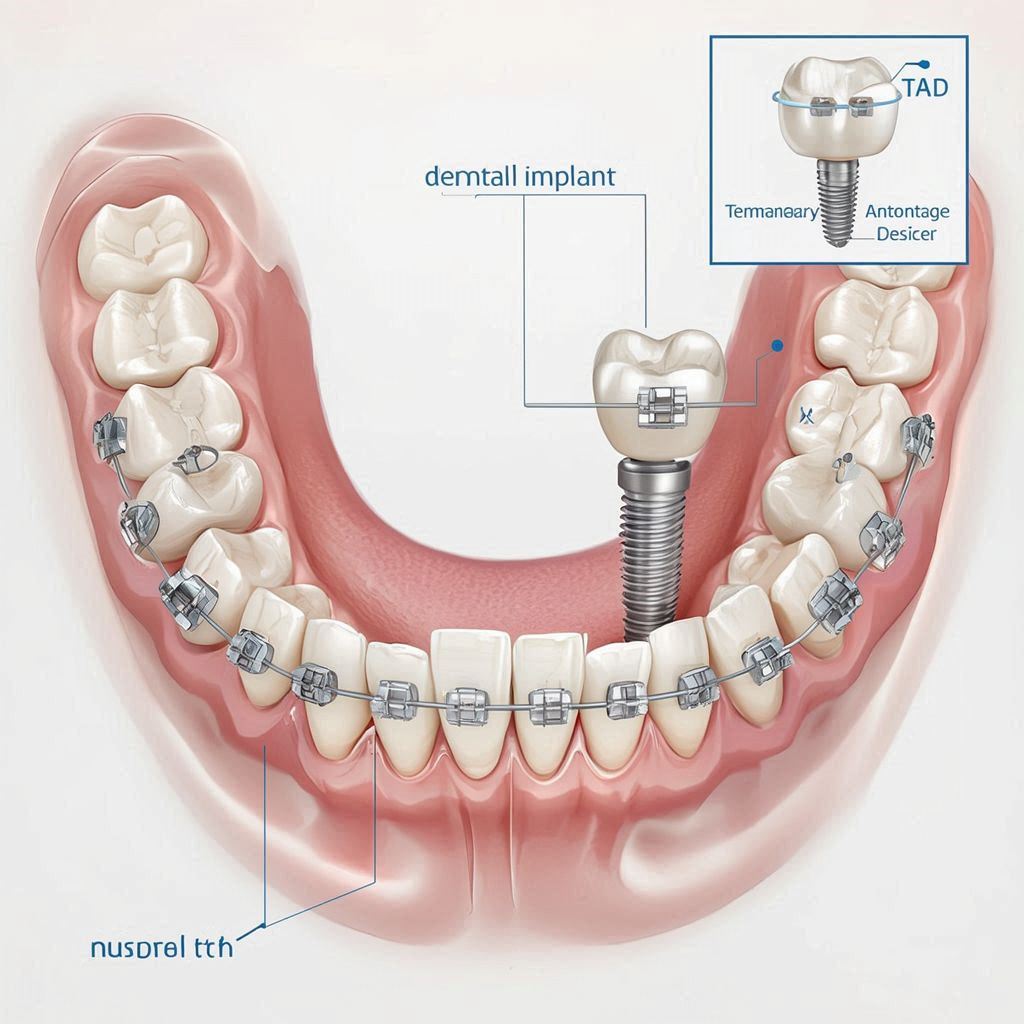
Strategy 4: Micro-Implants (Temporary Anchorage Devices)
This strategy has nothing to do with your existing implant. Instead, the orthodontist places tiny temporary implants (TADs) into your bone. These TADs act as anchors to move teeth away from your permanent implant.
By using TADs, the orthodontist can move crooked teeth without ever pushing against your expensive dental implant. The TADs take all the force instead.
Best for: Complex cases where natural teeth need to move toward the implant area.
The catch: TADs are small screws that are placed with local anesthesia. Most patients say it is not painful, but the idea can be intimidating.
When Braces Are a Bad Idea With Dental Implants
Let us be very clear. Sometimes the answer is no. A responsible orthodontist will refuse treatment in certain situations. Do not trust anyone who says “yes” to every case without hesitation.
You Want to Move the Implant Itself
If your primary goal is to move the location of your implant, braces will not help. You cannot pull an implant through bone. It is fused in place. The only way to “move” an implant is to remove it surgically and place a new one somewhere else. That is a separate procedure, not orthodontics.
Your Implant Is Already Failing
If your implant shows signs of bone loss, infection (peri-implantitis), or looseness, braces will make it worse. Orthodontic forces will accelerate the failure. You need to address the implant problem first. Sometimes that means removing the implant, letting the bone heal for six to twelve months, and then revisiting braces.
You Have Multiple Implants in the Same Arch
If you have three or four implants spread throughout your upper or lower jaw, moving the remaining natural teeth becomes extremely difficult. The implants act like walls. The natural teeth have nowhere to go. In these cases, orthodontists often recommend against braces altogether.
Severe Bone Loss Around the Implant
A healthy implant has bone hugging it on all sides. If a CT scan shows significant bone loss (more than two millimeters), your implant is already compromised. Adding braces is like adding weight to a cracked bridge. Not wise.
The Ideal Timeline: When to Get Implants vs. Braces
If you are reading this article before getting an implant, congratulations. You have the power to avoid all these complications. The order of treatment matters enormously.
Ideal Order (Least Complicated)
| Step | What happens | Typical Duration |
|---|---|---|
| 1 | Wear braces or aligners | 12 to 24 months |
| 2 | Finish orthodontic treatment | – |
| 3 | Wear retainers for 3 to 6 months to stabilize teeth | 3 to 6 months |
| 4 | Place dental implant | 1 day (surgery) |
| 5 | Wait for osseointegration (bone healing) | 3 to 6 months |
| 6 | Place final crown on implant | 1 day |
This order is the gold standard. Your orthodontist moves all your natural teeth into their perfect, final positions. Then, your implant dentist places the implant into that perfect space. The implant never experiences orthodontic force. It only experiences normal chewing forces.
Suboptimal Order (But Still Possible)
| Step | What happens | Risk Level |
|---|---|---|
| 1 | Place dental implant first | – |
| 2 | Wait for healing | Moderate |
| 3 | Start braces | Higher risk, special techniques needed |
| 4 | Finish braces | Possible, but more expensive and complex |
If you already have an implant, do not panic. Many people successfully get braces after implants. You just need an orthodontist who specializes in these cases.
Reader Note: If your dentist recommends placing an implant before braces, ask them why. There are rare medical reasons (like preventing bone loss in a gap), but usually it is better to do braces first. Get a second opinion if you are unsure.
Treatment Options for Specific Scenarios
Let us look at real-world situations. Find the description that matches your mouth.
Scenario A: Single Implant in the Lower Back, Crooked Front Teeth
Verdict: Very safe. Most orthodontists will say yes without hesitation.
Why it works: The implant is far away from the area that needs braces. The orthodontist simply does not put a bracket on the implant. Braces straighten the front six to eight teeth. The implant sits in the back, undisturbed.
Expected treatment time: Same as normal braces (12 to 18 months).
Scenario B: Implant Replacing a Lateral Incisor (Front Tooth), Adjacent Teeth Are Crooked
Verdict: Possible, but requires an experienced orthodontist and likely clear aligners.
Why it is tricky: The implant is in the smile zone. Neighboring teeth need to move. If the orthodontist is not careful, the moving teeth could push against the implant crown, causing bone loss.
How it is done: The orthodontist uses very light forces and checks the implant every four to six weeks with X-rays to monitor bone levels. Clear aligners are often preferred because they move teeth more gently.
Scenario C: Two Implants Replacing Molars on Both Sides, Crooked Front Teeth
Verdict: High risk. Many orthodontists will say no or recommend against it.
Why it is difficult: The implants are like two walls on the left and right. The front teeth are trapped between them. There is no room to move the front teeth forward or backward because the implants block the path.
Alternatives:
- Accept your current front tooth alignment
- Remove one implant (expensive and painful)
- Consider veneers or crowns to improve the appearance of front teeth without moving them
Scenario D: Implant Is Tilted or Angled Incorrectly
Verdict: Braces cannot fix this. You need implant revision.
What happened: Your implant was placed at a bad angle. Maybe it leans too far forward or too far backward. You want braces to “stand it up straight.” This does not work.
Real solution: An oral surgeon removes the existing implant. The bone heals for several months. A new implant is placed at the correct angle. Only then can you consider braces.
Risks You Need to Know Before Starting
Honesty protects you. Here are the real risks of getting braces with dental implants. These are not scare tactics. These are outcomes that happen in real dental offices every year.
Risk 1: Bone Loss Around the Implant (Marginal Bone Resorption)
This is the most common risk. Braces apply pressure. The implant transfers that pressure directly to the bone. Over time, the bone may start to melt away. You will not feel this happening. Only X-rays will show it.
How much bone loss is acceptable?
- 0.5 mm to 1 mm: Normal for implants under orthodontic force
- 1 mm to 2 mm: Concerning. Your orthodontist may stop treatment.
- More than 2 mm: The implant is at risk of failing.
Risk 2: Implant Loosening
If the bone loss becomes severe, the implant will start to feel wobbly. You might notice it when you chew or touch it with your tongue. A loose implant is a failing implant.
What happens next: Your dentist will tell you to stop wearing braces immediately. The implant may need to be removed. You will wait for bone healing. Then you decide whether to place a new implant or try a different tooth replacement (like a bridge).
Risk 3: Damage to the Implant Crown
Braces use metal brackets, wires, and sometimes elastic bands. These components can scratch, chip, or crack the porcelain crown on your implant.
Porcelain is hard, but it is also brittle. A metal bracket banging against a porcelain crown can cause small fractures. These fractures trap bacteria and lead to bad breath or gum inflammation around the implant.
Prevention: Your orthodontist can place a special metal or plastic shield over the implant crown to protect it during treatment.
Risk 4: Longer Treatment Time
Moving teeth around a stationary implant is like navigating around a parked car in a narrow garage. It takes more time. Your orthodontist cannot be aggressive. They have to use lighter forces and move teeth in smaller increments.
Expectation: A normal brace case takes 18 months. A brace case with an implant nearby can take 24 to 30 months.
Clear Aligners (Invisalign) vs. Traditional Braces for Implant Patients
You have a choice. Both options work, but they work differently. Here is a head-to-head comparison for patients with dental implants.
| Factor | Clear Aligners (Invisalign, etc.) | Traditional Braces |
|---|---|---|
| Force applied to implant | Low, intermittent | Moderate to high, continuous |
| Risk of bone loss | Lower | Higher |
| Ability to protect implant crown | Easy (no brackets touch it) | Difficult (brackets can hit crown) |
| Precision of movement | Good for simple to moderate cases | Excellent for complex movements |
| Ability to avoid implant entirely | Easy (aligner can be trimmed) | Moderate (brackets can be skipped) |
| Cost | $3,000 to $8,000 | $2,500 to $7,000 |
| Aesthetics during treatment | Nearly invisible | Visible metal or ceramic |
Which One Should You Choose?
Choose clear aligners if:
- Your implant is in the front of your mouth
- You only need mild to moderate tooth movement
- You are willing to wear aligners 22 hours per day
- You want the lowest possible risk to your implant
Choose traditional braces if:
- You have severe crowding or rotation
- Your implant is in the back of your mouth, far from the action
- You need to move teeth vertically (up and down)
- You have a history of not wearing aligners consistently
Important: Some orthodontists will only treat implant patients with clear aligners. This is not because braces are dangerous. It is because aligners give them more control over how much force reaches the implant. If your orthodontist insists on aligners, trust their judgment.
Cost Considerations: Budgeting for Braces With Implants
Here is an uncomfortable truth. Getting braces when you already have an implant is often more expensive than getting braces without an implant.
Why It Costs More
- Specialized orthodontist: Not every orthodontist treats these cases. You may pay a premium for an expert.
- More appointments: Your orthodontist will want to see you every four weeks instead of every eight weeks to monitor the implant.
- Additional X-rays: You will need periodic CBCT scans (3D X-rays) to check bone levels around the implant. Each scan costs $200 to $500.
- Possible crown replacement: If the implant crown is damaged or needs to be reshaped, that is an additional fee.
Average Price Ranges (USA, Private Pay)
| Service | Typical Cost |
|---|---|
| Comprehensive braces (no implant complication) | $3,500 to $6,000 |
| Comprehensive braces (with implant in same arch) | $5,000 to $8,000 |
| Clear aligner treatment (no implant complication) | $3,000 to $5,500 |
| Clear aligner treatment (with implant in same arch) | $4,500 to $7,500 |
| Additional CBCT scans (2 to 3 during treatment) | $400 to $1,500 |
| Replacement implant crown after braces | $1,500 to $3,000 |
Does insurance help?
Medical insurance usually does not cover orthodontics for adults. Dental insurance may cover a portion of braces (often $1,000 to $2,000 lifetime maximum). Implant-related complications are typically not covered if they result from orthodontic treatment. Read your policy carefully.
Questions You Must Ask Your Orthodontist Before Starting
You are the customer. You have the right to ask hard questions. Take this list to your consultation.
The Essential Questions
- “How many patients with dental implants have you treated with braces?”
- A good answer: “I treat 10 to 20 such cases per year.”
- A bad answer: “You would be my first.”
- “Will you place a bracket on my implant crown?”
- The correct answer: “No, never. We never put orthodontic force directly on an implant.”
- “How often will you take X-rays to check my implant bone levels?”
- The correct answer: “At the start, at 6 months, and at the end of treatment. More often if we see problems.”
- “What is your plan if my implant starts losing bone?”
- A good answer: “We will stop orthodontic forces immediately and refer you back to your implant dentist.”
- A bad answer: “That probably won’t happen, so we will cross that bridge later.”
- “Can you show me before-and-after photos of similar cases?”
- If they cannot show you any examples, find another orthodontist.
Warning Signs to Walk Away
- The orthodontist says, “It is fine, I do this all the time” without asking about your implant’s age or location.
- The orthodontist wants to put a bracket on your implant.
- The orthodontist does not plan to take any special X-rays of your implant.
- The orthodontist guarantees that nothing will go wrong.
No ethical orthodontist guarantees outcomes with implants. There is always risk. Accept the risk. Do not accept false promises.
What Happens If Your Implant Fails During Braces?
Let us talk about the worst-case scenario. Your implant starts to loosen. X-rays show significant bone loss. Now what?
Step 1: Stop Orthodontic Treatment Immediately
Your orthodontist will remove your wires, brackets, or aligners right away. All forces stop. This gives your bone and implant a chance to recover.
Step 2: Evaluate the Implant
Your implant dentist will take over. They will check for infection (peri-implantitis). They will measure how loose the implant is. They will review the bone levels.
Step 3: Decide on Removal or Retention
- If bone loss is mild (less than 2 mm): Your dentist may recommend leaving the implant in place but continuing to monitor it. You will likely stop braces permanently, or switch to a very different treatment plan.
- If bone loss is moderate to severe (more than 2 mm): The implant will be removed. This is a small surgical procedure done with local anesthesia. It takes about 15 to 30 minutes.
Step 4: Heal and Restart
After implant removal, you need to wait. The bone needs time to fill in the hole left by the implant. This takes four to six months.
After healing, you have three choices:
- Finish your braces without replacing the implant (live with a missing tooth)
- Place a new implant after braces are completely finished
- Choose a different tooth replacement, like a bridge or partial denture
Can You Sue Your Orthodontist?
This is a fair question. The answer depends on what you were told before treatment started.
- If your orthodontist warned you about the risk and you signed a consent form: You likely cannot sue. You accepted the known risk.
- If your orthodontist told you there was no risk or guaranteed success: You may have a case for negligence. Consult a dental malpractice attorney.
Most cases of implant failure during braces are not malpractice. They are unfortunate but known complications. This is why informed consent is so important.
A Note on Peri-Implantitis and Braces
Peri-implantitis is a fancy word for a serious problem. It means infection and inflammation around the implant, leading to bone loss.
Braces do not cause peri-implantitis. Bacteria cause it. However, braces make it harder to clean around implants.
Why Braces Increase Your Infection Risk
- Brackets and wires create tiny hiding spots for food and plaque
- Flossing around an implant with braces is extremely difficult
- Clear aligners trap saliva and bacteria against the implant crown
How to Prevent Peri-Implantitis During Braces
- Invest in a water flosser: Use it on the lowest setting around your implant twice daily.
- Use superfloss or implant-specific floss: These have a stiff end that threads under your braces.
- See your hygienist every three months: Not every six months. Every three months.
- Ask for prescription chlorhexidine rinse: Use it once daily for one week each month.
Warning: If you notice bleeding, pus, or a bad taste near your implant during braces, call your dentist immediately. Do not wait for your next orthodontic appointment.
The Psychological Aspect: Managing Expectations
Braces are an emotional journey. Add an implant into the mix, and anxiety levels rise. This is normal.
Common Fears (And Why They Are Okay)
“I am terrified of losing my implant.”
Good. That fear will keep you vigilant. You will attend every appointment. You will clean meticulously. You will ask questions. Use the fear as fuel, not as paralysis.
“What if I spend all this money and my implant still fails?”
This is a real risk. There is no way to eliminate it completely. However, with a skilled orthodontist and careful monitoring, the failure rate is low. Most studies show a 95% to 98% success rate for implants adjacent to orthodontic movement.
“Should I just live with crooked teeth?”
Only you can answer that. Some people choose peace of mind over perfect teeth. That is a valid choice. Others decide the aesthetic and functional benefits of straight teeth are worth the calculated risk.
A Realistic Mindset
Think of it this way. Driving a car has risks. You could crash. But you wear a seatbelt, obey traffic laws, and maintain your vehicle. Getting braces with implants is similar. You choose a skilled orthodontist (your seatbelt). You follow all instructions (traffic laws). You monitor your implant health (vehicle maintenance). The risk never goes to zero, but it becomes very, very small.
Alternative Options If Braces Are Too Risky
Maybe after reading this far, you have decided that braces are not for you. That is fine. You have other ways to improve your smile.
Option 1: Accept Your Smile As Is
This is always an option. Crooked teeth are not a medical emergency. If your bite functions well and you have no pain, straight teeth are a want, not a need.
Option 2: Porcelain Veneers
Veneers are thin shells of ceramic that cover the front of your teeth. They can make crooked teeth appear straight without moving them at all.
Pros: No orthodontic force near your implant. Completed in two to three visits. Immediate results.
Cons: Expensive ($1,500 to $2,500 per tooth). Requires removing some enamel from your natural teeth. Not reversible.
Option 3: Dental Bonding
This is a cheaper, less invasive version of veneers. Your dentist adds tooth-colored composite material to change the shape and position of your teeth visually.
Pros: Affordable ($300 to $600 per tooth). No enamel removal. Can be done in one visit.
Cons: Not as durable as veneers (lasts 3 to 5 years). Stains over time. Cannot fix severe crowding.
Option 4: Remove One Implant to Make Room for Braces
This sounds extreme, but some patients choose it. If you have a single implant that blocks all tooth movement, removing it might allow braces to work freely.
The process:
- Remove the problematic implant.
- Heal for six months.
- Get braces and finish treatment (12 to 18 months).
- Place a new implant in the corrected space.
Is it worth it? Only if your crooked teeth cause you significant distress and you have the budget for both procedures.
Success Stories: Realistic Examples
Let me share three composite examples (based on real cases, anonymized for privacy).
Case 1: Maria, Age 42
Situation: Implant replacing lower right first molar. Crooked lower front teeth.
Treatment: Clear aligners for 14 months. No bracket on the implant. Regular monitoring with X-rays.
Outcome: Front teeth straightened. Implant bone levels unchanged. Maria is thrilled.
Case 2: David, Age 55
Situation: Two implants replacing upper premolars. Crowded upper front teeth.
Treatment: Traditional braces for 22 months. Orthodontist used segmental technique, only bracing the front six teeth. Implants never touched.
Outcome: Front teeth straight. One implant lost 0.7 mm of bone (considered acceptable). David is happy but wishes he had done braces before implants.
Case 3: Linda, Age 38
Situation: Implant replacing lower lateral incisor (front tooth). Adjacent teeth severely rotated.
Treatment: Orthodontist recommended against braces. Linda chose porcelain veneers instead.
Outcome: Six veneers placed over two months. Teeth appear perfectly straight. Implant untouched and healthy. Linda says it was the right choice for her.
Step-by-Step: What to Do Right Now
If you are still reading, you are serious about this decision. Here is your action plan.
Step 1: Gather Your Records
Find your implant records. You need to know:
- The exact date the implant was placed
- The brand and type of implant (if possible)
- Any history of bone loss or infection
- The name of your implant dentist
Step 2: Schedule a Consultation With an Orthodontist Who Has Implant Experience
Do not just walk into any orthodontic office. Call ahead and ask:
“Does Dr. [Name] regularly treat patients who already have dental implants?”
If the receptionist hesitates or says “I think so,” keep calling.
Step 3: Bring Your Implant Dentist Into the Conversation
The best treatment happens when your orthodontist and implant dentist talk to each other. Ask both offices to share records and X-rays. A team approach protects you.
Step 4: Get a CBCT Scan
A regular X-ray shows two dimensions. A CBCT (cone beam CT) shows three dimensions. You need a CBCT to see exactly where your implant sits in relation to your natural teeth roots and nerves.
Do not skip this. Any orthodontist who treats you without a CBCT is cutting corners.
Step 5: Make a Decision With Open Eyes
Write down the risks. Write down the benefits. Write down the costs. Then decide.
There is no wrong answer. You can choose braces, veneers, acceptance, or removal of the implant. Only you know your priorities.
Conclusion (Summary in Three Lines)
You can get braces with dental implants, but you cannot move the implant itself. Your orthodontist will move the natural teeth around the implant using lighter forces, special techniques like segmental braces or clear aligners, and careful monitoring. For the safest and simplest outcome, always complete orthodontic treatment before placing dental implants.
Frequently Asked Questions (FAQ)
1. Can braces damage my dental implant?
Yes, braces can damage an implant if the orthodontist applies force directly to it. Damage includes bone loss, loosening, or fracture of the crown. However, with proper technique (leaving the implant out of the brace system), the risk is low.
2. How long after getting an implant can I get braces?
Most orthodontists recommend waiting at least 6 to 12 months after implant placement. This allows full osseointegration (bone healing). Starting braces too early risks pulling the implant out of the bone.
3. Can Invisalign move dental implants?
No. Invisalign, like all braces, cannot move a dental implant. Invisalign can only move natural teeth. The implant will stay exactly where it is. Invisalign is actually preferred by many orthodontists for implant patients because it applies gentler forces.
4. What happens if I need braces but already have an implant?
You have three options: (1) Get braces using the special techniques described in this article, (2) Choose veneers or bonding instead of moving your teeth, or (3) Remove the implant, get braces, then place a new implant afterward.
5. Can I get braces on only the teeth that don’t have implants?
Yes. This is called segmental orthodontics. Your orthodontist places braces only on a specific group of teeth, leaving the area around your implant completely undisturbed. This is a common and effective approach.
6. Will braces affect the crown on my implant?
They can. Metal brackets or wires can scratch porcelain crowns. Elastic bands can stain them. Your orthodontist can place a protective shield over the implant crown to prevent damage. You may also need a new crown made after braces are finished.
7. Is it better to get braces or an implant first?
Braces first, always. This is the gold standard. Straighten all your natural teeth into their final positions. Then place the implant into that perfect space. The implant never experiences orthodontic force.
8. Can I use my implant as an anchor for braces?
No. This was attempted in the past, but it often led to implant failure. Modern orthodontics avoids using implants as anchors. If your orthodontist suggests this, get a second opinion immediately.
9. How much does it cost to get braces with existing implants?
Expect to pay $1,500 to $2,500 more than standard braces. The extra cost covers more frequent appointments, additional X-rays, and the higher skill level required. Total cost typically ranges from $5,000 to $8,000 for comprehensive treatment.
10. What are the signs my implant is failing during braces?
Watch for these symptoms: bleeding or pus around the implant, a bad taste in your mouth, the implant feeling loose or wobbly, pain when chewing on that side, or visible recession (gums pulling away from the crown). Report any of these to your dentist immediately.
Additional Resource
American Association of Orthodontists (AAO) – Find an Orthodontist Tool
Use this official directory to locate orthodontists in your area. Filter by special interests and experience. Call potential providers and specifically ask about their experience treating patients with dental implants before booking a consultation.
👉 https://www.aaoinfo.org/find-an-orthodontist (Open in a new tab)
Disclaimer
This article is for informational purposes only and does not constitute medical or dental advice. Every mouth is unique. Dental implants vary by brand, placement technique, healing status, and patient health factors. You should always consult with a licensed orthodontist and a licensed implant dentist before making treatment decisions. The author and publisher are not liable for any outcomes resulting from the use of this information. Your specific case requires professional, in-person evaluation. Do not delay seeking professional advice based on what you have read here.