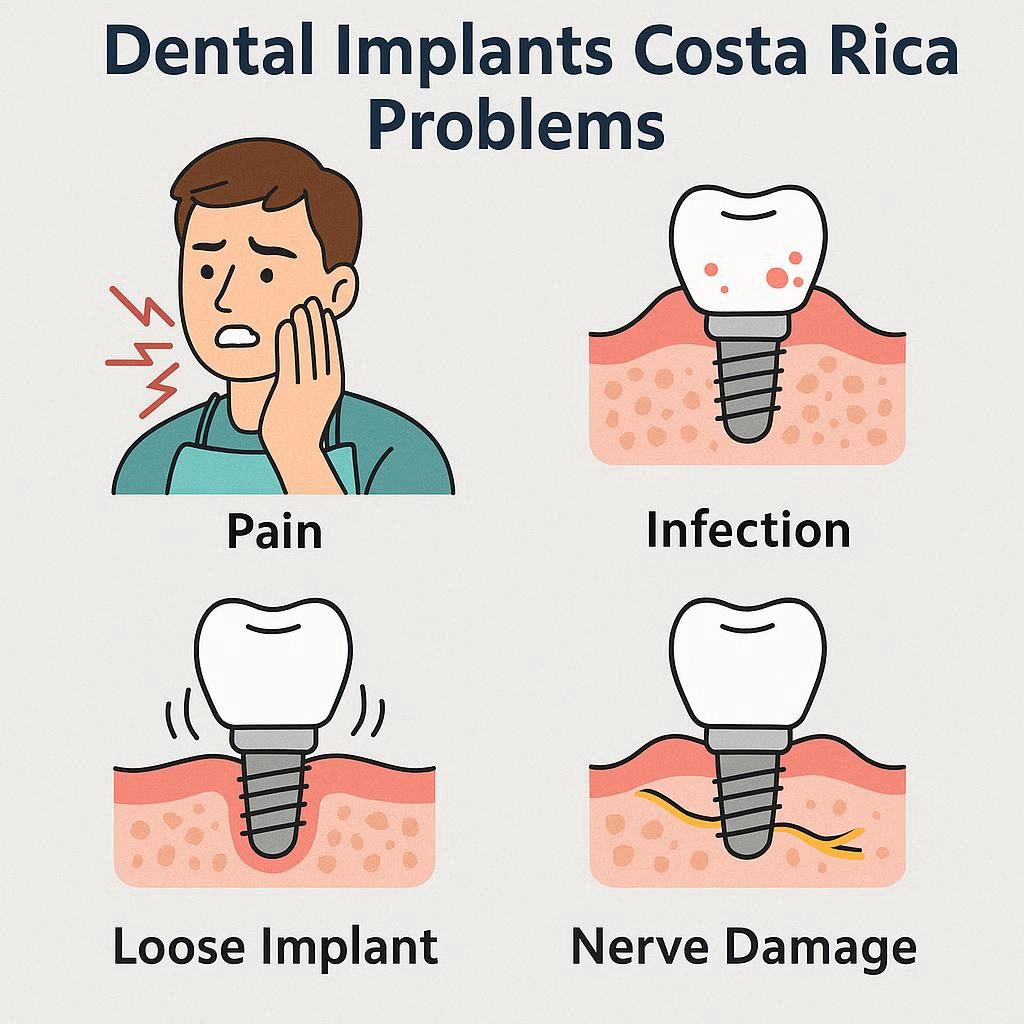
Dental Implants Costa Rica Problems
The idea is tempting. You have probably heard stories of people saving 50% to 70% on dental implants by flying south to Costa Rica. The lush jungles, the beautiful beaches, and a new smile? It sounds like a dream.
But let’s be real for a moment. Every medical procedure has risks. And when you combine surgery with international travel, things can get complicated.
You are here because you want the truth. You want to know what can go wrong. You want to understand the dental implants costa rica problems that clinics do not advertise on their websites.
This guide is not here to scare you. It is here to prepare you. By the time you finish reading, you will know exactly what to look for, what questions to ask, and how to decide if Costa Rica is truly the right choice for your smile.
Why Are So Many People Looking at Costa Rica for Dental Work?
Before we dive into the problems, it helps to understand the attraction. Costa Rica has become a hub for “dental tourism” for several honest reasons:
- Lower overhead costs. Rent, salaries, and materials are cheaper than in the US or Canada.
- High volume of patients. Some clinics do more implants in a week than a US dentist does in a month.
- Proximity. A direct flight from Miami to San José is only 2.5 hours.
- Vacation appeal. You recover near a beach instead of in a cold, snowy city.
However, lower prices do not automatically mean lower quality. But they also do not guarantee a problem-free experience. Let’s look at the real issues patients face.
Common Dental Implants Costa Rica Problems: An Overview
Not every patient has a bad experience. Thousands of people return from Costa Rica perfectly happy. But when problems happen, they tend to fall into specific categories.
| Problem Category | How Common? | Severity (1-10) |
|---|---|---|
| Poor communication with the lab | Frequent | 7 |
| Infection after returning home | Moderate | 8 |
| Implant rejection/failure | Low | 9 |
| Hidden travel costs | Very Frequent | 4 |
| No long-term follow-up | Frequent | 8 |
| Language barriers | Moderate | 5 |
| Substandard materials | Low but serious | 9 |
Important note: This table is based on patient reports and dental tourism forums. Your individual experience will depend heavily on the specific clinic you choose.
The #1 Problem: No Long-Term Follow-Up Care
Imagine this. You get three implants in San José. You fly home to Boston. Six weeks later, one implant feels loose. You call your Costa Rican clinic. They say, “You need to come back for an adjustment.”
What do you do?
This is the single biggest dental implants costa rica problem. Dental implants require healing. They require monitoring. The final crown is usually placed months after the implant screw.
What happens when you are already home:
- Your local dentist may refuse to touch another dentist’s work.
- If they do accept, they will charge full price for the repair.
- You face a choice: pay again in the US or book another expensive flight.
The real cost of no follow-up:
A $1,000 implant in Costa Rica can become a $4,000 repair in Chicago. Many patients end up paying twice.
Quote from a real patient (name withheld for privacy):
“I saved $5,000 on my implants in Costa Rica. Then I spent $6,000 fixing them when two failed. I should have just stayed home.”
Infection and Sterilization Risks
Costa Rica has excellent clinics with US-trained dentists. But not every clinic follows the same hygiene protocols you expect at home.
Infection is implant’s worst enemy. If bacteria get into the bone during surgery, the implant will not integrate. It will fail.
Signs of a post-implant infection:
- Swelling that gets worse after 5-7 days
- A bad taste in your mouth
- Fever that appears after returning home
- Pus around the implant site
Why this risk is higher for travelers:
- You are flying with a fresh wound. Airplane cabins are dry and full of recirculated air.
- You cannot return quickly for an antibiotic injection.
- Different antibiotic resistance patterns exist in different countries.
Ask any clinic for their sterilization certification. A professional clinic will show you their autoclave logs without hesitation. If they get defensive? Walk away.
The “Too Good to Be True” Price Trap
Let’s talk numbers. A full mouth of implants in the US can cost $30,000 to $60,000. In Costa Rica, some clinics advertise $10,000 to $15,000.
But here is the hidden truth. That low price often covers only the basic implant screw. By the time you add the abutment, the crown, the CT scan, the temporary teeth, and the travel costs, you might be closer to $20,000.
Hidden costs most patients forget:
| Expense | Approximate Cost |
|---|---|
| Round-trip flights | $400 – $800 |
| Hotel for 10-14 days | $700 – $1,500 |
| Meals and transport | $300 – $600 |
| Lost work days | Varies |
| Bone graft (if needed) | $500 – $1,500 extra |
| Final crowns | $300 – $800 each |
A patient recently shared their story online. They paid $6,000 for “all-on-4” implants. After adding flights, hotels, a bone graft, and emergency pain medication, their total was over $11,000. The same work in Texas would have been $18,000.
The savings? Still there. But much smaller than advertised.
Communication Breakdowns: Language and Expectations
Many Costa Rican dentists speak excellent English. They studied in the US or Europe. But the technicians in the lab? The assistants? The front desk staff? Not always.
Where communication fails:
- Treatment planning. You might agree to one type of implant, but the lab produces another.
- Pain management. “Un poco de dolor” (a little pain) means different things to different people.
- Warranty terms. A clinic says “lifetime warranty.” But that warranty is void if you do not return every six months for checkups at their office.
One patient’s real experience:
A woman from Texas requested zirconia implants (metal-free). The dentist agreed. After the surgery, she discovered titanium screws were used. The dentist explained, “Zirconia is too brittle for your bone type. I made the best medical decision.”
Was the dentist right? Probably. But he never explained this change before the surgery. She felt violated. Her trust was broken.
Golden rule: Never agree to surgery without a written treatment plan in English. Every material, every step, every cost must be listed.
Implant Failure Rates: What the Studies Say
Science is honest. Implant failure happens everywhere, not just in Costa Rica. The global average for implant failure is 5% to 10% over ten years.
But certain factors increase failure risk in dental tourism:
| Risk Factor | How Costa Rica Travel Makes It Worse |
|---|---|
| Smoking | No change, but you cannot see the dentist during healing |
| Diabetes (uncontrolled) | High. You cannot get easy follow-up care |
| Clenching/grinding | High. Night guards are rarely discussed |
| Poor bone density | Moderate. Bone grafts add complexity |
| Flying too soon after surgery | Very high. Air pressure changes affect clotting |
What a responsible clinic should do:
- Require a recent CT scan (not just X-rays)
- Test for allergies to metals or anesthetics
- Discuss your complete medical history in detail
- Ask about your medications, including supplements
If a clinic schedules your surgery over WhatsApp without a proper consult? That is a major red flag.
Legal Recourse and Malpractice: You Have Almost None
Here is an uncomfortable truth. If a dentist in the US damages your nerve, ruins your sinus, or places a faulty implant, you can sue. You can report them to the state dental board.
In Costa Rica? Much harder.
- Malpractice lawsuits require a Costa Rican lawyer. You would need to travel back for court dates.
- The statute of limitations is different. You might have only one year to file.
- Judgments are smaller. A $500,000 US verdict might be $50,000 in Costa Rica.
Read the fine print in your consent form:
Many Costa Rican clinics include binding arbitration clauses. You agree to settle disputes in a specific Costa Rican court. You waive your right to a US jury trial.
Most patients sign without reading. Do not be that patient.
The “Factory Clinic” Problem
Some Costa Rican dental clinics operate like assembly lines. They schedule 10 to 15 implant surgeries per day. The lead dentist places the screws. But assistants and recent graduates do the rest.
Signs of a factory clinic:
- They rush your consultation (under 10 minutes)
- You never meet the actual surgeon before the day of surgery
- They use multiple “travel agents” to refer patients
- Online reviews look fake (all 5 stars, no negative comments)
- They refuse to share before-and-after photos of failed cases (every clinic has failures)
You want a boutique clinic. You want a dentist who does 2-4 implant surgeries per day, not 15. You want a practice where the same person who plans your case also performs your surgery.
Travel Logistics That Ruin Your Recovery
Surgery is stressful. Travel is stressful. Doing both together is a recipe for complications.
Common travel-related problems:
- Blood clots from long flights. Sitting for hours after oral surgery increases DVT risk.
- Delayed bleeding. Cabin pressure changes can restart bleeding that had stopped.
- Poor nutrition. You are in a hotel room. You cannot cook soft foods easily. You eat airport sandwiches and sugary granola bars.
- No pain management backup. Your US doctor will not prescribe narcotics for a Costa Rican procedure. Your Costa Rican pharmacy might sell you antibiotics without a prescription, but painkillers are controlled.
A better approach:
If you must travel to Costa Rica, plan to stay for a minimum of 10 days. Ideally, 14 days. The first week is critical for healing. Do not fly home after 3 days just to save on a hotel.
Material Quality: Are You Getting Genuine Brands?
The best implant brands (Straumann, Nobel Biocare, Zimmer) cost the same globally. Not exactly the same, but close. A Straumann implant screw costs the dentist about $300-$400 anywhere in the world.
So how can a Costa Rican clinic charge $800 for an implant when a US clinic charges $2,500?
Three possibilities:
- Lower overhead (rent, staff, insurance, marketing). This is honest savings.
- Lower profit margin. Some clinics operate on volume. This is acceptable.
- Off-brand or counterfeit implants. This is dangerous.
How to protect yourself:
Ask for the implant box. Before they open it, ask to see the label. Take a photo of the lot number and expiration date. A legitimate clinic will be happy to show you.
If they say, “We buy in bulk and remove labels for sterilization,” leave immediately. That is not how modern implant systems work.
Bone Graft Problems Specific to Costa Rica
Many patients need bone grafts before implants. The jawbone shrinks after tooth loss. To place an implant, you need enough width and height.
In the US, bone graft material is regulated. It comes from human donors (screened for disease), cows, or synthetic sources. Every batch is tested.
In Costa Rica, regulations exist but enforcement varies.
Real risks with bone grafts abroad:
- Xenograft (cow bone) is usually safe. But some clinics use cheap, poorly processed materials.
- Allograft (human donor bone) requires strict screening. Not every Costa Rican lab follows US tissue bank standards.
- Synthetic grafts are safest, but many clinics avoid them because patients prefer “natural” materials.
Ask specifically: “What is the source of your bone graft material? Can I see the certificate of analysis?”
If the staff looks confused, choose another clinic.
Patient Story: When the “Dream Smile” Became a Nightmare
Let me share a composite story based on real patient cases. Names and details changed, but the situation is true to life.
Maria (52, from Florida):
Maria found a Costa Rica dental clinic on Facebook. The ads showed beautiful smiles and happy patients. She paid $4,500 for three implants.
The surgery felt fine. The dentist was kind. She flew home after 5 days.
Three weeks later, one implant felt mobile. Her local dentist took an X-ray. The implant was placed at the wrong angle. It had missed the bone entirely. It was floating in soft tissue.
The Costa Rican clinic offered to redo it for free. But Maria would need to pay for flights, hotels, and another week off work. Total: $2,500.
She said no. Her local dentist removed the failed implant and placed a new one for $4,200. Final cost for three implants? $8,700. She saved exactly $300 compared to doing it at home.
“I would have paid double to avoid the stress,” she told a dental forum. “You cannot put a price on sleeping well after surgery.”
The Psychological Stress of Dental Tourism
We talk about money and implants. But we rarely talk about anxiety.
Getting implants is already scary. You are awake during surgery (usually with local anesthesia). You hear the drilling. You feel pressure.
Now add:
- Being in a foreign country
- Not knowing who to call if something feels wrong
- Worrying about every single twinge or pain
- Reading online horror stories in your hotel room at 2 AM
This stress slows healing. Cortisol (the stress hormone) reduces blood flow to the gums. Poor blood flow means poor implant integration.
A dentist in San José told me privately:
“About 20% of my US patients call me panicking over normal post-op sensations. They are so afraid of failure that they manifest symptoms. Most of the time, the implant is fine. But their stress is real.”
Comparing Costa Rica to Other Dental Tourism Destinations
Costa Rica is not the only option. You might also consider Mexico, Colombia, Turkey, or Hungary. Each has different risks.
| Country | Travel from US | Cost Level | English Proficiency | Follow-Up Options |
|---|---|---|---|---|
| Costa Rica | Easy | $$ | High | Poor |
| Mexico (Los Algodones) | Very Easy | $ | Medium | Slightly better |
| Colombia | Moderate | $ | Low | Poor |
| Turkey | Difficult (long flight) | $$ | Medium | Very poor |
| Hungary | Difficult | $$$ | Medium | Poor |
Costa Rica is the best choice for English speakers who want a pleasant environment. But for follow-up care, none of these countries are good. Once you leave, you leave.
How to Reduce Your Risk: A Practical Checklist
You can still choose Costa Rica. Many people do and they have great results. But follow these rules to protect yourself.
Before you book anything:
- Get a quote from your local US dentist first. Know your baseline price.
- Ask your US dentist, “If something fails, will you help me? At what cost?”
- Research at least 3 Costa Rican clinics. Do not just pick the first Google result.
- Join Facebook groups for dental tourism. Read negative reviews carefully.
- Ask each clinic for a video consultation. See their facility.
During the video consult:
- Ask, “How many implants have you placed in the last 12 months?”
- Ask, “What is your failure rate?” (Honest answer: 3-7%)
- Ask, “Do you use CBCT (3D imaging) for every implant case?”
- Ask, “What brand of implants do you use? Why that brand?”
- Ask, “Who will do the surgery? Can I see their CV?”
Before surgery:
- Get a written treatment plan. Every step. Every cost. Every material.
- Get a written warranty. What exactly does it cover? For how long?
- Confirm if the warranty requires you to return to Costa Rica.
- Buy travel health insurance that covers dental emergencies.
- Arrange for a local “emergency dentist” in Costa Rica (not your main clinic).
After surgery:
- Stay at least 10 days. Do not rush home.
- Take photos of your implant site every day. Document healing.
- Keep all receipts, emails, and X-rays.
- Wait at least 3 months before booking final crowns.
What Does “Lifetime Warranty” Actually Mean in Costa Rica?
This is marketing genius. A “lifetime warranty” sounds amazing. But read carefully.
In the US: A lifetime warranty often means the manufacturer replaces a faulty implant for free. You pay only for the dentist’s time to remove and replace it.
In Costa Rica: A lifetime warranty usually means:
- The clinic will replace the implant screw for free (value: $200)
- But you pay for travel, hotel, and the dentist’s time ($2,000+)
- And the warranty is void if you miss a single checkup in Costa Rica
- And it does not cover the crown, only the screw
A better question to ask:
“If my implant fails in 2 years, what will I pay out of pocket? Please give me a dollar amount.”
If they cannot answer clearly, the warranty is worthless.
The Sinus Lift Problem: A Special Risk for Upper Molars
Upper back teeth (molars and premolars) sit close to your maxillary sinus. That is the air-filled space behind your cheekbones.
When you lose an upper molar, the sinus can expand downward. There is no bone left for an implant. You need a sinus lift procedure first.
Why sinus lifts are risky in dental tourism:
- A sinus lift punctures the sinus membrane on purpose. That membrane must heal.
- Flying with a healing sinus lift is dangerous. Air pressure changes can blow open the repair.
- Sinus infections are common after sinus lifts. Treating an infection from another country is hard.
Safer approach:
Do your sinus lift at home. Let it heal for 4-6 months. Then travel to Costa Rica for the implant placement. This splits the risk. Your local dentist handles the complex part. The Costa Rican dentist handles the standard implant.
Many clinics will disagree because they lose money. But your health matters more than their profit.
An Honest Comparison: Costa Rica vs. US for Implants
Let’s lay this out clearly. No bias. Just facts.
| Factor | Costa Rica | United States |
|---|---|---|
| Cost for single implant | $800 – $1,500 | $3,000 – $5,500 |
| Cost for full mouth | $12,000 – $20,000 | $30,000 – $60,000 |
| Follow-up care | Poor to none | Excellent |
| Legal protection | Minimal | Strong |
| Travel stress | High | None |
| Emergency access | Limited | Immediate |
| Dentist qualifications | Variable (some US-trained) | Standardized |
| Facility quality | Variable | Regulated |
Who is a good candidate for Costa Rica?
- You have simple cases (1-2 implants, healthy bone, no chronic diseases)
- You can stay for 10-14 days
- You have a local dentist willing to do follow-up care
- You understand that you are taking a risk
Who should avoid Costa Rica?
- You need a sinus lift or complex bone graft
- You have diabetes, autoimmune disease, or clotting disorders
- You cannot afford to pay for repairs twice
- You are a highly anxious patient
The Hidden Cost of “Emergency” Repairs at Home
Let’s say your implant fails. You go to a US dentist for a repair. What will they charge?
| Service | Typical Cost |
|---|---|
| Exam and X-ray | $150 – $300 |
| Remove failed implant | $500 – $1,000 |
| Bone graft (if needed) | $800 – $2,000 |
| New implant placement | $1,500 – $3,000 |
| New crown | $1,500 – $3,000 |
| Total possible repair | $4,450 to $9,300 |
Now add that to what you already paid in Costa Rica ($1,500 per implant + travel). You are now paying significantly more than if you had stayed home.
The emotional cost?
You feel foolish. You feel angry. You feel betrayed by the beautiful marketing.
I am not saying this will happen to you. But you must know it can.
Questions You Must Ask Before Choosing a Clinic
Print this list. Bring it to your video consultation. Do not be shy.
- “Who will perform my surgery? Can I see their license number?”
- “What brand of implants do you use? Why not a cheaper brand?”
- “Do you use a surgical guide (3D printed) for every implant?”
- “What happens if my implant fails after I go home?”
- “Can you give me three former patients to contact (not your favorites)?”
- “Do you have malpractice insurance that covers US patients?”
- “What is your policy on antibiotic prophylaxis?”
- “Will I meet the anesthesiologist before sedation?”
- “Can I see your sterilization room?”
- “What is your plan if I have a bleeding emergency at 2 AM?”
A good clinic thanks you for asking. A bad clinic gets annoyed.
The Role of Online Reviews: Separating Fake from Real
Online reviews can lie. They are easy to fake.
Signs of fake 5-star reviews:
- All reviews were posted in a 2-week period
- The language is overly promotional (“Dr. Smith is a miracle worker!”)
- Reviewers have only 1 review total on Google
- No negative reviews at all (every clinic has at least some unhappy patients)
Signs of fake 1-star reviews:
- The review is written by a competitor (check their other reviews)
- The complaint is vague (“bad experience” with no details)
- The reviewer has a pattern of leaving negative reviews everywhere
How to find real reviews:
Look for reviews that mention specific details. “Dr. Jones used a Straumann implant. My surgery took 45 minutes. The recovery was painful but manageable. I paid $1,200.” That is real.
Also, join private Facebook groups for dental tourism. People are more honest when their real name is attached.
What About All-on-4 or Full Mouth Rehabilitation?
Full mouth cases (All-on-4, All-on-6, or fixed bridges) are the riskiest procedures for dental tourism. Here is why.
You are replacing an entire arch of teeth. That is 4, 6, or even 10 implants in one surgery. The margin for error is tiny. If one implant fails, the whole bridge might fail.
Specific problems with full mouth cases in Costa Rica:
- Bite alignment. Your upper and lower teeth must meet perfectly. A small error causes pain, headaches, and broken crowns.
- Provisional phase. You need temporary teeth while the implants heal. If those temps break (and they often do), you cannot eat.
- Final delivery. The permanent bridge is made in a lab. If it does not fit perfectly, you need adjustments. You are already home.
A safer approach for full mouth:
Get the implant surgery in Costa Rica. Heal for 4-6 months at home. Return to Costa Rica for final bridge delivery. Yes, this means two trips. But it reduces the risk of a poorly fitting bridge.
The Danger of “Same-Day Teeth”
Some clinics advertise “Teeth in a Day.” You walk in with no teeth. You walk out with a fixed bridge on implants.
This is possible. But it is also risky.
Why same-day teeth are higher risk:
- The implants have zero time to integrate (fuse with bone)
- You cannot bite with full force for 3-6 months
- The temporary bridge puts pressure on healing implants
- If any implant fails, the whole bridge is compromised
In Costa Rica specifically: If your same-day bridge breaks after you return home, you have no local dentist to fix it. You are stuck wearing a broken appliance or no teeth at all.
Professional opinion: Same-day teeth work best for patients who stay near the clinic for 3-6 months. For tourists? They are a gamble.
How to Build a “Safety Net” Before You Go
You can reduce your risk significantly with advance planning. Here is how.
Step 1: Find a local US dentist who accepts dental tourism repairs.
Call 5-10 local dentists. Ask directly: “Will you see me if my Costa Rica implant fails?” Some will say no. Some will say yes for a fee. Find your “rescue dentist” before you travel.
Step 2: Set aside a repair fund.
Save an extra $3,000 to $5,000. This is your “oops” money. If you do not need it, great. You have a vacation fund for next year. If you need it, you are not financially ruined.
Step 3: Buy proper insurance.
Look for travel medical insurance that includes dental emergency coverage. Read the fine print. Some policies cover only $500. You need $5,000+.
Step 4: Get all your records before you leave.
Ask the Costa Rican clinic for:
- Pre-op CT scan (on a USB drive)
- Post-op X-rays
- Implant brand and serial numbers
- Surgical notes
Keep these in your carry-on luggage. Do not check them.
The Emotional Truth: You Are Not a Dentist
This sounds obvious. But many patients become “armchair experts” after reading online forums. They tell the dentist what implant brand to use. They demand a specific technique.
Please stop.
Your job is to choose a qualified dentist. Their job is to choose the best technique for your anatomy. If you cannot trust their judgment, do not let them operate on you.
A humble suggestion:
Find a dentist you trust completely. Then do what they say. If that means a bone graft you did not expect? Do it. If that means delaying crowns for 6 months? Wait.
Micromanaging your surgeon from another country is a recipe for disappointment.
Conclusion (Summary in Three Lines)
Dental implants in Costa Rica can save you money, but the risks of poor follow-up, hidden costs, and legal helplessness are real. Most problems arise not from the surgery itself, but from what happens after you fly home. Do your homework, build a safety net, and never choose a clinic based on price alone.
Frequently Asked Questions (FAQ)
1. Are dental implants in Costa Rica safe?
Yes, in accredited clinics with US-trained dentists. But “safe” does not mean “risk-free.” The surgery itself is similar to the US. The risk is in follow-up care and legal recourse.
2. What is the failure rate for implants in Costa Rica?
The same as globally: 3% to 10% over 10 years. But failure is harder to fix when you are not local.
3. Can my US dentist fix a Costa Rican implant?
Sometimes. Many US dentists refuse to touch another dentist’s work. Always ask your local dentist before traveling.
4. How long should I stay in Costa Rica after implant surgery?
Minimum 10 days. Ideally 14 days. The first week is critical for managing swelling, bleeding, and early healing.
5. What is the cheapest country for dental implants?
Mexico (Los Algodones) is usually cheaper than Costa Rica. But English proficiency and facility standards vary more.
6. Do Costa Rican dentists use American brands?
Many do (Straumann, Nobel Biocare, Zimmer). But some use Korean or Brazilian brands that are equally good. Ask specifically.
7. Is sedation dentistry available in Costa Rica?
Yes. IV sedation and general anesthesia are available. However, emergency protocols vary. Ask about their crash cart and oxygen supply.
8. What if I need a bone graft? Can I do that in Costa Rica too?
You can, but consider doing complex grafts at home. Sinus lifts and large block grafts are better done near your support system.
9. Will my insurance cover Costa Rican implants?
Almost never. US dental insurance rarely covers out-of-country procedures. Some travel medical plans cover emergencies only.
10. What is the single biggest red flag for a Costa Rican dental clinic?
They refuse to give you a written treatment plan in English before you arrive. Run away from any clinic that pressures you to pay without details.
Additional Resource
For unbiased, patient-reported reviews of Costa Rican dental clinics, visit the Dental Tourism Forum at:
https://dental-tourism.freeforums.net
This is not an affiliate link. This is a community-run forum where real patients share both good and bad experiences. Read for one week before making any decisions.
Disclaimer
This article is for informational purposes only. It does not constitute medical advice. Always consult with a licensed dentist in your home country before traveling for dental work. The author and publisher are not responsible for any outcomes related to your dental tourism decisions.