Why Does My Dental Implant Hurt When I Chew
You waited months for the healing process to finish. You spent time and money restoring your smile. Then one day, you bite into a sandwich, and a sharp jolt of pain stops you cold.
It is a worrying sensation. After all, a dental implant is supposed to feel natural. It should make chewing easier, not harder.
So, why does my dental implant hurt when I chew?
The honest answer is that it depends on your situation. Pain while chewing can mean something minor, like a bit of food trapped under the crown. But it can also signal a more serious problem, like a failing implant or an infection in the bone.
This guide walks you through every possible reason for that pain. You will learn how to identify the symptoms, what to do at home, and when to call your dentist. No complex medical language. Just clear, helpful information.
Important Note: This article is for educational purposes only. It does not replace a professional dental exam. If your implant pain is severe or accompanied by swelling and fever, contact your dentist immediately.
Understanding How a Healthy Implant Should Feel
Before we explore the causes of pain, it helps to know what normal feels like.
A fully healed and successful dental implant should not hurt when you chew. In fact, most patients report that their implant feels exactly like a natural tooth. You might feel pressure, but you should never feel pain.
Here is what a healthy chewing experience looks like:
- A firm, stable sensation when biting down.
- No sharp or shooting pain.
- No tenderness when you press on the gum above the implant.
- No clicking, movement, or unusual sounds.
If your experience does not match this list, something has changed. And that change needs attention.
The 7 Most Common Reasons Your Implant Hurts When Chewing
Let us break down the most likely culprits. Each cause has a different set of symptoms, risk factors, and solutions.
1. Peri-Implantitis (Infection Around the Implant)
This is the number one reason for implant pain during chewing. Peri-implantitis is a serious inflammatory condition. It affects the gum tissue and the bone that supports your implant.
Think of it like advanced gum disease, but around an implant instead of a natural tooth.
Symptoms to watch for:
- Red or swollen gums around the implant.
- Bleeding when you brush or floss near the area.
- A bad taste in your mouth or persistent bad breath.
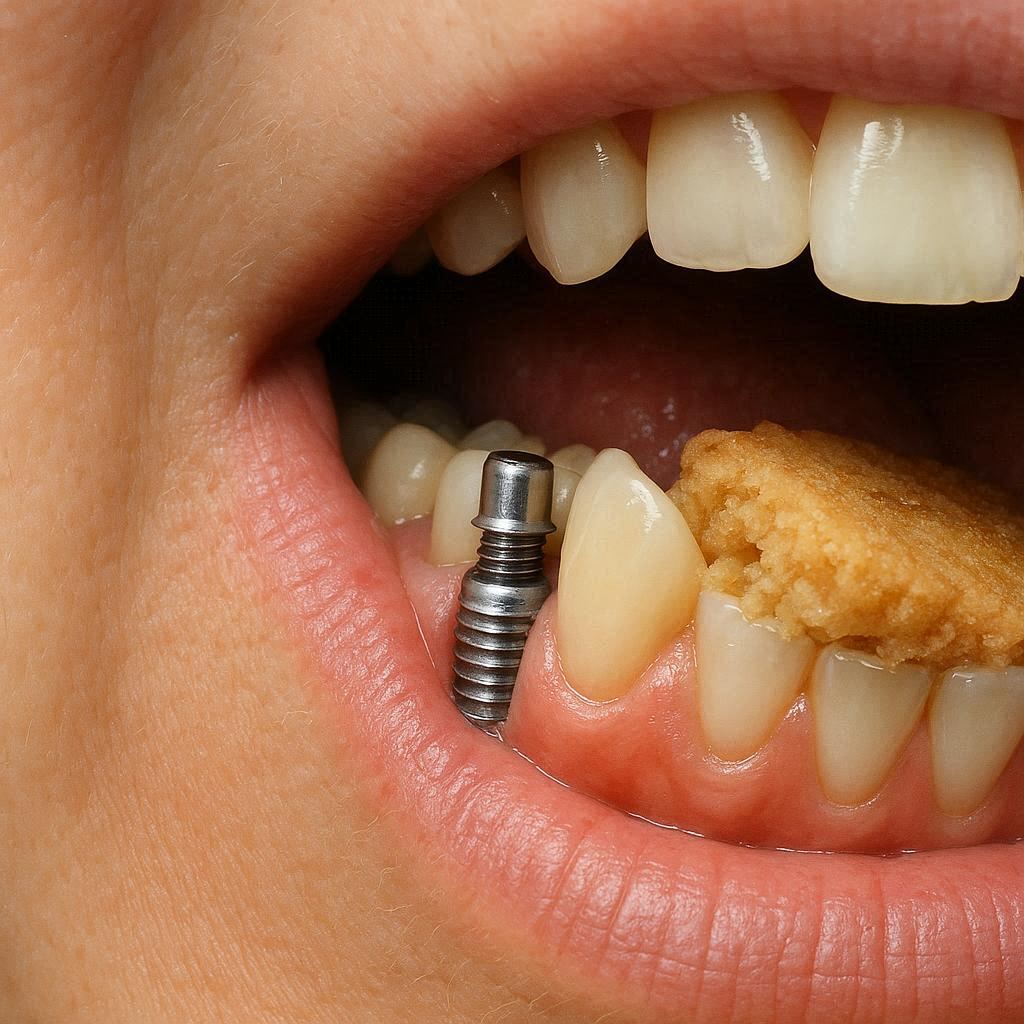
- The gum pulls away from the implant (you might see the metal threads).
- Pain when chewing that feels deep and achy.
Why chewing hurts: The infection destroys the bone that holds the implant in place. When you chew, the implant moves microscopically inside the infected socket. That movement triggers pain.
Who is at risk: Patients who smoke, have poor oral hygiene, or have a history of gum disease.
What your dentist will do: This requires professional cleaning under the gum line. In advanced cases, you may need surgery to clean the implant surface and regenerate lost bone.
2. Loose Abutment or Retaining Screw
A dental implant has several parts. The implant screw (the root replacement) goes into your jawbone. The abutment attaches to that screw. And the crown (the fake tooth) attaches to the abutment.
If any screw becomes loose, chewing will hurt.
Symptoms to watch for:
- A clicking or squeaking noise when you chew.
- The crown feels like it wiggles slightly.
- Pain that starts immediately when biting down and stops as soon as you release pressure.
Why chewing hurts: The loose parts shift under pressure. That shifting pinches your gum tissue or puts uneven stress on the implant screw.
Good news: This is one of the easiest problems to fix. Your dentist simply opens the crown, tightens the screw, and reseals the opening. The whole process takes about 15 minutes.
3. Crown or Cement Issues
If your implant crown was attached using dental cement, excess cement can cause big problems.
Sometimes, the dentist leaves a small amount of cement under the gum line. Your body sees this as a foreign object. Inflammation follows.
Symptoms to watch for:
- Localized pain only around that specific implant.
- Gums that bleed easily when touched.
- Pain that feels like pressure building up.
Why chewing hurts: The trapped cement causes chronic inflammation. When you chew, the blood flow increases to the area, and the inflamed tissue screams in protest.
What your dentist will do: Remove the crown, clean off all old cement, and reattach it properly. Sometimes, a laser is used to remove cement remnants from deep under the gum.
4. Occlusal Overload (Too Much Pressure)
Your implant has no periodontal ligament. Natural teeth have this tiny shock-absorbing tissue. It lets them move slightly under pressure. Implants are rigid. They do not move.
If your crown is too high, or if you grind your teeth at night (bruxism), the implant receives excessive force.
Symptoms to watch for:
- Pain that feels like a dull ache deep in the jawbone.
- Discomfort that gets worse throughout the day.
- A crown that touches before your other teeth touch.
Why chewing hurts: Every time you bite, you are slamming the implant into the bone without any cushion. Over time, this can cause bone micro-fractures or bone loss.
Who is at risk: Nighttime teeth grinders, people with misaligned bites, and those who chew very hard foods on one side only.
What your dentist will do: Adjust the crown to reduce contact. If you grind your teeth, you will need a custom night guard.
5. Nerve-Related Pain
The implant could be placed too close to a nerve. This is rare with modern imaging technology (CBCT scans), but it still happens in some cases.
Symptoms to watch for:
- Sharp, electric-shock-like pain when chewing.
- Tingling or numbness in your lip, chin, or gum.
- Pain that radiates to your ear, jaw joint, or temple.
Why chewing hurts: Pressure from chewing pushes the implant against the nerve. It is like pressing on a bruised nerve repeatedly.
What your dentist will do: Refer you to a specialist for a nerve conduction study. Treatment ranges from medication (gabapentin) to, in extreme cases, implant removal.
Note: Nerve-related implant pain is permanent in about 5-10% of cases. This is why choosing an experienced implant dentist matters immensely.
6. Sinus Problems (Upper Implants Only)
If your painful implant is in the upper jaw, specifically the premolar or molar area, your sinuses might be involved.
Symptoms to watch for:
- Pain that feels like sinus pressure (above your tooth).
- Pain that worsens when you bend over or blow your nose.
- A runny nose on only one side.
Why chewing hurts: The implant may be protruding into your sinus cavity. Every time you chew, you irritate the sinus lining. Alternatively, sinusitis (a sinus infection) can push down on the implant from above.
What your dentist will do: Take a special x-ray called a CBCT to see the implant’s position. If it is in the sinus, you may need a sinus lift and repositioning surgery.
7. Incomplete Osseointegration (Failed Healing)
Osseointegration is the process where your jawbone grows around the implant, locking it in place. It takes 3 to 6 months.
If you started chewing hard foods too early, or if you have a medical condition that affects bone healing (like uncontrolled diabetes or osteoporosis), the implant may never fully integrate.
Symptoms to watch for:
- The implant feels mobile (like a loose peg).
- Pain that has been present since the crown was attached.
- A “spongy” feeling when you chew.
Why chewing hurts: The implant is not solidly anchored. Chewing forces cause micro-movements, which hurt and also prevent further bone growth.
What your dentist will do: This is a failure. The implant usually needs to be removed, the bone grafted, and a new implant placed after healing.
Quick Reference Table: Match Your Pain to the Cause
Use this table to narrow down your specific symptoms.
| Type of Pain | Most Likely Cause | Urgency Level |
|---|---|---|
| Sharp, electric-like, with numbness | Nerve proximity | High (see dentist within days) |
| Deep, achy, with bleeding gums | Peri-implantitis | High (see dentist within days) |
| Clicking or wobbling sensation | Loose abutment screw | Moderate (see dentist within weeks) |
| Pressure pain that feels “too high” | Occlusal overload | Low to moderate |
| Pain when bending over (upper jaw) | Sinus involvement | Moderate |
| Constant dull ache since placement | Failed osseointegration | High |
| No visible gum swelling, only pain when biting hard foods | Hairline crack in crown | Low |
What You Can Do at Home (Before Seeing the Dentist)
You should never ignore implant pain. But you also do not need to panic. Here are safe steps to take right now.
Step 1: Change Your Diet
Switch to soft foods for 48 hours. Think yogurt, mashed potatoes, smoothies, scrambled eggs, and soup. Give the area a rest.
Avoid at all costs:
- Hard bread and crusty rolls.
- Nuts and seeds.
- Chewy candies or steak.
- Sticky foods like caramel.
Step 2: Improve Your Oral Hygiene Gently
Use a soft-bristled toothbrush. Gently clean around the implant. Do not scrub hard. Use a water flosser on the lowest setting. This removes food debris without traumatizing the gums.
Step 3: Salt Water Rinses
Mix one teaspoon of salt in a cup of warm water. Rinse for 30 seconds, three times per day. Salt water reduces inflammation and flushes out minor infections.
Step 4: Check for Movement
Using a clean finger or a spoon handle, gently press on the crown from the side. Does it move? Then press straight down. Any clicking or shifting means you need a dentist soon.
Step 5: Over-the-Counter Pain Relief
Ibuprofen (Advil, Motrin) is better than acetaminophen (Tylenol) for implant pain because it reduces inflammation. Follow the package instructions. Do not take pain relievers for more than three days without a diagnosis.
When to Call Your Dentist Immediately
Some symptoms require urgent care. Do not wait for your next cleaning appointment if you experience any of these:
- Fever over 100.4°F (38°C) along with implant pain.
- Swelling that spreads to your face, eye, or neck.
- Pus draining from the gum around the implant.
- Numbness or tingling in your lip or chin that was not there before.
- A mobile implant that moves when you touch it.
These signs point to a spreading infection, nerve damage, or implant failure. All need same-day or next-day attention.
How Dentists Diagnose the Problem
When you visit your dentist for implant pain, here is what to expect. Understanding the process reduces anxiety.
1. Visual Examination
The dentist looks at your gum color, texture, and swelling. They probe around the implant to check for bleeding or deep pockets.
2. Pressure Testing
You will bite down on a special paper or a cotton roll. This shows exactly where the pain originates and whether the crown is too high.
3. X-Rays (Periapical and Panoramic)
Standard x-rays show bone levels around the implant. If the bone looks like a saucer shape (cupping), that indicates peri-implantitis.
4. CBCT Scan (3D Imaging)
If standard x-rays are unclear, you will get a CBCT scan. This shows:
- The exact position of the implant relative to nerves.
- The quantity and quality of remaining bone.
- Whether the implant has broken or the screw is fractured.
5. Mobility Testing
The dentist uses two instruments to rock the implant gently. Any visible movement is abnormal. Natural teeth move less than 0.2 mm. Implants should move zero.
Treatment Options by Diagnosis
Once your dentist knows the cause, they will recommend a specific treatment. Here is what each looks like.
For Peri-Implantitis (Mild to Moderate)
- Non-surgical cleaning: A plastic-tipped ultrasonic scaler and special curettes clean the implant surface.
- Antibiotics: Oral antibiotics (amoxicillin or metronidazole) or localized antibiotic gels (Arestin).
- Laser therapy: A diode laser disinfects the pocket without damaging the implant.
For Peri-Implantitis (Advanced)
- Open flap debridement: The dentist cuts the gum open, cleans the implant threads, and smooths any rough surfaces.
- Bone graft: Synthetic or human bone is packed around the implant to rebuild lost support.
- Implant removal: If more than 50% of bone is lost, removal is the only option.
For Loose Screws or Abutments
- Torque tightening: The dentist uses a calibrated torque wrench to tighten the screw to exactly 20-35 Ncm.
- New screw: If the old screw is stripped or fractured, it is replaced. This costs $50-150.
For Occlusal Overload
- Crown adjustment: The dentist removes 0.1-0.3mm from the crown’s biting surface.
- Night guard: A hard acrylic guard for nighttime teeth grinding ($300-700).
- Equilibration: Minor reshaping of opposing teeth to balance your bite.
For Sinus Involvement
- Observation: If the implant is only 1-2mm into the sinus and you have no symptoms, nothing is done.
- Sinus lift with implant repositioning: The implant is removed, the sinus membrane is lifted, bone graft is placed, and after 6 months, a new implant is placed.
For Nerve Damage
- Observation: Minor nerve irritation often resolves in 3-6 months.
- Corticosteroids: Prednisone reduces nerve inflammation.
- Implant removal: If pain persists after 6 months, removing the implant may relieve pressure on the nerve.
Can a Dental Implant Be Saved If It Hurts?
The short answer is yes, in most cases.
Here are the realistic success rates for saving a painful implant based on the cause:
| Cause | Likelihood of Saving the Implant |
|---|---|
| Loose abutment screw | >98% |
| Excess cement | >95% |
| Occlusal overload | 90% (with night guard) |
| Mild peri-implantitis | 85-90% |
| Moderate peri-implantitis | 70-80% |
| Severe peri-implantitis | <30% |
| Incomplete osseointegration | <10% |
| Nerve damage | 50% (symptoms may remain) |
The earlier you seek treatment, the higher your chances of saving the implant. Do not wait “to see if it gets better.”
Preventing Implant Pain Before It Starts
An ounce of prevention saves you thousands of dollars and months of discomfort.
1. Choose the Right Dentist (The First Time)
Implant success depends heavily on the surgeon’s skill. Look for:
- A periodontist or oral surgeon with 5+ years of implant experience.
- The use of CBCT scanning for all implant placements.
- Published before-and-after cases similar to yours.
2. Commit to Professional Maintenance
Dental implants need professional care every 6 months. A regular hygienist cleaning is not enough. You need an implant-specific cleaning with plastic instruments (metal scalers scratch implants and invite bacteria).
3. Master Home Care for Implants
You cannot clean an implant like a natural tooth. Use these tools:
- Superfloss or implant floss: Has a stiff end to thread under the crown.
- Interdental brushes (e.g., TePe): Choose a size that fits snugly around the abutment.
- Water flosser: Use on medium setting with a special implant tip.
- No metal tools at home: Never use metal picks or scrapers near your implant.
4. Wear a Night Guard If You Grind
Bruxism is the silent killer of implants. Most patients do not know they grind. Signs include:
- Waking up with jaw soreness.
- Flat or chipped natural teeth.
- Your partner says you make grinding sounds at night.
A custom night guard costs $400-800 but protects a $5,000 implant. It is a bargain.
5. Manage Your Health Conditions
Certain medical issues dramatically increase implant pain risk. Be honest with your dentist about:
- Diabetes: Keep your HbA1c under 7.0% before getting an implant.
- Osteoporosis medications (bisphosphonates): These increase the risk of bone death (osteonecrosis).
- Autoimmune diseases: Conditions like rheumatoid arthritis slow healing.
- Smoking: Smokers have a 3x higher failure rate. Quit or switch to nicotine patches.
Realistic Costs: Diagnosis and Treatment of Painful Implants
Here is what you might pay in the United States (without insurance, since most dental insurances cover little for implants).
| Service | Average Cost |
|---|---|
| Emergency exam + x-ray | $150 – $300 |
| CBCT scan (3D imaging) | $350 – $650 |
| Tightening a loose screw | $150 – $350 |
| Crown adjustment | $100 – $250 |
| Peri-implantitis cleaning (per quadrant) | $300 – $800 |
| Open flap debridement (surgical cleaning) | $1,200 – $2,500 |
| Night guard (custom hard acrylic) | $400 – $800 |
| Implant removal only | $500 – $1,000 |
| Implant removal + bone graft | $1,500 – $3,000 |
| New implant placement (after healing) | $3,500 – $6,000 |
Insurance note: Some medical insurance plans cover implant removal if it is deemed medically necessary due to infection. Check your policy.
Frequently Asked Questions (FAQ)
Q1: Can dental implant pain go away on its own?
A: Rarely. If the pain is from a piece of trapped food, it might resolve after thorough cleaning. But true implant pain from loose screws, infection, or overload will not improve without dental treatment. Waiting usually makes it worse.
Q2: Why does my implant only hurt when I chew hard foods?
A: This suggests the crown is too high (occlusal overload) or there is a hairline crack in the crown. Soft foods do not generate enough force to trigger the pain. Hard foods reveal the problem.
Q3: Is it normal for a new implant to hurt after one year?
A: No. If your implant healed correctly and felt fine for 12 months, new-onset pain is not normal. Something has changed in the bone, gum, or hardware.
Q4: Can I use a Waterpik on a painful implant?
A: Yes, but use the lowest pressure setting and a specialized implant tip. High pressure can force bacteria deeper into an already infected pocket.
Q5: How long does implant pain last after tightening a loose screw?
A: Most patients feel immediate relief during chewing. You may have mild soreness in the gum for 2-3 days from the manipulation. This is normal.
Q6: Will antibiotics fix my painful implant?
A: Antibiotics can temporarily reduce infection symptoms, but they will not fix the underlying mechanical problem (loose screw, high crown, broken implant). You need a dentist to address the root cause.
Q7: Can an implant hurt years later because of gum recession?
A: Yes. As gums recede naturally with age, the implant abutment becomes exposed. The exposed metal can trap plaque, leading to inflammation and pain when chewing.
Q8: What happens if I ignore implant pain for six months?
A: The most common outcome is advanced bone loss, followed by implant failure. You will lose the implant and likely need a bone graft before a replacement. The graft adds 6 months and $2,000-4,000 to the process.
Additional Resource
For a detailed, step-by-step maintenance guide approved by the American Academy of Implant Dentistry, visit:
American Academy of Implant Dentistry (AAID) – Patient Education Library
Link: aaid.com/patient-resources/implant-maintenance
This free resource includes video demonstrations of proper flossing techniques, a checklist for choosing an implant dentist, and printable home care charts.
Conclusion
Dental implant pain when chewing is never normal, but it is almost always treatable. In three lines: Most causes range from a simple loose screw (fixed in 15 minutes) to peri-implantitis (requires professional cleaning). The sooner you see your dentist, the higher the chance of saving your implant without surgery. Do not ignore the pain—schedule an evaluation, switch to soft foods, and gently clean the area while you wait for your appointment.
Disclaimer: This article is for informational purposes only and does not constitute medical advice. Dental implant treatments vary based on individual anatomy, medical history, and the specific implant system used. Always consult with a licensed dentist or dental specialist for a proper diagnosis and treatment plan. The author and publisher disclaim any liability for any adverse effects arising from the use or application of information contained in this article.