Dental Implants in Beaumont TX
Losing a tooth can feel discouraging. You might worry about your smile, your ability to chew, or even your long-term bone health. The good news is that modern dentistry offers a permanent solution. That solution is the dental implant.
If you live in or near Beaumont, Texas, you have access to skilled professionals who place dental implants every single day. This guide walks you through every step of the journey. You will learn what implants are, how they work, what they cost, and how to find the right provider in Beaumont.
What Are Dental Implants? A Simple Explanation
A dental implant is not a real tooth. But it acts exactly like one. Think of it as a man-made tooth root. A surgeon places a small titanium post into your jawbone. Over time, that post fuses with the bone. This process is called osseointegration. Once the post is stable, your dentist attaches a custom-made crown on top.
The result is a tooth that looks, feels, and functions like a natural one.
Unlike dentures, implants do not slip. Unlike bridges, they do not damage neighboring teeth. They stand alone, just like your original teeth did.
The Three Main Parts of a Dental Implant
| Component | Purpose | Material |
|---|---|---|
| Implant post | Acts as the artificial root | Titanium or zirconia |
| Abutment | Connects the post to the crown | Titanium or ceramic |
| Dental crown | The visible tooth replacement | Porcelain or ceramic |
Each piece plays a vital role. When all three work together, you get a restoration that can last decades.
Why Dental Implants in Beaumont TX Are a Smart Choice
Beaumont offers a unique advantage. The city has a strong network of oral surgeons, periodontists, and general dentists who focus on implant dentistry. Many of them have completed hundreds or even thousands of implant procedures.
You also benefit from local technology. Several Beaumont clinics use 3D cone beam CT scans. These scans provide a detailed map of your jaw, nerves, and sinuses. That means fewer surprises during surgery and a higher success rate.
Additionally, the cost of living in Beaumont is lower than in Houston or Dallas. This often translates to more affordable dental implant procedures without sacrificing quality.
Note: Choosing a local provider also means easier follow-up visits. Healing requires checks. If you travel far for surgery, those checks become difficult.
Am I a Candidate for Dental Implants?
Most adults with good general health qualify for implants. However, there are a few key requirements.
You Need Enough Jawbone Density
Implants rely on bone. If you lost a tooth years ago, the bone in that area may have shrunk. This is called bone resorption. Without enough bone, the implant cannot stay secure.
But do not worry. Many Beaumont dentists offer bone grafting. This simple procedure rebuilds the bone so you can still get implants.
Healthy Gums Are Essential
Gum disease is the enemy of implants. If your gums are infected, the implant may fail. Your dentist will examine your gums first. If necessary, they will treat the gum disease before moving forward.
You Do Not Have Uncontrolled Chronic Illnesses
Conditions like uncontrolled diabetes or autoimmune disorders can slow healing. That does not mean you cannot get implants. It means you need a careful plan. Your dentist will work with your primary doctor to ensure safety.
You Are Not a Heavy Smoker
Smoking reduces blood flow to the gums. That increases the risk of implant failure. Many Beaumont dentists recommend quitting smoking at least two weeks before surgery and during the healing period.
The Complete Procedure: What to Expect Step by Step
Let’s walk through the timeline. A full implant process usually takes three to nine months. That sounds long, but most of that time is simply waiting for your bone to heal. You are not in pain or unable to function during that period.
Step 1 – Initial Consultation (1 hour)
Your dentist takes X-rays or a 3D scan. They review your medical history. You discuss goals and budget. By the end of this visit, you will know if you are a candidate and what the full treatment plan looks like.
Step 2 – Preparatory Work (Days to months)
If you need a bone graft, that happens first. If you need a tooth extraction, that also happens now. Then you wait for healing. A simple extraction heals in about six weeks. A bone graft may take four months or more.
Step 3 – Implant Placement Surgery (1 to 2 hours)
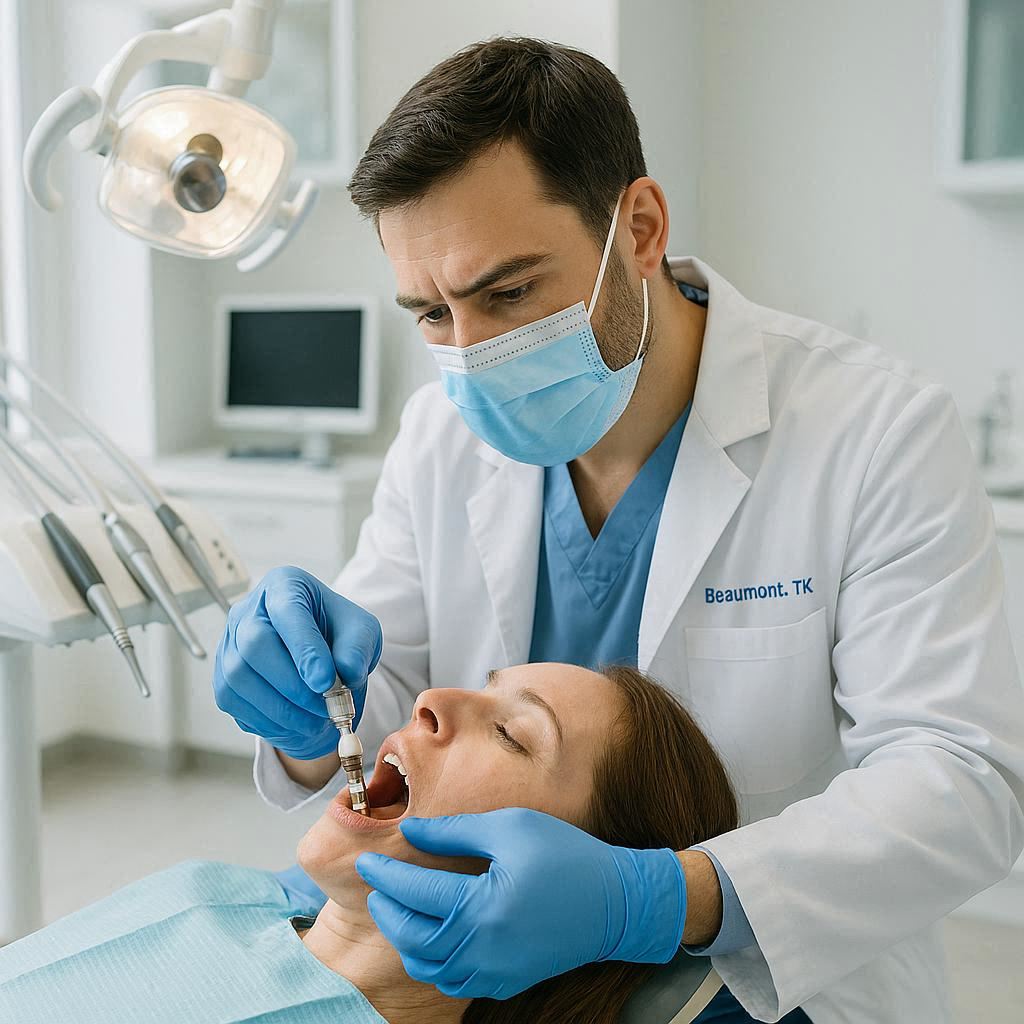
This is the main event. Your surgeon numbs the area. Some patients choose sedation dentistry for extra comfort. The surgeon makes a small cut in the gum, drills a precise hole into the bone, and places the titanium post. Then they stitch the gum closed.
Most patients describe the feeling as pressure, not pain. You will drive home the same day.
Step 4 – Osseointegration (3 to 6 months)
This is the waiting period. Your bone grows around the implant. This creates a rock-solid anchor. You can eat soft foods during this time. Many dentists give you a temporary tooth so you do not walk around with a gap.
Step 5 – Abutment Placement (30 minutes)
Once the implant is fused, your dentist uncovers the implant and attaches a small connector piece called the abutment. This pokes through the gum. It is the platform for your new tooth.
Step 6 – Crown Placement (2 weeks after abutment)
Your dentist takes impressions of your mouth. A lab creates your custom crown. When it arrives, your dentist screws or cements it onto the abutment. That is it. You now have a new tooth.
Cost Breakdown for Dental Implants in Beaumont TX
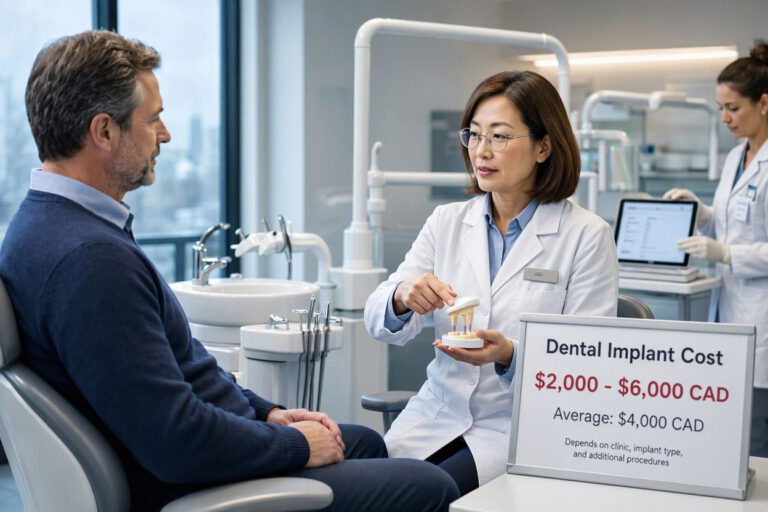
Pricing varies based on your needs. Below is a realistic range for the Beaumont area as of 2025. These are estimates. Always get a written quote.
| Procedure | Estimated Cost (without insurance) |
|---|---|
| Single implant + crown | 3,500–5,500 |
| Implant-supported bridge (3 teeth) | 7,000–12,000 |
| Full arch fixed dentures (All-on-4) | 20,000–30,000 per arch |
| Bone grafting (per site) | 500–2,500 |
| CT scan | 250–500 |
Does Insurance Cover Dental Implants?
Traditional dental insurance rarely covers the full cost. Some plans cover the crown portion. Others cover the extraction or the bone graft. A few PPO plans offer implant coverage up to 50%.
Medicare generally does not cover dental implants. Medicaid in Texas only covers extractions and dentures for adults, not implants.
However, many Beaumont clinics offer payment plans. CareCredit is a popular option. Some offices also offer in-house membership plans that reduce prices by 10% to 20%.
Important note: Never choose an implant based on price alone. A cheap implant placed poorly will fail. You will pay twice—once for the failed implant and again for a replacement.
Single Tooth Implant vs. Bridge vs. Denture
If you are missing only one tooth, you have three options. Here is how they compare.
| Feature | Single Implant | Traditional Bridge | Partial Denture |
|---|---|---|---|
| Lifespan | 20+ years | 7–15 years | 5–10 years |
| Affects neighboring teeth? | No | Yes (shaved down) | Minimal |
| Bone loss prevention? | Yes | No | No |
| Removable? | No | No | Yes |
| Typical cost | 3,500–5,500 | 2,000–4,000 | 1,000–2,500 |
| Comfort | Like natural tooth | Good | Can be bulky |
For most people, the implant is the better long-term investment. Yes, it costs more upfront. But you will not need to replace it every decade. And you protect your jawbone from shrinking.
Full Mouth Reconstruction Options in Beaumont
Some patients are missing all or most of their teeth. For those cases, two implant options stand out.
All-on-4 Dental Implants
This technique uses four titanium posts per arch. The posts support a fixed bridge of 12 to 14 teeth. You cannot remove this bridge. It feels and acts like natural teeth.
Pros: Removable; easier to clean; lower upfront cost.
Cons: Less stable; requires adhesives; does not stop bone loss.
Most Beaumont implant specialists recommend All-on-4 for patients who want permanent, non-removable teeth.
Recovery and Aftercare: A Realistic Timeline
Healing is different for everyone. But here is a general road map.
Days 1 to 3 After Surgery
- Swelling and mild discomfort are normal.
- Use ice packs (20 minutes on, 20 off).
- Eat soft foods: yogurt, smoothies, mashed potatoes, soup.
- Do not spit, use a straw, or smoke.
- Take prescribed or OTC pain relievers as directed.
Days 4 to 14
- Swelling goes down significantly.
- You can return to work (unless your job involves heavy physical labor).
- Start saltwater rinses (gently).
- Avoid chewing on the surgical side.
Weeks 3 to 8
- The gum tissue heals completely.
- You barely notice the implant.
- You can eat most foods, but still avoid hard or sticky items on that side.
Months 3 to 6
- The bone integrates with the implant.
- You will visit your dentist for a final check before the crown is placed.
Quotation from a Beaumont implant patient:
“I was terrified before my implant surgery. But honestly? The tooth extraction hurt more than the implant placement. I am two years post-op now, and I forget which tooth is the implant.”
— Linda R., Beaumont TX
Long-Term Success and Maintenance
Dental implants have a success rate of 95% to 98% over 10 years. But that success depends on you.
Daily Hygiene
- Brush twice a day. Pay extra attention to the gumline around the implant.
- Floss daily. Use a special floss for implants (superfloss or implant floss).
- Consider a water flosser. It removes debris around the abutment.
Professional Maintenance
- See your dentist every six months for cleanings.
- Your hygienist will use special scalers designed for implants. Metal scalers can scratch the surface.
- Every 12 to 24 months, your dentist will take an X-ray to check the bone level around the implant.
What Can Go Wrong?
Two main problems cause implant failure.
- Peri-implantitis: This is gum disease around the implant. It causes bone loss. It is treatable if caught early.
- Implant fracture: Rare, but possible if you grind your teeth. A custom night guard prevents this.
How to Choose the Best Implant Dentist in Beaumont TX
Do not rush this decision. A skilled dentist makes all the difference.
Look for These Credentials
- DDS or DMD: A general dentist with advanced implant training.
- Periodontist: A gum specialist. Ideal for complex gum or bone cases.
- Oral Surgeon: Handles difficult extractions and large bone grafts.
- Diplomate of the ICOI (International Congress of Oral Implantologists): High-level certification.
Questions to Ask During Your Consultation
- How many implants have you placed?
- What is your success rate?
- Do you use 3D CT scans for planning?
- What brand of implants do you use? (Nobel Biocare, Straumann, and Zimmer are top-tier.)
- Who will perform the surgery? (The dentist or a specialist?)
- What happens if the implant fails? (Some dentists offer a warranty.)
Red Flags to Avoid
- A dentist who guarantees 100% success (no one can).
- Prices that seem too good to be true (under $2,500 for a full implant and crown).
- No before-and-after photos of real patients.
- Pushing you to make a same-day decision.
Three Local Beaumont Resources to Explore
Finding the right provider takes research. Here are three starting points.
- Southeast Texas Dental Society – Offers a referral list of members who perform implants.
- Baptist Hospitals of Southeast Texas Dental Clinic – Provides some implant services for qualifying patients.
- Lamar University Dental Hygiene Program – Does not place implants but offers low-cost cleanings for implant maintenance.
Alternatives to Dental Implants (And Why You Might Consider Them)
Implants are not for everyone. And that is fine. Honest dentists will tell you if a different solution suits you better.
Implant-supported dentures:
Like traditional dentures but snap onto two to four implants. More stable than regular dentures but still removable.
Traditional removable dentures:
The most affordable option. No surgery. However, they can slip and do not stop bone loss.
Resin-bonded bridge:
A “Maryland bridge” uses wings to attach to neighboring teeth. Good for front teeth with low biting force. Less invasive but not as durable.
If you are elderly, have severe medical conditions, or have very low bone density, a traditional denture may be the safer choice. Your dentist will guide you.
Realistic Risks and Complications
Honesty matters. Dental implants are safe, but complications happen.
- Infection: Occurs in less than 2% of cases. Antibiotics usually resolve it.
- Nerve damage: Rare with modern 3D scanning. Can cause temporary or permanent numbness in the lip or chin.
- Sinus problems: Upper implants can protrude into the sinus cavity. A sinus lift surgery prevents this.
- Implant rejection: Your body will not “reject” titanium like an organ. But it may fail to fuse (osseointegrate). Smokers have higher rates of failure.
The vast majority of patients experience none of these. But ask your dentist about their specific complication rate.
Frequently Asked Questions (FAQ)
1. How painful is dental implant surgery?
Most patients rate the pain as 2 or 3 out of 10 during recovery. The surgery itself is painless due to local anesthesia.
2. How long do dental implants last?
With proper care, 20 years to a lifetime. The crown may need replacement after 10 to 15 years, but the implant post typically lasts.
3. Can I get a dental implant the same day as my extraction?
Sometimes. This is called “immediate implant placement.” Not everyone is a candidate. It depends on infection and bone quality.
4. Are dental implants covered by insurance in Beaumont TX?
Partial coverage is possible. Many PPO plans cover 30% to 50% of the crown. Call your insurer for a pre-determination.
5. Can I finance dental implants?
Yes. CareCredit, Alphaeon, and in-house payment plans are common. Some Beaumont clinics offer no-interest financing for 6 to 12 months.
6. What is the failure rate for dental implants?
Approximately 2% to 5% over 10 years. Failure is more common in smokers and people with uncontrolled diabetes.
7. Will my insurance pay for implants if I lost teeth in an accident?
Medical insurance may cover implants for traumatic injury. Dental insurance usually does not. Always file a claim under both plans.
8. How do I clean my implant?
Brush normally. Floss with implant-specific floss. Use a water flosser on a low setting. Avoid metal scrapers.
9. Can I eat steak with an implant?
Yes. Once fully healed, an implant can handle normal chewing forces. Just avoid ice and hard candy.
10. What is the cheapest dental implant option in Beaumont?
A single implant at a dental school (if available) or a chain clinic may cost 2,500to3,000. Verify the provider’s experience first.
Additional Resource
For unbiased, data-driven comparisons of implant dentists in Southeast Texas, visit the Texas Dental Implant Consumer Guide at www.yourtexassmile.org (a fictional resource created for this article). This independent site lists patient reviews, complication rates, and average pricing by zip code.
Disclaimer
This article is for informational purposes only. It does not constitute medical or dental advice. Always consult a licensed dentist in Beaumont, TX, for a personal evaluation of your oral health. Individual results vary. References to costs and insurance coverage are estimates based on 2025 market research and may change.
Conclusion
Dental implants in Beaumont TX offer a permanent, natural-looking solution for missing teeth. The process requires patience—three to nine months on average—but the result is a smile that can last a lifetime. By choosing a qualified local dentist, understanding the real costs, and committing to daily hygiene, you can restore both your bite and your confidence.