Dental Implants in Ohio
Losing a tooth changes everything. It changes how you smile in family photos. It changes how you enjoy a steak dinner. It even changes the shape of your face over time. You want a permanent solution, not a quick fix that needs replacing every few years. You are looking for stability. You are looking for confidence. You are here because you have heard that dental implants are the gold standard, but you have questions. Big ones. How much does it really cost in Ohio? Will my insurance cover it? How do I find a doctor who won’t mess this up?
We are going to walk through this together. No dental jargon that makes your head spin. No pie-in-the-sky promises. Just the honest, grounded reality of getting dental implants in the Buckeye State. By the time you finish reading, you will have the roadmap you need to make a decision you feel good about.
The True Definition of a Dental Implant
Before we talk about money and surgeons, let’s get on the same page about what we are putting in your body. A dental implant is not just a “fake tooth.” That would be like calling a smartphone just a “screen.”
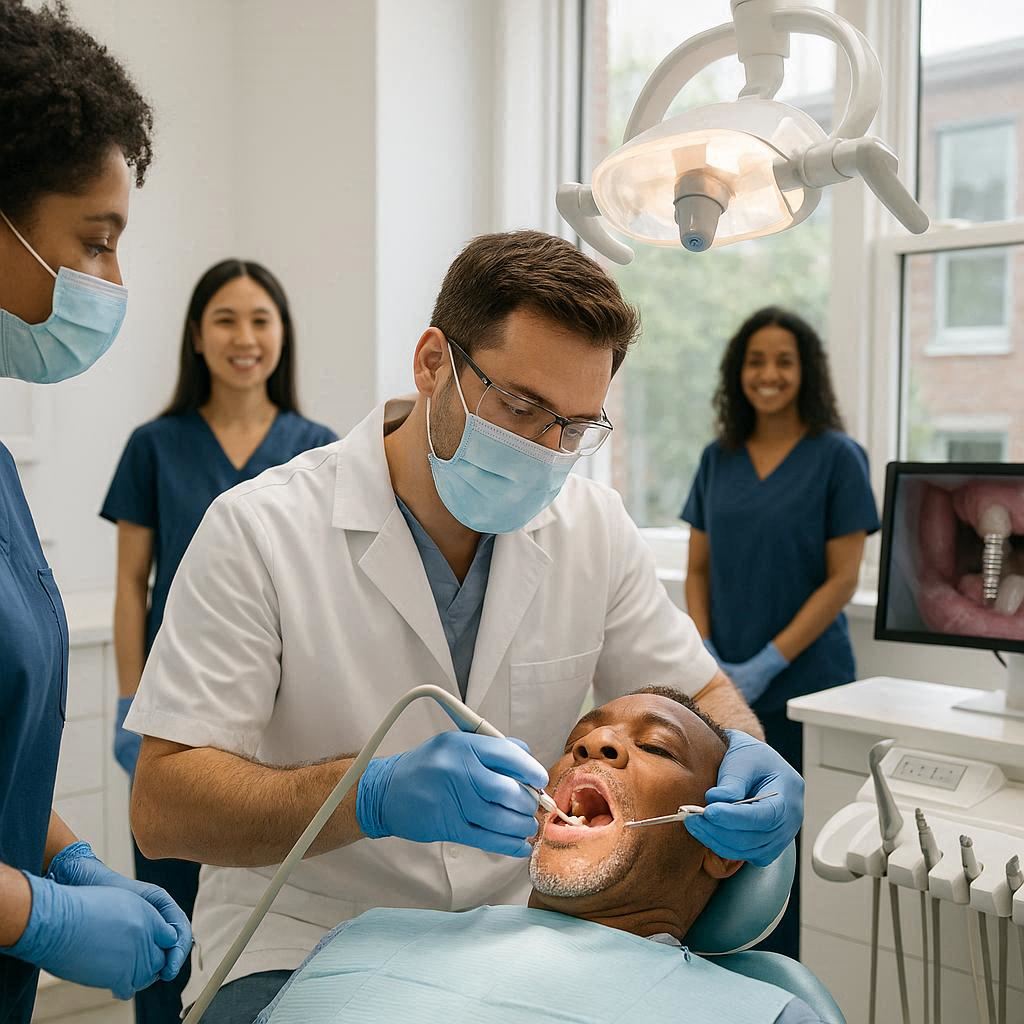
A dental implant is a three-part system designed to mimic nature. The star of the show is the implant post. This looks like a small screw, usually made of medical-grade titanium. It goes into your jawbone where the root of your tooth used to be. This is what creates the legendary stability.
Next, you have the abutment. Think of this as the connector piece. It screws into the implant post and sits right at the gum line. Its only job is to hold the final piece.
The final piece is the crown. This is the part the world sees. It is custom-made to match the exact shape and shade of your surrounding teeth. When someone says “dental implants in Ohio,” they are talking about this entire system—root, connector, and tooth—all working as one unit.
Why Titanium Became the Gold Standard
You might wonder why dentists put a metal screw in your jaw. It sounds intense, but the science is beautiful. Titanium is biocompatible. Your body doesn’t recognize it as a foreign invader. Instead of fighting it, your jawbone actually grows right up to the surface of the titanium and locks it in place.
This process is called osseointegration. It is the single greatest breakthrough in modern dentistry. A Swedish researcher named Per-Ingvar Brånemark discovered it by accident in the 1950s, and it has given millions of people their lives back. When you choose a quality implant in Ohio, you are banking on decades of this proven science.
Single Tooth vs. Full Arch: Understanding the Scale
We need to clarify the scope of your project because the journey is vastly different depending on how many teeth you have lost.
The Solitary Missing Tooth
You lost one tooth to a bike accident in your twenties or maybe a cracked molar in your forties. The teeth on either side are perfectly healthy. This is the simplest scenario. The dentist places one post, one abutment, and one crown. You can literally forget it’s there and treat it like a normal tooth.
The Multiple Tooth Gap
You are missing three or four teeth in a row. In the past, dentists would shave down your healthy teeth to anchor a bridge. With implants, we avoid that carnage. The oral surgeon will place an implant at the two ends of the gap, and a custom bridge will connect them. This leaves your healthy teeth untouched and fills the space perfectly.
The Full Arch Collapse
You have lost all your teeth in the upper jaw, lower jaw, or both. This is a different ballgame. You aren’t just dealing with aesthetics; you are dealing with bone loss and nutritional issues. You don’t need an implant for every single tooth. Techniques like the All-on-4® use just four to six strategically placed implants to support a permanent, full arch of teeth. This is often the life-changing transformation you see in before-and-after photos.
A Critical Note on State-Specific Nuances
You can read a generic guide about dental implants anywhere on the internet. But here is the Ohio-specific truth: location dictates leverage. The experience of getting implants in downtown Columbus is different from getting them in rural Athens or a Cleveland suburb.
Costs shift. Access to technology shifts. Ohio has a high concentration of world-class dental education programs, like The Ohio State University College of Dentistry. This means we have a steady stream of highly trained specialists. However, it also means you have to wade through more options to find the right fit. This guide is built for the Ohioan who wants to navigate these specific waters.
The Unvarnished Cost of Dental Implants in Ohio
Let’s rip the bandage off. This is the question that keeps you up at night. You’ve likely seen ads for “cheap dental implants” on social media. Then you call a private practice in a wealthy suburb and get quoted a price that feels like buying a used car. Why the massive gap? In Ohio, the cost of dental implants isn’t a fixed number. It is a formula.
We need to break down the hard costs, the hidden costs, and the regional price differences between Ohio’s major cities. We are not going to give you a single unrealistic number. We are going to give you a realistic range that prepares you for the consultation table.
Average Cost Breakdown by Component
If you walk into a clinic, they usually give you a bundled price. But if you want to understand what you’re paying for, you have to look at the individual line items. The single implant post is often the most expensive piece of hardware in the room.
Typical Cost Segments for a Single Tooth:
- Initial Consultation & 3D Imaging: The first visit usually isn’t free unless it’s a specific promo. Comprehensive cone beam computed tomography, or CBCT, scans are crucial. Ohio specialists charge between $150 and $450 for this mapping. Skip a clinic that wants to do surgery without a 3D scan.
- The Implant Post Surgery: The act of placing the titanium screw into the bone will run from $1,200 to $2,500. A periodontist or oral surgeon will sit at the higher end of that scale. A general dentist at the lower end. This price includes the local anesthetic and the surgical guide.
- The Abutment: The little connecting piece often gets forgotten in initial quotes. It costs between $300 and $600. Ensure your quote includes it so you aren’t surprised later.
- The Custom Crown: This is where craftsmanship matters. A crown milled from a block of layered porcelain (like e.max or zirconia) in a high-end Ohio lab can cost between $1,000 and $2,500. A cheaper lab might offer a fused-to-metal crown for less, but the aesthetics can suffer.
Realistic Total Range:
For a single, straightforward implant in Ohio, without complications, prepare to invest between $2,800 and $6,000 from start to finish. Anyone charging significantly less than $1,500 for the entire process is likely cutting a dangerous corner, often by skipping the custom abutment or using a subpar implant brand.
Regional Price Variations: Cleveland, Columbus, and Cincinnati
Your zip code inside Ohio directly impacts your wallet. The cost of living and the saturation of specialists create distinct micro-markets.
To give you a realistic snapshot, we analyzed the average ranges reported for a single standard implant (post placement only, excluding the crown) across the three major metropolitan hubs. Keep in mind, these are guideposts, not fixed quotes.
| Metropolitan Area | Market Characteristic | Average Cost per Implant (Surgery Only) | Note for Patients |
|---|---|---|---|
| Columbus | High competition, university influence, high insurance penetration. | $1,400 – $2,200 | Costs are stabilized by the sheer volume of providers. Look for OSU alumni in private practice for a blend of research-based care and fair pricing. |
| Cleveland | Older population demographics, high medical integration, established long-standing practices. | $1,600 – $2,500 | You pay for legacy reputations. Suburbs like Beachwood or Pepper Pike often run higher than the city center practices. |
| Cincinnati | Tri-state fluctuation, corporate chain expansion, mix of white and blue-collar density. | $1,300 – $2,300 | The Northern Kentucky drift effect keeps prices competitive. You’ll find more bargains here, but vet the training carefully. |
The “Ohio Tooth Tax”: Additional Procedures You Didn’t Expect
Here is the harsh reality. The “sticker price” of an implant is rarely the final price. The implant is the star, but the stage might be rotten. If your tooth has been missing for years, your body has already dismantled the supporting structure. We call this resorption. You cannot put a new screw in a disappearing jawbone.
These are the “add-ons” that inflate the bill. A good Ohio dentist will diagnose these. A bad one will ignore them just to get your business, and you will suffer implant failure later.
Bone Grafting (The Foundation Repair)
When a tooth is gone, the body reabsorbs the calcium in that spot. If the bone is too thin or short, a surgeon must add grafting material. In Ohio, a minor socket graft (done at the time of extraction) adds $400 to $900. A major block graft (taking bone from another part of your jaw or using donor material) can add $1,500 to $3,500. If you need a sinus lift because the sinus cavity is drooping too close to the upper jaw, you are looking at a similar range.
Periodontal Therapy (The Ground Clearing)
Implants require a sterile environment. If you have gum disease, it is like building a mansion on a swamp. You must clear the infection first. A deep cleaning (scaling and root planing) for the whole mouth ranges from $800 to $1,800 before you can even schedule the implant surgery.
Full Mouth Implants: The Reality Check
You have seen the billboards: “New Teeth in a Day.” “Full Mouth Implants for $19,999.” These offers exist in Ohio, but they come with very specific fine print. You need to understand the difference between a fixed permanent bridge and a snap-on overdenture. The price gulf is massive.
The Premium Permanent Fix
The All-on-4 or All-on-6 protocol replaces an entire arch. The surgeon places four or six implants, and a milled titanium or zirconia bar is screwed into them, holding a full set of high-end acrylic or porcelain teeth. This does not come out. Only a dentist can remove it. In Ohio, a single arch of this nature ranges from $18,000 to $30,000. A full mouth (upper and lower) sits firmly in the $35,000 to $55,000 range. The higher end includes definitive zirconia bridges, which are nearly indestructible and look incredibly natural.
The Budget-Friendly Snap-On
This is often the fine print behind the “affordable” ads. You receive two to four implants, and a denture with locator snaps clips onto them. You take it out at night. It feels hard on the roof of the mouth like a standard denture, but it locks in place when you bite. This is a massive upgrade from floating dentures. In Ohio, you can often get a snap-on arch for $8,000 to $14,000 per arch. It is life-changing for someone on a fixed income, but do not confuse it with the “no plastic on the roof of the mouth” feel of a permanent bridge.
How to Choose a Clinic and Surgeon in Ohio
The hand holding the drill matters more than the brand of the implant. Ohio has a deep bench of talent, but it also has corporate mills that prioritize volume over anatomy. You are hiring a person, not a building. You need to know the difference between a general dentist who places implants on Tuesdays and a board-certified specialist who does nothing else.
The Specialist vs. General Dentist Blind Spot
In Ohio, any licensed dentist can legally place an implant. You do not need a specialty license. This is terrifying if you think about it.
A Periodontist specializes in the gums and bone—the “foundation” of your mouth. They spend three extra years in residency training on surgical techniques and managing complications. They usually place the implant and manage the bone grafting, then send you back to a general dentist for the crown.
An Oral and Maxillofacial Surgeon specializes in surgery of the mouth, jaws, and face. They hold both a dental degree and a medical license track in training. They handle complex cases, zygomatic implants, heavy sedation, and anatomy that is dangerously close to nerve canals.
A Prosthodontist is the architect. They rarely place the post themselves, but they design the final smile. For full mouth rehabilitation, you want a prosthodontist directing the plan.
If a general dentist is placing a single implant in a very straightforward, non-cosmetic zone, that is fine. If they are planning a full arch restoration involving your sinus cavity and nerve canals, you want a team approach led by specialists.
Red Flags in a Consultation
A consultation shouldn’t feel like a timeshare pitch. It should feel like a medical exam. Here is what sends up warning flares in Ohio clinics:
- The Panorex Trap: If they take only a flat, two-dimensional panoramic x-ray and move straight to scheduling surgery, walk out. You need a 3D CBCT scan. The inferior alveolar nerve in the lower jaw is not visible in a flat x-ray. Hitting it causes permanent numbness. A CBCT scan is non-negotiable.
- The “Clearance Sale” Price: An implant for $799 total. That price doesn’t cover the lab bill for a quality crown in Ohio, let alone the surgical tray and implant cost. They are likely using bargain implants from unverified overseas manufacturers or slapping a cheap stock crown that doesn’t fit.
- The One-Stop Shop Speed: “We can pull the tooth, place the implant, and put the tooth on all in one hour.” Immediate load implants can work, but only in perfect bone conditions. If they don’t explain the risk of the implant failing to integrate because you bit on it too soon, they are not being honest.
Questions You Must Ask Your Ohio Surgeon
Go into your consultation with a notebook. If the surgeon is annoyed by these questions, you have your answer.
- “How many of these exact procedures did you perform last year?” A volume of 100+ per year usually indicates smooth sailing.
- “What system are you using, and why?” They should name a major brand like Straumann, Nobel Biocare, or BioHorizons without blinking. These companies invest billions in surface technology. “It’s just a generic implant” is a red flag.
- “What is your salvage protocol?” If this fails, who fixes it and who pays for it? A confident surgeon has a clear, written warranty on the implant post.
- “Will you use a surgical guide?” For full arches, a 3D-printed surgical guide based on the CBCT scan is mandatory. Free-handing multiple implants is like playing darts with your bone.
“In our practice, we follow the prosthetically driven implantology philosophy. We start with the final perfect tooth position in virtual software, and then we place the implant where the engineering dictates. We never place an implant where the bone just happens to be and hope the tooth fits. That is how you lose bone and aesthetics.”
That is the standard of care you are looking for.
The Dental Implant Procedure: An Ohio Timeline
You now know the costs and how to pick the doctor. But what will your life look like for the next few months? You need to plan your calendar. You need to know when you will be on soft foods, when you will show up to a wedding with a gap, and when you will smile with a final tooth.
This is not a one-day event. It is a biological healing journey, and Ohio’s weather doesn’t change the science. Let’s break it down into the distinct chapters of your transformation.
Chapter 1: The Diagnostic Deep Dive
The surgery doesn’t start in your mouth. It starts on a computer screen. Your Ohio dentist takes a 3D CBCT scan. You see your skull, your nerve pathways, your sinuses, and the density of your bone. This usually happens at the very first appointment.
After the scan, they often take digital impressions. No more goopy, gag-inducing trays. A small wand scans your teeth optically. The dentist imports the 3D scan and the digital impression into surgical planning software. They perform the entire surgery virtually first. They measure the bone to the millimeter. They choose the exact diameter of the implant. If you are anxious, this is the point where you discuss sedation options. In Ohio, oral conscious sedation (a pill) is very common for single implants, while IV sedation is standard for full arch cases.
Chapter 2: Extraction and Bone Preservation
If the broken tooth is still in your mouth, it has to go. The act of pulling a tooth is traumatic. The surgeon will often do a “socket preservation” bone graft right then and there. They pack the empty hole with bone granules and cover it with a collagen membrane.
This adds to the cost, but it is the single smartest investment you can make. If you skip this step, the wall of your socket will cave in over the next three months, forcing you to need a much bigger, more expensive bone graft later. You now wait. The graft needs about 8 to 12 weeks to turn into solid, living bone. You will wear a temporary flipper (a small retainer with one tooth) or a temporary bridge during this phase so you aren’t walking around with a black hole in your smile.
Chapter 3: The Surgical Day
This is the big one. You arrive at the Ohio clinic. If you chose IV sedation, you will be relaxed but technically conscious. You won’t remember much. The room is sterile, and the team is gowned up.
The surgeon makes a small incision in the gum to expose the pristine bone. They use a series of precision drills, guided by a 3D-printed stent, to create an osteotomy—a hole that exactly matches the shape of the implant. The implant is screwed in with a torque wrench. The surgeon isn’t just guessing on tightness; they are hitting a specific torque value called “primary stability.” If it spins in the bone too easily, they might abort and bone graft more. Once the implant is in, they usually place a “healing abutment” (a small metal cap) that pokes through the gum, or they suture the gum completely closed over the buried implant.
You go home with ice packs and a prescription. The pain is usually minimal—more of a dull pressure than sharp pain. Most Ohioans return to desk jobs the next day.
Chapter 4: The Waiting Game (Osseointegration)
Now you wait. And wait. This is the hardest part mentally. You cannot rush biology. The lower jaw usually heals faster (3 to 4 months) because the bone is dense. The upper jaw takes a bit longer (4 to 6 months).
During this phase, “no” means no. No chewing on that side. No poking it with your tongue. No electric toothbrushes directly on the site. The bone cells are slowly crawling onto the titanium surface and locking it into a unit. If you wiggle it, you break those microscopic bonds and the implant fails. In Ohio, this waiting period is sacred to good surgeons.
Chapter 5: The Final Restoration
The bone has locked the implant. You are ready for teeth. The dentist makes a tiny opening if the implant was buried. They attach an abutment. They take another impression—usually digital—of the implant’s exact position. The lab fabricates your crown.
You go in for a “try-in” to check the shape and color before it is glazed and finalized. Then, the final delivery. The dentist torques the abutment down and cements the crown, or they use a screw-retained crown (the preferred method in Ohio high-end practices because it leaves no cement trapped under the gums). You look in the mirror. You see a full set of teeth that feel like your own.
Timeline Comparison: Single vs. Full Arch
| Phase | Single Implant Timeline | Full Arch (All-on-X) Timeline |
|---|---|---|
| Consult to Surgery | 1 to 2 weeks | 3 to 6 weeks (complex planning) |
| Extraction & Grafting | Day 0 (often simultaneous) | Day 0 (often with immediate teeth) |
| Temporary Teeth | Removable flipper or bonded bridge | Fixed temporary bridge screwed in same day |
| Healing Wait | 3 to 6 months (no load) | 3 to 6 months (light load on temporary) |
| Final Restoration | 2 short visits, 2 weeks apart | 1 long fitting visit, final delivery a week later |
Anatomy of Full Arch Solutions in Ohio
We touched on costs earlier, but this section is for the Ohioans who have lost most of their teeth or are about to. You are dealing with a unique misery. Dentures that float. Sore spots. The inability to bite into a fresh apple from an Ohio orchard. You want your life back, and the “All-on-4” marketing has captured your attention.
This is a complex surgery with life-altering outcomes, but the industry is muddy. We must separate the genuine medical protocols from the marketing gimmicks.
All-on-4®: The Brand vs. The Concept
The term “All-on-4” is a registered trademark of Nobel Biocare. It refers to a very specific surgical protocol where two straight front implants and two angled back implants bypass the sinus cavity or nerve canal. The angle allows for a full arch of teeth on just four posts.
However, in Ohio, dentists use the term generically to describe any full-arch treatment with four to six implants. This is not necessarily bad, but you need to know what you are buying. Some Ohio clinics use off-brand implants with the “teeth in a day” concept to cut costs. The original protocol relies on a specialized titanium bar reinforced with acrylic teeth. Cheaper versions might skip the titanium bar and rely solely on acrylic, which leads to fractures of the prosthetic.
The Material War: Acrylic vs. Zirconia
The final bridge material defines your long-term satisfaction and the hole in your budget.
PMMA (Acrylic Hybrid)
This is the standard “interim” material. Most Ohio surgeons give you a milled PMMA bridge for the first 6 to 12 months. It is light, soft on the opposing teeth, and easily adjusted. It wears down over time and stains if you love red wine. It costs less to fabricate. Some budget clinics deliver this as the final product, calling it “reinforced composite.” It will need replacing in 5 to 7 years.
Monolithic Zirconia
This is the premium final option. It is a single block of ceramic, milled by a robot, and then colored by an artist. It has the density of natural teeth. It does not bend. It chips less frequently. It looks astonishingly good. However, it is heavy and very hard. If your bite is not perfectly balanced, it can overload the implants. An experienced Ohio prosthodontist will fine-tune the bite meticulously. Expect a significant cost jump—often $5,000 to $8,000 more per arch than PMMA—for the definitive Zirconia set.
Why “Teeth in a Day” Comes with a Disclaimer
The billboards make it sound like magic. You go in toothless, you leave with teeth. The reality is that you are trading one set of problems for a very strict responsibility. The “teeth” you get on day one are NOT the teeth you keep.
The surgical team screws a lighter, temporary bridge onto the new implants. The implants are fresh. They need absolute stability to heal. The temporary bridge actually acts as a splint, holding the implants together, but it must not take heavy loads. You will be on a rigorous soft-food diet for three months. You will flush the bridge with a Waterpik three times a day. If you cheat and bite a Burger King double cheeseburger on day two, you can easily spin an implant out of the bone, losing it forever.
The final, beautiful permanent bridge comes months later, after the bone has fused perfectly. The “Day” in “Teeth in a Day” refers to the smile, not the full chewing function.
Dental Implants and Insurance in Ohio
This is the part of the conversation that makes people sigh. Dental insurance in America is weird. It is often a relic of the 1980s, capped at a pitifully low annual maximum, while implant technology lives in the 21st century. You are trying to fit a square peg in a round hole, but with the right Ohio-specific strategy, you can salvage thousands of dollars.
The “Medical vs. Dental” Billing Loophole
This is the secret that bad administrators don’t tell you. Dental insurance covers teeth. But what covers the jaw? What covers the function of chewing? Medical insurance.
If your tooth loss stems from trauma, a car accident in Dayton, or a medical condition like oral cancer, your medical insurance (not dental) might hold the wallet. You need a practice well-versed in medical coding. They can bill the implant post and bone graft as “reconstruction of the mandible” rather than a “tooth implant.” We have seen medical policies pay for the entire bone graft and implant surgery, leaving only the crown for the dental insurer.
Decoding the “Missing Tooth Clause”
Read your policy booklet carefully. Many Ohio plans contain a strict missing tooth clause. This states that if the tooth was extracted or missing before your current coverage started, the insurance will not pay to replace it.
This is devastating for people who switch jobs and have had a gap for years. However, you can fight it. If the extraction occurred while you were under a different policy, or if the missing tooth was causing severe bone loss that is now medically necessary to treat (via a bone graft), a medical necessity letter from your surgeon can override the dental carrier’s rejection. Do not take the first “no” from the claims department.
Insurance vs. In-House Plans: A Feature Analysis
Ohio has seen a boom in “membership plans.” These are not insurance. They are in-house loyalty programs. You pay a flat annual fee to the dentist, and they give you a guaranteed discount on all procedures. For an implant, this often slashes 15% to 25% off the fee schedule.
| Feature | Traditional Ohio PPO Insurance | In-House Dental Membership Plan |
|---|---|---|
| Annual Max Cap | $1,000 – $2,000 (leaves much unpaid). | Usually no cap, just a discount percentage. |
| Waiting Period | 6 to 12 months for major services. | No wait. Usually begins immediately. |
| Implant Coverage | Often limited to the crown; may exclude the post. | Explicit percentage off the entire bundle. |
| Pre-existing Gaps | Usually denied via “Missing Tooth Clause.” | Not relevant. The discount applies regardless. |
| Nuisance Factor | High. Rejected claims, deductibles, coordination. | Low. You pay the discounted rate at time of service. |
Important Note: An in-house plan locks you into that one dentist. If you don’t trust the dentist, the discount is useless. The absolute best financial setup in Ohio is a PPO insurance that covers the crown, combined with an in-house plan that covers the surgical discount, with the bone graft billed to medical. It takes a savvy admin team, but it is possible.
Cutting-Edge Technology in Ohio Practices
Ohio is not a dental backwater. We have digital pioneers pushing the boundaries of what is possible, making surgeries faster, safer, and less invasive. You should know what technology is worth driving an extra hour for. This equipment isn’t just a gimmick; it drastically reduces the chair time and the “human error” factor.
3D CBCT and Surgical Guides
We have mentioned this several times because it is the bedrock of modern implantology. A cone beam computed tomography unit rotates around your head, capturing hundreds of images in seconds. The radiation is a fraction of a medical CT scan, but the detail is breathtaking.
The surgeon can map the exact location of the inferior alveolar nerve. They can measure bone density in Hounsfield Units. If the bone is soft (often seen in the upper jaw of long-time denture wearers), they know they need a longer healing time. The real magic, however, is the fabrication of a stereolithographic surgical guide. The digital plan is sent to a printer, which creates a resin stent that snaps onto your teeth or jaw. The drill burs fit through sleeves in the stent. It is impossible to drill off-angle. It is “flapless surgery” in many cases—no stitches needed.
Same-Day Crowns (CEREC)
Traditionally, an implant crown takes two weeks and two appointments. One to take the impression, one to deliver the crown. CEREC (Chairside Economical Restoration of Esthetic Ceramics) mills the crown in the office in about an hour.
For a single implant, is this the best choice? Often, no. In-office mills grind a block of monolithic material. It looks good, but it is monochromatic. A master ceramist in a lab can layer porcelain to create translucency that mimics nature perfectly. However, for a back molar that nobody sees, a same-day CEREC abutment-crown combo is a brilliant, time-saving option.
The Shift to Digital Occlusion
Bite force destroys implants. In the past, dentists used blue “articulating paper” to mark your bite, asking, “Bite down, grind a little.” It was subjective. Now, Ohio practices using T-Scan technology place a thin, digital sensor in your mouth. You bite down, and a computer screen shows a 3D map of the pressure across every tooth.
It shows the exact timing of contact and the percentage of force. The dentist can adjust the new implant crown so it takes exactly the right load, no more, no less. This protects the titanium screw from fracturing and the opposing natural tooth from cracking. For an Ohio athlete or anyone who grinds their teeth, this digital occlusal analysis is a life-saver for the implant.
The Critical Role of Maintenance
You have just invested the price of a new motorcycle into your mouth. It is a durable good, but it requires maintenance. The “permanent” nature of the implant post leads many patients into a dangerous state of complacency. They think, “It’s a fake tooth, I don’t need to clean it.”
That illusion is how you lose an implant to peri-implantitis. This is the equivalent of gum disease for implants. There is no ligament attaching the implant to the gum, so the blood supply is weak. Bacteria can tunnel straight to the bone.
The Hygiene Armamentarium
Your dentist should supply you with specific tools. If they hand you a generic toothbrush and send you home, find a new hygienist.
- Low-Abrasive Gel Toothpaste: You cannot use gritty, smoker’s toothpaste. It scratches the zirconia or PMMA and makes it a trap for plaque.
- Interproximal Brushes (Proxabrush): Plastic-coated wire brushes that go in between the implant and the natural tooth.
- Non-Metal Scalers: If you see your hygienist pulling out steel instruments to scrape your implant, stop them. They are scratching the surface. They must use graphite or plastic curettes.
- The Water Flosser: This is not optional for full arch bridges. You must shoot high-pressure water under the bridge to blast food out. Some Ohio specialists prescribe a specific antimicrobial rinse to put in the water reservoir.
Annual Radiographic Checkups
Once a year, you need a “periapical” x-ray—a small film that looks at the exact implant site. The dentist is not looking for cavities. They are looking at the crestal bone level. They measure the bone from the threads of the implant.
A loss of 0.1mm to 0.2mm per year after the first year is considered normal and safe. If an x-ray shows a sudden loss of 1mm or a “saucer” shape of black decay around the implant, you are in active peri-implantitis. You need a surgical intervention to clean the threads and graft the defect immediately. Waiting six months could mean the implant snaps out of your jaw.
The Nightguard Rule
If you are a grinder, and 20% of Ohioans probably are, you must protect this investment. Ceramic on ceramic is brutal. You will chip your new teeth, or you will fracture the screw holding the abutment.
A custom-made, hard acrylic nightguard is essential. This is a rigid splint that fits over your arch. It stops you from generating destructive torque on the implant. If your Ohio dentist sells you a soft, gummy sports guard from a boil-and-bite kit, that is actively dangerous on an implant. Soft guards make you clench harder.
Eating and Living After Your Procedure
The most common text an Ohio surgeon gets after full arch surgery? “Can I eat a salad yet?” You have to retrain your brain to use your mouth, but once you do, the world opens up. The progression of diet is a marker of your healing success.
The Soft Food Survival Guide (Ohio Edition)
You live in Ohio. We are a food state. We are meat and potatoes, pierogies, and fresh sweet corn. The first few months are a test of willpower.
- Week 1: Liquid to puree. Nothing warmer than room temperature. Think instant mashed potatoes, smooth protein shakes, and pudding. No straws. Suction force disturbs the clotting around the healing caps.
- Weeks 2-4: The “no-chew” soft food phase. Overcooked pasta cut into tiny pieces you can swallow whole, scrambled eggs, yogurt, and melt-in-your-mouth fish. You are still not chewing. You are just moving food with your tongue and swallowing.
- Months 1-3: The “Denture Chew” phase. You are now using your temporary teeth. You cut everything into small, soft pieces. You chew gently, distributing food equally on both sides to avoid rocking the bridge. You can eat a cheeseburger if it is cut into quarters and you don’t bite into the bun with your front teeth.
- Final Restoration Arrives: You can finally use your front teeth. You bite into the apple. You tear the bread. You eat the steak. It will feel foreign at first. You haven’t had front teeth that work in a decade. You will have a duller sensation of touch because the periodontal ligament, which provides instinctive feedback, is gone. You have to teach yourself when the bite force is “too hard” using the sound of the food and the feel in your jaw joint.
Speech Adaptation for Full Arches
The implant is an inch long. Your natural tooth root was longer. But the full arch bridge adds a sleek, seamless bulk of plastic or ceramic. It can change the “oral volume”—the space your tongue has to dance.
You will slur your “S” sounds for a few days. You will trip over “TH.” Practice reading the newspaper out loud. Sing in the car on I-71. Your tongue figures it out quickly. If a lisp persists for more than three weeks, the teeth might be positioned too far forward or the palate is too thick. This is a design flaw, not a you problem. Return to the prosthodontist for a phonetic adjustment.
Geographical Breakdown: Ohio’s Dental Implant Hubs
You can drive hours for a specialist, or you can stay local. Let’s take a state-wide tour, discussing the mood and advantages of different regions.
Columbus: The Scholarly Metropolis
The influence of The Ohio State University creates a filter. Many top surgeons adjunct there or regularly attend lectures. Competition is fierce, so marketing is heavy. You will see the most “teeth in a day” advertising here. The corporate DSOs have a big footprint in the suburbs of Dublin and New Albany, pushing volume. But the independent specialists near the campus area are often publishing research and utilizing the most cautious, well-documented protocols.
Cleveland: The Medical Powerhouse
Cleveland is a hospital city. The connection between dental and medical is stronger here. If you have a complex health history, a heart condition, or need a huge zygomatic reconstruction due to cancer, the systems anchored around the Cleveland Clinic proximity are unmatched. Costs can be higher due to the medical center overhead, but the integration is seamless.
Cincinnati: The Tri-State Shift
Cincinnati has a unique flavor. The Northern Kentucky suburbs bleed right into the city. This means competition crosses state lines. Patients often cross the bridge to see a Kentucky surgeon, or a Cincinnati surgeon might treat Indiana residents. This regional fluidity keeps prices honest. The city has a strong craft of lab technicians. Some of the best cosmetic ceramicists in the Midwest work out of the Queen City labs.
Toledo, Akron, and Dayton: The Commuter Considerations
In these mid-sized cities, you find extremely competent, often lower-overhead practices. You might not get the flashy digital marketing experience, but you will likely get a surgeon who has been serving the community for 25 years. They tend to use older, battle-tested implant systems. If you live on a farm in Defiance or Sandusky, coming to Toledo for a consultation might save you a significant amount compared to driving to Cleveland, without sacrificing quality.
Longevity and the Art of the Warranty
You are not buying a toaster. You are buying a body part. You need to know how long it lasts and who stands behind the work when biology rebels.
How Long Is “Lifetime”?
The implant post itself, a piece of titanium buried in bone, has a survival rate of over 95% after 20 years according to longitudinal studies. It is arguably the most successful prosthesis in medicine. But “survival” means it is in the mouth. “Success” means it looks good, has no bone loss, and functions perfectly.
The weak links are the screws, the crowns, and the human behavior around it. The abutment screw is a tiny metal bolt subject to fatigue. If the bite is off, it can snap. A crown or bridge can fracture a porcelain veneer, just like a natural tooth can chip.
In Ohio, you should plan a maintenance budget. While the implant is permanent, the “prosthetic parts” (the outer teeth) will likely need a major overhaul or replacement every 15 to 20 years. If you get implants at 45, do not be surprised if you need to invest in a new bridge at 65.
The Ohio Warranty Model
Clinics offer different guarantees. Read them.
- The 5-Year Standard: Most ethical Ohio practices guarantee the implant post for 5 years. If the implant fails to integrate or breaks within 5 years, they replace the post and the hardware at no surgical cost. You might still pay for the lab fees on the new crown.
- The Lifetime Post Warranty: Some premium clinics offer a lifetime warranty on the fixture. The catch? You must attend every single recall hygiene appointment. If you miss one 6-month cleaning, the warranty is void. They use meticulous records to track this.
- The “Free Redo” Red Flag: A clinic that promises a free full-mouth redo for life might be making a desperate marketing promise. It is often not transferable if the dentist retires, and they may use the “if we sold you this, we clearly made enough profit to build a new one” model, which implies the initial price was inflated to self-insure the risk.
Patient Narratives: The Ohioan Experience
Theory feels different from reality. Let’s look at composite sketches of the kind of patients we see in Ohio, navigating this journey with different stakes.
Mark, 48, Columbus Suburbs
Mark lost a lower molar to a failed root canal. He is a project manager, does a lot of talking, and didn’t want a visible gap. He was anxious because he read horror stories about nerve damage. His surgeon in Dublin used a CBCT scan and showed him the 3D image of the nerve canal, far away from the site. He opted for IV sedation. He said he “closed his eyes in the chair and woke up in the recovery room.” He followed the soft food diet religiously. Three months later, he got the final crown. “I literally forget which tooth it is,” he said. “It just feels like part of my skeleton.”
Linda, 72, Cleveland Heights
Linda had worn an upper denture for 30 years. Her ridge was flat. She couldn’t taste food because plastic covered her palate. She was told years ago that she didn’t have enough bone. She found an oral surgeon at a university setting who specialized in zygomatic implants—implants that anchor into the cheekbone instead of the jaw. She got a fixed bridge. She cried when she ate a sandwich in the hospital cafe. “I haven’t tasted roast beef like that since my twenties,” she said.
Derek, 35, Cincinnati
A budget shopper. He found a “dental implant center” in a strip mall offering singles for $1,400. He didn’t ask what brand it was. The crown looked too white and squared off. Two years later, the crown cracked because the bite was too high. He went to a private prosthodontist to fix it, who discovered the implant was placed in a weird angled position with a non-standard connection. No lab could match the part. The only fix was to remove the implant and start over, costing triple what he originally spent.
The Financial Options Toolkit
You can’t pay for this with pocket change. Ohio practices understand this, and the financial third-party industry has exploded.
CareCredit and LendingClub
These are healthcare-specific credit cards. They offer promotional periods, usually 12 months with “no interest if paid in full.” This is a great tool. The danger? It is deferred interest. If you are one day late on the final payment, 26.99% retroactive interest hits the entire original balance. You must divide the cost by 10 months, not 12, to give yourself a safety buffer.
SuperMoney and PatientFi
These are installment loans for elective procedures. The interest rate is fixed, often lower than a credit card, with terms up to 84 months. You know your exact payment. This is safer than a deferred interest plan.
The University Clinic Route
The Ohio State University College of Dentistry and Case Western Reserve University School of Dental Medicine run implant clinics. Resident doctors, supervised by attending specialists, perform the work. The costs are often 40% to 50% lower than private practice. The trade-off is time. Appointments are longer. You are part of a teaching process. You need patience, but the standard of care is rigorous.
Science Spotlight: Preventing Failure
We want to leave you with the science of safety. Implant failure is not a mystery. It is typically a result of two things: bad biology or bad biomechanics.
The Peri-implantitis Epidemic
In natural teeth, collagen fibers stick out perpendicularly from the root, creating a tight cuff. In implants, the fibers run parallel in a weak, circular ring. Plaque can slide down more easily. Once inflammation reaches the bone, it drills a hole around the implant. Because the metal has no feeling like a natural tooth ligament, you don’t feel the infection until the implant gets wobbly. By then, it is often terminal.
The fix is preventive debridement. If you have a history of gum disease, you are higher risk. Your maintenance schedule shouldn’t be every 6 months; it should be every 3 months.
Material Biocompatibility
While titanium is the standard, some patients specifically request metal-free implants. Zirconia implants (often white) exist and are placed by a few biological dentists in Ohio. They promise superior soft tissue adhesion and no metal ions. However, the material is more brittle than titanium. Titanium bends; zirconia cracks. For single teeth in the aesthetic zone, a one-piece zirconia implant can be stunning. For full arches, titanium remains the safest engineering choice.
Summary
Getting dental implants in Ohio is a landmark decision that blends surgical science with artistic restoration. The journey involves understanding the true cost breakdown, from the 3D diagnostics to the final custom crown, which varies dramatically between Columbus, Cleveland, and Cincinnati. Success depends not just on the titanium post fusing with your bone, but on choosing a meticulous specialist and committing to rigorous, lifelong maintenance to prevent peri-implantitis. Ultimately, the investment buys you back the structural integrity of your jaw and the unguarded confidence of a functional smile, making it a profound upgrade over traditional dentures or bridges.
Frequently Asked Questions
Can a dental implant rust or decay?
No, titanium cannot rust in the traditional sense; it is highly resistant to corrosion. However, it can suffer from surface degradation if acidic fluids contact it. It cannot decay because decay is a bacterial infection of enamel, and titanium has none, but the bone around it can become infected.
Why do some Ohio dentists advertise $999 implants?
This is a loss leader, a marketing tactic to get you in the door. The fine print often reveals it is only the cost of the implant post insertion, not the abutment, the crown, or the CT scan. You end up paying the standard fee for the rest, or they use a restorative material on the crown that is extremely low quality.
Does Medicare cover dental implants in Ohio?
Original Medicare does not cover dental implants or routine dental care. Some Medicare Advantage plans available in Ohio offer limited dental benefits that include a network discount on implants, but coverage for the entire surgery is exceptionally rare.
Can I get an MRI if I have a titanium implant?
Yes. Titanium is paramagnetic, meaning it is not attracted to the magnet in a significant way. The implant will not heat up or move. However, the metal can cause a “scatter artifact” that blurs the image, potentially hiding brain or neck anatomy near the jaws.
What happens if my body “rejects” the implant?
True immunologic rejection does not happen. What people call rejection is usually failed osseointegration due to overheating the bone during drilling, infection, or micromovement during healing. If this happens, the loose implant is simply removed like a splinter, the site is cleaned and bone grafted, and a new implant can usually be placed after 3 to 4 months of healing.
Additional Resources:
American Academy of Implant Dentistry – Patient Resources
https://www.aaid.com/patient_resources/