
Dental Implants in St George
Restoring your smile is a journey that combines art, science, and a deep understanding of personal well-being. For residents of Southern Utah, the search for a permanent solution to missing teeth often leads to one specific, life-changing procedure. This guide provides an in-depth, honest, and realistic look at the world of tooth replacement in the greater Washington County area.
Losing a tooth is not merely a cosmetic inconvenience. It impacts the way you chew nutritious foods, the clarity of your speech, and the structural integrity of your jawbone. Over time, the bone that once held a natural tooth begins to resorb or shrink away. This can lead to a sunken facial appearance that ages a person prematurely. Dentures and bridges offer surface-level solutions, but they do not address the underlying issue of bone loss.
That is where modern implant dentistry comes into play. The goal of this extensive resource is not just to explain a procedure but to walk you through the entire ecosystem of care available in the St. George region. We will cover the financial realities, the biological processes, the local expertise, and the long-term maintenance required to ensure your investment lasts for decades.
The journey toward a complete smile is deeply personal. Whether you are missing a single tooth due to a hiking accident in Snow Canyon or you are struggling with ill-fitting dentures that make dining out on Main Street a challenge, this information belongs to you. Let us explore the path forward with clarity and confidence.
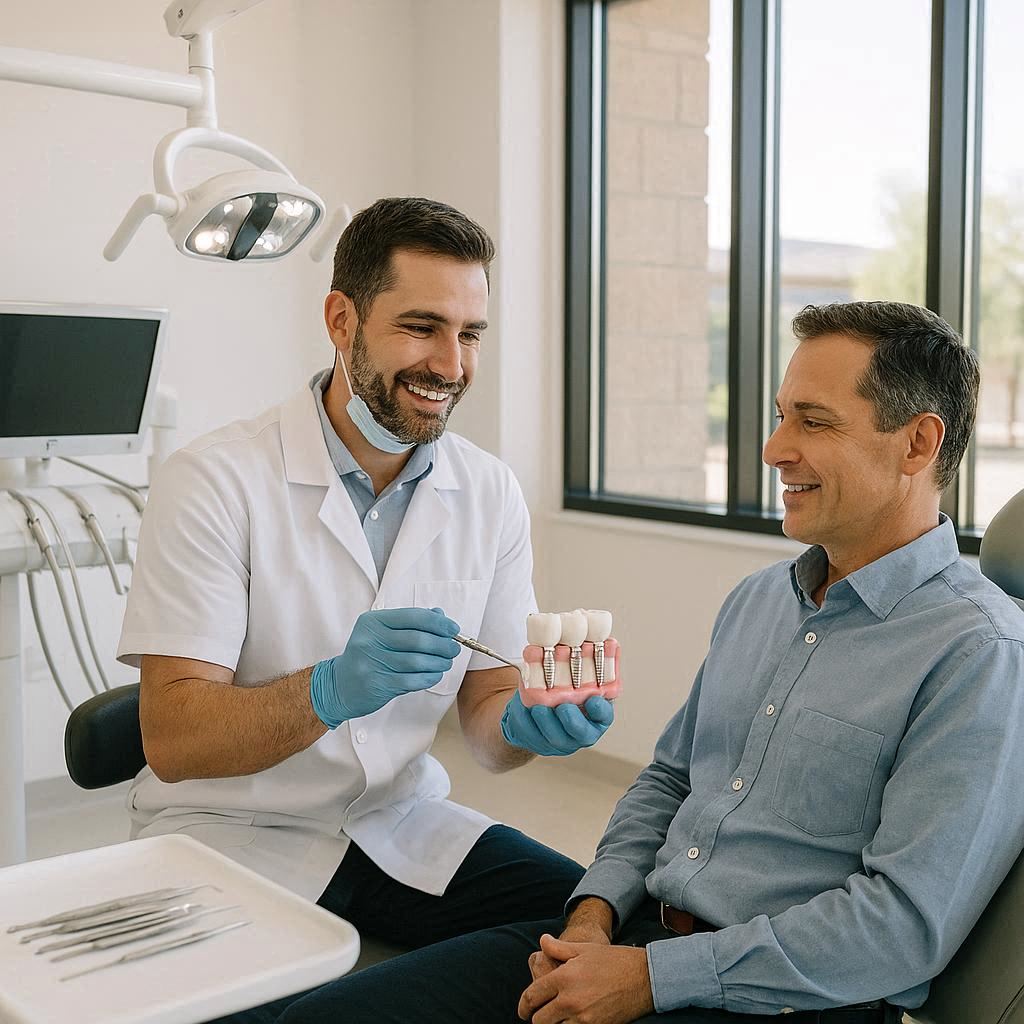
The Fundamentals of Tooth Replacement
Before diving into specific offices and price points in St. George, it is essential to understand the “hardware” involved. A dental implant is not a single piece of equipment. It is a three-part system designed to mimic nature.
The Implant Fixture
This component is a small, screw-shaped post made of biocompatible titanium or zirconia. Surgeons place this fixture directly into the jawbone through a precise surgical procedure. Over the course of several months, the bone cells grow right up against the surface of this post. This process, known as osseointegration, creates a bond that is as strong as a natural tooth root. This is the critical difference between an implant and a bridge. An implant replaces the root.
The Abutment
Once the bone has healed and accepted the fixture, a small connector piece called an abutment is attached to the top. This piece protrudes just slightly above the gumline. Think of it as the foundation sticking out of the ground before you build the house. It serves as the anchor point for the visible tooth.
The Prosthesis
This is the part of the smile that everyone sees. It is the crown, bridge, or denture that attaches to the abutment. In St. George dental labs, technicians meticulously craft these crowns from porcelain or zirconia to match the color, translucency, and shape of the surrounding natural teeth in the red rock light.
The St. George Advantage: Why Local Matters
Choosing dental implants in St. George is different than choosing them in a larger, more humid metropolitan area. The local environment and community culture play a significant role in both the procedure and the outcome.
A Hub of Specialized Expertise
St. George has become a retirement destination and a growing community for active families. With this demographic shift, the demand for high-end restorative and surgical dentistry has skyrocketed. As a result, the area attracts board-certified oral surgeons and prosthodontists who have trained at top-tier institutions across the country. Many professionals choose to practice here not just for the business opportunity, but for the quality of life. This means you have access to a level of care that rivals Salt Lake City or Las Vegas, but with the convenience of a short drive across town.
The Desert Climate and Healing
The dry climate of Southern Utah presents a unique advantage for surgical recovery. Humidity can often exacerbate post-operative discomfort and increase the risk of certain infections. The arid environment of St. George is generally conducive to clean, dry incision healing. Furthermore, the active lifestyle here encourages patients to walk and move gently after surgery, which promotes blood flow and faster recovery times.
Understanding the Water and Bone Health
One realistic consideration for anyone in Washington County is the mineral content of the local water supply. St. George water is famously hard. While this does not affect the titanium implant itself, it can contribute to calculus (tartar) buildup on the visible crown portion over time. Patients who invest in this procedure must be vigilant about professional cleanings to protect the gum tissue surrounding the implant. We will discuss this maintenance in depth later in this guide.
A Realistic Look at the Timeline
One of the most common points of confusion is the time commitment required. Social media often advertises “Teeth in a Day,” which is a fantastic option for specific candidates, but it is not the standard protocol for everyone. A realistic guide demands a realistic timeline.
Phase 1: Consultation and 3D Imaging (1-2 Weeks)
Your journey begins not with a drill, but with a scanner. Modern practices in St. George utilize Cone Beam Computed Tomography (CBCT). This technology creates a 3D map of your jawbone, nerves, and sinuses. It allows the surgeon to perform the entire procedure virtually on a computer screen before touching a scalpel. This is non-negotiable for safety and precision.
Phase 2: Preparatory Procedures (Varies)
Sometimes the foundation needs repair before building. If a tooth is still present but failing, an extraction is necessary. Often, the surgeon can place the implant at the same time as the extraction (immediate placement). However, if infection is present, a bone graft may be needed to fill the void left by the tooth. Bone grafting adds time. Healing from a graft can take 3 to 6 months before the implant can be placed.
Phase 3: Surgical Placement (1 Day)
The actual surgery to place the titanium post is remarkably efficient. For a single implant, the procedure often takes less than an hour. You will be under local anesthesia, and sedation options are available for comfort. You will leave the office with a temporary solution—either a small healing cap on the implant or a temporary flipper tooth if the site is visible.
Phase 4: Osseointegration (3-6 Months)
This is the waiting period. There is nothing you can do to rush this. The bone must fuse to the implant. During this time, you must avoid chewing on the site. The implant is vulnerable to movement. This is the phase where patience truly pays off.
Phase 5: Restoration (2-3 Weeks)
Once the implant is stable, you return to the office for the abutment and final crown delivery. Impressions (digital or physical) are taken, and the lab fabricates your new tooth. Two weeks later, it is torqued into place, and you leave with a fully functional, permanent tooth.
Comprehensive Cost Analysis in St. George
Let’s address the financial elephant in the room. You are making a significant investment, and you deserve transparency. The cost of dental implants in St. George is influenced by the local economy, the cost of living for the specialists, and the quality of materials used. Prices here may differ slightly from national averages, often falling into a mid-to-upper range due to high demand and quality of care.
Important Note: The figures provided below are realistic estimates for the St. George, Utah market as of the current year. They represent the “all-in” cost from a reputable private practice using high-quality components. These are not minimum prices at discount chains, nor are they the fees of a specialist catering exclusively to cosmetic luxury markets.
| Procedure Type | Description | Estimated Cost Range (St. George) | Timeline | Key Consideration |
|---|---|---|---|---|
| Single Tooth Implant | Implant Post, Abutment, and Porcelain Crown | $3,800 – $6,500 | 4-8 Months | Replaces one tooth; prevents shifting of neighbors. |
| Implant-Supported Bridge | 2 Implants supporting 3-4 teeth in a row | $8,500 – $15,000 | 5-9 Months | Avoids damaging healthy adjacent teeth (unlike traditional bridge). |
| Snap-On Denture (Overdenture) | 2-4 Implants stabilizing a removable lower denture | $12,000 – $22,000 (per arch) | 4-6 Months | Eliminates denture adhesive; still removable for cleaning. |
| Full Arch Fixed (All-on-4®) | 4-6 Implants supporting a full set of permanent, non-removable teeth | $22,000 – $35,000 (per arch) | 1 Day (temp) + 6 Months (final) | Highest level of function; feels most like natural teeth. |
| Bone Grafting (If Needed) | Addition of bone material to fortify jaw ridge | $400 – $1,200 (per site) | Adds 3-6 months | Often required for back teeth or long-term denture wearers. |
| Sinus Lift (If Needed) | Lifting sinus membrane to create space for upper back implants | $1,500 – $3,000 | Adds 4-8 months | Specific to upper jaw back teeth area. |
Quotation from a Local Dental Implant Coordinator:
“When patients in St. George ask me why the range is so wide, I always point to the warranty on the parts and the training of the surgeon. You can find a cheaper implant, but you are often paying for a ‘stock’ abutment rather than a custom one designed for your specific gum shape. The custom work prevents food traps and bone loss years later. It’s an investment in the future, not just the present.”
Navigating Dental Insurance and Financing in Southern Utah
Most dental insurance plans classify implants as a “Major” procedure. They often cover the crown portion at the same percentage they cover a traditional bridge (usually 50%), but they rarely cover the surgical placement of the implant post itself.
Realistic Insurance Expectations:
- Maximums: Be aware that most plans have an annual maximum benefit of $1,500 to $2,000. Once that is exhausted, you are responsible for the remainder.
- Missing Tooth Clause: Some older policies have a clause that will not cover the replacement of a tooth that was missing before the policy went into effect. If you lost the tooth 10 years ago, insurance may deny coverage for the implant.
- Medical Insurance Billing: There are specific instances where medical insurance may cover part of the implant procedure. This includes cases of trauma (a car accident on I-15) or congenital defects. This requires expert coding knowledge from the practice’s billing department.
Financing Solutions Common in St. George:
Given the high retirement population, practices in the St. George area are exceptionally adept at navigating financing. You will commonly encounter:
- CareCredit: A healthcare credit card offering 0% interest promotional periods (often 12-18 months).
- In-House Membership Plans: Many St. George dentists offer a “Wellness Plan.” For a flat annual fee, you receive cleanings and a discount (often 15-20%) on all major procedures, including implants.
- Phased Treatment Planning: You do not have to pay for everything upfront. The fees are naturally spread out over the 6-8 month timeline of the procedure.
The Reality of “Teeth in a Day” in St. George
This is a heavily marketed term, and it is a legitimate procedure. But a trustworthy guide must clarify who actually qualifies.
What It Is:
A surgical team places 4 to 6 implants and immediately attaches a temporary, fully functional set of teeth on the same day. You leave with a smile.
The Reality Check (Who Is a Candidate?):
- Sufficient Bone: You need enough bone in the front of the jaw to anchor those angled posterior implants. If you have been missing teeth for decades and the bone has shrunk to a pencil-thin ridge, you may not be a candidate without extensive (and time-consuming) grafting.
- Health Status: Uncontrolled diabetes or heavy smoking severely compromises the body’s ability to heal around four fresh implant wounds simultaneously. In St. George, where an active lifestyle is paramount, surgeons are particularly cautious about smoking status due to the high failure rate of immediate load implants in smokers.
What Happens After the “Day”:
This is the most important part. That same-day smile is a temporary fixed bridge. It is made of acrylic. It looks great, but it is not designed for heavy chewing. You must follow a strict soft-food diet for 3-6 months while the bone heals. After healing, you return to the office to have a final, precision-milled, high-strength zirconia bridge made. That final bridge is the one that will last for decades. The “Teeth in a Day” is a means to an end—it allows you to live your life and smile at the farmers market while you heal.
Types of Materials: What Are You Actually Getting?
The final tooth on your implant is not just “a crown.” The material choice matters for longevity, especially in a community where people are hiking on sandstone and eating tougher, healthier foods.
| Material | Best Use Case | Durability | Aesthetic Quality | St. George Suitability |
|---|---|---|---|---|
| Porcelain-Fused-to-Metal (PFM) | Back Molars | Very High | Fair (Gray line at gum) | Good for heavy chewers; cost-effective. |
| Layered Zirconia | Front Teeth | High | Excellent (Translucent) | Preferred for smiles visible in Zion sunlight. |
| Monolithic Zirconia | Full Arches / Bridges | Extreme | Good (Opaque) | Best for full-mouth cases where breaking a tooth is a risk. |
| Lithium Disilicate (e.max) | Single Front Crowns | High | Superb (Natural Light Play) | Top choice for single tooth replacement in the “aesthetic zone.” |
A Detailed List: What to Ask During Your Consultation
Walking into a consultation in St. George can be intimidating. You want to be an informed participant in your care, not just a passenger. Here is a checklist of questions that separate a surface-level chat from a deep, value-driven conversation.
- “May I see your 3D scan of my bone?”
- Why it matters: You should see the volume of bone you have. If the doctor cannot show you this, they are planning blindly. Demand to see the roadmap.
- “How many implants have you placed in this exact location of the jaw?”
- Why it matters: Placing an implant in the front (aesthetic zone) is different than placing one near the nerve in the lower jaw. Experience in the specific site matters.
- “Who is making the final tooth? Is it a local lab, and can I meet them if needed?”
- Why it matters: St. George has excellent local labs. A dentist who sends work to a cut-rate out-of-state lab may compromise on the color matching for the unique St. George lighting.
- “What is the warranty on the implant fixture versus the crown?”
- Why it matters: Implant companies like Straumann or Nobel Biocare offer lifetime replacement warranties on the fixture if it fails due to manufacturing defect. The crown usually has a 5-10 year warranty.
- “If I have a problem on a Saturday afternoon after hiking, who do I call?”
- Why it matters: You need a practice that provides emergency access to the actual surgeon, not just a generic answering service.
Bone Grafting: The Unseen Foundation
In the context of dental implants in St. George, bone grafting is the most common “additional procedure” that catches patients off guard. When a tooth is lost, the body redirects calcium and minerals away from that area of the jaw. This is called resorption.
The “Tent Pole” Analogy:
Imagine you remove a tent pole from the sand. The sand collapses into the hole. If you try to stick the pole back in later, there isn’t enough depth. A bone graft is like filling that hole with wet sand and letting it solidify before you put the pole back. It provides the 3D volume necessary to hold the implant screw.
Common Grafting Scenarios in St. George Patients:
- Socket Preservation: Placing graft material immediately after a tooth extraction. This saves you from a bigger, more expensive graft later. Highly recommended.
- Ridge Augmentation: Widening a jawbone that has become too thin (common in denture wearers).
- Sinus Lift: The maxillary sinus (air cavity in your cheek) expands downward as we age. For upper back teeth, the bone floor may be paper-thin. A sinus lift gently elevates the sinus membrane to make room for the implant.
The Surgical Experience: Sedation and Comfort
St. George is home to many patients who experience dental anxiety. The good news is that implant surgery is often more comfortable than a tooth extraction because the bone has fewer nerve endings than the tooth ligament.
Levels of Sedation Offered:
- Local Anesthetic Only: You are awake but completely numb. You feel pressure and vibration but no pain.
- Nitrous Oxide (Laughing Gas): Takes the edge off. You drive yourself home.
- Oral Conscious Sedation: You take a pill before arrival. You are awake but deeply relaxed and may not remember the procedure. You need a driver.
- IV Sedation (Twilight Sleep): Administered by a trained professional. You are in a state of deep relaxation but easily arousable. This is standard for full-arch procedures.
Important Note for St. George Residents: Due to the altitude and climate, hydration before and after IV sedation is critical. Drink plenty of water the day before surgery (unless instructed otherwise). Dehydration can make IV access difficult and worsen post-op fatigue.
Recovery: The First 72 Hours in St. George
You have had the surgery. You are home, looking out at the red cliffs. What should you realistically expect?
Day 1:
- Bleeding: Light oozing is normal. Change gauze as directed.
- Swelling: Apply ice packs to the face in 20-minute intervals. This is the most effective way to limit bruising and swelling.
- Diet: Cold liquids only. Smoothies (no straw! The suction can dislodge the clot). Protein shakes are excellent for healing.
Day 2-3:
- Swelling Peak: Swelling usually peaks around 48 hours post-op. Do not be alarmed if you look like you lost a fight with a hiking trail.
- Oral Hygiene: Start warm salt water rinses gently. Do not swish vigorously. Let the water fall out of your mouth. Do not brush the surgical site.
- Pain Management: Most patients in St. George manage comfortably with over-the-counter ibuprofen and Tylenol alternated. Narcotics are rarely needed for single implants but may be prescribed for multiple implants.
Activities to Avoid:
- Hiking: Do not hit the Chuckwalla Trail on Day 2. Increased heart rate and blood pressure can cause throbbing and bleeding.
- Golf: The twisting motion of a drive can stress the jaw and neck muscles.
- Yoga: Inversions (downward dog) increase blood pressure in the head. Keep your head above your heart.
Long-Term Maintenance: The Million-Dollar Smile Secret
You have invested the equivalent of a nice used car or even a small boat into your mouth. Protecting that investment is non-negotiable.
Peri-Implantitis: The Silent Threat
While implants cannot get a cavity, the gums and bone around them can get infected. This is called peri-implantitis. It is the number one cause of late-term implant failure. The gums around the implant become inflamed, and the bone quietly melts away. Because there is no nerve in the implant, you feel no pain until the implant is already loose and failing.
The St. George Maintenance Protocol:
- Water Flosser is Mandatory: String floss is okay, but a Waterpik with a special implant tip (Pik Pocket tip) is far superior for flushing out bacteria from under the crown edge.
- Professional Cleanings (3-4 times per year): You cannot clean these as well as a hygienist with specialized plastic or titanium scalers. Metal scalers will scratch the implant surface, creating grooves for bacteria to hide.
- Night Guard: If you grind your teeth (and many of us do while sleeping), a custom night guard is essential. You can break a natural tooth, but you can also break the screw that holds the crown to the implant. Replacing a broken implant screw is a complex and costly repair.
Why Choose St. George Over Traveling Abroad or North?
Some residents consider traveling to Mexico or Las Vegas for “cheaper” dental work. While the upfront price tag is lower, the total cost of ownership often is not.
The Value of Local Follow-Up:
- Lab Remakes: If the crown doesn’t match perfectly, you want a lab in St. George that can do a custom shade match in the natural light, not a lab thousands of miles away.
- Complications: If that implant screw loosens on a Friday night before your family reunion at Sand Hollow, you want a doctor who is 15 minutes away, not a 6-hour drive or a plane ride away.
- Continuity of Care: The surgeon who placed the implant knows the exact angle, the exact brand of implant, and the exact torque value used. This information is critical if a repair is needed 10 years from now.
Technology Spotlight: What to Look For in a St. George Office
The field of implant dentistry is driven by digital technology. When researching “Dental Implants in St George,” pay attention to the technology stack advertised by the practice.
| Technology | Benefit to You | Why It Matters in St. George |
|---|---|---|
| CBCT (Cone Beam CT) | Zero guesswork on nerve location. | Avoids permanent nerve damage (paresthesia) to the lip/chin. |
| Intraoral Scanner (Digital Impressions) | No goopy, gag-inducing impressions. | More accurate fit for the final crown; faster turnaround. |
| 3D Printer (In-Office) | Same-day delivery of surgical guides or temporary teeth. | Reduces the number of visits to the office, saving you time. |
| Piezoelectric Surgery | Ultrasonic bone cutting. | Less trauma to soft tissue, less post-operative swelling and pain. |
The Psychological Impact: More Than Just Teeth
It is easy to get lost in the clinical details of titanium screws and abutments. But the true value of dental implants in St. George lies in the restoration of self-esteem. Our community values an active, outdoor, social lifestyle. Whether it’s smiling for a photo at the top of Angel’s Landing or laughing with friends over dinner at Cliffside Restaurant, a confident smile is central to the experience.
Patients who transition from failing teeth or loose dentures to stable implants report:
- Improved nutrition due to the ability to chew raw vegetables and proteins.
- Increased social engagement.
- A more youthful appearance due to the preservation of jawbone structure.
This procedure is not just about replacing what was lost; it is about reclaiming the life you want to live in one of the most beautiful corners of the country.
Understanding the Different Types of Implant Restorations
Let’s break down the specific scenarios you might be facing in St. George.
Scenario 1: The Single Missing Tooth (Often a Molar)
The Problem: You lost a back tooth years ago and just “got used to it.” Now the tooth above it is starting to drift down (super-eruption) and the teeth next to it are tipping.
The Solution: A single dental implant with a crown.
St. George Reality: This is the most straightforward and predictable procedure. It preserves the health of the neighboring teeth (unlike a bridge which requires drilling down perfectly good teeth).
Scenario 2: Multiple Missing Teeth in a Row
The Problem: You have a gap of two or three missing teeth.
The Solution: An Implant-Supported Bridge. Two implants placed at the ends of the gap support a bridge of three teeth in the middle.
Advantage over Dentures: It is fixed. You do not take it out at night. It feels like having your own teeth back.
Scenario 3: The Edentulous Patient (No Teeth)
The Problem: You are a long-term denture wearer. You have used so much Polygrip over the years that you cannot taste your food. You avoid public speaking because you fear the lower denture will fly up.
The Solution: Snap-On Dentures (Overdentures).
St. George Benefit: With just two implants in the lower jaw, a denture becomes rock solid. You can eat corn on the cob at the Peach Days celebration without worry. This is often the most life-changing option for seniors on a fixed income, as it offers a massive increase in quality of life for a lower cost than a full fixed bridge.
A Note on Age and Candidacy
“How old is too old?” This is a frequent question in a community with a vibrant senior population.
The Answer: There is no upper age limit for dental implants. Bone heals slower in an 85-year-old than a 25-year-old, but it still heals. The primary determining factor is general health, not chronological age. A healthy 90-year-old who hikes Snow Canyon weekly is a better candidate than a 50-year-old with uncontrolled Type 2 Diabetes and a pack-a-day smoking habit.
Medication Considerations in St. George:
A realistic guide must address the prevalence of osteoporosis in the senior female population.
- Bisphosphonates (Fosamax, Actonel, Boniva): These oral medications for bone density have a very low but real risk of a complication called MRONJ (Medication-Related Osteonecrosis of the Jaw) following oral surgery.
- The Protocol: You must inform your surgeon. For oral bisphosphonates taken less than 4 years, implant placement is generally considered safe. For IV bisphosphonates (often used for cancer treatment), the risk is higher and requires a specialist’s clearance. A reputable St. George surgeon will coordinate with your rheumatologist or oncologist before proceeding.
The Digital Workflow: From Scan to Smile
Modern practices in St. George have largely abandoned the tray of pink goo. The digital workflow enhances accuracy.
- Scanning: The dentist uses a wand to take thousands of pictures of your teeth and the implant position. A 3D model appears on the screen instantly.
- Design: The dentist designs the shape of the crown virtually, ensuring it fits the bite perfectly.
- Milling: A machine in the office (or a local lab) carves the tooth out of a solid block of ceramic.
- Delivery: The tooth is placed on the implant. Because of the digital precision, adjustments are minimal. You spend less time in the chair and more time enjoying the view.
Complications: Honesty is the Best Policy
No surgical procedure has a 100% success rate. While the success rate of implants in healthy individuals is over 95%, complications can occur. A reliable guide prepares you for these possibilities.
Short-Term Complications:
- Failure to Integrate: The bone does not fuse to the implant. The implant feels loose or falls out within the first few months. Cause: Often related to smoking, infection during healing, or surgical error.
- Nerve Injury: Damage to the Inferior Alveolar Nerve (lower jaw) causing numbness of the lip and chin. Prevention: 3D CBCT scanning prevents this 99.9% of the time.
- Sinus Perforation: Creating a hole between the mouth and the sinus cavity (upper jaw). Management: Usually heals on its own with antibiotics and decongestants; sometimes requires a minor repair.
Long-Term Complications:
- Peri-Implantitis: Discussed earlier. Solution: Early detection and deep cleaning by a hygienist. Advanced cases may require surgery to clean the implant surface and graft new bone.
- Screw Loosening/Fracture: The abutment screw can break. Solution: A specialist can usually drill out the broken screw and replace it without removing the implant fixture. This is a testament to why using a reputable implant brand with available parts is crucial.
The Environmental Connection: Outdoor Lifestyle and Implant Care
Living in St. George means spending a lot of time outdoors. This impacts implant care in specific ways.
Hydration:
The desert heat and high altitude mean constant water intake is necessary. A dry mouth (xerostomia) is the enemy of dental implants. Saliva is the body’s natural mouthwash. Without it, bacteria thrive. If you are on medications that cause dry mouth (common for blood pressure), you must be extra vigilant about using xylitol mints or dry mouth rinses to protect your implant gums.
Sun Exposure:
If you have a new full-arch zirconia bridge, the material is extremely hard but it is not invincible. The color is stable and will not stain from coffee or red wine. However, the gums around the implant are just as susceptible to sun damage as the rest of your skin. Use a lip balm with SPF to protect the delicate tissue at the gumline from the intense Southern Utah sun.
Trauma Protection:
If you mountain bike on the Bearclaw Poppy Trail or play pickleball at The Gubler Park, consider a sports mouthguard. A direct blow to the face can fracture a porcelain crown or, in rare cases, cause trauma to the implant bone interface. A custom guard is a small price to pay for peace of mind.
Financing Your New Smile: A Deeper Dive into Local Options
We touched on costs earlier, but let’s look at how St. George residents specifically structure these payments.
Health Savings Accounts (HSAs) and Flex Spending (FSAs):
Dental implants qualify as a medical expense. If you have an HSA or FSA, you can use those pre-tax dollars to pay for the entire procedure. This effectively gives you a 20-30% discount, depending on your tax bracket. Many St. George employers offer these plans.
Timing the Procedure:
Because implant treatment spans two calendar years (e.g., surgery in November, restoration in May), you can strategically maximize insurance benefits. Use this year’s insurance maximum for the surgery and next year’s maximum for the crown. This is a common and legal way to reduce out-of-pocket costs. Your St. George dentist’s financial coordinator will help you map this out.
Finding the Right Specialist in the St. George Area
You will see many signs and websites advertising “Implants.” How do you filter through the noise?
- Oral and Maxillofacial Surgeon: These are the surgeons. They spend 4-6 years in hospital-based surgical residency after dental school. They handle complex bone grafting, sedation, and wisdom teeth. If your case involves sinuses, nerves, or major bone loss, this is the specialist you want placing the fixture.
- Periodontist: A gum and bone specialist. They are experts in the soft tissue and the biology of healing. They are excellent for managing aesthetic cases in the front of the mouth and treating gum disease before implant placement.
- Prosthodontist: The architect of the smile. They design the teeth that go on top of the implants. They are masters of bite alignment and cosmetic appearance. For full-mouth reconstruction, a prosthodontist is essential.
- General Dentist with Advanced Training: Many general dentists in St. George have taken hundreds of hours of continuing education in implantology. They are perfectly qualified for straightforward, single-tooth cases.
Quotation from a St. George Periodontist:
“I tell my patients: The implant itself is an inert piece of hardware. The success of the case lies in the biology of the gums and bone around it. I can place a perfect implant, but if the patient doesn’t have the dexterity to clean it or the commitment to maintenance, it will fail. We have to partner with the patient for life.”
The Emotional Journey: From Shame to Pride
Many people delay seeking information about dental implants in St. George because of embarrassment. They feel shame over losing teeth, believing it reflects a failure of hygiene or self-care. It is vital to understand that tooth loss is often genetic, traumatic, or the result of systemic health issues beyond your control.
The day you get your final crown cemented or your snap-on denture secured is a day of transformation. It is not just a dental appointment; it is a shift in self-perception. You stop covering your mouth when you laugh. You order the steak instead of the soup. You smile without thinking.
That psychological return on investment is immeasurable, and it is the reason why, despite the cost and the time commitment, patients in St. George consistently rate this procedure as one of the best decisions they have ever made for their health and happiness.
A Note on Dental Tourism
The allure of crossing the border to Los Algodones or flying to Costa Rica for cheap implants is strong. The price difference can be 50-70% less. As a realistic guide, we must acknowledge this while presenting the counterbalance.
The Hidden Costs of Traveling for Implants:
- Travel Expenses: Flights, hotels, and time off work add up.
- The “One and Done” Myth: You cannot have an implant placed and restored in one 3-day trip. You need two trips minimum (Surgery trip and Restoration trip). If a complication arises, you need a third or fourth trip.
- Material Traceability: If the implant brand used abroad is not FDA-approved or not available in the US, no St. George dentist will be able to fix it if it breaks. They literally do not have the screwdriver for that specific implant.
- Standard of Care Differences: Infection control standards vary widely. The risk of contracting a bloodborne illness or antibiotic-resistant infection is higher in unregulated clinics.
While it works out for some, the peace of mind of having your implant placed by a board-certified surgeon 10 minutes from your St. George home is a premium that most local residents find worth paying.
The Future of Implants: What’s on the Horizon?
The field is constantly evolving. Here is what we are seeing on the cutting edge that may soon be standard in St. George practices.
- Dynamic Navigation: Similar to GPS for the jaw. A camera tracks the drill in real-time, showing the surgeon exactly where they are in the 3D scan. This allows for even smaller incisions and “flapless” surgery.
- Immediate Molar Replacement: New techniques are allowing for the placement of a temporary chewing tooth on a back molar implant immediately. This has long been the “holy grail” of implant dentistry, as back teeth are notoriously difficult to stabilize instantly.
- Growth Factors: The use of PRF (Platelet-Rich Fibrin) derived from your own blood. During surgery, your blood is drawn and spun in a centrifuge. The concentrated healing factors are placed in the implant site to speed up bone healing and reduce discomfort.
Conclusion
Dental implants in St. George offer a transformative solution for tooth loss, leveraging local surgical expertise and advanced technology to restore both function and aesthetics. The process requires a realistic understanding of the timeline, a transparent view of the financial investment, and a lifelong commitment to maintenance. Ultimately, this procedure provides the residents of Southern Utah with the freedom to smile, eat, and live with unwavering confidence against the backdrop of the beautiful red rock landscape.
Frequently Asked Questions (FAQ)
Q: How painful is the dental implant procedure?
A: Most patients report that the surgery itself is less traumatic than a tooth extraction. With modern anesthesia and sedation options available in St. George, you will feel pressure and vibration but no sharp pain. Post-operative discomfort is typically managed effectively with over-the-counter ibuprofen for 2-3 days.
Q: Can I get dental implants if I have been wearing dentures for 20 years?
A: Yes, absolutely. This is a common scenario in St. George. Long-term denture wear leads to jawbone shrinkage. You will likely require a bone graft to rebuild the ridge before or during implant placement. A 3D scan will determine exactly how much bone is available and what grafting is necessary to support the implants.
Q: Will my dental insurance in St. George cover the cost?
A: Dental insurance typically covers the crown portion at a percentage (usually 50% up to your annual maximum). It rarely covers the surgical placement of the implant post itself. Some medical insurance plans may cover part of the surgery if the tooth loss was due to an accident or medical condition. It is best to have the office submit a pre-authorization to know exactly what your out-of-pocket cost will be.
Q: How long do dental implants really last?
A: The titanium implant fixture itself can last a lifetime if it successfully integrates and is kept free of peri-implantitis. The visible crown (tooth part) typically lasts 10-15 years before needing replacement due to normal wear and tear, just like a crown on a natural tooth. Regular maintenance cleanings in St. George are the key to longevity.
Q: Can I smoke if I get dental implants?
A: Smoking is the single biggest risk factor for implant failure. Nicotine constricts blood vessels, severely limiting the oxygen and healing factors that reach the surgical site. Most reputable St. George surgeons will strongly advise you to quit smoking before surgery and will require you to stop completely for at least 2 weeks before and 2 months after the procedure. Failure rates in smokers are significantly higher.
Q: What is the difference between a Snap-On Denture and All-on-4?
A: A Snap-On Denture (overdenture) rests on 2-4 implants and is removable by the patient for daily cleaning. An All-on-4 prosthesis is a full arch of teeth that is screwed down and only removed by the dentist during maintenance visits. The All-on-4 feels more like natural teeth and offers more chewing power, but it comes at a higher cost.
Q: Can my body reject the implant?
A: True “rejection” (like an organ transplant) is rare because titanium is biocompatible and inert. What is commonly called rejection is actually failure to integrate. This happens when the bone fails to grow onto the implant surface. Causes include infection, movement of the implant during healing, smoking, or certain autoimmune conditions. It is not an allergic reaction.
Q: Are there any restrictions on what I can eat with implants?
A: Once fully healed (after 6 months), there are virtually no restrictions. You can eat steak, apples, corn on the cob, and nuts. This is the primary functional advantage over dentures. However, we still caution against chewing on ice cubes or using your teeth as tools to open packages, as this can break the porcelain crown just as it would break a natural tooth.
Additional Resource:
For unbiased, peer-reviewed information on implant safety and materials, you can visit the American Academy of Implant Dentistry (AAID) website.
Link: American Academy of Implant Dentistry – Patient Resources


