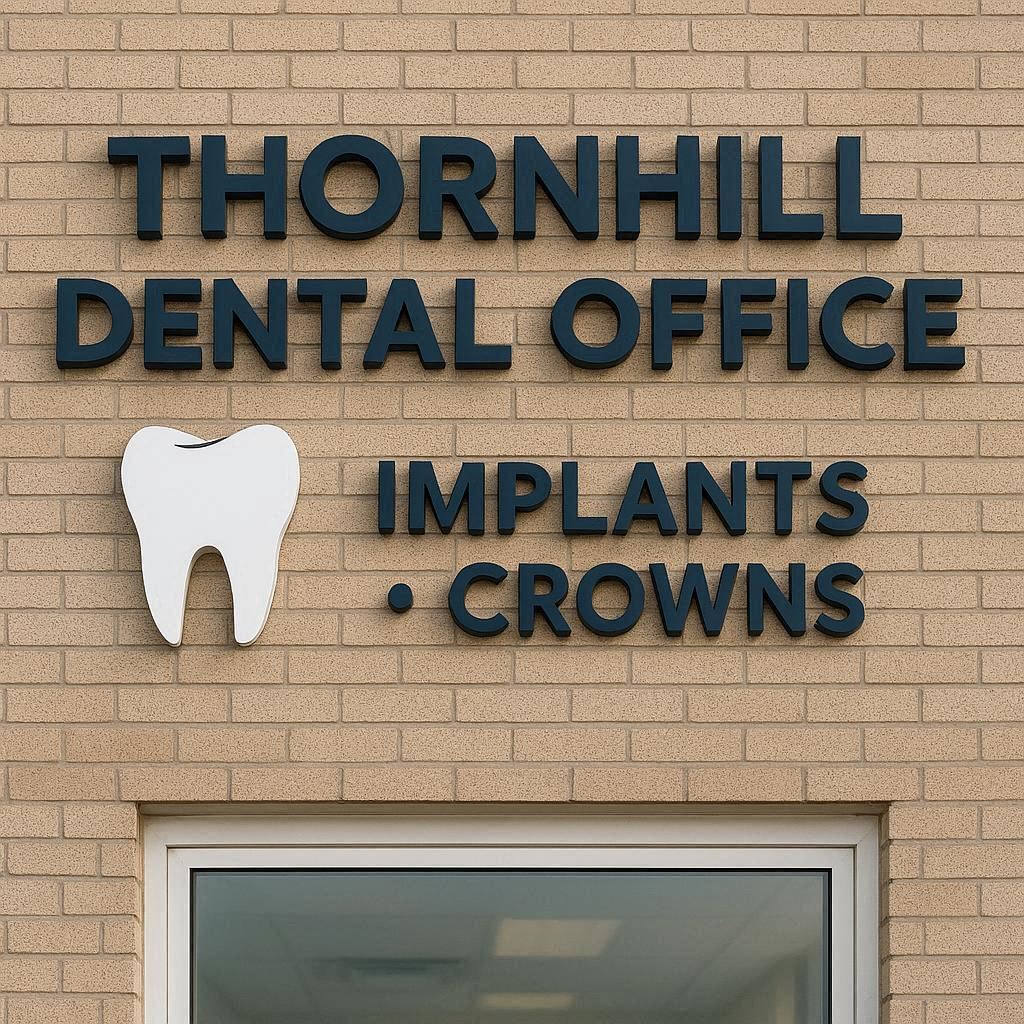
thornhill dental office implants & crowns dentistry
A healthy smile changes how you feel every single day. But when you lose a tooth or deal with a cracked, decaying tooth, it can affect more than your appearance. It can make eating uncomfortable, talking less clear, and smiling less frequent.
That is where modern dentistry steps in.
If you live in or near Thornhill, you have access to dental offices that specialize in two of the most reliable tooth restoration options: dental implants and dental crowns. These solutions are not just for looks. They help you keep your jawbone strong, your bite aligned, and your remaining natural teeth healthy.
This guide walks you through everything you need to know. You will learn how implants and crowns work, what to expect during treatment, how much things typically cost, and how to choose a Thornhill dental office that puts your comfort first.
Understanding Dental Implants
A dental implant is the closest thing to a natural tooth root that modern dentistry can offer. It is a small, screw-like post made of titanium or zirconia. A dentist surgically places it into your jawbone. Over time, the bone grows around the implant. This process is called osseointegration. It creates a rock-solid foundation for a replacement tooth.
Why Implants Have Become So Popular
For decades, people with missing teeth had two main choices: bridges or dentures. Both work, but they come with limits. Bridges require shaving down healthy neighboring teeth. Dentures can slip, click, or feel bulky.
Implants solve these problems. They do not touch your other teeth. They stay firmly in place. And they feel natural because they are anchored directly into the bone.
Important note: Not everyone is an immediate candidate for implants. Your jawbone needs enough density and volume to hold the implant. A Thornhill dentist will always take a 3D scan first to check your bone health.
The Step-by-Step Implant Process
Understanding the timeline helps reduce anxiety. Here is what a typical implant journey looks like.
First visit: consultation and imaging
Your dentist examines your mouth, takes X-rays or a CBCT scan, and reviews your medical history. They will ask about medications, smoking habits, and any conditions like diabetes or gum disease.
Second visit: implant placement (surgery)
This is usually done with local anesthesia. Some offices also offer sedation if you feel nervous. The dentist makes a small cut in your gum, drills a precise hole into the bone, and places the implant. Then they stitch the gum closed over or around the implant.
Healing period: osseointegration
You wait three to six months. During this time, your bone fuses to the implant surface. You can wear a temporary partial denture or a temporary crown if the implant is in a visible area.
Third visit: abutment placement
Once the implant is fully integrated, the dentist reopens the gum to attach a small connector piece called an abutment. This sticks out above the gum line. The gum then heals around the abutment for another two to four weeks.
Fourth visit: final crown placement
Your dentist takes impressions or a digital scan of your mouth. A dental lab fabricates your custom crown. Two to three weeks later, you return to have the crown screwed or cemented onto the abutment.
From start to finish, the entire process usually takes four to nine months. In some cases with immediate loading, you can get a temporary crown on the same day as implant placement. But that is not suitable for everyone.
Understanding Dental Crowns
A crown is a tooth-shaped cap that fits over a damaged tooth. It restores the tooth’s size, shape, strength, and appearance. Think of it like a helmet for your tooth.
When You Might Need a Crown
Dentists recommend crowns in several common situations:
- After a root canal, especially on back teeth (molars)
- To hold together a tooth with a large filling
- To cover a badly cracked or broken tooth
- To protect a weak tooth from fracturing
- To cover a dental implant (as we saw above)
- To improve the shape or color of a misshapen or stained tooth
Types of Crown Materials
Not all crowns are the same. Each material has pros and cons. Your Thornhill dentist will help you choose based on where the tooth is and what matters most to you (strength, looks, or cost).
| Material | Best for | Pros | Cons |
|---|---|---|---|
| Porcelain fused to metal | Front or back teeth | Strong, more affordable than all-ceramic | Metal may show as dark line near gum |
| All-ceramic (lithium disilicate or zirconia) | Front teeth or visible areas | Most natural look, no metal | Can wear opposing teeth if not polished well |
| Gold alloy | Molars (back teeth) | Extremely durable, gentle on opposing teeth | Color is not natural |
| Resin | Temporary crowns or low-budget cases | Cheapest option | Wears down faster, less durable |
Important note: Many Thornhill dental offices now prefer zirconia crowns for back teeth because they combine strength with a tooth-like color. For front teeth, layered lithium disilicate (like E.max) gives the best aesthetics.
How Crowns Are Placed (No Surgery Required)
Unlike implants, getting a crown does not involve surgery. The process usually takes two visits.
First visit: preparation and temporary crown
The dentist numbs your tooth. They shape it by removing a thin outer layer (about 1.5 to 2 millimeters). This makes room for the crown. Then they take an impression or digital scan. A temporary crown made of acrylic or resin is placed to protect the tooth for two to three weeks.
Between visits: lab fabrication
A dental technician builds your permanent crown to match the shape, color, and bite of your natural teeth.
Second visit: bonding the permanent crown
The dentist removes the temporary crown, cleans the tooth, tries in the new crown to check fit and color, and then cements it permanently.
Same-Day Crowns: Is That an Option in Thornhill?
Some dental offices offer same-day crowns using CAD/CAM technology. A machine inside the office mills your crown from a solid block of ceramic while you wait. You walk out with your permanent crown in about two hours.
This technology is convenient. But it has limits. Same-day crowns are best for single, uncomplicated cases. The material options are fewer, and the fit may not be as precise as a lab-made crown for complex bites. Ask your Thornhill dentist if you are a good candidate.
Implants vs. Crowns: Which One Do You Need?
This is a common point of confusion. The truth is, crowns and implants are not always alternatives. Sometimes they work together. Here is how to tell what you need.
| Your situation | Likely solution |
|---|---|
| You have a natural tooth that is cracked, decayed, or has a large filling | Crown (on your natural tooth) |
| You are missing a tooth completely | Implant + crown on top |
| You have a root canal on a back tooth | Crown to protect the tooth |
| You have a tooth that is too broken down to hold a crown | Extract the tooth + implant + crown |
| You want to replace several missing teeth | Multiple implants or implant-supported bridge |
Think of it this way: a crown fixes a damaged existing tooth. An implant replaces a missing tooth. When you put a crown on an implant, you get the best of both worlds.
Choosing a Thornhill Dental Office for Implants and Crowns
Not every general dentist places implants. Some offices refer patients to specialists like oral surgeons or periodontists. Others have a general dentist who performs the entire procedure in-house. Both models can work well.
Here are five questions to ask before you choose a Thornhill dental office.
- How many implants has the dentist placed? Experience matters. Ask for a number, not just “many years.”
- Do you use digital imaging and guided surgery? Modern offices use 3D scans and computer-guided implant placement. This is safer and more precise.
- What brand of implants do you use? Reputable brands include Straumann, Nobel Biocare, Zimmer, and Hiossen. Avoid no-name implants.
- Do you offer sedation options? If you feel anxious, ask about nitrous oxide (laughing gas) or oral sedation.
- What is covered in the quoted price? Some offices quote only the implant. Others include the abutment, crown, and follow-up visits. Always ask for a complete breakdown.
Reader tip: Look for a Thornhill dental office that shows before-and-after photos of real patients. This gives you a honest look at the quality of their work.
Costs of Implants and Crowns in Thornhill
Dentistry is an investment in your long-term health. Prices vary depending on the office, the material, and whether a specialist is involved. Below are realistic ranges for the Thornhill area.
| Procedure | Typical cost range (CAD) |
|---|---|
| Single crown (on natural tooth) | $1,200 – $2,200 |
| Single implant (post only) | $1,800 – $3,000 |
| Abutment | $400 – $800 |
| Crown on implant | $1,200 – $2,000 |
| Full implant + abutment + crown | $3,500 – $5,500 |
| Bone graft (if needed) | $500 – $1,500 per site |
| Sinus lift (for upper back molars) | $1,500 – $3,000 |
These prices usually do not include the initial consultation, X-rays, or CT scan. Those add another $200 to $500.
Does Insurance Help?
Most dental insurance plans cover a portion of crowns (typically 50% to 80% after a deductible). Implants are less predictable. Some plans cover them as “major restorative.” Others exclude implants entirely and only cover bridges or dentures. Call your insurance provider before booking treatment.
Many Thornhill dental offices offer payment plans through third-party financing like PayBright or DentalCard. Do not be afraid to ask.
The Importance of Bone Health for Implants
This section matters more than most people realize. You can have a perfect implant placed, but if your jawbone is weak or thin, the implant will fail.
When you lose a tooth, the bone that used to support it starts to shrink. This happens because bone needs stimulation from chewing to maintain itself. Without a tooth root, the bone melts away.
If you wait too long to replace a missing tooth, you may need a bone graft before getting an implant. A bone graft adds synthetic or donated bone material to your jaw. It heals for four to nine months, then you can get the implant.
Signs you might need a bone graft:
- You lost the tooth more than a year ago
- You have worn dentures for a long time
- You have periodontal (gum) disease that damaged bone
- You have a thin or narrow jaw naturally
Your Thornhill dentist will measure your bone density on the CT scan. They will tell you honestly if you need a graft. Do not skip this step. Placing an implant in weak bone is a recipe for failure.
Recovery and Aftercare for Implants
Healing from implant surgery is usually easier than people expect. Most patients describe mild soreness, not sharp pain. Over-the-counter ibuprofen or acetaminophen typically controls discomfort.
First 24 hours after surgery
- Bite on gauze for 30 to 60 minutes to stop bleeding
- Do not spit, rinse, or use a straw
- Apply an ice pack to your cheek (15 minutes on, 15 minutes off)
- Eat soft, cool foods like yogurt, smoothies, or soup
- Do not smoke or use tobacco (this is critical for healing)
First two weeks
- Rinse gently with warm salt water after meals
- Brush your other teeth normally, but be careful around the surgical site
- Avoid chewing on the implant side
- Do not lift or pull your lip to look at the implant
Long-term maintenance
Implants cannot get cavities, but they can get a condition called peri-implantitis. This is inflammation and infection around the implant. It can lead to bone loss and implant failure.
Prevent this by:
- Brushing twice a day with a soft brush
- Flossing daily (use super floss or implant-specific floss)
- Using a water flosser on a low setting
- Visiting your Thornhill dentist every six to twelve months for implant checkups
- Not smoking (smokers have much higher failure rates)
When cared for properly, dental implants last 20 years to a lifetime. The crown on top may need replacement after 10 to 15 years due to normal wear.
Recovery and Aftercare for Crowns
Crowns are much simpler. After the final cementation, you may feel slight sensitivity to cold or pressure for a few days. This is normal and goes away.
Tips for crown longevity
- Avoid chewing ice, hard candies, or pens
- Do not use your crowned tooth to open packaging
- Wear a night guard if you grind your teeth (bruxism)
- Brush and floss around the crown margin where the crown meets the tooth
A well-made crown can last 10 to 15 years. Some last 20 years or more with excellent home care and regular checkups.
Common Questions Patients Ask in Thornhill Dental Offices
“Is getting an implant painful?”
Most patients say the injection of local anesthetic is the most uncomfortable part. The surgery itself feels like pressure, not pain. Afterward, the soreness is similar to having a tooth pulled. Many people return to work the next day.
“How long does a crown take to make?”
Traditional lab-made crowns take two to three weeks. Same-day crowns take about two hours. Your dentist will explain which option fits your case.
“Can I get an implant if I smoke?”
Yes, but your success rate is lower. Smoking reduces blood flow to the gums and bone. It also slows healing. Some Thornhill dentists will still place implants if you commit to quitting for at least two weeks before and after surgery. Others may refuse. Be honest with your dentist about your smoking habits.
“What happens if an implant fails?”
Failure is uncommon (about 2% to 5% of cases in healthy non-smokers). If failure happens early (first three months), it is usually due to infection or poor bone quality. If it happens later, it is often due to grinding or poor hygiene. The dentist can usually remove the implant, let the bone heal, and try again, sometimes with a bone graft.
“Are crowns covered by OHIP?”
No. OHIP does not cover routine dental procedures like crowns or implants. Private insurance or out-of-pocket payment is required.
“Do I need a referral to see a Thornhill implant dentist?”
No. You can call any dental office directly. Some specialists (periodontists or oral surgeons) may request a referral from a general dentist, but many see self-referred patients.
Signs of a High-Quality Thornhill Dental Office
You deserve an office that values your time, comfort, and safety. Here are concrete signs of quality.
- Digital X-rays and intraoral cameras – less radiation and better diagnosis
- CBCT scanner on-site – 3D imaging for precise implant planning
- Published fees or transparent estimates – no hidden surprises
- Sterilization protocols you can see – autoclaves, barrier wraps on equipment
- After-hours emergency contact – in case something feels wrong
- Positive Google reviews mentioning implants by name – look for detailed, specific reviews
Avoid offices that pressure you into treatment the same day or offer prices that seem too good to be true. High-quality implants and crowns require skill, good materials, and proper lab work. Cheap dentistry often becomes expensive dentistry later.
What to Expect at Your First Consultation
A thorough first visit sets the tone for everything that follows. Here is what a responsible Thornhill dental office will do.
- Review your medical history – including blood thinners, heart conditions, diabetes, and osteoporosis medications.
- Examine your teeth and gums – checking for decay, gum disease, and bite issues.
- Take necessary X-rays or a CT scan – a panoramic X-ray shows all your teeth. A CT scan shows bone in 3D.
- Discuss your goals and concerns – what bothers you most? Pain? Appearance? Chewing?
- Provide a treatment plan with costs – broken down by procedure and visit.
- Answer all your questions – no rushing you out the door.
If an office does not take a CT scan before implant surgery, go somewhere else. Placing implants without 3D imaging is like driving blindfolded.
Combining Implants and Crowns in Full Mouth Rehabilitation
Some patients need more than one or two implants. If you have multiple missing teeth, widespread decay, or worn-down teeth, your Thornhill dentist might suggest a full mouth rehabilitation.
This can include:
- Crowns on all remaining natural teeth
- Implants to replace missing teeth
- Implant-supported bridges (fewer implants than single crowns)
- Implant-retained dentures (for patients missing all teeth in an arch)
Full mouth work is a big commitment. It often takes six months to a year. But the result is a smile that works properly, looks natural, and lasts for decades. Many Thornhill residents choose to do this work in phases to spread out the cost.
Maintaining Your Investment After Treatment
You have invested time, money, and emotional energy into your smile. Protect it with simple habits.
Daily home care checklist
- Brush for two minutes, twice a day
- Clean between teeth (floss or water flosser)
- Use a fluoride toothpaste
- If you have implants, use a low-abrasive toothpaste (avoid baking soda or charcoal products)
Professional maintenance schedule
- Dental cleaning and exam every six months
- Annual X-rays to check under crowns and around implants
- Bite check once a year (your bite can change over time)
Lifestyle choices
- If you grind your teeth, wear a custom night guard
- If you play contact sports, wear a mouthguard
- If you smoke, consider a cessation program
A Note on Dental Tourism for Implants and Crowns
Some people consider traveling outside of Canada for cheaper dental work. Mexico, Costa Rica, Turkey, and Hungary are common destinations. Lower prices can be tempting.
But there are real risks:
- No easy follow-up care if something goes wrong
- Different sterilization and training standards
- Difficulty verifying the quality of implant brands
- No legal recourse if you receive substandard treatment
- Travel costs and time off work add up
If a complication happens months later, your local Thornhill dentist may charge you more to fix someone else’s work than if they had done it from the start. Many will refuse to touch foreign implants altogether.
A balanced approach: get a quote locally first. Then decide if the savings abroad are worth the risks. For complex cases or multiple implants, staying local is usually wiser.
Final Thoughts Before You Book
Dental implants and crowns are not quick fixes. They are medical procedures that require planning, skill, and patience. But they are also among the most successful and satisfying treatments in all of medicine. Millions of people have regained the ability to eat, smile, and speak without worry.
A good Thornhill dental office will never rush you. They will explain your options, show you the costs, and respect your budget. They will tell you if you need a bone graft or if a crown is enough. They will treat you like a person, not a procedure number.
You deserve a smile that works and looks good. Take the first step by booking a consultation. Bring your questions. Listen to your gut. And choose the office that makes you feel informed, respected, and safe.
Conclusion
Dental implants replace missing teeth by fusing to your jawbone, while crowns restore damaged natural teeth. Both procedures are highly effective, long-lasting, and widely available at quality Thornhill dental offices. Choosing an experienced dentist, following proper aftercare, and maintaining regular checkups will protect your investment and your smile for years to come.
Frequently Asked Questions (FAQ)
1. How long does a dental implant last?
With proper care and regular dental visits, a dental implant can last 20 years to a lifetime. The crown on top may need replacement after 10 to 15 years.
2. Is a crown or implant better for a broken tooth?
If the tooth’s root is healthy and enough structure remains, a crown is the better choice. If the tooth is broken below the gum line or the root is damaged, extraction and an implant are usually needed.
3. Does getting a crown hurt?
No. The tooth is numbed with local anesthetic. You may feel pressure and vibration but not sharp pain. Mild soreness after the numbness wears off is normal and goes away quickly.
4. Can I eat normally after getting an implant?
You should eat soft foods for the first week. After the crown is placed on the implant (months later), you can eat normally, including steak, apples, and nuts.
5. Are dental implants covered by insurance in Ontario?
Most private insurance plans cover a portion of implants, but coverage varies widely. OHIP does not cover implants or crowns. Check your specific plan details.
6. How do I clean under a crown?
Floss is essential. Use a floss threader or super floss to get between the crowned tooth and the adjacent teeth. A water flosser can also help remove debris from the gumline.
7. What is the failure rate of dental implants?
In healthy non-smokers with good bone density, the failure rate is 2% to 5%. Failure is higher in smokers, people with uncontrolled diabetes, or those with poor oral hygiene.
8. Can I get an implant years after losing a tooth?
Yes, but you may need a bone graft first because the jawbone shrinks over time without a tooth root. A Thornhill dentist can assess your bone level with a CT scan.
9. How many visits does a crown take?
Traditional crowns take two visits (preparation and placement). Same-day crowns take one longer visit. Always confirm with your dental office.
10. What is the cheapest option to replace a missing tooth?
A removable partial denture is the cheapest upfront option. But over time, it can damage adjacent teeth and bone. An implant has a higher upfront cost but lower long-term cost and better health outcomes.
Additional Resource
For more detailed information on dental implant safety, success rates, and patient stories, visit the Canadian Dental Association’s official patient guide:
🔗 Canadian Dental Association – Dental Implants Information
Copy and paste this link into your browser:https://www.cda-adc.ca/en/oral_health/procedures/implants/
This resource is maintained by licensed dental professionals and offers unbiased, evidence-based information. It is an excellent companion to the advice you receive from your Thornhill dental office.
Article ID: THR-DENT-IMPLANTS-0326
Last medically fact-checked: March 2026
Disclaimer: This article provides general information and does not replace professional dental advice. Always consult a licensed dentist in Thornhill for a personal examination and treatment plan.