Do Dentures Qualify As Substantial Dental Implants?
The language of restorative dentistry is a minefield of imprecise terminology, where patients and even some dental professionals conflate fundamentally different treatments. A common phrase that emerges in consultation rooms and insurance inquiries is the question of whether dentures qualify as “substantial dental implants.” This specific phrasing is not a clinical term but a linguistic collision between two entirely separate treatment philosophies. To answer the question directly and unequivocally: No, dentures do not qualify as dental implants, and dental implants are not a type of denture. They are biologically, structurally, and functionally distinct entities. A denture is a removable prosthetic device that replaces missing teeth and rests on the gums. A dental implant is a surgically placed titanium or zirconia fixture that replaces the tooth root and integrates with the jawbone.
The confusion likely arises from the category of implant-supported overdentures, a hybrid treatment where a full denture is anchored by a small number of dental implants. In this scenario, the denture is “substantial” in that it is a full-arch prosthesis, and it is “implant” because it snaps onto implants. However, the denture itself remains a removable acrylic appliance. It does not become an implant. Understanding this distinction is not merely an academic exercise; it has profound implications for your treatment plan, your insurance coverage, the long-term maintenance of your oral health, and the very sensation of having teeth. This guide will dissect the definitions of dentures and dental implants, explore the middle ground of implant-retained overdentures, and clarify the critical difference between something that replaces a tooth and something that replaces a root.
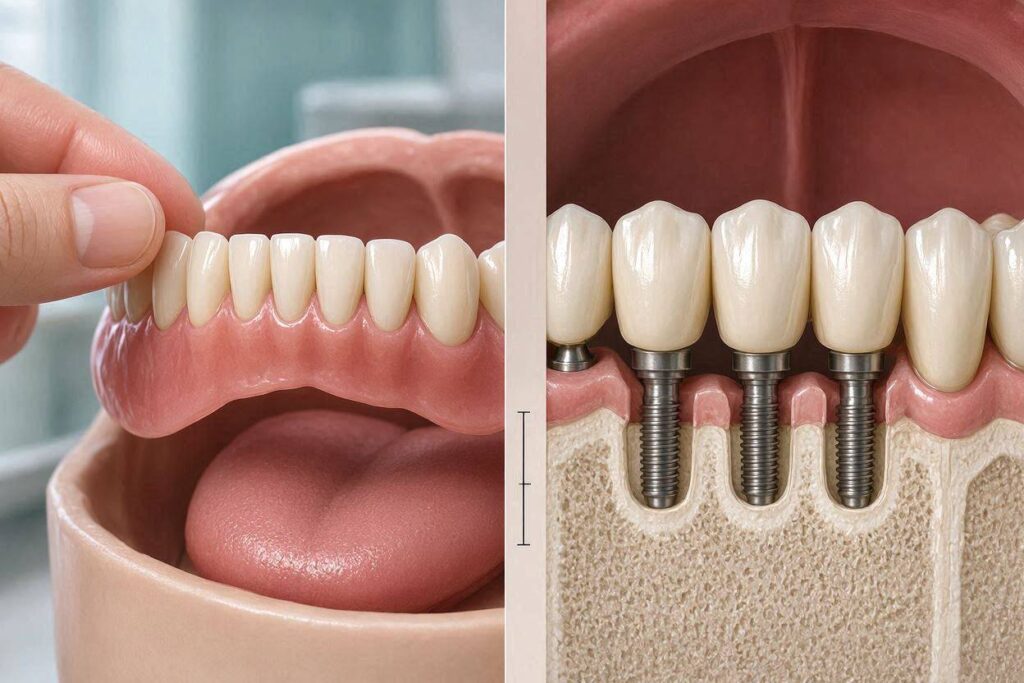
Defining the Denture: A Removable Mucosal Prosthesis
A denture is a removable appliance that replaces missing teeth and the surrounding gum tissue. It is typically fabricated from a pink, gum-colored acrylic resin base that holds a full set of artificial teeth made of acrylic or porcelain. A complete denture replaces all the teeth in an upper or lower arch. A partial denture replaces one or more missing teeth and is secured to the remaining natural teeth with metal or flexible clasps.
The key biological feature of a denture is that it is supported by the oral mucosa, the soft, movable gum tissue covering the underlying jawbone. The denture sits on top of the gums. It does not penetrate into the bone. The forces of chewing are transmitted from the denture, through the compressible gum tissue, and into the bone. This is an inefficient and unstable transfer of force. A lower denture, in particular, is notorious for being loose, shifting during speech, and lifting during eating because the tongue and the cheek muscles constantly dislodge it. The underlying jawbone, deprived of the direct mechanical stimulation of tooth roots, progressively resorbs over the years. The ridge shrinks. The denture that fit well five years ago becomes loose and requires relining or replacement.
A denture is a prosthetic device that must be removed at night and soaked in a cleaning solution. It is a foreign body that the patient must learn to control with their tongue and cheeks. It covers the palate, which impairs taste and can trigger a gag reflex. For millions of people, a well-made denture is a functional and aesthetic lifeline, but it is fundamentally a removable oral appliance, not a surgical implant.
Defining the Dental Implant: A Surgical Bone-Anchored Root Replacement
A dental implant is, by definition, a surgical device. It is a sterile, threaded post, most commonly made of commercially pure titanium or a titanium alloy, which is surgically placed into a precisely drilled channel in the jawbone. The implant replaces the root of a missing tooth. The bone then heals around the implant in a process called osseointegration, fusing the titanium surface directly to the living bone. The implant becomes a permanent, structural part of the patient’s skeleton.
The dental implant serves as an anchor for a prosthetic tooth. A small connector piece, an abutment, is screwed into the implant, and a custom-made crown is cemented or screwed onto the abutment. The implant does not rest on the gum; it is embedded in the bone. The chewing forces are transmitted directly through the implant into the bone, just like a natural tooth root. This direct loading of the bone preserves the bone. The implant does not move, click, or shift. It does not need to be removed. It is brushed and flossed like a natural tooth. A single-tooth implant is a fixed, permanent restoration.
A full arch of missing teeth can be replaced by a fixed bridge supported by four to six implants. This is not a denture; it is a fixed implant bridge. The patient does not remove it. Only the dentist can remove it for maintenance. This is the critical distinction. A denture is removable by the patient. An implant is surgically fixed in the bone. They are not points on a spectrum; they are different categories of medical device.
The Middle Ground: Implant-Supported Overdentures
This is where the terminology becomes tangled. The implant-supported overdenture is a hybrid treatment designed to solve the problem of the loose, unstable lower denture. Two to four dental implants are surgically placed in the front of the lower jaw, the area where the bone is densest and most resistant to resorption. After the implants heal, a specially fabricated full denture is created that snaps onto the implants using small, precision attachments.
The denture is still a denture. It is removable. The patient takes it out at night to clean it. The acrylic base still rests partially on the gums. However, the implants provide retention and stability. The denture does not lift or float. The patient can chew with far greater force and confidence. The denture is “implant-retained” or “implant-stabilized,” but it has not become an implant. It is a denture that clips onto implants. It is a substantial improvement in quality of life over a conventional denture, and it is often the ideal solution for a patient who has been struggling for years with a loose lower denture, but it is not the same as a fixed, full-arch implant bridge.
The confusion in the phrase “substantial dental implant” likely stems from this category. A patient might describe their new, stable, implant-snapped denture as finally having “a substantial implant solution” to their problem. The denture is a full-arch prosthesis, a substantial restoration, and it uses implants. But the denture itself is not an implant. The implant is the small titanium root-form fixture in the bone. The denture is the removable acrylic prosthesis on top.
The Billing and Insurance Distinction
This semantic confusion has financial consequences. Dental insurance codes clearly distinguish between a denture, an implant, and an implant-supported overdenture. A complete denture is billed under a specific code (D5110 or D5120). A surgical implant placement is billed under a completely different surgical code (D6010). The implant-supported overdenture is billed under a specific prosthetic code that indicates it is a removable prosthesis retained by implants.
If a patient’s insurance plan explicitly excludes “dental implants” but covers “dentures,” the implant-supported overdenture becomes a battleground. The denture portion may be covered as a prosthetic benefit, but the surgical implants and the precision attachments will be denied as an excluded service. The patient must understand that they are receiving two distinct treatments: a removable denture, which is often a covered basic benefit, and surgical implant therapy, which is often a major, elective procedure with limited or no coverage. The term “substantial dental implant” appears nowhere in the insurance coding manual, and using it in a pre-authorization request will only create confusion and delay.
Conclusion
Dentures do not qualify as substantial dental implants; a denture is a removable, gum-supported acrylic prosthesis, while a dental implant is a surgically embedded titanium root replacement that fuses with the jawbone. The implant-supported overdenture represents a powerful hybrid solution, giving a removable denture incredible stability by snapping onto implants, but the denture component itself remains a removable appliance. Understanding these definitions is critical for navigating insurance benefits, setting realistic expectations, and distinguishing between a temporary, removable mucosal device and a permanent, osseointegrated skeletal anchor.
FAQ
Can a denture be permanently attached to dental implants?
Yes, but it is then technically a fixed full-arch implant bridge, not a denture. The patient cannot remove it. A “screwmentable” bridge is fixed and only removed by the dentist.
Is an implant-supported denture still removable?
Yes. An implant-supported overdenture is designed to be removed by the patient for daily cleaning. It snaps onto the implants for retention and stability.
What is the difference between an overdenture and a fixed implant bridge?
An overdenture is removed nightly and rests on the gums and implants. A fixed bridge is screwed into the implants, does not touch the gums significantly, and is only removed by the dentist.
Why would a dentist recommend an implant-supported denture instead of a fixed bridge?
An implant overdenture is often less expensive, requires fewer implants, and can replace lost gum and lip support better than a fixed bridge in cases of severe bone atrophy.
Do I still need bone grafting for an implant-supported denture?
Often, no. The implants for an overdenture are typically placed in the front of the jaw, where the bone is denser and more resistant to resorption, avoiding the atrophic back regions that might need a graft.
Additional Resources
For a comprehensive understanding of denture and implant prosthetic options, visit the American College of Prosthodontists: https://www.gotoapro.org/