Can Dental Implanted Molar Chew Meat?
The ultimate test of a tooth replacement is not how it looks in a photograph or how it feels when you run your tongue over it. The ultimate test is function. It is the moment you sit down at a restaurant, order a steak, cut into it, and bring that first bite to your mouth. For a patient who has lived with a missing molar, the question “Can a dental implanted molar chew meat?” is not a hypothetical curiosity. It is a deeply practical, emotionally charged inquiry that goes to the very heart of why they are investing in an implant. They are not just buying a tooth; they are buying back the ability to eat normally, to share a meal without anxiety, and to nourish their body with the foods they once enjoyed.
The answer is a resounding yes. A successfully integrated, properly restored dental implant placed in the molar position can chew meat, and not just tender cuts. It can handle steak, roasted chicken, and a juicy hamburger. It can handle the chewy, fibrous texture of a grilled piece of lamb. However, this yes comes with a crucial biological and mechanical asterisk. An implant does not chew meat the same way a natural molar does, and the patient must understand the difference to protect their investment for a lifetime. The implant-molar complex is a rigid, bone-fused unit that lacks the sensory shock absorption of a natural tooth. You can chew meat, but you must learn to chew with a new, mindful relationship to your bite force. This comprehensive guide will explore the biomechanics of chewing with an implant molar, the healing timeline that allows you to return to a normal diet, the specific risks of overload and fracture, and the dietary common sense that will keep your implant functioning for decades.
The Biomechanics of Chewing: Natural Tooth vs. Implant
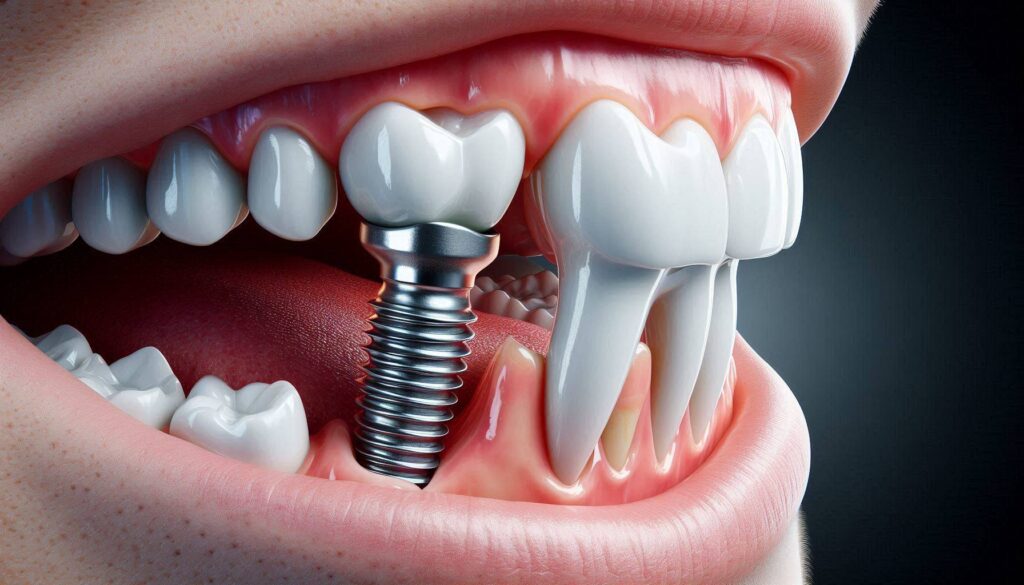
To understand how an implant molar handles meat, you must first understand the fundamental structural difference between a natural tooth and an implant. A natural molar is not cemented into the bone; it is suspended by the periodontal ligament. This ligament is a network of collagen fibers that runs from the root surface to the surrounding bone. It acts as a biological shock absorber. When you bite down on a piece of meat, the ligament compresses slightly, stretching the nerve fibers and sending a precise, millisecond-by-millisecond feedback signal to your brain about the hardness, texture, and position of the food. This is proprioception. Your brain instinctively modulates the force of your jaw muscles. If you bite down on a hidden piece of bone or gristle, the ligament senses the sudden hard object, and your brain immediately relaxes the muscles, preventing damage. The ligament also allows the tooth to move microscopically within the socket, distributing the chewing forces along the entire root surface.
A dental implant has no periodontal ligament. It is ankylosed, which means it is fused directly to the bone. There is no shock absorber, no cushion of collagen. The implant receives the full, undampened force of your bite. The proprioception is diminished, although not absent entirely. The bone itself has sensory nerves, and the implant transmits vibrations directly to the bone. You can feel that you are chewing, and you can sense the texture of the food, but the fine-grained, protective tactile feedback is blunted. You cannot sense the subtle overload the way a natural tooth can warn you. This means you must consciously moderate your bite force. The implant is strong, but it is not indestructible, and it relies on your intelligent use, not a biological ligament, to survive.
The Healing Timeline: When Can You Chew Meat?
The ability to chew meat on a dental implant is not granted on the day of surgery. It is earned through a disciplined, phased healing process. Violating this timeline is the single most common cause of early implant overload and failure.
Phase 1: The Initial Healing Period (First 1-2 Weeks)
Immediately after the implant surgery, the implant has only mechanical stability. It is screwed into the bone, but there is no biological integration. The blood clot is forming, and the soft tissue is healing. Your diet must be strictly soft and liquid. Smoothies, yogurt, mashed potatoes, soup, scrambled eggs, and protein shakes are your staples. You must not chew on the implant side at all. Any force applied to the implant during this critical vascularization phase can cause micro-motion, disrupt the blood clot, and lead to a fibrous encapsulation instead of osseointegration. You are protecting the surgical site.
Phase 2: The Osseointegration Period (Next 3-6 Months)
The implant is now buried under the gum (in a two-stage procedure) or has a healing abutment. The bone is actively growing onto the titanium surface. During this entire period, the implant must be completely unloaded. You continue to avoid chewing on that side. You can gradually introduce a soft, non-chewy diet on the opposite side. Pasta, soft bread, fish, and well-cooked vegetables are acceptable. You must not tear into a piece of meat with the implant site. The forces of chewing, even transmitted through the jawbone, can stress the healing implant.
Phase 3: The Temporary Crown Phase
Once the implant is exposed and a temporary crown is placed, you begin to tentatively load the implant. The temporary crown is often made of acrylic and is not designed for full force. Your dentist will advise a soft, cautious diet. You can start chewing very soft foods directly on the implant, slowly and deliberately. This is the period of “testing” the implant, allowing the bone to adapt to the load. The bone around the implant remodels and strengthens in response to controlled forces.
Phase 4: The Final Crown Delivery
When the final, permanent ceramic or zirconia crown is torqued or cemented into place, the implant is fully ready for functional loading. This is the moment you can begin to reintroduce meat into your diet on the implant side. You will start with tender, slow-cooked meats that pull apart easily. You will cut your food into small, manageable pieces. You will chew slowly and deliberately, paying close attention to the sensation. You will not immediately order a well-done sirloin and tear into it with your front teeth. You will progress over several weeks, building your confidence and your bite strength.
What Types of Meat Can an Implant Molar Handle?
Once fully healed and restored, a single implant molar can handle a remarkably normal diet. The implant itself is made of a titanium alloy that is stronger than human bone. The crown is made of a modern ceramic, like layered zirconia or lithium disilicate, which has a flexural strength that exceeds the forces of normal human mastication. The weak link in the system is not the implant or the crown; it is the bone-implant interface and the patient’s proprioceptive intelligence.
You can comfortably chew:
- Tender cuts of beef: Filet mignon, ribeye (trimmed of heavy gristle), roast beef.
- Poultry: Chicken breast, turkey, roasted duck, all cut off the bone.
- Pork: Tenderloin, chop (cut off the bone), pulled pork.
- Ground meats: Hamburgers, meatloaf, meatballs.
- Fish: All types of fish, including firmer fish like salmon and tuna.
- Lamb: Tender cuts, stewed lamb.
The foods you must approach with extreme caution or avoid entirely on the implant side include foods that create a sudden, uncontrolled, high-leverage force. The most dangerous foods for an implant molar are:
- Hard, crunchy bones: Do not gnaw on a pork chop bone or a chicken wing bone. This is a sudden, unpredictable hard object.
- Unpopped popcorn kernels: These are notorious for causing dental fractures in natural teeth and can exert a focal, crushing force on an implant crown.
- Hard nuts and seeds: Chewing a whole almond or a Brazil nut directly on the implant creates a concentrated high force.
- Chewy, sticky candies: Caramel, toffee, and hard taffy exert a prolonged, tensile force on the crown and the abutment screw, risking screw loosening or crown debonding.
- Ice: Chewing ice is a pathological habit that should be avoided with any teeth, natural or implant.
The guiding principle is to use the implant molar as you would a well-made tool. It is for chewing soft to moderately firm foods. It is not a nutcracker, a bone crusher, or a bottle opener.
The Risk of Overload and Screw Loosening
The most common mechanical complication with a posterior implant is not a fracture of the implant itself, but loosening of the abutment screw. The screw that connects the crown to the implant is a tiny, precision-torqued titanium fastener. Under excessive or repetitive off-axis loading, the screw can stretch and lose its preload. The patient will feel a slight squishiness or clicking when chewing. This is not a biological failure; it is a mechanical one. The dentist can simply replace the screw and torque it to the manufacturer’s specification. However, if the loose screw is ignored and the patient continues to chew on the wobbly crown, the movement can damage the internal connection of the implant, requiring a far more complex and costly repair.
Bruxism, the unconscious clenching and grinding of teeth during sleep, is the ultimate overload risk. The forces generated during a bruxism episode can be ten times the force of normal chewing. These massive, lateral, uncontrolled forces are the enemy of the rigid implant-bone interface. A patient with a known bruxism habit must be protected with a custom-fitted, hard acrylic nightguard that covers the implant crown and distributes the grinding forces across the entire arch.
Conclusion
A dental implanted molar can absolutely chew meat, from tender steak to roasted chicken, once the implant has fully osseointegrated and the final crown is delivered. However, the implant lacks the biological shock absorption of a natural periodontal ligament, requiring the patient to eat mindfully, avoid hard or unyielding objects like bones and unpopped kernels, and to cut their food into manageable pieces. The long-term ability to chew normally is the reward for a disciplined healing period and a commitment to intelligent, protective use of the prosthesis.
FAQ
How long after implant surgery can I eat a steak?
You must wait until the final crown is delivered and the implant is fully integrated, which is typically 4 to 6 months after surgery. You then start with tender, soft meats and gradually work your way up.
Can chewing meat loosen a dental implant?
Properly chewing soft to moderately firm meat will not loosen a healthy, integrated implant. However, chewing on a hard bone, gristle, or ice can create an overload that may loosen the abutment screw.
Why does my implant feel different when I chew meat?
The implant lacks the periodontal ligament’s proprioceptive feedback, so the sensation is duller and more pressure-oriented than the tactile sensitivity of a natural tooth.
Will I ever be able to eat without thinking about my implant?
Yes. After a period of mindful adaptation, most patients report that their implant becomes an unconscious part of their chewing function. You simply eat normally, while avoiding the obvious hard, damaging foods.
Can an implant molar break from chewing meat?
A properly manufactured titanium implant will not break from chewing meat. The crown could fracture if it is poorly made or if you bite into a hidden hard object, but normal meat mastication is well within the implant’s tolerance.
Additional Resources
For authoritative information on the functional outcomes and long-term success of dental implants, visit the Academy of Osseointegration: https://www.osseo.org/