The Complete Guide to HIPAA Dental Procedure Codes
Dental billing can feel like learning a foreign language. When you add HIPAA requirements into the mix, many practice managers and dentists find themselves overwhelmed. You might wonder which codes to use, how to format claims, and what happens if you make a mistake. This guide answers all those questions clearly and honestly.
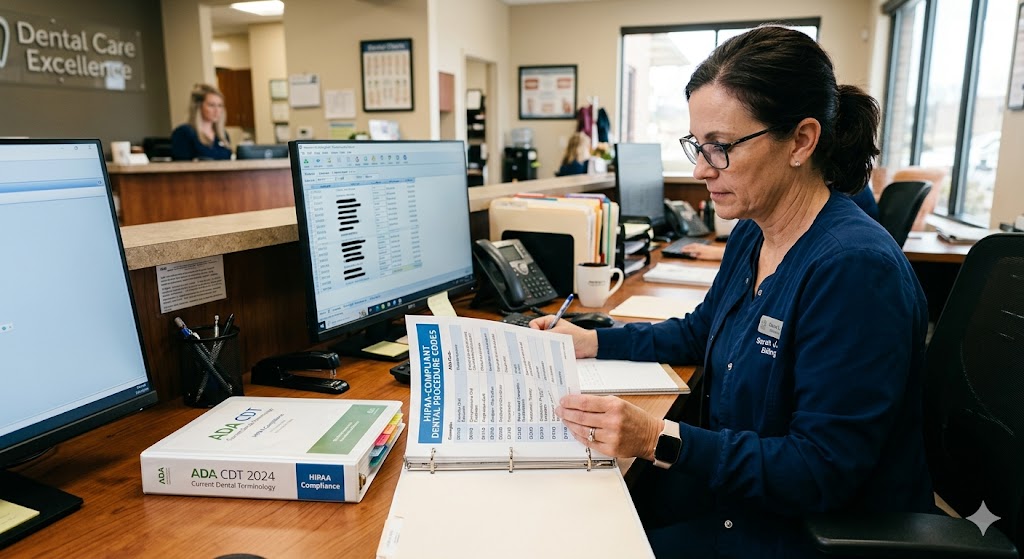
HIPAA dental procedure codes refer to the standard code set that dental practices must use when they submit electronic claims. The Health Insurance Portability and Accountability Act mandates specific code sets to create uniformity across healthcare. For dentistry, this means using Current Dental Terminology codes, known as CDT codes, for all procedure reporting on electronic transactions.
This article walks you through everything you need to know. You will learn about the relationship between HIPAA and dental codes, how to use CDT codes correctly, common mistakes to avoid, and what a compliant electronic claim looks like. The information here comes from current, verified standards and aims to serve as a lasting reference for your practice.
Understanding the Foundation: HIPAA and Dental Procedure Codes
The connection between HIPAA and dental procedure codes often confuses people new to dental administration. Let’s break it down into simple terms.
What HIPAA Actually Requires for Dental Codes
Congress passed HIPAA in 1996. One of its key provisions required the Secretary of Health and Human Services to adopt national standards for electronic healthcare transactions. Before HIPAA, healthcare providers, including dentists, used various local or proprietary codes to bill for services. A filling in California might have a completely different code than the same filling in New York. Insurance companies each had their own forms and codes. This chaos made claims processing slow, expensive, and error-prone.
HIPAA changed this by designating specific code sets as the national standard. For dental procedures, the designated code set is the Code on Dental Procedures and Nomenclature, universally called CDT codes. The American Dental Association owns, maintains, and updates the CDT code set annually.
The key regulation here is found in 45 CFR Part 162. It states that covered entities, which include most dental practices that submit claims electronically, must use the standard code sets for specific transactions. For dental services, CDT codes serve as the HIPAA-adopted code set within the Healthcare Common Procedure Coding System, the broader framework that also includes medical CPT codes.
This means if your dental practice sends claims electronically, you must use CDT codes to describe the procedures you performed. You cannot make up your own codes. You cannot use outdated codes from a previous year. You must use the current, valid CDT codes as published by the ADA.
Why HIPAA Dental Procedure Codes Matter
Understanding this requirement matters for several practical reasons beyond simply following the law.
First, using correct HIPAA-compliant codes ensures you get paid. Insurance carriers build their processing systems around CDT codes. When you submit a claim with a valid, specific code, the system can automatically adjudicate it. Using incorrect or non-standard codes triggers denials and delays.
Second, standardized codes allow for clear communication. When you send a claim to an insurer, the code tells them exactly what you did. This clarity reduces requests for additional documentation and speeds up the payment cycle.
Third, compliance protects your practice from penalties. The Office for Civil Rights enforces HIPAA rules. While they most commonly pursue cases involving privacy violations, submitting non-compliant electronic transactions can trigger audits and corrective action plans.
Here is a comparative look at the impact of using correct versus incorrect HIPAA dental procedure codes:
| Aspect | Correct HIPAA CDT Codes | Incorrect or Non-Standard Codes |
|---|---|---|
| Claims Processing | Smooth, often automatic adjudication | Delays, manual review required |
| Payment Speed | Faster, predictable payment cycles | Slow, often stuck in pending status |
| Denial Rate | Lower rate of denials for coding issues | High rate of denials and rejections |
| Audit Risk | Low risk of coding-related findings | Elevated risk during payer audits |
| Interoperability | Easy data exchange with other providers | Data cannot transfer cleanly |
| Compliance Status | Meets HIPAA electronic transaction standards | Violates HIPAA transaction standards |
This table illustrates why mastering HIPAA dental procedure codes directly benefits your practice’s financial health and operational efficiency.
Who Must Follow These Standards
Not every dental practice must comply with every HIPAA rule, but most do. The term covered entity defines who falls under HIPAA’s requirements. A dental practice qualifies as a covered entity if it transmits any health information in electronic form in connection with a transaction for which HHS has adopted a standard.
Practically speaking, if your practice submits claims electronically to any insurance company, you are a covered entity and must use CDT codes for those claims. Even if you use a clearinghouse or billing service, you remain responsible for compliance. The clearinghouse acts as your business associate, but the duty to submit compliant claims stays with you.
Some small, cash-only practices that never submit electronic claims might technically fall outside the HIPAA transaction standards. However, such practices remain rare. Most patients have some form of dental benefits, and even patients without insurance increasingly expect electronic records and communication.
The CDT Code Set: Your HIPAA Dental Procedure Code Standard
CDT codes form the backbone of HIPAA-compliant dental billing. Understanding their structure, categories, and proper use proves essential for every dental professional.
The Structure of a CDT Code
The ADA publishes a new edition of the CDT manual each year, with changes taking effect on January 1st. Each code consists of a letter followed by four digits, like D0120 or D1110. The letter “D” stands for “Dental,” setting these codes apart from the five-digit numeric CPT codes used in medicine.
Every code entry in the CDT manual includes three parts: the code itself, a nomenclature that serves as the official short description, and a descriptor that provides a more detailed explanation of the procedure. For example, code D0120 has the nomenclature “periodic oral evaluation – established patient” and a longer descriptor clarifying what the evaluation includes.
This structure ensures that everyone using a given code understands its meaning in the same way. The descriptor serves as the definitive reference when questions arise about what a code covers.
The 12 Categories of Service
The CDT code set organizes all dental procedures into 12 categories of service. Each category groups related procedures together, making it easier to find the right code for a particular treatment.
Here is the complete list of CDT categories with their code ranges:
Category I: Diagnostic
Codes D0100 through D0999
This category covers examinations, evaluations, imaging, and tests. Common codes include periodic exams, comprehensive exams, bitewing radiographs, and panoramic images.
Category II: Preventive
Codes D1000 through D1999
Preventive procedures like prophylaxis, fluoride treatments, and sealants live here. These codes see heavy daily use in general dental practices.
Category III: Restorative
Codes D2000 through D2999
Fillings, crowns, inlays, onlays, and other restorations fall under this category. Both direct and indirect restorations appear here.
Category IV: Endodontics
Codes D3000 through D3999
Root canal treatments, pulpotomies, apexification procedures, and other endodontic services occupy this category.
Category V: Periodontics
Codes D4000 through D4999
Scaling and root planing, periodontal maintenance, osseous surgery, and gingival procedures are found here.
Category VI: Prosthodontics, Removable
Codes D5000 through D5899
Complete dentures, partial dentures, and repairs or adjustments to removable prostheses.
Category VII: Prosthodontics, Fixed
Codes D5900 through D5999
This category previously held fixed partial denture codes but now primarily contains implant-related fixed prosthodontic codes, with many procedures moved to Category VIII.
Category VIII: Implant Services
Codes D6000 through D6199
Implant placement, implant-supported prostheses, and related surgical components.
Category IX: Oral and Maxillofacial Surgery
Codes D7000 through D7999
Extractions, biopsies, surgical procedures, and other oral surgery services.
Category X: Orthodontics
Codes D8000 through D8999
Comprehensive orthodontic treatment, interceptive treatment, and retention procedures.
Category XI: Adjunctive General Services
Codes D9000 through D9999
Anesthesia, professional visits, drugs, appliances for sleep apnea, and miscellaneous services.
Category XII: Diagnostic, Preventive, and Other Services
Codes D0000 through D0999
This category shares its range with Category I but covers procedures like case presentations and consultations that may not directly involve clinical treatment.
Annual Updates and Their Importance
The ADA updates the CDT code set every year. A dedicated committee, the Code Maintenance Committee, meets to consider requests for new codes, revisions to existing codes, and deletion of obsolete codes. The committee includes representatives from various dental specialty organizations, insurance carriers, and the ADA itself.
Each year brings changes. Some years add dozens of new codes. Other years focus more on revisions and clarifications. Regardless of the scope, dental practices must implement the new codes by January 1st for HIPAA compliance.
Failing to update your systems creates problems. Old codes may no longer exist. New codes may offer better specificity that insurers require. A common pitfall involves practices continuing to use a deleted code because their software defaults to it or because staff members remember it from habit.
Important Note: You should obtain the current CDT manual from the ADA. Using outdated code lists, free online sources that may not reflect current codes, or pirated versions creates compliance risk and denies you the full descriptors and guidelines that accompany the official codes.
The HIPAA Dental Claim Format: 837D Transaction
Having the right codes represents only half of the equation. You must also use those codes within the correct electronic format. HIPAA adopted the ASC X12N 837D transaction as the standard for dental claims.
What the 837D Transaction Contains
The 837D serves as the electronic equivalent of the paper ADA Dental Claim Form. It contains all the information needed to process a dental claim, structured in a specific format that computer systems can read and process automatically.
The transaction includes several key components:
Submitter and Receiver Information: Identifies who sends the claim and which payer receives it.
Billing Provider Information: Details about the dental practice, including the NPI and tax identification number.
Subscriber and Patient Information: Identifies the insured person and, if different, the patient who received treatment.
Claim Details: Lists the date of service, place of service, and other claim-level data.
Service Lines: Each procedure reported with its CDT code, tooth number, quadrant, surface, quantity, and charge amount.
Additional Information: Can include supporting documentation, narratives, and attachments for procedures requiring additional explanation.
The 837D format accommodates multiple claims in a single file, allowing practices to batch their submissions efficiently.
Data Elements Required for Compliant Claims
An 837D claim contains many data elements. Some are always required. Others become required depending on the specific circumstances. Understanding these requirements prevents rejections.
Here are the essential data elements for every claim:
- Provider NPI number for the billing entity
- Provider NPI number for the treating dentist if different
- Patient’s name and date of birth
- Subscriber’s name and member ID
- Payer ID for the insurance carrier
- Date of service
- CDT procedure code for each service line
- Charge amount for each service
- Tooth number or quadrant when applicable
- Oral cavity designation when applicable
- Number of surfaces for restorative procedures
Missing any of these elements typically causes a claim rejection at the clearinghouse or payer level, meaning the claim never enters the adjudication system.
Differences Between Paper and Electronic Formats
While the 837D serves as the electronic standard, many practices still use the paper ADA Dental Claim Form for certain payers or situations. The two formats contain the same essential information but differ in important ways.
The paper form, formally called the ADA Dental Claim Form (version 2024), provides a visual layout that staff members fill out manually or with software that prints the form. The 837D transaction contains the same data but in a structured, computer-readable format.
Here is a comparative table of the two formats:
| Feature | ADA Paper Claim Form | HIPAA 837D Electronic Transaction |
|---|---|---|
| Format | Physical or printed document | Electronic data file (ANSI X12) |
| Submission Method | Mail or fax | Electronic submission through clearinghouse |
| Processing Speed | Slower, manual entry by payer | Faster, automatic system processing |
| Error Correction | Returns by mail with explanation | Electronic rejection reports |
| Attachment Handling | Physical or digital attachments | Electronic attachments using 275 transaction |
| Code Usage | Same CDT codes required | Same CDT codes required |
| HIPAA Compliance | Not HIPAA standard for electronic claims | Mandatory for electronic claims |
It is worth noting that for electronic claims, HIPAA requires the 837D format. Some practice management systems may offer a “print image” or PDF claim submission, but these do not meet the HIPAA standard for electronic transactions. True HIPAA-compliant electronic claims must use the 837D format.
Mastering CDT Codes for Specific Clinical Scenarios
Let’s move from theory to practice. The following sections walk through common clinical situations and the CDT codes that properly describe them.
Diagnostic Services: The Starting Point for Every Case
Diagnosis begins every dental case. Proper coding here sets the stage for treatment planning and insurance coverage determinations.
Periodic Oral Evaluation (D0120): This code applies to an established patient returning for a routine check-up. The evaluation includes charting, oral cancer screening, and a treatment plan update. Most recall patients receive this code.
Comprehensive Oral Evaluation (D0150): Use this code for new patients or established patients who have experienced significant changes in health status or who have been away from the practice for an extended period. This evaluation is more thorough than the periodic exam and often includes a complete full-mouth series of radiographs.
Limited Oral Evaluation (D0140): This code fits when a patient presents with a specific problem. A toothache, a broken filling, or a localized concern. The evaluation focuses on that specific issue rather than the entire mouth.
Comprehensive Periodontal Evaluation (D0180): When you perform full periodontal charting, including probing depths, recession, attachment levels, furcation involvement, and mobility, this code applies. It often accompanies new patient comprehensive exams or periodic evaluations where periodontal concerns exist.
For radiographs, the codes specify image type and number:
- D0210: Intraoral – complete series including bitewings
- D0220: Intraoral – periapical first radiographic image
- D0230: Intraoral – periapical each additional image
- D0270: Bitewing – single radiographic image
- D0272: Bitewings – two images
- D0274: Bitewings – four images
- D0330: Panoramic radiographic image
Selecting the correct radiographic code depends on the number and type of images captured.
Important Note: Some insurers bundle diagnostic services with preventive visits. Always verify coverage before submitting claims, especially for comprehensive evaluations and full-mouth series performed on the same day.
Preventive Procedures: Codes for Cleanings and Prevention
Preventive codes cover the services patients most commonly associate with routine dental visits.
Adult Prophylaxis (D1110): This code describes a cleaning for a patient with generally healthy periodontal tissues. The procedure removes plaque, calculus, and stain from tooth surfaces. Most adult recall patients receive this code.
Child Prophylaxis (D1120): Same procedure as D1110, but for patients with primary or transitional dentition. Age cutoffs vary by payer, but many use 12 or 14 years as the transition point to D1110.
Scaling in Presence of Generalized Moderate or Severe Gingival Inflammation (D4346): This relatively newer code bridges the gap between a routine prophylaxis and full scaling and root planing. Use it when a patient has generalized gingivitis with significant inflammation, bleeding, and pseudopocketing but no true attachment loss. This code tells the payer that the patient required more than a routine cleaning but does not have periodontitis.
Fluoride Varnish Application (D1206): The most common fluoride code for children and, increasingly, for adults with high caries risk or sensitivity.
Sealants (D1351): Applied to pits and fissures of teeth for caries prevention. Typically limited to permanent molars and sometimes premolars, though clinical judgment should guide use.
Restorative Codes: Precision Matters
Restorative coding requires attention to surfaces and materials. Errors here cause frequent denials and claim adjustments.
Amalgam Restorations (D2140-D2161): These codes specify the number of surfaces restored. D2140 covers one surface. D2150 covers two surfaces. D2160 covers three surfaces. D2161 covers four or more surfaces.
Resin-Based Composite Restorations (D2330-D2335): Structured similarly to amalgam codes but for tooth-colored restorations. D2330 covers one surface on anterior teeth only. D2331 covers two surfaces. D2332 covers three surfaces. D2335 covers four or more surfaces or those involving the incisal angle.
For posterior composite restorations, use D2391 through D2394, which follow the same surface-counting structure.
A Note on Surface Coding: When reporting a restoration, count the number of involved surfaces. A mesial-occlusal restoration counts as two surfaces (MO). A mesial-occlusal-distal restoration counts as three surfaces (MOD). Do not include surfaces that receive only bonding or etching without actual restorative material placement.
Surgical Codes: Extractions and Oral Surgery
Surgical codes describe procedures ranging from simple extractions to complex impaction removals.
Simple Extraction (D7140): Use this code when removing an erupted tooth or exposed root that does not require elevation of a mucoperiosteal flap or removal of bone. The key word is “simple.” The tooth comes out with forceps.
Surgical Extraction (D7210): This code applies when extraction requires mucoperiosteal flap elevation and, in some cases, bone removal or tooth sectioning. Even if the tooth comes out easily after flap elevation, the code remains D7210 because the surgical approach distinguishes it from a simple extraction.
Soft Tissue Impaction Removal (D7220): An impacted tooth covered by soft tissue that requires flap elevation. No bone removal needed.
Partial Bony Impaction Removal (D7230): An impacted tooth where part of the crown lies under bone. Requires flap elevation and some bone removal.
Full Bony Impaction Removal (D7240): An impacted tooth where most or all of the crown lies under bone. Requires flap elevation and significant bone removal.
Important Note on Tooth Numbers: Always report the specific tooth number for extractions and surgical procedures. Claims without tooth numbers face automatic denials from most payers.
Navigating the Most Confusing HIPAA Dental Procedure Codes
Some codes create more confusion than others. Let’s address these head-on.
Scaling and Root Planing vs. Prophylaxis
The distinction between scaling and root planing and a prophylaxis generates more claim denials and post-payment reviews than almost any other coding area.
Scaling and Root Planing (D4341 and D4342) codes apply when the patient has active periodontitis with attachment loss, bone loss visible radiographically, and calculus extending below the gingival margin onto root surfaces.
D4341 covers one to three teeth per quadrant. D4342 covers four or more teeth per quadrant. Note that these codes apply to quadrants, not arches or full mouths.
To justify scaling and root planing, documentation must include:
- Full periodontal charting with probing depths
- Radiographs showing bone loss
- Evidence of calculus on root surfaces
- A diagnosis of periodontitis
Without this documentation, insurers often downgrade these codes to a prophylaxis or deny them outright. This represents one of the most common audit triggers for dental practices.
Periodic Evaluation vs. Limited Evaluation
Choosing between D0120 (periodic evaluation) and D0140 (limited evaluation) trips up many practices.
Use D0120 when a patient comes for their routine recall appointment. Even if you identify a problem during this visit, the primary purpose of the visit was a routine check-up. You report D0120 and then schedule the patient for treatment of the identified problem at a subsequent appointment.
Use D0140 when a patient presents with a specific complaint and you examine only the area of concern. A patient with a toothache on tooth #30 who receives an exam focused on that tooth and surrounding area should receive D0140. You do not perform a full periodic evaluation in this scenario.
Palliative Treatment vs. Definitive Care
D9110 (Palliative Emergency Treatment of Dental Pain) covers temporary relief of acute pain. This code sees frequent misuse.
D9110 applies when a patient presents with pain, and you provide temporary relief without addressing the underlying cause definitively. You might place a sedative dressing, smooth a sharp tooth edge, or adjust an occlusion temporarily. The patient returns later for definitive treatment.
If you address the cause definitively at the same visit, do not use D9110. Code for the definitive procedure. Using D9110 alongside a definitive procedure on the same tooth on the same day will likely result in the D9110 being denied.
Full Mouth Debridement
D4355 (Full Mouth Debridement) enables comprehensive evaluation and diagnosis when heavy calculus or plaque covers tooth surfaces so extensively that you cannot perform a proper exam.
This code applies when a patient, often one who has not seen a dentist in years, presents with calculus covering most tooth surfaces. You physically cannot see the teeth well enough to diagnose caries, existing restorations, or periodontal status.
After debridement, the patient returns for a comprehensive evaluation and definitive treatment planning. D4355 is never billed on the same day as a prophylaxis or scaling and root planing. Most insurers limit this code to once per patient per lifetime, though some allow it once every three to five years.
Common HIPAA Dental Procedure Code Mistakes and Their Solutions
Even experienced billing teams make mistakes. Here are the most common ones and how to prevent them.
Using Outdated Codes
The ADA deletes codes every year. Some practices fail to update their systems and continue using deleted codes. Claims with deleted codes get rejected.
Solution: Subscribe to annual CDT updates through the ADA or your practice management software vendor. Implement the updates before January 1st each year. Run test claims in your sandbox environment to verify all codes are current.
Mismatched Tooth Numbers and Codes
A restoration code with four surfaces on a lower incisor raises immediate red flags. Similarly, reporting a restoration on tooth number and procedure that does not align clinically triggers denials.
Solution: Build clinical logic rules into your practice management software where possible. Train clinical staff on proper tooth numbering and code selection before they enter treatment plans.
Upcoding and Downcoding
Upcoding means reporting a more complex or higher-paying code than the service actually performed. Downcoding means the opposite. Insurers watch for both patterns.
Common upcoding examples include:
- Reporting surgical extractions for simple extractions
- Claiming four-surface restorations when only two surfaces were restored
- Using scaling and root planing codes for patients with gingivitis but no periodontitis
Solution: Let clinical findings drive code selection. The dentist should select codes based on what they see and do, not on insurance benefits. Document everything thoroughly to support your code choices.
Missing or Incomplete Narratives
Many procedures require additional explanation through narratives. High-cost prosthodontic cases, periodontal surgery, and procedures exceeding typical frequency limitations all benefit from or require narratives.
Solution: Create narrative templates for common scenarios requiring explanation. Store them in your practice management system. Customize each narrative to the specific patient and procedure rather than using generic text that insurers recognize and ignore.
Billing the Wrong Payer
Some patients have multiple dental plans. Billing the primary versus secondary payer correctly affects both compliance and payment.
Solution: Verify coordination of benefits for every patient at every visit. Software can help track primary and secondary coverage, but front desk staff must verify and update this information regularly.
The 837D in Practice: Building a Compliant Electronic Claim
Let’s walk through the construction of an 837D transaction step by step.
The Loop Structure of an 837D
The 837D transaction uses a hierarchical loop structure. Each loop contains specific segments with defined data elements. Understanding this structure helps you troubleshoot rejected claims.
Loop 1000A: Submitter Name
Contains information about the entity sending the claim file.
Loop 1000B: Receiver Name
Identifies the insurance payer receiving the claim.
Loop 2000A: Billing Provider Hierarchical Level
Contains the billing provider’s NPI, tax ID, and contact information.
Loop 2000B: Subscriber Hierarchical Level
Contains subscriber and patient demographic information.
Loop 2300: Claim Information
Holds claim-level data including dates of service, diagnosis codes if applicable, and claim-level identifiers.
Loop 2400: Service Line
Contains the CDT codes, tooth numbers, surfaces, charges, and other procedure-specific data.
Each loop nests within higher-level loops, creating a structured data file that payer systems can parse reliably.
Required Segment Fields for Dental Claims
Within these loops, specific fields carry the data that matters most for dental claims.
BHT Segment: Begins the transaction and specifies the transaction type (837D for dental) and purpose (original submission, replacement, void).
NM1 Segment: Appears in multiple loops to identify providers, subscribers, and patients. For dental providers, the NPI (National Provider Identifier) in the NM109 element proves critical.
SV3 Segment: Appears in Loop 2400 and contains the dental procedure information. This segment carries the CDT code, tooth number when applicable, oral cavity designation, number of surfaces, and charge amount.
TOO Segment: Tooth information. When a procedure involves a tooth, this segment specifies which tooth using Universal/National Tooth Numbering System (tooth numbers 1-32 for permanent teeth, A-T for primary teeth).
Example: A Simple Claim Step by Step
Consider a patient named Jane Smith who comes to Dr. Roberts for a periodic evaluation and adult prophylaxis.
Claim-Level Data:
- Patient: Jane Smith
- Subscriber: John Smith (Jane’s spouse)
- Insurance: ABC Dental Plan
- Service Date: January 15, 2026
Service Lines:
- Line 1: D0120 – Periodic Oral Evaluation – $75
- Line 2: D1110 – Adult Prophylaxis – $95
Required Data Elements for Line 1:
- CDT Code: D0120
- Charge: $75
- No tooth number (not applicable for evaluation codes)
Required Data Elements for Line 2:
- CDT Code: D1110
- Charge: $95
- No tooth number (not applicable for prophylaxis)
The practice management software assembles these data elements into the proper 837D loops and segments automatically. However, knowing what the final transaction contains helps you understand rejection reports when something goes wrong.
Common 837D Rejection Reasons
Even correctly coded claims can face rejection due to formatting or data errors in the 837D transaction.
Invalid NPI: The provider NPI in the 837D does not match what the payer has on file. Verify NPI numbers in your system quarterly.
Missing Subscriber ID: The subscriber identification number is blank or incorrect. Always verify member IDs at each visit.
Invalid Payer ID: The payer identification code in the 837D does not match any known payer. Obtain the correct electronic payer ID from the clearinghouse or payer directly.
Service Facility Mismatch: The location where services were performed does not match the provider’s credentialed locations. Report the actual location of service using the correct address and NPI.
HIPAA Compliance Beyond Codes: Privacy and Security Considerations
HIPAA dental procedure code compliance exists within a larger framework of privacy and security obligations.
The Connection Between Coding and Privacy
The codes you submit on claims become part of the patient’s protected health information. Payers store this data. Clearinghouses transmit it. The coded description of dental treatment reveals clinical information about the patient.
This means proper coding practices support privacy compliance. When you use correct, specific codes, you transmit only the necessary minimum information to describe the service accurately. Using vague or incorrect codes could expose more information than necessary or, conversely, fail to communicate what the payer needs.
Minimum Necessary Standard
HIPAA requires covered entities to limit protected health information to the minimum necessary to accomplish the intended purpose. When submitting claims, use codes that describe exactly what you did without including extraneous data. Do not add unnecessary documentation unless the payer requires it for adjudication.
Business Associate Agreements
Your clearinghouse serves as a business associate under HIPAA. They transmit your claims, including the CDT codes, to payers. You must have a current business associate agreement with your clearinghouse. This agreement outlines their obligations to protect the information you entrust to them, including the coded clinical data in your 837D transactions.
The Annual CDT Code Update Cycle: Staying Current
HIPAA requires use of the current valid code set. For dental practices, this means implementing the ADA’s annual CDT updates.
Why Annual Updates Occur
Dentistry evolves. New technologies emerge. New materials come to market. Techniques advance. The CDT code set must keep pace with clinical reality. The Code Maintenance Committee reviews proposals for new codes, revisions, and deletions throughout the year and votes on them each spring for implementation the following January.
How to Implement Updates Smoothly
A systematic approach prevents the chaos that can accompany code changes.
Step 1: Obtain the New CDT Manual Early
The ADA typically releases the new manual in the fall. Order it promptly so you have time to review changes before they take effect on January 1.
Step 2: Identify Changes That Affect Your Practice
Not every code change matters for every practice. An orthodontic-only practice may not need to worry about new restorative codes. Focus on changes relevant to your services.
Step 3: Update Your Practice Management Software
Most software vendors release updates incorporating the new CDT codes. Install these updates promptly and test them before January 1.
Step 4: Train Your Team
Hold a training session covering the code changes. Walk through clinical scenarios that involve new or revised codes. Ensure everyone understands the proper use.
Step 5: Update Templates and Favorites Lists
Many practice management systems allow you to build favorites lists or quick-pick code lists. Update these to reflect the current codes, removing deleted codes and adding new ones.
Step 6: Audit Early Claims
Review the first week of claims submitted with new codes. Look for denials related to coding issues and address problems immediately.
Managing Coordination of Benefits with HIPAA Codes
Coordination of benefits adds complexity to dental coding. When a patient has two dental plans, proper coding ensures correct payment from each.
Primary vs. Secondary Payer Rules
The primary payer must process the claim first. The secondary payer then considers the primary payer’s payment before calculating their obligation. The patient’s relationship to the subscriber usually determines which plan is primary.
For children covered by both parents’ plans, the birthday rule often applies. The parent whose birthday falls earlier in the calendar year provides primary coverage. Some plans use different rules, so always verify with each payer.
Coding Consistency Across Payers
You must submit the same CDT codes to both primary and secondary payers. You cannot change codes to maximize reimbursement from the secondary payer. Doing so constitutes fraud.
The 837D format accommodates coordination of benefits by including fields for other payer information, including the primary payer’s payment amount. Your practice management system should handle this automatically when you set up the coordination correctly.
HIPAA Dental Procedure Codes for Specialties
Different specialties use different subsets of CDT codes heavily. Understanding your specialty’s most important codes helps optimize your billing.
Oral Surgery Codes
Oral and maxillofacial surgeons use Category IX codes extensively, but also need codes from other categories for evaluation and management.
Frequently used oral surgery codes include:
- D7210: Surgical extraction of an erupted tooth
- D7220-D7241: Impaction removal codes
- D7310-D7321: Alveoloplasty
- D7510-D7511: Incision and drainage of abscess
- D7953: Bone replacement graft for ridge preservation
Oral surgeons also sometimes cross-code to medical insurance using CPT codes when procedures address medical conditions or result from trauma.
Periodontal Codes
Periodontists focus on Category V codes but also use surgical and diagnostic codes.
Key periodontal codes include:
- D4341/D4342: Scaling and root planing
- D4240/D4241: Gingival flap procedures
- D4260/D4261: Osseous surgery
- D4270-D4276: Soft tissue grafts
- D4910: Periodontal maintenance (critical for post-surgical patients)
Periodontal maintenance (D4910) deserves special attention. After a patient completes active periodontal treatment, subsequent maintenance visits should use D4910, not D1110. This distinction matters for both clinical accuracy and insurance reimbursement. D4910 procedures typically include site-specific scaling, polishing, and re-evaluation of the patient’s periodontal condition.
Pediatric Dentistry Codes
Pediatric dentists use many preventive and restorative codes while also navigating behavior management and sedation codes.
Common pediatric codes include:
- D1120: Child prophylaxis
- D1206: Fluoride varnish
- D1351: Sealant per tooth
- D2930-D2934: Prefabricated crowns
- D9222/D9223: Moderate sedation
- D9420: Hospital or ambulatory surgery center call
Behavior management codes often require careful documentation and pre-authorization, especially for sedation services.
Orthodontic Codes
Orthodontists work primarily in Category X but need diagnostic codes for records and evaluations.
Core orthodontic codes include:
- D8080: Comprehensive orthodontic treatment of the adolescent dentition
- D8670: Periodic orthodontic treatment visit
- D8680: Orthodontic retention
- D0330: Panoramic radiographic image
- D0340: Cephalometric radiographic image
Orthodontic claims typically span months or years of treatment, making proper initial coding critical. Most insurers require pre-authorization for comprehensive treatment, and the initial submission establishes the codes that will apply throughout the case.
Audits and Reviews: What Payers Look For
Insurance carriers audit dental claims regularly. Understanding what triggers an audit helps you avoid scrutiny.
Common Audit Triggers
Payers analyze claims data for patterns that suggest inappropriate coding or billing. Specific triggers that commonly appear include:
High Utilization of High-Reimbursement Codes: A practice that reports significantly more surgical extractions or scaling and root planing procedures than peers in the same geographic area attracts attention.
Unusual Code Pairings: Reporting a prophylaxis and scaling and root planing on the same day for the same patient raises questions. Similarly, frequent use of palliative treatment codes alongside definitive procedures on the same teeth invites review.
Billing Patterns That Match Specific Dates: If every recall patient receives scaling and root planing, regardless of clinical need, auditors will notice the pattern.
Tooth Numbers That Do Not Align With Codes: Anterior teeth receiving posterior composite codes or wisdom teeth reported with simple extraction codes when surgical extraction appears more typical triggers review.
Preparing for an Audit
Every practice should maintain audit-ready records. This preparation involves:
Complete Clinical Documentation: Every procedure code on a claim should have corresponding clinical documentation in the patient record. The documentation must support the code selected. For scaling and root planing, this means full periodontal charting. For extractions, this means radiographs showing the tooth and surrounding bone.
Consistent Narrative Use: For procedures that require narratives, keep copies of the narratives submitted with claims. Store them with the patient record.
Clear Medical Necessity: Document the reason for every procedure. “Why did this patient need this treatment?” is the fundamental question auditors ask. Your records should answer it clearly.
Signed Treatment Plans and Consents: Signed documents demonstrate that the patient understood and agreed to the treatment plan that generated the claim codes.
Responding to Audit Requests
If a payer requests records, respond promptly and completely. Provide exactly what they ask for, nothing more and nothing less. Incomplete responses often lead to adverse findings that could have been avoided with thorough documentation.
Quote from a dental consultant: “The single most important element in surviving a payer audit is documentation. I have seen practices with excellent clinical care lose appeals simply because the dentist did not write down what they saw and did. If it’s not documented, in the payer’s eyes, it didn’t happen.”
The Role of Dental Practice Management Software
Your practice management software forms the central hub for HIPAA-compliant coding and claim submission.
Software Features That Support Compliance
Modern practice management systems offer features specifically designed to support coding accuracy and HIPAA compliance.
Code Lookup and Validation: Good software validates CDT codes against the current code set, preventing use of deleted codes.
Clinical Decision Support: Some systems alert users when code combinations appear unusual or when documentation requirements exist for certain codes.
Automated Claim Scrubbing: Before claims leave your office, the software checks for missing data elements, incompatible codes, and other common errors.
HIPAA-Compliant Transmission: Claims transmit through secure, encrypted connections to clearinghouses, maintaining the integrity and confidentiality of the coded data.
Audit Trail Maintenance: The software tracks who entered or changed codes, when, and from which workstation, creating accountability.
Choosing and Maintaining Your System
Select a practice management system that commits to timely CDT updates. Ask potential vendors about their update schedule and whether updates occur automatically or require manual intervention.
Once you have a system, maintain it properly. Install updates promptly. Review error reports. Train staff on new features. A well-maintained system prevents many coding errors before they reach the claim submission stage.
The Cost of Non-Compliance: Why Getting It Right Matters
Non-compliance with HIPAA dental procedure code standards carries real consequences.
Financial Consequences
Incorrect coding leads directly to denied claims, delayed payments, and reduced cash flow. Each denied claim costs staff time to investigate, correct, and resubmit. Some practices report that denied claims cost $25 to $50 each in administrative expenses, not counting the delay in reimbursement.
Worse, patterns of incorrect coding can trigger post-payment audits and takebacks. Payers can request repayment for claims they determine were improperly coded, even years after payment.
Regulatory Consequences
The Office for Civil Rights can impose civil monetary penalties for HIPAA violations. While these penalties most commonly apply to privacy and security violations, submitting non-compliant electronic transactions is a violation of HIPAA’s administrative simplification provisions.
Penalties range from $100 to $50,000 per violation, depending on the level of culpability, with annual maximums reaching $1.5 million.
Reputational Consequences
Frequent claim issues frustrate patients. When claims deny because of coding errors, patients receive explanations of benefits showing non-covered services or denials. They call your office. They become unhappy. Some leave the practice.
Building a reputation for smooth, accurate billing enhances patient trust and practice growth.
Building a HIPAA-Compliant Coding Culture in Your Practice
Compliance works best as a cultural value, not a periodic fire drill.
Training and Education
Invest in ongoing education for every team member involved in coding. The dentist who selects codes, the hygienist who charts treatment, and the front desk staff who verify insurance all affect coding accuracy.
For Dentists: Annual CDT code updates training. Review of common coding pitfalls in your specialty. Documentation best practices.
For Hygienists: Understanding the difference between prophylaxis and scaling and root planing. Proper charting to support periodontal codes.
For Administrative Staff: Insurance verification procedures. Code entry accuracy. Coordination of benefits rules.
Creating Accountability
Designate a coding compliance officer, even in a small practice. This person stays current on CDT changes, monitors denial patterns, and serves as the go-to resource for coding questions.
Conduct regular internal audits. Review a sample of claims monthly. Compare the codes submitted to the clinical documentation. Identify patterns of error and address them through training or system adjustments.
Making It Easy to Do the Right Thing
Design your systems and workflows so that correct coding is the easiest path. Build code favorites lists that contain only current, appropriate codes. Create templates for common treatment plans. Set up system alerts for missing documentation. The goal is to make compliance the default, not an extra effort.
Future Trends in HIPAA Dental Procedure Coding
The landscape of dental coding continues to evolve.
Diagnostic Coding in Dentistry
Historically, dental claims have not required diagnosis codes the way medical claims do. This is changing. Some payers now require or request diagnosis codes on dental claims to establish medical necessity.
The ADA publishes the SNODENT (Systematized Nomenclature of Dentistry) diagnostic codes, which integrate with the broader SNOMED CT system. While not yet mandatory for HIPAA compliance, these diagnostic codes represent a likely future direction.
Greater Specificity in Codes
The trend across all healthcare coding is toward greater specificity. New codes distinguish between procedures that previously shared a code. Material-specific codes, technique-specific codes, and codes that capture treatment details more precisely continue to appear annually.
This specificity supports better data analysis, clearer communication, and more accurate reimbursement. It also requires more attention to detail from coding professionals.
Real-Time Adjudication
As electronic systems mature, some payers move toward real-time claim adjudication. In this model, the claim processes instantly, and the payer returns payment and patient responsibility amounts immediately. This requires perfectly coded claims, as there is no manual review step to catch and correct errors.
Practical Tools and Resources for HIPAA Dental Procedure Codes
Several resources can help your practice maintain HIPAA coding compliance.
ADA CDT Manual: The official source for current codes, descriptors, and coding guidelines. Available in print and digital formats from the ADA store.
ADA Coding HelpLine: ADA members can call for guidance on coding questions from ADA coding specialists.
Practice Management Software Support: Your software vendor provides training and support for the coding features of their product.
Dental Coding Consultants: Independent consultants who specialize in dental coding can provide training, conduct audits, and help resolve complex coding questions.
Payer Provider Relations: Each insurance carrier has provider relations representatives who can answer coding questions specific to that payer’s policies.
Additional Resource: For the most current HIPAA transaction standards documentation, visit the ASC X12 website at www.x12.org. This organization develops and maintains the electronic transaction standards, including the 837D format used for dental claims.
Regional and Payer-Specific Considerations
While HIPAA creates a national standard for codes, payers may still vary in their coverage policies and coding interpretations.
Medicare Dental Coding
Medicare generally does not cover routine dental care, but certain dental procedures performed in connection with covered medical procedures require careful coding. Oral examinations prior to cardiac surgery, extractions necessary for radiation treatment for jaw cancer, and certain surgical procedures may qualify for Medicare coverage when properly coded.
Medicaid Dental Coding
State Medicaid programs operate under their own rules within the HIPAA framework. Each state may cover different CDT codes, require prior authorization for specific codes, or limit frequency on different schedules. Know your state’s dental Medicaid manual.
Commercial Payer Variations
Even with HIPAA standardization, commercial payers apply different coverage policies. A code valid for HIPAA may still be denied based on the payer’s determination of dental necessity or coverage limitations. Always verify benefits before treatment when coverage questions exist.
Conclusion
HIPAA dental procedure codes represent the standardized CDT code set that dental practices must use for electronic claim submissions. Using correct, current CDT codes within properly formatted 837D transactions satisfies HIPAA requirements, accelerates reimbursement, and protects your practice from audit risk. Building a practice culture that prioritizes accurate coding through ongoing training, systematic verification, and thorough documentation creates a foundation for both compliance and financial health.
Frequently Asked Questions
Q: Are dental practices required to use CDT codes for paper claims?
A: HIPAA’s code set requirements apply specifically to electronic transactions. However, payers expect the same CDT codes on paper claims because their processing systems use these codes regardless of submission format. Using any other codes on paper claims would cause processing delays and denials.
Q: What happens if I use a deleted CDT code?
A: The claim will reject at the payer or clearinghouse level. You must resubmit with the current valid code. If the ADA deleted the old code and did not provide a direct crosswalk to a new code, you must select the most appropriate current code based on the procedure performed.
Q: Can I use medical CPT codes for dental procedures?
A: For procedures performed in a dental office, you should use CDT codes when submitting on a dental claim form or 837D transaction. If you submit a medical claim (837P or CMS-1500) for procedures that cross over to medical coverage, you may need to use CPT codes. This often applies to oral surgery procedures for medical conditions or trauma.
Q: How often do CDT codes change?
A: The ADA updates the CDT code set annually. New codes become effective January 1 each year. Deleted codes should not be used after December 31 of the prior year.
Q: Does HIPAA require diagnosis codes on dental claims?
A: Currently, diagnosis codes are not mandatory for HIPAA-compliant dental claims. However, individual payers may require or request them, and the trend is moving toward greater use of diagnostic codes in dentistry.
Q: What is the penalty for using incorrect HIPAA dental procedure codes?
A: Financial penalties for HIPAA transaction violations can range from $100 to $50,000 per violation, depending on the level of culpability. More commonly, practices experience denied claims, payment delays, and post-payment audits with repayment obligations.
Q: Can insurance companies require codes not in the CDT manual?
A: No. Under HIPAA, payers must use the standard CDT codes. They cannot require proprietary or non-standard codes. They may, however, require narratives or additional documentation to support certain codes.
Q: What is the difference between the 837D and a printed ADA claim form?
A: The 837D is the electronic data file formatted according to ASC X12 standards. The ADA Dental Claim Form is the paper document. For HIPAA-compliant electronic claims, you must use the 837D format. A PDF or image of the paper form does not satisfy the electronic transaction standard.
Q: How should I code when a procedure spans multiple teeth?
A: For procedures like scaling and root planing, use the quadrant codes (D4341 for one to three teeth per quadrant, D4342 for four or more teeth per quadrant). For individual restorations, code each tooth separately. For full arch or full mouth procedures, use the appropriate codes that describe the full scope (such as D4355 for full mouth debridement).
Q: Do I need to use CDT codes if my practice is completely cash-based and does not submit any claims?
A: If you never submit electronic claims to health plans, you may not fall under HIPAA’s transaction standards. However, using standard CDT codes in your records still represents best practice for clear communication, potential future claims submission, patient referrals, and compliance with state regulations that may require standard coding.
Disclaimer: This article provides general information about HIPAA dental procedure codes and is not intended as legal advice. Coding standards, payer policies, and regulations change over time. Consult the current ADA CDT manual, your practice management software documentation, and qualified professional advisors for guidance specific to your practice situation. The author and publisher disclaim any liability for errors or omissions or for actions taken based on this information.