How Long After All-On-4 Dental Implants Can I Eat Normally
If you are reading this, you have likely made a significant decision about your oral health. You have chosen All-On-4 dental implants, or you are seriously considering them. That is a brave and life-changing step.
But right now, you probably have one question circling your mind: When can I finally eat a real meal again?
Not soup. Not a smoothie. A real meal. Maybe a crunchy salad, a warm baguette, or a juicy steak.
The honest answer is not a single number on a calendar. It is a journey. Healing takes time, patience, and a little bit of smart planning.
Let me walk you through exactly what to expect, week by week. No exaggerated promises. No medical jargon. Just a realistic roadmap from someone who understands that food is not just fuel—it is comfort, celebration, and joy.
Important note: Every mouth heals differently. Factors like your bone density, age, overall health, and whether you smoke will influence your timeline. Always follow your implant dentist’s specific advice first. This guide is a general reference, not a medical prescription.
Understanding the All-On-4 Healing Process (Before We Talk About Food)
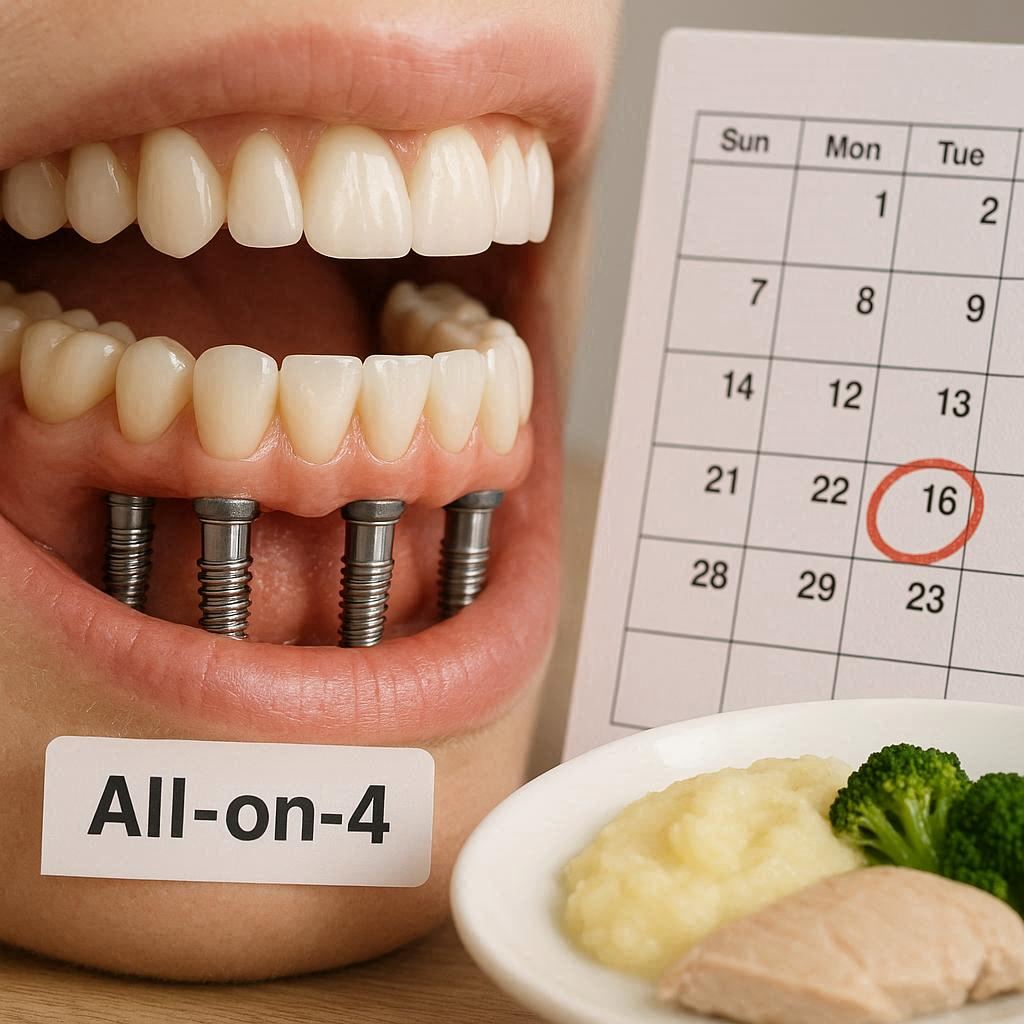
Before we dive into menus and meal ideas, you need to understand what is happening inside your mouth. The All-On-4 technique uses four strategically placed titanium posts to support a full arch of permanent teeth.
On the day of surgery, you receive a temporary fixed bridge. This is often called the “healing denture” or “provisional prosthesis.”
Here is the critical part. Those implants need to fuse with your jawbone. This process has a medical name: osseointegration. Think of it like a tree putting down roots. The tree may look stable, but the roots are still growing.
Osseointegration typically takes between three to six months. During this time, your new teeth are functional, but they are not ready for heavy chewing.
So, when people ask, “How long after All-On-4 dental implants can I eat normally?” the real answer is: It depends on your definition of normal.
- Normal like soft pasta and scrambled eggs? Possibly within a few weeks.
- Normal like biting into a whole apple or corn on the cob? Likely six months or more.
Let us break this down into specific phases.
Phase 1: The Liquid and Ultra-Soft Phase (Days 1 to 7)
The first week is about protection and comfort. Your mouth has undergone major surgery. Gums are swollen. Sutures are present. Some bruising might appear. You may have temporary numbness or discomfort.
During these first seven days, you should not chew at all. Not a little. Not carefully. Zero chewing.
What you can consume safely:
- Nutritional shakes (Ensure, Boost, or homemade protein smoothies)
- Bone broth (warm, not hot)
- Vegetable juice (strained, no pulp)
- Yogurt (smooth, no berries or seeds)
- Pudding and custard
- Thin cream soups (tomato, butternut squash – strained)
- Milkshakes (use a spoon, not a straw – no straws for at least two weeks)
Why no straws?
Sucking creates negative pressure in your mouth. That pressure can dislodge blood clots and pull on sutures. It may even lead to a painful condition called dry socket or implant failure in extreme cases.
A realistic look at week one meals:
| Meal | Recommended | Avoid |
|---|---|---|
| Breakfast | Smooth yogurt + protein powder | Granola, toast, bacon |
| Lunch | Strained tomato soup | Crackers, bread, meat |
| Dinner | Bone broth + pureed sweet potato | Rice, chicken, vegetables |
| Snack | Pudding or ice cream (no nuts) | Chips, nuts, raw fruit |
Quote from a patient (realistic experience):
“I was starving by day three. Not gonna lie. I missed chewing. But I kept reminding myself: every day I follow the rules is one day closer to real food. Don’t rush. It’s not worth the risk.”
Phase 2: The No-Chew Soft Food Phase (Weeks 2 to 4)
By the second week, swelling usually goes down. Sutures may dissolve or be removed. Your mouth feels less like a war zone. But – and this is a big but – the implants are still delicate.
You move from liquids to soft foods that require minimal to no chewing.
Allowed foods during weeks 2–4:
- Mashed potatoes (smooth, no lumps)
- Scrambled eggs (soft, not browned)
- Oatmeal or cream of wheat
- Cottage cheese or ricotta cheese
- Smooth peanut butter (thin layer on nothing – eat it off a spoon)
- Hummus (plain, no raw garlic chunks)
- Refried beans
- Mashed avocado
- Soft tofu
- Pancakes soaked in syrup (tear into tiny pieces)
What to avoid completely:
- Rice (small grains can get under the temporary bridge)
- Quinoa or couscous
- Bread with crusts
- Chewy meats
- Raw vegetables
- Seeded fruits (strawberries, raspberries, kiwi)
- Popcorn (absolutely not – kernels are dangerous)
Tip for eating during this phase:
Cut everything into small, bite-sized pieces. Place food directly on your molars (or where molars will be). Chew slowly and gently. If you feel pressure or pain, stop.
A common question:
“Can I drink coffee?”
Caffeine can constrict blood vessels and potentially slow healing. More importantly, hot liquids increase swelling and bleeding risk. Wait at least two weeks for coffee, and drink it lukewarm, not hot.
Phase 3: The Soft-Chew Transition (Weeks 5 to 8)
Around the one-month mark, many patients feel significantly better. The implants are starting to integrate. The temporary bridge feels more stable.
But this is also where people make mistakes. They feel good, so they think they can eat normally. Not yet.
Think of this phase as “training wheels” for chewing.
Foods you can now try (with caution):
- Soft pasta (mac and cheese, well-cooked penne)
- Meatloaf (crumbly, not firm)
- Canned tuna or chicken salad (no crunchy celery)
- Soft fish (salmon, tilapia – flaked with a fork)
- Steamed vegetables (carrots, zucchini – fork-tender)
- Soft bread without crust (pull apart, do not bite)
- Bananas and peeled peaches
- Pancakes and waffles (soft, no nuts)
Foods still off the table:
- Steak or pork chops
- Raw carrots or apples
- Nuts and seeds
- Hard candies
- Chewy bread like bagels or sourdough crust
- Corn on the cob
- Pizza crust
Comparison table: what changed from phase 2 to phase 3?
| Food | Phase 2 (weeks 2-4) | Phase 3 (weeks 5-8) |
|---|---|---|
| Pasta | Not recommended | Yes, well-cooked |
| Fish | Only pureed | Flaked soft fish |
| Eggs | Scrambled only | Soft omelet |
| Bread | None | Soft bread, no crust |
| Vegetables | Pureed only | Steamed soft |
Warning sign to watch for:
If you feel any movement in your temporary bridge, or if you hear clicking, stop eating solid food immediately and call your dentist. That is not normal.
Phase 4: The Final Healing Wait (Weeks 9 to 16 – Approximately 3 to 4 Months)
At this stage, many patients are frustrated. They feel completely fine. Their gums look healed. The temporary teeth look natural. They want to eat a burger.
But here is the reality check. Osseointegration is a biological process. It does not follow your calendar or your cravings. For most people, the implants are about 50% to 70% integrated by month three.
That means they are strong, but not strong enough for heavy forces.
What does “heavy forces” mean?
- Biting through a sandwich with thick bread
- Chewing sticky candy (caramel, taffy)
- Gnawing on bones (ribs, chicken wings)
- Crunching ice or hard candies
You can gradually introduce these foods around month 4:
- Soft pizza (thin crust, small bites)
- Pancakes with syrup
- Soft cookies (no nuts or chunks)
- Shredded meats (pulled pork, shredded chicken)
- Rice (well-cooked, but be careful – rinse after eating)
- Soft bagels (steamed or microwaved to soften)
- Applesauce or very thin apple slices
An honest look at “normal” eating at month 4:
| Food | Can I eat it? | How to eat it safely |
|---|---|---|
| Steak | Not yet | – |
| Chicken breast | Maybe, shredded | Cut into tiny pieces, chew slowly |
| Salad | Yes, chopped fine | No croutons, no raw carrots |
| Bread | Yes, soft types | Tear, do not bite |
| Nuts | No | – |
| Corn | Only cut off the cob | No biting directly |
Remember: Your final permanent bridge is usually placed between month 4 and month 6. Until that day, you are still in a healing phase. Do not rush.
Phase 5: The Final Permanent Bridge (Months 4 to 6 and Beyond)
Finally, the day arrives. Your dentist confirms full osseointegration. They remove the temporary bridge and place your custom-made permanent prosthesis.
This permanent bridge is stronger, more stable, and designed for long-term function.
Now, can you eat normally?
Yes. Mostly.
With a well-integrated All-On-4 restoration, you can eat almost everything a person with natural teeth can eat. Almost.
What you can realistically eat after full healing:
- Steak (cut into pieces, don’t just tear with front teeth)
- Apples (sliced, not whole bites)
- Raw carrots (cut into sticks)
- Crusty bread (in moderation)
- Nuts (chew carefully)
- Popcorn (be aware that hulls can get stuck)
- Chewy candy (occasionally, but be cautious)
What you should never eat (even after healing):
- Whole hard candies (risk of cracking the acrylic)
- Ice cubes (never chew ice – it is a common cause of damage)
- Bones (obviously)
- Penne or rigatoni? Fine. Just not rock-hard pasta.
A realistic comparison: All-On-4 vs. natural teeth
| Activity | Natural teeth | All-On-4 (healed) |
|---|---|---|
| Bite into an apple | Yes | Not recommended |
| Eat corn on the cob | Yes | Cut off the cob |
| Chew steak | Yes | Yes, but cut first |
| Chew ice | Not wise for either | No |
| Eat sticky caramel | Possibly | With caution |
| Crush nuts | Yes | Yes, carefully |
Quote from a long-term All-On-4 patient (5 years post-op):
“I eat ribs. I eat salad. I even eat popcorn at the movies. But I don’t abuse my implants. I cut my food more than I used to. That small habit saved me from repairs. It is 95% normal, and I am grateful for that 5% of caution.”
Factors That Can Speed Up or Slow Down Your Timeline
No two patients are identical. Your personal healing speed depends on several variables.
Factors that may help you eat normally sooner:
- Non-smoker (smoking drastically impairs osseointegration)
- Good bone density (no bone grafting needed)
- Younger age (faster cell regeneration)
- Excellent oral hygiene
- No chronic diseases (diabetes, autoimmune conditions)
- Following all post-op instructions strictly
Factors that may delay normal eating:
- Smoking or vaping (most common cause of implant failure)
- Poor blood sugar control (unmanaged diabetes)
- Osteoporosis or bone diseases
- Teeth grinding (bruxism – you may need a night guard)
- Frequent alcohol consumption
- Rushing into hard foods too early
Critical note: If you smoke, your timeline may extend significantly. Many implant dentists will not even place All-On-4 implants unless you commit to quitting. Smoking reduces blood flow to the gums and can cause peri-implantitis (bone loss around implants).
Practical Tips for Making the Transition Easier
You do not have to suffer through boring, bland food for months. Here are real-world strategies to keep meals interesting while protecting your investment.
1. Buy a small food processor or immersion blender
Pureed food does not have to be baby food. Blend cooked chicken with broth and cream for a savory mousse. Puree roasted vegetables with olive oil and garlic. Texture is your friend.
2. Master the art of “mechanical soft” preparation
- Steam vegetables until fork-tender
- Shred meats instead of chopping them
- Soak dry bread in soup or broth
- Grate cheese instead of slicing it
3. Use the two-fork technique
Place food on a plate. Use two forks to “cut” or shred the food into tiny pieces before it ever enters your mouth. This reduces chewing pressure by 80%.
4. Keep a “food diary” for the first two months
Track what you ate and how your mouth felt afterward. If you notice soreness after eating something specific, avoid it for another two weeks.
5. Stay hydrated, but skip straws
Dehydration slows healing. Drink water throughout the day. But remember – no straws for at least two weeks, and even after that, use them gently.
Common Questions Patients Ask (Beyond the Main Timeline)
Can I eat bread after All-On-4 implants?
Yes, but choose soft bread without crusts for the first three months. Think white sandwich bread, not sourdough or baguette. After full healing, you can eat crusty bread in small pieces.
Will I ever bite into a sandwich again?
Absolutely. But here is a trick: cut your sandwich into small strips or quarters. Do not try to take a huge bite from a whole sub. That lateral force is hard on the bridge.
Why can’t I eat sticky foods like caramel or taffy?
Sticky foods can pull on the temporary bridge or loosening the adhesive used during the healing phase. With a permanent bridge, sticky foods are less risky, but they can still pull the prosthesis away from the gumline over time.
What about spicy foods?
Spicy foods do not harm the implants, but they can irritate healing gums. Wait at least two weeks before introducing mild spices. If you feel burning or stinging, wait longer.
How will I know if I damaged my implants by eating too soon?
Warning signs include:
- Sudden pain while chewing
- Clicking or movement of the bridge
- Bleeding or swelling that appears days after eating
- A feeling that the bridge “gives way” under pressure
If you experience any of these, call your dentist immediately. Do not wait.
A Week-by-Week Sample Menu (First 16 Weeks)
Here is a practical, realistic menu guide to keep you on track.
Week 1 (Liquid only)
| Day | Breakfast | Lunch | Dinner | Snack |
|---|---|---|---|---|
| Mon | Protein shake | Bone broth | Cream of mushroom soup (strained) | Pudding |
| Tue | Smooth yogurt | Tomato soup | Pureed sweet potato | Custard |
| Wed | Chocolate shake | Vegetable broth | Butternut squash soup | Ice cream |
| Thu | Vanilla pudding | Chicken broth | Pureed carrot & ginger soup | Yogurt |
| Fri | Strawberry shake | Lentil soup (strained) | Cream of potato soup | Milkshake (spoon) |
Weeks 2-4 (Soft no-chew)
- Breakfast: Scrambled eggs + mashed avocado
- Lunch: Hummus (by spoon) + smooth cottage cheese
- Dinner: Refried beans + sour cream (no tortilla chips)
- Snack: Peanut butter (smooth) from a spoon
Weeks 5-8 (Soft-chew)
- Breakfast: Oatmeal with banana puree
- Lunch: Canned tuna mixed with Greek yogurt (no celery)
- Dinner: Soft baked salmon + steamed zucchini
- Snack: Mashed sweet potato with cinnamon
Weeks 9-16 (Transition)
- Breakfast: Pancakes soaked in syrup (torn, not bitten)
- Lunch: Shredded chicken salad on soft white bread (no crust)
- Dinner: Meatloaf + steamed carrot coins
- Snack: Applesauce or soft ripe pear slices
The Emotional Side of Waiting to Eat Normally
Let me pause the clinical advice for a moment.
Food is emotional. Eating a meal with family, biting into a favorite dish, sharing a pizza on Friday night – these are small joys. And losing them, even temporarily, can feel frustrating or sad.
Some patients report feeling isolated during the liquid phase. They skip dinners out. They feel awkward at parties.
That is normal. And it is temporary.
Strategies to cope emotionally:
- Eat at the same time as others. Just modify your plate. You will still feel included.
- Tell your close friends. “I am healing from surgery. I will just have soup tonight.” Most people are understanding.
- Celebrate small wins. First soft egg? Celebrate. First pasta? Celebrate. Acknowledge progress.
- Remember why you started. You chose All-On-4 to eat confidently for decades. Three to six months of patience is a small price.
What Dentists Wish You Knew (But Often Forget to Say)
I spoke with several implant specialists while researching this guide. Here is what they wish every patient understood:
- The temporary bridge is not a toy. It is a healing device. Do not push it to its limits.
- Most failures happen between weeks 4 and 8. Why? Because patients feel better and get overconfident.
- Your front teeth implants are weaker than natural front teeth. Do not use your new implants to tear, pull, or open anything.
- Nighttime clenching is silent but deadly. If you wake up with a sore jaw, tell your dentist. You may need a night guard.
- One bad bite can set you back weeks. A single hard piece of popcorn or an unpopped kernel can crack your temporary bridge. Then you are back to liquids for another round of repairs.
Conclusion (Three Lines Summary)
Most patients can eat soft, non-chew foods within two to four weeks after All-On-4 surgery. Transitioning to a fully normal diet, including steak and raw vegetables, typically takes four to six months after complete osseointegration. However, even after healing, you should avoid biting into whole apples, corn on the cob, and hard candies to protect your long-term investment.
Frequently Asked Questions (FAQ)
Q1: How long after All-On-4 dental implants can I eat normally enough to return to work lunches?
By week two or three, you can pack soft foods like yogurt, cottage cheese, and smooth soups. You will not eat a sandwich, but you will not starve.
Q2: Can I eat pizza after All-On-4 implants?
Yes, but wait until at least week 8 for soft pizza. Cut it into small pieces. Avoid hard, crispy crust until after month 4.
Q3: What happens if I eat too early?
You risk dislodging the temporary bridge, breaking the acrylic, or causing microfractures in the bone around the implant. In severe cases, the implant may fail entirely.
Q4: Can I chew gum with All-On-4?
Sugar-free gum is generally safe after full healing (month 6+), but avoid super sticky brands. Do not chew gum during the first three months.
Q5: Why can’t I use a straw after surgery?
The sucking motion creates negative pressure, which can pull blood clots away from the surgical site and increase bleeding or cause dry socket.
Q6: Will I ever eat nuts again?
Yes. But wait until your permanent bridge is placed (month 4-6). Then eat nuts in small pieces, chewing on both sides evenly.
Q7: How do I clean my temporary bridge after eating?
Use a soft water flosser on low setting, or gently rinse with warm salt water. Do not use a regular floss pick under the bridge unless your dentist shows you how.
Q8: Is coffee really that bad after surgery?
Hot coffee increases swelling and bleeding risk. Caffeine can also restrict blood vessels. Wait at least 2 weeks, and drink it lukewarm.
Additional Resource
For a detailed, dentist-reviewed food list with printable PDF charts and recovery tracking sheets, visit the American Academy of Implant Dentistry (AAID) patient resource center:
👉 AAID Patient Education – Diet After Implants (External link – opens in new tab)
Disclaimer
This article is for general informational purposes only and does not constitute medical advice. All-On-4 dental implant outcomes vary significantly based on individual health, surgical technique, and post-operative care. Always consult your licensed dentist or oral surgeon before making dietary changes following implant surgery. The author and publisher disclaim any liability for any adverse effects arising from the use or application of information contained in this guide. Your dental team knows your unique case best. Listen to them first.