How Much Does A Private Dental Bridge Cost In The Uk?
A missing tooth is more than just a gap in your smile. It can affect how you eat, how you speak, and how you feel about yourself. It can also cause your remaining teeth to shift, leading to bite problems and further tooth loss. If you are missing one or more teeth, a dental bridge is a common and effective solution.
In the UK, you have two main options: NHS treatment or private treatment. NHS bridges are heavily subsidized, but they come with strict eligibility rules and long waiting lists. Private bridges offer more choice, faster treatment, and better aesthetics, but they cost more. So, how much does a private dental bridge cost in the UK?
The short answer is that a private dental bridge in the UK costs between £500 and £3,000 per unit. A typical three-unit bridge (replacing one missing tooth) costs £1,500 to £4,500. The exact price depends on the type of bridge, the materials used, and the dentist you choose.
This guide will break down everything you need to know about private dental bridge costs in the UK. We will look at the different types of bridges, the materials, and the factors that affect the price. We will compare NHS and private costs. We will also share tips to save money and find a reputable dentist. By the end, you will have a clear picture of what to expect.
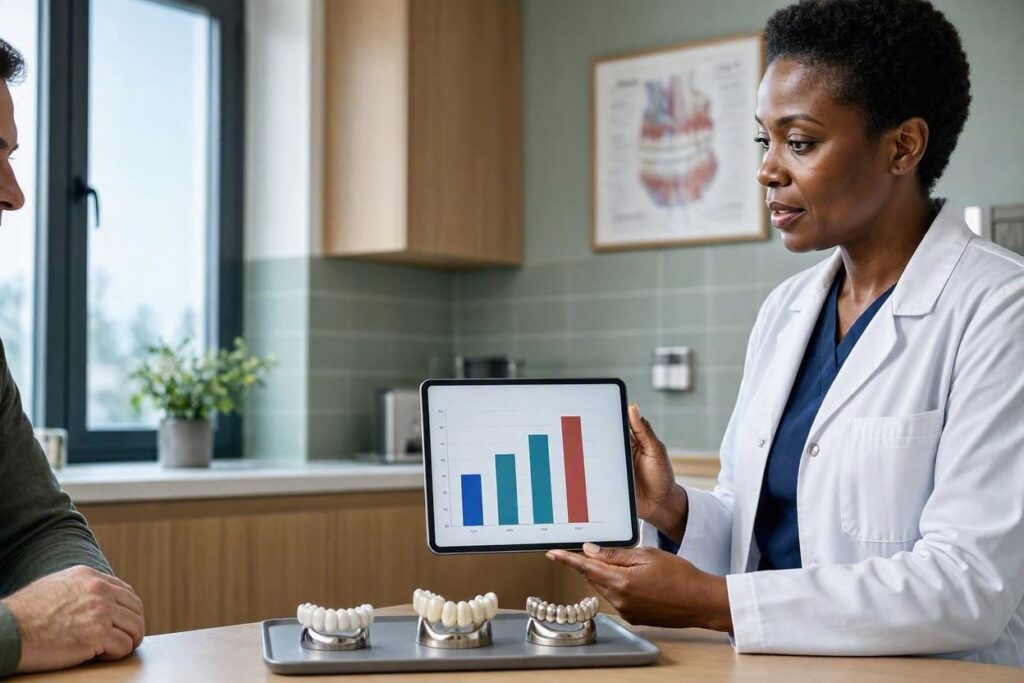
What Is A Dental Bridge?
A dental bridge is a fixed appliance that fills the gap left by one or more missing teeth. It is called a “bridge” because it literally bridges the gap between your remaining teeth.
A traditional bridge consists of:
- Abutments: The teeth on either side of the gap. These are crowned to support the bridge.
- Pontic: The artificial tooth that fills the gap.
- Connectors: The parts that join the pontic to the abutments.
Bridges are cemented into place. They are not removable. You clean them with special floss or interdental brushes.
Types Of Dental Bridges And Their Costs
There are several types of dental bridges. Each has a different price point and is suitable for different situations.
1. Traditional Dental Bridge
This is the most common type. It uses the teeth on either side of the gap as anchors. Those teeth are filed down and crowned. The bridge is then cemented onto them.
- Cost: £1,500 – £4,500 for a three-unit bridge.
- Pros: Strong, durable, natural-looking.
- Cons: Requires damaging healthy adjacent teeth.
2. Cantilever Bridge
This is used when there is only one tooth next to the gap. The bridge is anchored to that single tooth. It is often used for front teeth.
- Cost: £1,000 – £3,000 for a two-unit bridge.
- Pros: Does not require crowning teeth on both sides.
- Cons: Less stable than traditional bridges, can put stress on the anchor tooth.
3. Maryland Bridge (Resin-Bonded Bridge)
This is a less invasive option. Instead of crowning the adjacent teeth, a metal or porcelain wing is bonded to the back of them. It is often used for front teeth.
- Cost: £500 – £1,500 per unit.
- Pros: Minimal damage to adjacent teeth, cheaper.
- Cons: Less durable, can come loose, not suitable for back teeth.
4. Implant-Supported Bridge
This is the gold standard for replacing multiple missing teeth. Instead of using natural teeth as anchors, the bridge is supported by dental implants placed in the jawbone.
- Cost: £4,000 – £15,000+ depending on the number of implants.
- Pros: Does not damage adjacent teeth, preserves jawbone, very stable.
- Cons: Very expensive, requires surgery, longer treatment time.
Comparison Table: Types Of Dental Bridges
| Type | Average Cost (UK) | Durability | Best For |
|---|---|---|---|
| Traditional Bridge (3 units) | £1,500 – £4,500 | 10-15 years | Back teeth, multiple teeth |
| Cantilever Bridge | £1,000 – £3,000 | 5-10 years | Front teeth, one anchor tooth |
| Maryland Bridge | £500 – £1,500 | 5-10 years | Front teeth, minimal damage |
| Implant-Supported Bridge | £4,000 – £15,000+ | 20+ years | Multiple missing teeth |
What Affects The Cost Of A Private Dental Bridge In The UK?
Several factors determine what you will pay for a private bridge.
1. The Number Of Units
A bridge is priced per unit. A unit is each tooth that is part of the bridge. A traditional three-unit bridge replaces one missing tooth. It has two abutment crowns and one pontic. That is three units. If you are replacing two missing teeth, you might need a four-unit bridge. More units mean a higher cost.
2. The Material
Bridges can be made from different materials.
- Porcelain Fused to Metal: The most common. It is strong and looks natural. Cost: £500 – £800 per unit.
- All-Porcelain (Ceramic): Better aesthetics, especially for front teeth. Cost: £600 – £1,000 per unit.
- Zirconia: Very strong and natural-looking. Cost: £700 – £1,200 per unit.
- Gold: Very durable but visible. Cost: £600 – £1,000 per unit.
3. The Dentist’s Experience
A general dentist will charge less than a prosthodontist (a specialist in crowns and bridges). A specialist may charge 20% to 50% more. But for complex cases, the extra expertise is worth it.
4. Your Location
Prices vary by region. In London and the South East, prices are higher. In the North of England, Scotland, and Wales, prices are lower.
| Region | Average Cost (3-unit bridge) |
|---|---|
| London | £2,500 – £4,500 |
| South East | £2,000 – £3,800 |
| Midlands | £1,800 – £3,200 |
| North West | £1,500 – £2,800 |
| Scotland | £1,500 – £2,800 |
| Wales | £1,500 – £2,800 |
5. Additional Procedures
You may need extractions, root canal treatment, or gum treatment before the bridge is fitted. These add to the cost.
6. The Lab Used
High-end labs produce better-looking, more precise bridges. They charge more.
NHS Dental Bridge Costs
In the UK, the NHS provides dental bridges at a subsidized cost. The charge is the Band 3 fee. As of the most recent updates for England, this is £306.80. This covers the entire bridge, regardless of the number of units.
However, there are strict rules:
- The bridge must be medically necessary. The NHS does not provide bridges for purely cosmetic reasons.
- The bridge must be the most appropriate treatment. If a denture or implant is deemed more suitable, the NHS may not fund a bridge.
- Waiting lists can be long.
- The materials used may be basic. You may not get a high-end porcelain or zirconia bridge.
NHS vs. Private: A Comparison
| Feature | NHS | Private |
|---|---|---|
| Cost (3-unit bridge) | £306.80 | £1,500 – £4,500 |
| Eligibility | Strict (medical need) | Anyone |
| Waiting Time | Months to years | Immediate to weeks |
| Material Choice | Limited | Full choice |
| Aesthetics | Basic | High-end |
| Choice Of Dentist | Limited | Full choice |
Does Insurance Cover Private Dental Bridges?
Some private dental insurance plans in the UK cover bridges. However, coverage varies widely.
1. Coverage Percentage
Most plans cover 50% to 80% of the cost. Some plans have a yearly maximum, such as £1,000 to £2,000.
2. Waiting Periods
Many plans require you to be enrolled for 6 to 12 months before you can claim for a bridge.
3. Pre-Authorization
You may need to get pre-authorization from your insurance company before starting treatment.
4. Exclusions
Some plans exclude bridges or only cover them if they are medically necessary.
Common UK Dental Insurance Providers:
- Bupa
- Denplan
- Simplyhealth
- Vitality
- Aviva
Payment Plans And Financing Options
Dental bridges are a significant investment. Most private dentists in the UK offer payment plans.
1. In-House Payment Plans
Many practices offer interest-free monthly payments. You pay a deposit and then pay the rest over 6 to 24 months.
2. Third-Party Financing
Companies like Medenta, Chrysalis Finance, and Braemar Finance offer loans for dental treatment. You can apply online and get approved quickly.
3. 0% Interest Credit Cards
Some people use 0% interest credit cards to spread the cost. Just be sure to pay it off before the interest kicks in.
4. Dental Savings Plans
These are not insurance. You pay an annual fee to join a network of dentists. You get discounted rates on treatments. Examples include Denplan Essentials and Practice Plan.
How To Save Money On A Private Dental Bridge
You do not have to pay full price. Here are some tips.
1. Get Multiple Quotes
Visit at least three dentists. Ask for a written treatment plan and a full breakdown of costs. Compare them.
2. Consider A Dental School
Dental schools in the UK offer treatment at reduced costs. The work is done by supervised students. It takes longer, but it can save you hundreds of pounds. Look for schools in London, Manchester, Birmingham, and other major cities.
3. Go Outside London
If you live in London, consider traveling to a dentist outside the M25. Prices can be 30% to 50% lower.
4. Choose A Maryland Bridge
If you are replacing a front tooth, a Maryland bridge is much cheaper than a traditional bridge. It is less durable, but it is a good option for some people.
5. Ask For A Discount
Some dentists offer discounts for cash payments or for seniors. It never hurts to ask.
6. Use Your Denplan Or Insurance
If you have dental insurance, use it. It can cover a significant portion of the cost.
The Process Of Getting A Private Dental Bridge
Here is what to expect.
Step 1: Consultation
The dentist examines your mouth and takes X-rays. They discuss your options and give you a treatment plan.
Step 2: Preparation
The abutment teeth are filed down to make room for the crowns. This is done under local anesthesia.
Step 3: Impressions
The dentist takes impressions of your teeth. These are sent to a dental lab.
Step 4: Temporary Bridge
A temporary bridge is placed to protect your teeth while the permanent one is being made. This takes 1 to 2 weeks.
Step 5: Fitting
The permanent bridge is fitted and cemented into place. The dentist checks the fit, color, and bite.
Step 6: Follow-Up
You may need a follow-up visit to ensure the bridge is comfortable.
Quotes From UK Patients
“I got a private bridge in London. It cost £3,500 for three units. It looks amazing. I can eat anything now. It was worth the money.” — Sarah, London
“I went to a dentist in Manchester. It was much cheaper than London. I paid £1,800 for my bridge. The quality was excellent.” — David, Manchester
“I had a Maryland bridge for my front tooth. It cost £800. It is not as strong as a traditional bridge, but it looks great and was affordable.” — Emma, Birmingham
Important Note For Readers
Prices for dental bridges in the UK change over time. The ranges in this article are estimates based on current market data. Always get a personalized quote from a licensed dentist. Do not rely solely on online information for your treatment decisions. Your specific needs may result in a different price.
Frequently Asked Questions (FAQ)
1. How much does a private dental bridge cost in the UK?
A private dental bridge in the UK costs £500 to £3,000 per unit. A three-unit bridge costs £1,500 to £4,500.
2. Is a dental bridge cheaper on the NHS?
Yes. The NHS Band 3 charge is £306.80 for a bridge. However, you must meet strict eligibility criteria.
3. Does dental insurance cover bridges in the UK?
Some private dental insurance plans cover bridges. Coverage is usually 50% to 80%, with a yearly maximum.
4. How long does a dental bridge last?
A well-made bridge lasts 10 to 15 years. With good oral hygiene, it can last longer.
5. Is a bridge better than an implant?
It depends. Implants are generally considered the gold standard because they do not damage adjacent teeth. But bridges are faster and cheaper.
6. Can I get a bridge if I have gum disease?
You need to treat the gum disease first. A bridge can make gum disease worse if it is not under control.
7. How do I clean a dental bridge?
You need to clean under the bridge with special floss or interdental brushes. Your dentist will show you how.
8. Will a dental bridge look natural?
Yes. Modern porcelain and zirconia bridges look very natural. Your dentist will match the color to your other teeth.
9. Can I eat normally with a dental bridge?
Yes. Once you are used to it, you can eat most foods. Avoid very hard or sticky foods.
10. What happens if my bridge breaks?
Contact your dentist immediately. They can repair or replace it. Do not try to fix it yourself.
Conclusion
The cost of a private dental bridge in the UK ranges from £500 to £4,500 depending on the type, materials, and your location. It is a significant investment, but it can restore your smile and your quality of life. NHS bridges are cheaper but have strict eligibility rules. Private bridges offer more choice, better aesthetics, and faster treatment. By getting multiple quotes and considering options like dental schools or payment plans, you can find a solution that fits your budget. A dental bridge is an investment in your oral health that can last for many years.
Additional Resource:
For more information on dental bridges and oral health, visit the Oral Health Foundation: