In Edmonton How Much Do Dental Bridges Cost?
Edmonton is the capital of Alberta and a vibrant city known for its river valley, festivals, and friendly communities. It is also home to many excellent dental clinics. If you are missing one or more teeth, you may be considering a dental bridge. Bridges are a popular way to replace missing teeth. They restore your smile, improve your ability to chew, and help maintain the shape of your face. But how much do dental bridges cost in Edmonton?
The answer depends on several factors. These include the type of bridge, the number of teeth being replaced, your dentist, and whether you have insurance. In this comprehensive guide, we will break down the real costs of dental bridges in Edmonton. We will look at average prices, what affects the fee, insurance options, and practical tips to save money. We will also cover the bridge process, aftercare, and common questions.
Whether you live in downtown Edmonton, St. Albert, Sherwood Park, or elsewhere in the region, this article will help you understand what to expect when you get a dental bridge.

What Is a Dental Bridge?
A dental bridge is a fixed dental restoration that replaces one or more missing teeth. It is called a “bridge” because it literally bridges the gap created by missing teeth. The bridge is anchored to the teeth on either side of the gap. These anchoring teeth are called abutments. The replacement tooth or teeth in the middle are called pontics.
Dental bridges offer several benefits:
- Restore your smile: Bridges fill the gap left by missing teeth.
- Improve chewing: They allow you to bite and chew properly.
- Maintain facial shape: Missing teeth can cause your face to sag. Bridges help maintain your facial structure.
- Prevent shifting: Nearby teeth can drift into the empty space. Bridges prevent this.
- Restore speech: Missing teeth can affect how you speak. Bridges help you speak clearly.
- Durability: With good care, bridges can last 10 to 15 years or more.
Bridges are a good option for many people. However, they are not right for everyone. Your dentist will tell you if a bridge is suitable for your situation.
Types of Dental Bridges
There are several types of dental bridges. Each has its own advantages and costs.
Traditional Bridges
Traditional bridges are the most common type. They consist of a pontic (replacement tooth) held in place by dental crowns on the abutment teeth. The crowns are cemented onto the teeth on either side of the gap.
Traditional bridges are strong and durable. They require the abutment teeth to be shaped down to fit the crowns. This is an irreversible procedure.
Cantilever Bridges
Cantilever bridges are used when there is only one tooth next to the gap. The pontic is supported by a crown on just one side. This type of bridge is less common because it can put too much pressure on one tooth.
Maryland Bridges
Maryland bridges, also called resin-bonded bridges, use a metal or porcelain framework that is bonded to the back of the abutment teeth. They require less shaping of the abutment teeth. They are often used for front teeth.
Implant-Supported Bridges
Implant-supported bridges are anchored to dental implants instead of natural teeth. They are the most stable and natural-looking option. They also prevent bone loss. However, they are more expensive and require surgery.
Composite Bridges
Composite bridges are made of composite resin. They are less expensive but less durable. They are often used as a temporary solution.
Your dentist will recommend the best type of bridge for your needs.
Average Costs of Dental Bridges in Edmonton
The cost of a dental bridge in Edmonton varies by type, the number of teeth being replaced, and the clinic. Here is a general overview.
| Type of Bridge | Average Cost in Edmonton (CAD) | Average Cost (USD) |
|---|---|---|
| Traditional bridge (3 units) | $2,500 – $4,500 | $1,900 – $3,400 |
| Traditional bridge (4+ units) | $3,500 – $6,000 | $2,600 – $4,500 |
| Cantilever bridge (3 units) | $2,000 – $3,500 | $1,500 – $2,600 |
| Maryland bridge (3 units) | $1,500 – $3,000 | $1,100 – $2,200 |
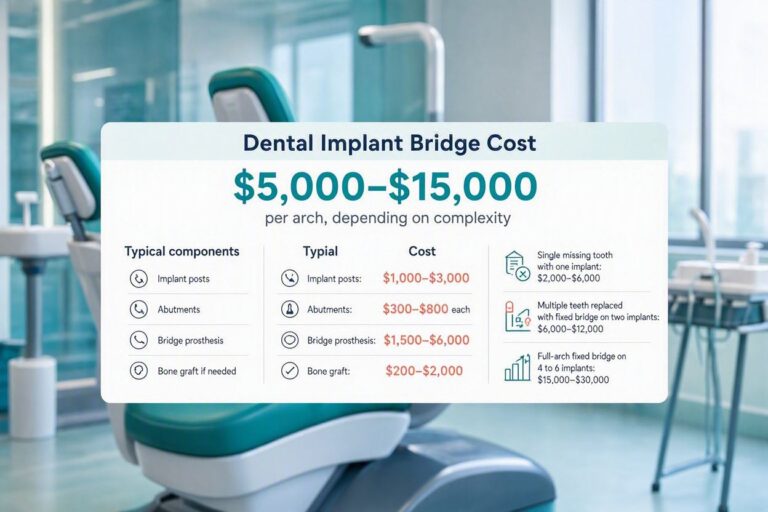
| Implant-supported bridge (per arch) | $8,000 – $20,000 | $6,000 – $15,000 |
| Composite bridge (temporary) | $500 – $1,500 | $370 – $1,100 |
These prices are estimates. Your actual cost depends on your specific needs and the clinic you choose. In Edmonton, prices can vary between downtown clinics and those in suburban areas.
The cost of a traditional bridge is often calculated per unit. A unit is a crown or a pontic. A three-unit bridge (one pontic and two crowns) is the most common. Each unit costs $800 to $1,500. So a three-unit bridge costs $2,400 to $4,500.
Implant-supported bridges are much more expensive because they require dental implants. Each implant costs $2,000 to $4,000. A full arch bridge may need 4 to 6 implants.
Factors That Affect the Cost of Dental Bridges in Edmonton
Several factors can change the final price you pay for a dental bridge in Edmonton.
Type of Bridge
Traditional bridges are more expensive than Maryland or cantilever bridges. Implant-supported bridges are the most expensive.
Number of Teeth Being Replaced
The more teeth you need to replace, the higher the cost. A three-unit bridge costs less than a five-unit bridge.
Material Used
Bridges can be made from porcelain, ceramic, gold, or a combination of materials. Porcelain and ceramic look natural and cost more. Gold is durable but visible. Base metal alloys cost less.
Dentist’s Experience
A highly experienced dentist or prosthodontist may charge more. A general dentist may charge less. For best results, choose a dentist with experience in bridges.
Clinic Location
Clinics in downtown Edmonton or affluent areas like Glenora may charge more. Clinics in suburban areas or smaller towns may charge less. Rent and operating costs affect prices.
Technology Used
Clinics that use digital scanners, 3D imaging, and CAD/CAM technology may charge more. These tools improve accuracy and comfort.
Additional Procedures
If you need extractions, root canals, or bone grafting before getting a bridge, these add to the cost. Extractions cost $150 to $400 per tooth. Root canals cost $500 to $1,500.
Temporary Bridge
You may need a temporary bridge while your permanent bridge is being made. This adds $200 to $500 to the cost.
Insurance Coverage
If you have dental insurance, your out-of-pocket cost will be lower. Insurance often covers 50% of the cost of a bridge. However, there may be an annual maximum or a waiting period.
Dental Bridge Costs in Edmonton vs. Other Canadian Cities
How does Edmonton compare to other Canadian cities? Here is a comparison for a traditional three-unit bridge.
| City | Average Cost (CAD) |
|---|---|
| Edmonton | $2,500 – $4,500 |
| Calgary | $2,500 – $4,500 |
| Vancouver | $3,000 – $5,500 |
| Toronto | $3,000 – $5,500 |
| Ottawa | $2,800 – $5,000 |
| Montreal | $2,500 – $4,800 |
| Winnipeg | $2,300 – $4,200 |
| Halifax | $2,500 – $4,500 |
Edmonton is in the middle range. It is similar to Calgary and Halifax. It is cheaper than Vancouver and Toronto. Winnipeg is slightly cheaper.
Does Insurance Cover Dental Bridges in Edmonton?
Insurance coverage for dental bridges varies. Many dental insurance plans in Alberta cover bridges as a major service. However, coverage is often partial.
Here are some key points about insurance and dental bridges in Edmonton:
- Dental insurance: Many plans cover 50% of the cost of a bridge after you meet your deductible. There may be an annual maximum, such as $1,000 or $1,500.
- Alberta Health Services: Alberta Health Services does not cover dental bridges for adults. It may cover some dental services for children under certain programs.
- Alberta Works: If you receive income support, you may be eligible for dental coverage. Check with your worker.
- Non-Insured Health Benefits (NIHB): If you are a First Nations or Inuit person, you may be eligible for coverage through the NIHB program.
- FSA/HSA: You can use pre-tax dollars from these accounts to pay for a bridge. This saves you money on taxes.
- No insurance? If you do not have insurance, ask your dentist about discounts, payment plans, or a dental discount plan.
Always check with your insurance provider before starting treatment. Ask about your coverage, annual maximum, and waiting periods.
How to Save Money on Dental Bridges in Edmonton
Dental bridges can be expensive. Here are practical ways to reduce the cost.
Use Insurance
If you have dental insurance, use it. It can cut your cost in half. Make sure you understand your coverage.
Ask About Discounts
Many dentists offer discounts for new patients, seniors, military members, or families. Ask if there are any current promotions.
Consider a Dental School
Dental schools offer treatment at a reduced cost. In Alberta, you can check with the University of Alberta School of Dentistry. Students work under supervision. Treatment takes longer, but it is much cheaper.
Choose a Less Expensive Material
Porcelain and ceramic bridges look natural but cost more. If the bridge is on a back tooth, a metal alloy bridge may be a good option. It is durable and less expensive.
Get a Second Opinion
If your dentist recommends a bridge, get a second opinion. Another dentist may confirm the need or offer a different solution.
Use FSA or HSA Funds
If you have an FSA or HSA, use it. You save on taxes, which reduces the effective cost.
Ask About Payment Plans
Many dentists offer payment plans. You can spread the cost over several months. Some plans have no interest.
Travel to a Smaller City
Clinics in smaller cities or rural areas often charge less than those in Edmonton. If you are willing to travel, you can save money.
Consider Dental Tourism
Some people travel to other countries for dental treatment. Popular destinations include Mexico, Thailand, and Hungary. However, you need to factor in travel costs and follow-up visits.
The Dental Bridge Process in Edmonton
If you decide to get a dental bridge, here is what to expect.
Step 1: Consultation and Examination
Your dentist will examine your mouth and take X-rays. They will discuss your options and recommend a treatment plan.
Step 2: Preparing the Abutment Teeth
The dentist will numb your mouth and reshape the abutment teeth. This involves removing some of the outer layer of the teeth to make room for the crowns.
Step 3: Impressions
The dentist will take impressions of your teeth. These are used to make your custom bridge. Some clinics use digital scanners instead of traditional impressions.
Step 4: Temporary Bridge
You will get a temporary bridge to protect your teeth while the permanent bridge is being made. This usually takes one to two weeks.
Step 5: Fitting the Permanent Bridge
When your permanent bridge is ready, you will return to the office. The dentist will remove the temporary bridge and check the fit and color of the new one. They will adjust it if needed.
Step 6: Cementing the Bridge
The dentist will cement the bridge in place. You may need to bite down on a piece of gauze to help it set. The dentist will check your bite and make final adjustments.
Step 7: Aftercare
Your dentist will give you instructions on how to care for your new bridge. You should avoid chewing hard foods for a few days. You should also maintain good oral hygiene.
Aftercare for Your Dental Bridge
A dental bridge can last for many years if you take care of it. Here are some tips.
- Brush and floss regularly: Clean your bridge just like your natural teeth. Use a bridge threader or interdental brush to clean under the pontic.
- Avoid hard foods: Do not chew ice, hard candy, or popcorn kernels. These can crack your bridge.
- Avoid grinding: If you grind your teeth at night, wear a night guard. This protects your bridge and other teeth.
- Avoid staining foods and drinks: Coffee, tea, red wine, and tobacco can stain your bridge over time.
- Visit your dentist regularly: Regular check-ups help catch problems early.
- Do not use your teeth as tools: Do not open packages or tear things with your teeth.
With good care, a bridge can last 10 to 15 years or more.
Personal Experiences and Testimonials
Here are some illustrative experiences from people who got dental bridges in Edmonton. These are based on common patient feedback.
“I needed a three-unit bridge. My dentist in downtown Edmonton charged $3,800. My insurance covered half, so I paid $1,900. The procedure was quick and painless. I am very happy with the result.” — Sarah, Edmonton
“I do not have insurance, so I went to the University of Alberta dental school. I paid $2,200 for my bridge. It took longer, but I saved a lot.” — Mark, Edmonton
“I needed a bridge on my front teeth. My dentist recommended a Maryland bridge. It cost $2,500. It looks natural and I did not need my other teeth shaved down.” — Emily, St. Albert
“I got an implant-supported bridge. It cost $15,000. It was expensive, but it feels just like real teeth. I would do it again.” — David, Sherwood Park
These stories show that dental bridges in Edmonton can be affordable with planning. Results depend on the type of bridge and the dentist’s skill.
Important Notes for Readers
- Prices change: The costs in this article are estimates. Always confirm with your dentist.
- Consult a professional: Only a licensed dentist can determine if you need a bridge and what type is best.
- Read the treatment plan: Understand what is included and what is not.
- Ask about warranties: Some bridges come with a warranty. Ask about the terms.
- Check your insurance: Understand your coverage before you start treatment.
- Do not delay treatment: Missing teeth can cause other problems. Early treatment saves money and pain.
- Maintain good oral hygiene: This helps your bridge last longer.
- Be patient: The bridge process takes time. Do not rush it.
Frequently Asked Questions (FAQ)
1. How much does a dental bridge cost in Edmonton?
A traditional three-unit bridge costs $2,500 to $4,500. Implant-supported bridges cost $8,000 to $20,000 or more.
2. Is a dental bridge cheaper than an implant?
Yes, usually. A traditional bridge costs less upfront than an implant. However, implants may last longer and preserve bone.
3. Does insurance cover dental bridges in Edmonton?
Many dental insurance plans cover 50% of the cost. There may be an annual maximum. Check with your provider.
4. Can I get a dental bridge without insurance?
Yes. You can pay out of pocket. Ask your dentist about discounts or payment plans. You can also visit a dental school for lower prices.
5. How long does a dental bridge last?
With good care, a bridge can last 10 to 15 years or more.
6. Does getting a dental bridge hurt?
The procedure is done with local anesthesia, so you should not feel pain. You may have some sensitivity afterward.
7. How long does it take to get a dental bridge?
The process usually takes two visits. The first visit is for preparation and impressions. The second visit is for fitting the permanent bridge. It takes about one to two weeks between visits.
8. Can I eat normally with a dental bridge?
Yes, after the permanent bridge is placed, you can eat normally. Avoid very hard foods for a few days.
9. What if my dental bridge feels loose or falls out?
Contact your dentist right away. Do not try to fix it yourself. A loose bridge can be re-cemented.
10. Is a dental bridge better than a partial denture?
It depends. A bridge is fixed and more stable. A partial denture is removable and less expensive. Your dentist will recommend the best option.
11. Can I get a dental bridge on my front teeth?
Yes. Maryland bridges and porcelain bridges are often used for front teeth. They look natural.
12. How do I clean under my dental bridge?
Use a bridge threader or interdental brush to clean under the pontic. Your dentist will show you how.
13. What is the difference between a bridge and a crown?
A crown covers a single tooth. A bridge replaces one or more missing teeth and is anchored to adjacent teeth.
14. How do I find a good dentist for a bridge in Edmonton?
Look for a licensed dentist with experience in bridges. Ask for recommendations, read reviews, and check credentials.
15. Can I use FSA or HSA funds for a dental bridge?
Yes. Dental bridges are an eligible expense for FSA and HSA funds.
Conclusion
Dental bridges in Edmonton cost between $2,500 and $20,000, depending on the type and number of teeth. Traditional bridges are the most common and cost $2,500 to $4,500. Implant-supported bridges are more expensive but more stable. Insurance may cover part of the cost. By comparing providers, asking about discounts, and considering dental schools, you can save money. Always consult with a licensed dentist to determine the best option for your needs. Dental bridges can restore your smile and improve your quality of life.
Additional Resource
For more information about dental bridges and oral health, visit the Canadian Dental Association website: https://www.cda-adc.ca
You can also find a licensed dentist in Alberta through the Alberta Dental Association and College: https://www.dentalhealthalberta.ca