How Much Does An Inlay Dentist Cost?
The world of restorative dentistry is filled with solutions for teeth that have been damaged by decay or trauma. When a tooth has a cavity that is too large for a simple filling, but not damaged enough to require a full crown, the dentist has a middle-ground option. This option is an inlay or an onlay.
These restorations represent a perfect balance between conservation and strength. They allow the dentist to preserve more of your natural tooth structure while providing a durable, long-lasting repair. However, the terminology can be confusing for patients. What exactly is an inlay? How is it different from an onlay? And most importantly, how much does it cost?
This comprehensive guide will explore the world of inlays and onlays. We will explain what they are, why they are used, and provide a detailed breakdown of their costs. Our goal is to equip you with the knowledge you need to make an informed decision when your dentist presents you with this treatment option.
Understanding the Terminology: Inlays vs. Onlays
Before we dive into costs, it is essential to understand the difference between these two similar-sounding procedures. The distinction is based on the location and extent of the damage being repaired.
The Inlay: Filling the Gaps
An inlay is a custom-made restoration that is used to repair a tooth when the damage is contained within the cusps—the raised points or bumps on the chewing surface of your back teeth (molars and premolars). Think of it as a high-tech, custom-made filling.
The process involves removing the decay, taking an impression of the prepared tooth, and having a dental laboratory fabricate a solid piece (usually made of porcelain, ceramic, or gold) that fits precisely into the prepared space. The inlay is then bonded or cemented into place.
The Onlay: Covering the Cusps
An onlay is a more extensive version of an inlay. It is used when the damage extends beyond the grooves of the tooth and involves one or more of the cusps. Instead of just filling a hole, an onlay is designed to cover and protect the entire chewing surface, including the cusps.
Because it covers more of the tooth, an onlay is sometimes referred to as a “partial crown.” It provides significant reinforcement to a weakened tooth, preventing it from fracturing.
A Simple Analogy
Think of your tooth like a table.
- A filling is like patching a small hole in the tabletop.
- An inlay is like cutting out a damaged section of the tabletop and fitting a new, precisely-cut piece of wood into that hole.
- An onlay is like replacing the entire damaged top of the table with a new, solid piece.
The Inlay Procedure: A Two-Visit Process
Getting an inlay or onlay is typically a two-appointment process, similar to getting a crown.
Visit 1: Preparation and Impression
- Numbing: The dentist will numb the area with a local anesthetic.
- Removal of Decay: The dentist will remove all the decayed or damaged tooth structure.
- Preparation: The remaining tooth is shaped to receive the restoration.
- Impression: A precise impression (traditional or digital) is taken of the prepared tooth and the surrounding teeth. This impression is sent to a dental laboratory.
- Temporary Restoration: A temporary filling or onlay is placed to protect the tooth while the lab fabricates your permanent restoration.
Visit 2: Fitting and Bonding
- Removal of Temporary: The temporary restoration is removed.
- Try-In: The dentist will check the fit, color, and bite of the new inlay or onlay.
- Bonding: Once you and the dentist are satisfied with the fit, the restoration is permanently bonded to the tooth using a strong dental cement.
- Polishing: The restoration is polished to a smooth, natural shine.
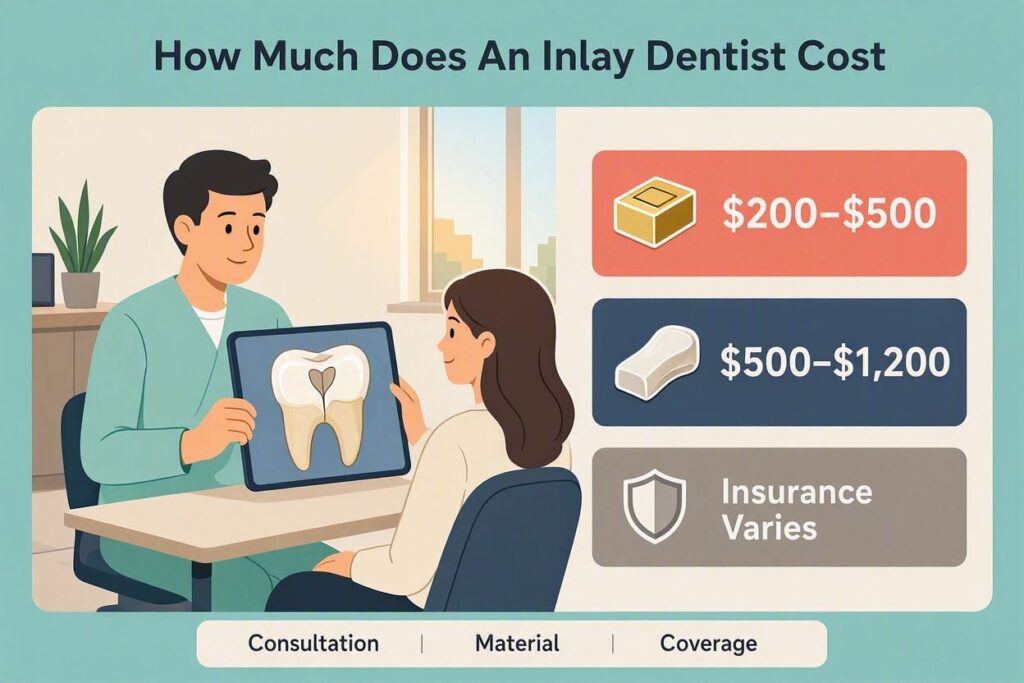
How Much Does An Inlay Dentist Cost? A Realistic Breakdown
Now, let’s address the central question. The cost of an inlay or onlay is a significant factor for most patients. These restorations are more expensive than simple fillings, but they offer superior strength and longevity.
Average Cost in the United States
The cost is typically calculated per tooth, and the price depends primarily on the material used.
| Type of Restoration | Material | Average Cost (Per Tooth) |
|---|---|---|
| Inlay | Porcelain/Ceramic | $650 – $1,200 |
| Inlay | Gold | $800 – $1,500 |
| Onlay | Porcelain/Ceramic | $800 – $1,500 |
| Onlay | Gold | $1,000 – $2,000 |
These prices are comprehensive and typically include the cost of the local anesthetic, the preparation, the impression, the temporary restoration, the laboratory fee, and the final bonding.
Why Are They More Expensive Than Fillings?
A simple amalgam (silver) filling might cost $100-$250, and a composite (white) filling might cost $150-$450. An inlay costs significantly more for several reasons:
- Laboratory Fees: A filling is done directly in your mouth in a single visit. An inlay is custom-made in a dental laboratory by a skilled technician. This lab fee can be $200-$400 of the total cost.
- Materials: The materials used for inlays (high-grade porcelain or gold) are more expensive than standard filling materials.
- Time and Skill: The procedure is more complex and time-consuming. It requires two appointments and a high level of precision to ensure a perfect fit.
Inlays vs. Fillings vs. Crowns: Which is the Best Value?
To understand where an inlay fits in the spectrum of restorative options, it is helpful to compare them directly.
| Feature | Composite Filling | Inlay/Onlay | Crown |
|---|---|---|---|
| Average Cost | $150 – $450 | $650 – $1,500 | $800 – $2,000+ |
| Longevity | 5-7 years | 10-20 years | 10-15 years |
| Strength | Moderate. Can weaken a tooth if large. | High. Reinforces the tooth. | Highest. Caps the entire tooth. |
| Tooth Preservation | Preserves tooth, but a large filling can weaken it. | Excellent. Preserves more tooth than a crown. | Moderate. Requires significant tooth reduction. |
| Procedure | Single visit. | Two visits. | Two visits. |
The Verdict
An inlay or onlay offers a fantastic middle ground. It is stronger and more durable than a filling, making it a better long-term value. It is also more conservative than a crown, preserving more of your natural, healthy tooth structure. This is a significant advantage, as preserving natural tooth structure is a key principle of modern dentistry.
Does Dental Insurance Cover Inlays and Onlays?
The answer is usually yes, but with a nuance. Dental insurance policies typically categorize restorations into different classes.
- Fillings: Usually covered at a higher percentage (e.g., 80%).
- Inlays/Onlays and Crowns: These are considered “major” restorative procedures. They are usually covered at a lower percentage (e.g., 50%).
The important nuance is that your insurance company may only reimburse you for the cost of an amalgam (silver) filling, even if you choose to get a porcelain inlay. This is called a “benefit of the lesser alternative.”
For example, if your policy covers 80% of a filling and you get an inlay, the insurance might calculate its payment based on the cost of a filling, not the inlay. You would then be responsible for the difference. This is a crucial question to ask your insurance provider before proceeding with treatment.
Important Note: Always ask your dentist’s office to submit a “pre-treatment estimate” to your insurance company. This will give you a clear, written statement of exactly what your policy will pay for your inlay or onlay.
Frequently Asked Questions (FAQ)
1. Is getting an inlay painful?
No. The procedure is performed under local anesthesia, so you will not feel any pain. You may experience some mild sensitivity after the anesthesia wears off, but this is temporary.
2. How long does an inlay last?
With proper care, a porcelain or gold inlay can last 10 to 20 years or even longer. They are significantly more durable than standard fillings.
3. Can an inlay be whitened?
No. The porcelain material used for an inlay does not respond to teeth whitening agents. If you are planning to whiten your teeth, you should do so before getting your inlay made so the dentist can match the color.
4. What is the difference between an inlay and an onlay?
An inlay fits within the cusps of the tooth, like a puzzle piece. An onlay covers one or more of the cusps, providing more coverage and reinforcement.
5. Is a CEREC same-day inlay available?
Yes. Many dentists now use CEREC technology, which allows them to design and fabricate porcelain inlays and onlays in their office in a single visit. You do not need a temporary or a second appointment. The cost is usually comparable to a traditional lab-made inlay.
6. Why would a dentist recommend an inlay instead of a filling?
A dentist will recommend an inlay when a cavity is too large for a standard filling to be durable. A large filling can weaken the remaining tooth structure and is more prone to cracking or leaking. An inlay provides a stronger, more durable, and better-sealing restoration.
Additional Resource
For more information on restorative dental procedures, visit the American Dental Association’s patient education website, MouthHealthy.
Conclusion
An inlay or onlay represents a significant investment in your dental health, with costs typically ranging from $650 to $1,500 per tooth depending on the material and extent of the restoration. This price is justified by the superior strength, longevity, and conservative nature of the treatment compared to a standard filling. For patients with moderate tooth damage, this middle-ground option offers the best long-term value by preserving natural tooth structure while providing a durable repair that can last for decades.