How Much Does Invisalign Cost?
Invisalign has changed the way people think about straightening their teeth. Instead of metal brackets and wires, Invisalign uses a series of clear, removable aligners that gently move your teeth into place. They are nearly invisible, comfortable, and removable, which makes them a popular choice for adults and teenagers alike.
But there is one big question that stops many people from booking a consultation: how much does Invisalign cost?
The price of Invisalign can vary a lot. Some people pay $3,000. Others pay $8,000 or more. The final cost depends on where you live, how complex your case is, how long treatment lasts, and the dentist or orthodontist you choose.
This guide will walk you through everything you need to know about Invisalign costs. We will look at average prices, compare costs around the world, explain what affects the price, and show you ways to make treatment more affordable. By the end, you should have a clear picture of what to expect and how to plan for your new smile.
What Is Invisalign?
Invisalign is a brand of clear aligners made by Align Technology. It is not the only clear aligner system on the market, but it is the most well-known.
Here is how it works:
- Your dentist or orthodontist takes a digital scan or impression of your teeth.
- A treatment plan is created using special software.
- A series of custom-made clear aligners is produced.
- You wear each aligner for about one to two weeks, then switch to the next one.
- Over time, your teeth move little by little until they reach the desired position.
Invisalign aligners are made of a smooth, BPA-free plastic. They are clear, so most people will not notice you are wearing them. You take them out to eat, drink, brush, and floss.
Invisalign can treat many orthodontic issues, including:
- Crowded teeth
- Gaps between teeth
- Overbite
- Underbite
- Crossbite
- Open bite
Mild cases may take only a few months. Complex cases can take a year or more.
The Average Cost Of Invisalign
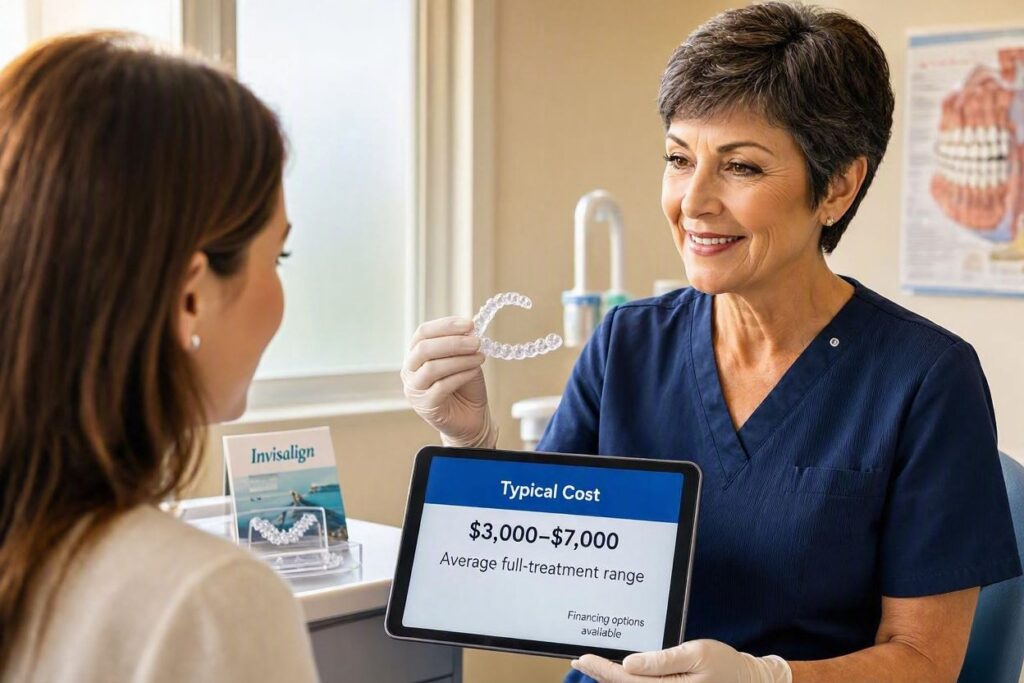
In the United States, the average cost of Invisalign ranges from $3,000 to $8,000. The exact price depends on the complexity of your case and the provider you choose.
Here is a rough breakdown:
- Mild cases: $3,000 – $4,500
- Moderate cases: $4,500 – $6,000
- Complex cases: $6,000 – $8,000+
In Canada, prices are similar, ranging from $3,500 to $8,500 CAD. In the UK, you can expect to pay £2,500 to £5,500. In Australia, prices range from $4,000 to $9,000 AUD.
These are just averages. Some providers charge more, and some charge less. Always get a personalized quote.
What Affects The Cost Of Invisalign?
Many factors influence the final price. Let us look at the most important ones.
1. Complexity Of Your Case
This is the biggest factor. Mild crowding or small gaps are easier to fix and require fewer aligners. Complex cases with bite issues, severe crowding, or large gaps need more aligners and longer treatment. More aligners mean higher lab fees and more chair time, so the price goes up.
2. Your Location
Where you live makes a big difference. In major cities like New York, Los Angeles, Toronto, or London, prices are higher. In smaller towns or rural areas, prices are lower. The cost of living and rent for the dental office affect fees.
3. The Provider
An orthodontist (a specialist in tooth movement) usually charges more than a general dentist. Orthodontists have extra training and experience, and they often handle more complex cases. General dentists may offer Invisalign at a lower price, but check their experience and results.
4. Length Of Treatment
The longer your treatment, the more you will pay. Treatment can last anywhere from 6 months to 24 months or more. Some providers charge a flat fee regardless of length, while others charge by the number of aligners or visits.
5. Type Of Invisalign
Invisalign offers different treatment options:
- Invisalign Express: For minor corrections, usually 5 aligners or fewer. Cheaper.
- Invisalign Lite: For mild to moderate cases, up to 14 aligners.
- Invisalign Full: For moderate to complex cases, unlimited aligners for a set period.
- Invisalign Teen: Designed for teenagers, includes compliance indicators.
- Invisalign First: For children ages 6 to 10.
Each option has its own price range.
6. Additional Services
Sometimes Invisalign is not enough on its own. You may need:
- Attachments: Small tooth-colored bumps bonded to your teeth to help aligners grip. Usually included in the price.
- IPR (Interproximal Reduction): Gentle polishing between teeth to create space. May add to the cost.
- Retainers: After treatment, you need retainers to keep your teeth straight. These often cost extra.
- Whitening: Some packages include whitening, others charge extra.
- Accelerated treatment devices: Like Propel or AcceleDent, which can speed up treatment for an extra fee.
7. Insurance Coverage
If you have orthodontic insurance, it may cover part of the cost. We will discuss insurance in more detail later.
Comparative Table: Invisalign Cost By Case Complexity
| Case Complexity | Average Cost (USD) | Typical Treatment Time |
|---|---|---|
| Mild | $3,000 – $4,500 | 6 – 12 months |
| Moderate | $4,500 – $6,000 | 12 – 18 months |
| Complex | $6,000 – $8,000+ | 18 – 24+ months |
Invisalign Cost Around The World
Let us compare prices in different countries. These are approximate ranges for full treatment.
| Country | Average Cost (Local Currency) | Approx. USD |
|---|---|---|
| United States | $3,000 – $8,000 | $3,000 – $8,000 |
| Canada | $3,500 – $8,500 CAD | $2,600 – $6,300 |
| United Kingdom | £2,500 – £5,500 | $3,200 – $7,000 |
| Australia | $4,000 – $9,000 AUD | $2,700 – $6,000 |
| New Zealand | $5,000 – $10,000 NZD | $3,000 – $6,000 |
| Ireland | €3,000 – €6,500 | $3,300 – $7,100 |
| Germany | €3,000 – €7,000 | $3,300 – $7,700 |
| France | €3,000 – €6,500 | $3,300 – $7,100 |
| Spain | €2,500 – €5,500 | $2,700 – $6,000 |
| Mexico | $40,000 – $90,000 MXN | $2,000 – $4,500 |
| Costa Rica | $3,000 – $5,500 | $3,000 – $5,500 |
| Thailand | ฿80,000 – ฿180,000 | $2,300 – $5,200 |
| India | ₹150,000 – ₹350,000 | $1,800 – $4,200 |
| Turkey | $2,000 – $4,500 | $2,000 – $4,500 |
Prices vary by clinic and city. These ranges are for general comparison only.
Invisalign Vs. Traditional Braces: Cost Comparison
Many people wonder if Invisalign is more expensive than braces. The answer is: usually, yes, but not always.
| Treatment | Average Cost (USD) | Notes |
|---|---|---|
| Traditional Metal Braces | $2,000 – $6,000 | Cheapest option, very effective |
| Ceramic Braces | $3,000 – $7,000 | Less visible than metal |
| Lingual Braces | $5,000 – $10,000 | Hidden behind teeth |
| Invisalign | $3,000 – $8,000 | Clear, removable, comfortable |
In some cases, Invisalign can cost about the same as ceramic braces. But for simple cases, metal braces are often cheaper. For complex cases, Invisalign may cost more than metal braces but less than lingual braces.
Does Insurance Cover Invisalign?
Dental insurance often covers orthodontic treatment, including Invisalign, if it is medically necessary. However, many plans have age limits or lifetime maximums.
Here is what you need to know:
- Medical necessity: If your teeth are severely misaligned and causing health problems, insurance may cover part of the cost.
- Cosmetic purposes: If you want Invisalign purely for cosmetic reasons, insurance is less likely to cover it.
- Lifetime maximum: Many plans have a lifetime orthodontic benefit, such as $1,500 or $2,000. Once you use it, it does not renew.
- Age limits: Some plans only cover orthodontics for children under 18. Others cover adults too.
- In-network providers: You may get better coverage if you see a dentist or orthodontist in your insurance network.
Always call your insurance company before starting treatment. Ask specific questions:
- Is Invisalign covered?
- What percentage is covered?
- Is there a lifetime maximum?
- Do I need pre-authorization?
- Are there any waiting periods?
How To Make Invisalign More Affordable
Invisalign is an investment, but there are ways to reduce the cost.
1. Use Insurance
If you have orthodontic coverage, use it. Even a few hundred dollars helps.
2. Flexible Spending Accounts (FSAs) And Health Savings Accounts (HSAs)
If you have an FSA or HSA, you can use pre-tax dollars to pay for Invisalign. This can save you 20% to 30% depending on your tax bracket.
3. Payment Plans
Most orthodontic offices offer in-house payment plans. You pay a down payment and then monthly installments. Some plans are interest-free.
4. Third-Party Financing
Companies like CareCredit, LendingClub, and OrthoFi offer loans for dental and medical procedures. Check the interest rates and terms carefully.
5. Discounts
Ask about discounts for:
- Paying in full upfront
- Multiple family members getting treatment
- Being a student or senior
- Referrals
6. Dental Schools
Dental schools often offer orthodontic treatment at a reduced cost. Students perform the work under supervision. Treatment takes longer, but you can save a lot.
7. Compare Providers
Get quotes from at least three providers. Prices can vary by thousands of dollars for the same treatment.
8. Consider Other Clear Aligners
Invisalign is the most famous brand, but there are cheaper alternatives like SmileDirectClub (now closed), Byte, Candid, and others. Some are mail-order and do not require office visits. Be careful: these options may not be suitable for complex cases, and you may not get the same level of care.
The Invisalign Process: Step By Step
Understanding the process helps you see where your money goes.
Step 1: Consultation
You meet with a dentist or orthodontist. They examine your teeth, discuss your goals, and take X-rays or scans. Some offices charge for the consultation; many offer it for free.
Step 2: Treatment Plan
Using 3D imaging, the provider creates a digital treatment plan. You can see a preview of your future smile. You approve the plan before proceeding.
Step 3: Aligners Are Made
Your custom aligners are manufactured by Align Technology. This takes one to two weeks.
Step 4: You Wear The Aligners
You wear each set for 20 to 22 hours per day, changing to a new set every one to two weeks. You visit your provider every 6 to 8 weeks for check-ups.
Step 5: Refinements
Sometimes teeth do not move exactly as planned. Your provider may order refinement aligners to fine-tune the result.
Step 6: Retainers
After treatment, you must wear retainers to keep your teeth from shifting back. Retainers are often an extra cost.
Quotations From Dental Professionals
“Invisalign is a fantastic tool, but it is not right for every case. The cost reflects the planning, the technology, and the follow-up care. Patients should focus on the result, not just the price.”
— Dr. Emily Nguyen, Orthodontist
“I always tell my patients to think of Invisalign as an investment in their confidence. You wear your smile every day. It is worth doing right.”
— Dr. Michael Ross, General Dentist
Important Notes For Readers
- Invisalign is not always the cheapest option. Compare with braces.
- The cheapest provider is not always the best. Check experience and reviews.
- Treatment time varies. Do not believe promises of “perfect teeth in 3 months” for complex cases.
- Retainers are essential. If you do not wear them, your teeth will shift back.
- Some mail-order aligner companies have faced lawsuits and regulatory issues. Be cautious.
- Always get a written treatment plan and cost breakdown before you pay.
FAQ
1. How much does Invisalign cost?
In the US, Invisalign costs between $3,000 and $8,000. The price depends on case complexity, location, and provider.
2. Is Invisalign cheaper than braces?
Usually not. Metal braces are often cheaper. But Invisalign can be similar in price to ceramic braces.
3. Does insurance cover Invisalign?
Sometimes. If orthodontics is medically necessary, insurance may cover part of the cost. Check your plan for details.
4. Can I pay for Invisalign in installments?
Yes. Most providers offer monthly payment plans, often interest-free.
5. How long does Invisalign treatment take?
Mild cases can take 6 months. Complex cases can take 24 months or more.
6. Is Invisalign painful?
You may feel soreness for a few days after switching to a new aligner. It is usually mild.
7. Can I eat with Invisalign?
No. You must remove aligners before eating or drinking anything other than water.
8. How often do I change aligners?
Most people change every 1 to 2 weeks, as directed by their provider.
9. What happens if I lose an aligner?
Contact your provider. You may need to order a replacement, which can cost extra.
10. Is Invisalign worth the money?
If you want a discreet, comfortable way to straighten your teeth and you are committed to wearing the aligners, Invisalign can be worth it. It can boost your confidence and improve your oral health.
Additional Resource
For more information about Invisalign and clear aligners, visit the American Association of Orthodontists:
https://www.aaoinfo.org
Conclusion
Invisalign typically costs between $3,000 and $8,000, depending on case complexity, location, and provider. Insurance and payment plans can make it more affordable. While it is an investment, a straight smile can improve your confidence and oral health for a lifetime.