How Much Does It Cost To Start A Dental Practice?
Starting a dental practice is a major life decision. It offers independence, the potential for high income, and the chance to build something of your own. But it also requires significant upfront investment. Many dentists dream of owning their own practice, but the costs can be daunting. How much does it actually cost to start a dental practice? The answer depends on whether you build from scratch, buy an existing practice, or open a startup in a smaller space.
This guide will break down the costs of starting a dental practice in the United States, Canada, the UK, and other markets. You will learn about the major expenses, from equipment and real estate to staffing and marketing. We will also cover financing options, cost-saving strategies, and expert advice. By the end, you will have a realistic picture of what it takes to launch your own dental practice.
Overview: The Three Main Paths To Ownership
There are three common ways to become a dental practice owner:
- Start from scratch (de novo): You find a location, design the office, buy equipment, and build a patient base from zero.
- Buy an existing practice: You purchase a practice from a retiring or transitioning dentist. This includes patients, equipment, and staff.
- Start a startup or small practice: You open a smaller, leaner office, often with fewer chairs and a focus on a niche service.
Each path has different costs. Buying an existing practice is often the most expensive upfront but can be faster to profitability. Starting from scratch is cheaper in some ways but takes longer to build a patient base.
Average Cost To Start A Dental Practice
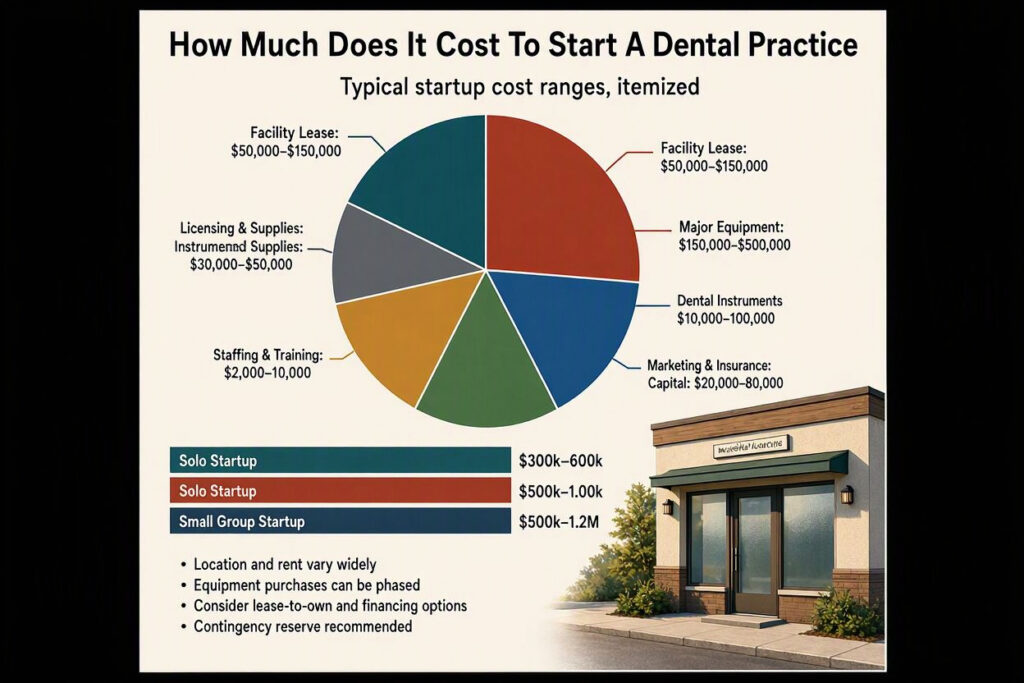
The cost to start a dental practice varies widely. In the United States, a typical de novo practice costs between $500,000 and $1,000,000. A startup or smaller practice might cost $250,000 to $500,000. Buying an existing practice can cost $500,000 to $2,000,000 or more, depending on the size and location.
Here is a breakdown of average costs for a de novo practice in the US:
| Expense Category | Estimated Cost (USD) |
|---|---|
| Leasehold improvements | $100,000 – $300,000 |
| Dental equipment (chairs, X-rays, etc.) | $150,000 – $400,000 |
| Office furniture and computers | $20,000 – $50,000 |
| Dental supplies (initial) | $10,000 – $30,000 |
| Permits, licenses, and legal fees | $5,000 – $20,000 |
| Marketing and branding | $10,000 – $50,000 |
| Staff salaries (first 3-6 months) | $50,000 – $150,000 |
| Working capital (operating cash) | $50,000 – $100,000 |
| Insurance (malpractice, property) | $5,000 – $15,000 |
| Total | $400,000 – $1,115,000 |
These are rough estimates. Actual costs depend on your location, the size of your office, and the quality of equipment you choose.
Regional Price Variations
The cost to start a dental practice varies by country and city. Here is a general comparison for a de novo practice:
| Country | Average Startup Cost (Local Currency) | Approx. USD |
|---|---|---|
| United States | $500,000 – $1,000,000 | $500,000 – $1,000,000 |
| Canada | CAD $400,000 – $800,000 | $300,000 – $600,000 |
| United Kingdom | £200,000 – £500,000 | $250,000 – $625,000 |
| Australia | AUD $400,000 – $900,000 | $270,000 – $600,000 |
| Germany | €200,000 – €500,000 | $220,000 – $550,000 |
| India | ₹20 lakh – ₹50 lakh | $25,000 – $62,000 |
| Philippines | ₱2M – ₱6M | $35,000 – $105,000 |
In countries with lower labor and real estate costs, startup expenses are much lower. However, revenue potential may also be lower.
Major Expense Categories
Let’s break down the main costs in more detail.
1. Real Estate And Leasehold Improvements
You need a space for your practice. You can lease or buy. Leasing is more common for startups because it requires less capital. A typical dental office needs 1,200 to 2,500 square feet. Rent varies by location:
- Small town: $15 – $30 per square foot per year
- Suburban: $20 – $40 per square foot
- Urban: $30 – $80 per square foot
- Prime city: $50 – $150 per square foot
Leasehold improvements include plumbing, electrical, walls, flooring, and dental-specific needs like gas lines and vacuum systems. These can cost $50 to $200 per square foot. For a 1,500-square-foot office, that’s $75,000 to $300,000.
2. Dental Equipment
Dental equipment is the largest single expense. You need:
- Dental chairs and delivery units: $5,000 – $15,000 each
- X-ray systems (panoramic, intraoral): $20,000 – $80,000
- Sterilization equipment: $5,000 – $20,000
- Handpieces and small instruments: $5,000 – $15,000
- CAD/CAM or milling machines (optional): $50,000 – $150,000
- Computers and practice management software: $10,000 – $30,000
A typical two-chair practice might spend $150,000 to $250,000 on equipment. A larger practice with four or more chairs can spend $400,000 or more.
3. Office Furniture And Technology
You need desks, chairs, cabinets, waiting room furniture, phones, printers, and computers. Budget $20,000 to $50,000.
4. Dental Supplies
Initial supplies include gloves, masks, needles, anesthetics, composites, impression materials, and more. Expect $10,000 to $30,000 for the first few months.
5. Permits, Licenses, And Legal Fees
You need a business license, dental license, DEA registration (for prescribing), and possibly a controlled substance permit. Legal fees for forming an entity, reviewing leases, and drafting contracts can cost $5,000 to $20,000.
6. Marketing And Branding
You need a website, logo, signage, business cards, and digital marketing. Budget $10,000 to $50,000 for the first year. Ongoing marketing costs $2,000 to $10,000 per month.
7. Staff Salaries
You will need at least one dental assistant and a front desk person. Many practices also hire a hygienist. Salaries vary:
- Dental assistant: $35,000 – $50,000 per year
- Front desk: $30,000 – $45,000
- Hygienist: $60,000 – $90,000
- Associate dentist (if applicable): $120,000 – $200,000
Budget $50,000 to $150,000 for the first 3-6 months until revenue covers payroll.
8. Working Capital
You need cash to cover expenses before revenue catches up. Most experts recommend 3 to 6 months of operating expenses, which can be $50,000 to $150,000.
9. Insurance
Malpractice insurance, property insurance, and workers’ compensation cost $5,000 to $15,000 per year.
Buying An Existing Practice Vs Starting From Scratch
| Factor | Buying Existing | Starting From Scratch |
|---|---|---|
| Upfront cost | $500,000 – $2,000,000+ | $400,000 – $1,000,000 |
| Patient base | Immediate | Build from zero |
| Cash flow | Often positive day one | Negative for months |
| Equipment | Existing (may be outdated) | New (your choice) |
| Staff | Existing | Hire and train |
| Risk | Lower | Higher |
| Control | Limited by existing systems | Full control |
| Time to profitability | 6 – 12 months | 12 – 24 months |
Buying an existing practice is often more expensive but less risky. Starting from scratch gives you more control but takes longer to become profitable.
Financing Options
Most dentists cannot pay cash for a practice. Here are common financing options:
- Bank loans: SBA loans in the US (7(a) or 504) are popular. They offer long terms and low down payments. In Canada, the Business Development Bank of Canada (BDC) offers similar programs.
- Equipment financing: Lease or finance equipment separately.
- Private investors: Some dentists bring in a partner or investor.
- Seller financing: When buying an existing practice, the seller may finance part of the purchase.
- Home equity loans: Some dentists use personal assets.
- Retirement funds: Some use self-directed IRAs or 401(k) rollovers.
Expect to need 10-20% down for a bank loan. SBA loans often require 10% down and have terms up to 10 years for equipment and 25 years for real estate.
How To Save Money When Starting A Dental Practice
- Start smaller: A two-chair practice costs less than a four-chair one. You can expand later.
- Buy used equipment: Refurbished dental chairs and X-ray machines can save 30-50%.
- Negotiate your lease: Ask for a rent-free period or tenant improvement allowance.
- Share space: Consider a professional building with shared utilities.
- Hire slowly: Start with one assistant and a front desk person. Add a hygienist when patient volume grows.
- Do your own marketing: Learn basic SEO and social media to reduce costs.
- Join a group purchasing organization: Get discounts on supplies and equipment.
- Buy an existing practice: It may cost more upfront but has immediate cash flow.
Expert Opinions
“Starting a dental practice is not cheap, but it is one of the best investments you can make in your career. The key is to plan carefully, secure enough working capital, and not overspend on fancy equipment you do not need yet.”
— Dr. James Rodriguez, Practice Owner, Texas
“I always tell young dentists to consider buying an existing practice. You get patients, staff, and cash flow from day one. Starting from scratch is exciting, but it is a long road to profitability.”
— Dr. Sarah Mitchell, Dental Consultant
Important Notes For Readers
Note 1: Costs in this article are estimates. Actual costs vary by location, practice size, and market conditions.
Note 2: Do not underestimate working capital. Many practices fail because they run out of cash before becoming profitable.
Note 3: Consult with an accountant and a dental attorney before signing any lease or loan.
Note 4: Consider the long-term costs of equipment maintenance and replacement.
Note 5: Marketing is essential. Budget for it from the start.
Frequently Asked Questions
How much does it cost to start a dental practice?
In the US, a de novo dental practice costs between $500,000 and $1,000,000. A smaller startup can cost $250,000 to $500,000. Buying an existing practice can cost $500,000 to $2,000,000 or more.
Can I start a dental practice with no money?
No. You need capital for equipment, leasehold improvements, and working capital. However, you can use bank loans, SBA loans, or seller financing to reduce your upfront cash needs.
Is it better to buy an existing practice or start from scratch?
Buying an existing practice is often less risky and faster to profitability. Starting from scratch gives you more control but takes longer to build a patient base.
How long does it take to become profitable?
Most de novo practices become profitable within 12 to 24 months. Existing practices may be profitable immediately.
What is the biggest expense when starting a dental practice?
Dental equipment and leasehold improvements are usually the largest expenses. Working capital is also critical.
Do I need a business partner?
Not necessarily. Many dentists start solo. A partner can share costs and risk but also adds complexity.
What licenses do I need to start a dental practice?
You need a dental license, a business license, a DEA registration (for prescribing), and possibly a controlled substance permit. Requirements vary by state or province.
Additional Resources
For more information on starting a dental practice, visit the American Dental Association website. The ADA Practice Institute offers resources on practice management and financing. In Canada, the Canadian Dental Association provides similar guidance.
Conclusion
Starting a dental practice costs between $500,000 and $1,000,000 in the US, with major expenses including equipment, leasehold improvements, and working capital. Buying an existing practice costs more but offers immediate cash flow. By planning carefully, securing financing, and controlling costs, you can build a successful practice without running out of money.