
How Much Does One Tooth Cost With Invisalign?
Invisalign is a popular way to straighten teeth without metal braces. It uses clear, removable aligners to move teeth into the right position. Most people get Invisalign for their whole smile. But some people only need to fix one tooth. Maybe you have a slightly rotated tooth. Maybe you have a small gap next to one tooth. Maybe one tooth shifted after braces. In these cases, you might wonder: how much does one tooth cost with Invisalign?
The answer is not as simple as you might think. Invisalign is not usually priced per tooth. It is priced for the whole treatment. However, there are options for minor corrections that cost less. In this comprehensive guide, we will explain how Invisalign pricing works for single-tooth cases. We will look at average costs, the types of Invisalign available, what affects the fee, insurance options, and practical tips to save money. We will also cover the treatment process, aftercare, and common questions.
Whether you need to fix one tooth or a few, this article will help you understand what to expect.
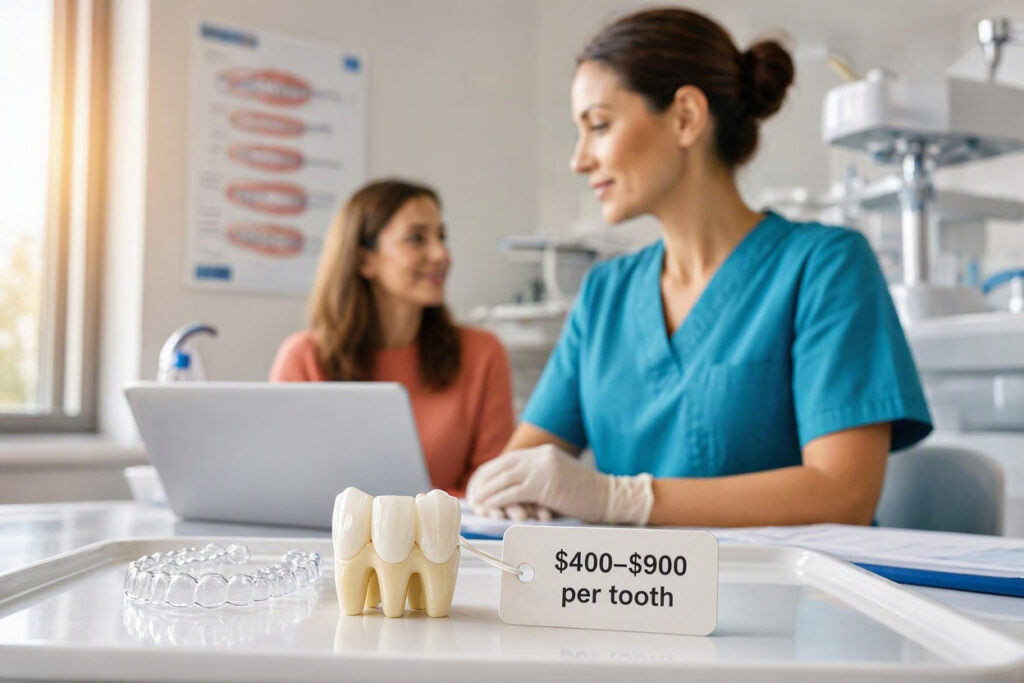
What Does “One Tooth” Mean in Invisalign?
When people ask about the cost of one tooth with Invisalign, they usually mean one of two things:
- They only need to move one tooth. The rest of their teeth are straight. They want to know if they can just treat that one tooth.
- They want to know the per-tooth cost. They are trying to understand how Invisalign pricing breaks down.
It is important to know that Invisalign does not work on just one tooth in isolation. Aligners are made for the whole arch. Even if only one tooth needs to move, the aligner covers all your teeth. This is because the aligner needs to grip the other teeth to apply force. So you cannot just buy an aligner for one tooth.
However, you can get a shorter, simpler treatment that focuses on minor movement. This is often called “minor tooth movement” or “limited treatment.” It costs less than full Invisalign.
How Invisalign Pricing Works
Invisalign is priced based on the complexity of your case. Your orthodontist examines your teeth, takes scans, and creates a treatment plan. The plan shows how many aligners you need and how long treatment will take. The price is for the whole treatment, not per tooth.
Here are the main factors that determine the price:
- Number of aligners: More aligners mean higher cost.
- Length of treatment: Longer treatment means higher cost.
- Complexity of movement: Moving teeth further or rotating them more is harder. It costs more.
- Your orthodontist: Experience and location affect the price.
- What is included: Some packages include retainers and follow-up visits. Others charge extra.
So, if you only need to move one tooth a small amount, you might need only a few aligners. This can be much cheaper than full treatment.
Average Cost for Single-Tooth Invisalign
There is no official “one tooth” price for Invisalign. But there are treatment options for minor cases. These are often called Invisalign Express, Invisalign Lite, or Invisalign i7. Here are the average costs.
| Treatment Type | Best For | Average Cost (USD) |
|---|---|---|
| Invisalign i7 | Very small movements (one tooth) | $1,500 – $2,500 |
| Invisalign Express | Minor crowding or spacing | $2,000 – $3,500 |
| Invisalign Lite | Moderate cases | $3,500 – $5,000 |
| Invisalign Full | Complex cases | $5,000 – $8,000 |
If you only need to move one tooth, Invisalign i7 or Express may be enough. These treatments use fewer aligners and take less time. They cost less than full Invisalign.
Some orthodontists may offer a “single-tooth” or “limited” treatment plan. This is not an official Invisalign package, but it uses Invisalign aligners for a short period. The cost can range from $1,000 to $3,000. It depends on the orthodontist and your case.
It is important to note that these prices are estimates. Your actual cost depends on your orthodontist and your specific needs.
Invisalign i7: The Best Option for One Tooth
Invisalign i7 is designed for very minor tooth movement. It is ideal for cases where only one or a few teeth need small adjustments. It uses a maximum of seven aligners per arch. Treatment usually takes three to six months.
Invisalign i7 is often used for:
- Fixing a slightly rotated tooth
- Closing a small gap
- Relapse after braces
- Minor crowding
The average cost of Invisalign i7 is $1,500 to $2,500. This is the most affordable Invisalign option. It is a good choice if you only need to fix one tooth.
However, not all orthodontists offer Invisalign i7. You may need to call around to find a provider. Also, not all cases qualify. Your orthodontist will tell you if i7 is right for you.
Invisalign Express: For Slightly Larger Cases
Invisalign Express is for minor to moderate cases. It uses up to 10 aligners per arch. Treatment usually takes six to twelve months. It is more flexible than i7 and can correct slightly more complex movements.
The average cost of Invisalign Express is $2,000 to $3,500. It is still much cheaper than full Invisalign.
If your single-tooth issue is more than a tiny rotation, Express may be the better option. Your orthodontist will recommend the right package.
Factors That Affect the Cost of Single-Tooth Invisalign
Even for one tooth, several factors can change the price.
Complexity of the Movement
Moving a tooth a small distance is easier than rotating it or moving it vertically. Simple movements need fewer aligners and cost less. Complex movements need more aligners and cost more.
Your Orthodontist’s Experience
A highly experienced orthodontist may charge more. A general dentist who offers Invisalign may charge less. For best results, choose an orthodontist with clear aligner experience.
Geographic Location
Prices vary by city and state. In big cities like New York or San Francisco, treatment costs more. In smaller towns, it costs less. The same is true across countries.
What Is Included
Some orthodontists include retainers, follow-up visits, and X-rays in the price. Others charge extra. Always ask what is included.
Insurance Coverage
If you have dental insurance, your out-of-pocket cost may be lower. However, many plans do not cover minor orthodontic treatment. Check with your provider.
Additional Dental Work
If you need a cleaning, filling, or other treatment before Invisalign, these add to the cost.
Invisalign vs. Other Options for One Tooth
If you only need to fix one tooth, you have other options besides Invisalign. Here is a comparison.
| Treatment | Average Cost (USD) | Pros | Cons |
|---|---|---|---|
| Invisalign i7 | $1,500 – $2,500 | Discreet, removable, no metal | Limited to minor cases |
| Traditional Braces (partial) | $1,000 – $2,500 | Effective, strong | Visible, fixed |
| Ceramic Braces (partial) | $1,500 – $3,000 | Less visible than metal | Still visible, fixed |
| Dental Bonding | $300 – $600 per tooth | Quick, affordable | Not for moving teeth, can stain |
| Veneers | $800 – $2,000 per tooth | Covers cosmetic issues | Irreversible, expensive |
| Tooth Reshaping | $200 – $500 | Quick, affordable | Only for minor shape issues |
Invisalign is a good choice if you want to move a tooth without metal braces. It is discreet and comfortable. However, it may not be the cheapest option. Bonding or reshaping can fix cosmetic issues for less. But they do not move teeth. Only orthodontic treatment can move teeth.
Does Insurance Cover Single-Tooth Invisalign?
Insurance coverage for single-tooth Invisalign varies. Many dental insurance plans cover orthodontic treatment. However, they often have a lifetime maximum, such as $1,000 to $2,000. They may also require that treatment is medically necessary.
For single-tooth cases, insurance may not cover the treatment. This is because it is often considered cosmetic. If the tooth is causing pain, difficulty chewing, or other health issues, it may be covered. You will need documentation from your dentist.
Here are some key points about insurance and single-tooth Invisalign:
- Dental insurance: Some plans cover a portion of orthodontic treatment. Coverage is often 50% after your deductible.
- Lifetime maximum: Most plans have a lifetime maximum. This is the total amount they will pay for orthodontics.
- Waiting period: Some plans have a waiting period for orthodontic coverage.
- Pre-authorization: Most plans require pre-authorization before treatment.
- Medical insurance: Usually does not cover Invisalign unless it is medically necessary.
- FSA/HSA: You can use pre-tax dollars from these accounts to pay for Invisalign. This saves you money on taxes.
Always check with your insurance provider before starting treatment. Ask about your orthodontic benefits, lifetime maximum, and whether single-tooth treatment is covered.
How to Save Money on Single-Tooth Invisalign
Even for one tooth, Invisalign can be expensive. Here are practical ways to reduce the cost.
Compare Multiple Orthodontists
Get quotes from at least three orthodontists. Compare what is included, not just the price. A slightly higher quote may include more services.
Ask About Invisalign i7 or Express
If your case is minor, ask if Invisalign i7 or Express is an option. These cost less than full Invisalign.
Ask About Discounts
Many orthodontists offer discounts for new patients, students, military members, or referrals. Ask if there are any promotions.
Use FSA or HSA Funds
If you have an FSA or HSA, use it. You save on taxes, which reduces the effective cost.
Consider a Dental School
Dental schools offer orthodontic treatment at a reduced cost. Students work under supervision. Treatment takes longer, but it is much cheaper.
Ask About Payment Plans
Most orthodontists offer payment plans. You can spread the cost over several months. Some plans have no interest.
Check Insurance Again
Even if your insurance does not cover single-tooth Invisalign, you may be able to use out-of-network benefits. Submit a claim and see if you get reimbursed.
Consider Other Options
If Invisalign is too expensive, ask about other options. Bonding or reshaping may fix the appearance of one tooth for less. But remember, they do not move teeth.
The Process for Single-Tooth Invisalign
If you decide to get Invisalign for one tooth, here is what to expect.
Step 1: Consultation and Examination
You visit the orthodontist for a consultation. They examine your teeth and take X-rays or scans. They discuss your goals and recommend a treatment plan.
Step 2: 3D Scanning
The orthodontist uses a digital scanner to create a 3D model of your teeth. This is fast and comfortable. No messy impressions are needed in most modern clinics.
Step 3: Treatment Planning
The orthodontist creates a digital treatment plan. You can see a preview of your future smile. The plan shows how your tooth will move and how long it will take.
Step 4: Aligner Fabrication
Your aligners are custom-made. They are usually produced in the United States. It can take one to three weeks for them to arrive.
Step 5: Wearing Aligners
You wear each set for 20 to 22 hours per day. You change to a new set every one to two weeks. You remove them to eat, drink, brush, and floss.
Step 6: Follow-Up Visits
You visit the orthodontist every 6 to 10 weeks. They check your progress and give you new aligners. Some clinics offer virtual check-ups.
Step 7: Retainers
After treatment, you wear retainers to keep your tooth in place. You may wear them full-time for a few months, then at night.
Aftercare for Single-Tooth Invisalign
After your treatment, you need to wear a retainer. This is very important, even for one tooth. Without a retainer, the tooth can shift back to its old position.
Here are some tips for aftercare:
- Wear your retainer as instructed: Usually full-time for a few months, then at night.
- Clean your retainer regularly: Use a soft toothbrush and cool water. Avoid hot water, which can warp the plastic.
- Keep your retainer safe: Store it in its case when not in use.
- Visit your orthodontist for check-ups: They will monitor your retainer and make adjustments if needed.
- Maintain good oral hygiene: Brush and floss daily. This keeps your teeth and gums healthy.
With good care, your results can last a lifetime.
Personal Experiences and Testimonials
Here are some illustrative experiences from people who had single-tooth Invisalign. These are based on common patient feedback.
“I had one crooked tooth after braces. I got Invisalign i7. It cost $1,800. Treatment took four months. It was quick and easy. I am very happy with the result.” — Emily, USA
“I had a small gap between my front teeth. My orthodontist recommended Invisalign Express. It cost $2,500. I paid $1,000 after insurance. The gap closed in six months.” — Jason, Canada
“I only needed to move one tooth. My dentist said full Invisalign was the only option. It cost $5,000. I got a second opinion and found an orthodontist who offered Invisalign i7 for $2,000. I saved a lot.” — Maria, USA
“I did not have insurance, so I went to a dental school. I paid $1,200 for single-tooth Invisalign. It took longer, but it was worth it.” — David, UK
These stories show that single-tooth Invisalign can be affordable if you shop around. Results depend on following your orthodontist’s instructions.
Important Notes for Readers
- Prices change: The costs in this article are estimates. Always confirm with your orthodontist.
- Consult a professional: Only a licensed orthodontist can tell you if Invisalign is right for you.
- Invisalign is not per tooth: You cannot buy an aligner for just one tooth. The aligner covers your whole arch.
- Minor cases cost less: If you only need small movement, ask about Invisalign i7 or Express.
- Read the contract: Understand what is included and what is not.
- Wear aligners as instructed: Invisalign only works if you wear them 20–22 hours per day.
- Keep your aligners clean: Poor hygiene can cause cavities and gum problems.
- Be patient: Results take time. Do not rush the process.
- Check the brand: Make sure your orthodontist uses genuine Invisalign aligners.
- Ask about retainers: Retainers are essential to keep your tooth in place after treatment.
Frequently Asked Questions (FAQ)
1. How much does one tooth cost with Invisalign?
There is no set price per tooth. Invisalign is priced for the whole treatment. For minor single-tooth cases, Invisalign i7 or Express costs $1,500 to $3,500.
2. Can I get Invisalign for just one tooth?
Yes, but the aligner will cover your whole arch. You cannot get an aligner for just one tooth. However, you can get a shorter treatment that focuses on one tooth.
3. What is Invisalign i7?
Invisalign i7 is a limited treatment for very minor tooth movement. It uses up to seven aligners per arch. It is the cheapest Invisalign option.
4. Is Invisalign i7 available everywhere?
No. Not all orthodontists offer Invisalign i7. You may need to call around to find a provider.
5. Does insurance cover single-tooth Invisalign?
It depends on your plan. Some plans cover orthodontic treatment. Others do not. Single-tooth cases are often considered cosmetic. Check with your provider.
6. How long does single-tooth Invisalign take?
Treatment can take three to twelve months. It depends on your case. Invisalign i7 usually takes three to six months.
7. Can I use FSA or HSA funds for single-tooth Invisalign?
Yes. Invisalign is an eligible expense for FSA and HSA funds.
8. What if I only need to fix a small gap?
Invisalign i7 or Express can close small gaps. Your orthodontist will tell you if you are a candidate.
9. Can Invisalign fix a rotated tooth?
Yes. Invisalign can rotate teeth. Minor rotations are easier and cost less. Severe rotations may need full Invisalign.
10. Is single-tooth Invisalign worth the cost?
For many people, yes. It is a discreet way to fix one tooth. But only you can decide if the benefit justifies the cost.
11. What are the alternatives to single-tooth Invisalign?
Alternatives include partial braces, dental bonding, veneers, and tooth reshaping. Each has pros and cons. Ask your dentist for advice.
12. How do I find an orthodontist who offers Invisalign i7?
Search online for “Invisalign i7 near me” or call local orthodontists. You can also use the Invisalign website to find providers.
13. Does single-tooth Invisalign hurt?
You may feel mild pressure when you change aligners. This is normal. It means the aligners are working. The pressure usually goes away in a few days.
14. Can I eat with single-tooth Invisalign?
You must remove your aligners before eating. You can eat whatever you want, but you need to brush before putting the aligners back in.
15. What happens after single-tooth Invisalign?
You will need to wear a retainer to keep your tooth in place. Without a retainer, the tooth can shift back.
Conclusion
Single-tooth Invisalign is not priced per tooth. But if you only need minor movement, you can get a shorter, cheaper treatment like Invisalign i7 or Express. These cost between $1,500 and $3,500. The exact price depends on your orthodontist, your location, and your case. Insurance may cover part of the cost. By comparing providers and asking about limited treatment options, you can save money. Always consult with a licensed orthodontist to see if you are a candidate for single-tooth Invisalign.
Additional Resource
For more information about Invisalign and to find a certified orthodontist, visit the official Invisalign website: https://www.invisalign.com


