How Much Is One Molar Dental Implant?
A missing molar is a functional crisis hidden in the back of your mouth. No one sees it when you smile, but you feel it with every meal. The first molar bears the brunt of your chewing force, generating up to 90 kilograms of pressure per square centimeter. When it is gone, you instinctively shift your chewing to the other side, creating an unbalanced, asymmetric load on your jaw joint and your remaining teeth. The bone in the empty socket begins its silent, irreversible resorption. A dental implant for a single molar is not a cosmetic luxury. It is a structural, functional restoration of your mouth’s most powerful workhorse. But the unique demands of the molar position—the immense vertical forces, the wide chewing surface, the limited access, and the dense bone—make its implant a specific clinical and financial case. This guide is a deep, precise cost analysis for a single molar dental implant. It dissects every component of the fee, explains why a molar implant costs what it does, compares the material options, and provides a clear financial map for this essential restoration.
The All-Inclusive Cost Range for One Molar Implant
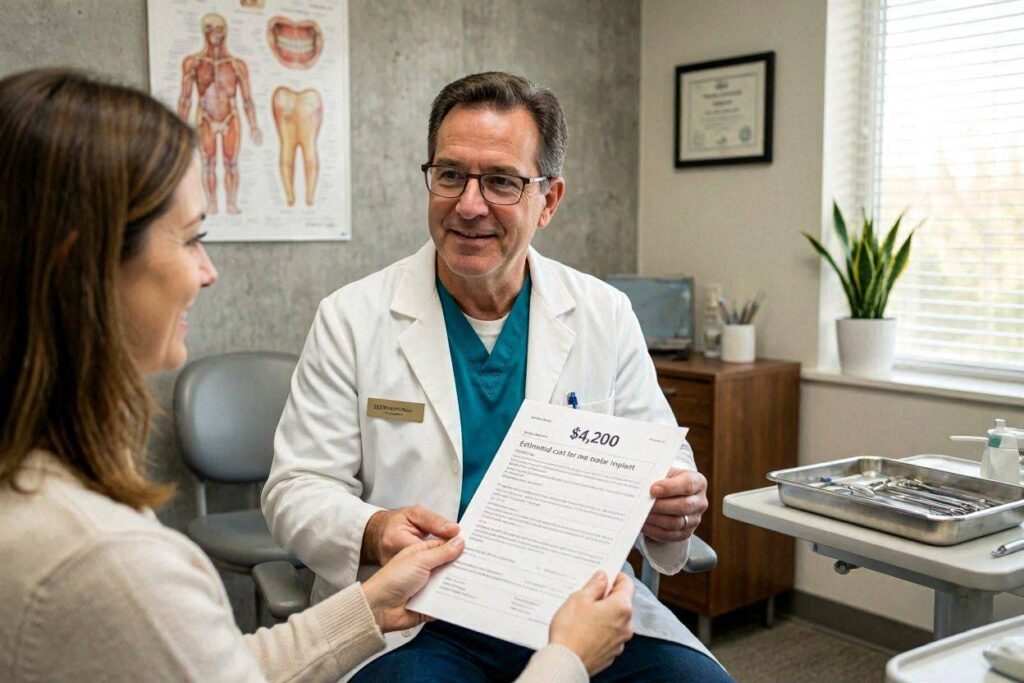
In the United States, a complete single molar dental implant—meaning the surgical placement of the titanium post and the delivery of the final, functional crown, with no additional bone grafting—will cost between $3,500 and $6,000. This is the realistic, all-in, out-the-door price in a private practice setting. This range places a molar implant at the upper end of single-tooth implant pricing, reflecting the specific technical demands of the posterior region. The cost can climb to $7,000 to $9,000 if significant bone grafting or a sinus lift is required. In a dental school or residency program, the same complete molar implant can cost between $2,000 and $3,500, reflecting the subsidized, educational environment. For patients considering dental tourism, a single molar implant with a reputable brand in Mexico, India, or Thailand can range from $900 to $1,800.
The Anatomical and Mechanical Challenge of the Molar
Why is a molar implant a distinct category? The answer lies in the biomechanics. The first molar is the primary engine of mastication. It is a wide, multi-rooted tooth with a large, flat chewing table. The forces it generates are not just vertical but have significant lateral, grinding components. An implant in this position must be wide-diameter, typically 5.0mm to 6.0mm, to match the tooth’s emergence profile and to withstand the bending forces. A narrow implant in a molar position is a mechanical failure waiting to happen.
The bone in the posterior mandible is dense, type D1 or D2 cortical bone. While this density provides excellent primary stability, it also has a poorer blood supply, which can slow healing. The posterior maxilla, by contrast, has softer, more spongy bone, type D3 or D4, and is directly beneath the maxillary sinus. The sinus floor can be perilously low, often requiring a sinus lift procedure to create enough vertical bone height for a safe implant. The inferior alveolar nerve runs through the posterior mandible, a vital structure that must be precisely avoided. These anatomical complexities demand advanced 3D imaging, and they often require adjunctive surgical procedures, which add to the total cost. A molar implant is not a simple incisor implant. It is a high-load, anatomically demanding restoration.
The Detailed Cost Breakdown for a Molar Implant
The single fee is an aggregate of several distinct line items, each contributing to the final functional and biological result.
The 3D CBCT Scan and Diagnostics Fee
For a molar implant, a two-dimensional panoramic X-ray is dangerously insufficient. A Cone Beam Computed Tomography (CBCT) scan is the standard of care. It reveals the exact proximity of the sinus or the nerve, the thickness of the buccal bone plate, and the internal density of the bone. This diagnostic fee ranges from $300 to $650 and is often credited toward the total surgical fee if you proceed with treatment.
The Surgical Placement Fee
This is the fee for the sterile surgical procedure. It includes the local anesthesia, the surgical suite setup, the flap reflection, the precision drilling sequence, and the surgeon’s expertise. For a molar, this fee reflects the need for a wide-diameter osteotomy and the careful management of dense bone or soft bone. This fee ranges from $1,500 to $2,800.
The Implant Fixture: A Wide-Diameter Platform
A molar implant is a wide-platform fixture, designed with a broader top to support a large molar crown. Premium brands (Straumann Bone Level Tapered, Nobel Biocare NobelParallel) offer specific wide-diameter implants. A value-tier wide implant (Osstem TSIII, Dentium SuperLine) is clinically excellent. The implant fixture is a line item within the surgical fee. A premium brand will push the total package to the $5,000-$6,000 range, while a value brand will place it in the $3,500-$4,500 range.
The Abutment: A Heavy-Duty Connector
For a molar, the abutment is typically a stock or custom titanium component. Titanium is chosen for its superior fracture resistance in this high-force zone. A gold-plated, heavy-duty abutment screw is used. The abutment and screw are engineered to withstand years of cyclic loading. This component, including the torque delivery, is part of the restorative fee.
The Crown: The Masticatory Surface
The crown for a molar is a functional, not just an aesthetic, device. The material choice balances strength, wear resistance, and cost.
- Full Monolithic Zirconia Crown: This is the premium choice for a molar. It is a single block of high-strength zirconia ceramic, milled to precisely replicate the cusps and grooves of a natural molar. It has a flexural strength of over 1,000 MPa, making it virtually unbreakable. The cost for this crown and the abutment is $2,000 to $3,000.
- Porcelain-Fused-to-Metal (PFM) Crown: A time-tested, strong option. A metal substructure provides strength, and tooth-colored porcelain is layered on top. The risk is the porcelain layer chipping under heavy function. It is more economical, with the abutment and crown ranging from $1,500 to $2,200.
- Layered Zirconia Crown: A zirconia framework with layered porcelain for aesthetics. This is typically for premolars, not heavy-function molars, as the porcelain can fracture.
The Adjunctive Procedures: The Hidden Cost Variables
A molar implant is often quoted as a “straightforward” fee, but the final price depends on the state of the extraction site.
Socket Preservation Bone Graft
If the molar is being extracted at the same time as the implant is placed, or if the extraction was recent and the socket has walls but needs a filler to preserve the ridge width, a socket graft is performed. This adds $500 to $1,200 to the total fee.
Major Ridge Augmentation
If the molar was extracted years ago and the bone ridge has severely atrophied into a thin, knife-edged crest, a significant block bone graft is required. This is a separate, more complex surgical procedure, adding $1,500 to $3,500 and delaying the implant placement by four to six months.
Sinus Lift (Maxillary Molar)
For an upper first or second molar, a low sinus floor is a common finding. A sinus floor elevation, performed through the implant osteotomy (a crestal approach) or through a side window (lateral approach), is required. This adds $2,000 to $4,500 to the case. The sinus lift is often the single largest additional cost in upper molar implantology.
The Insurance Factor and Temporal Splitting
Dental insurance in the U.S. typically covers a molar implant at the same 50% rate as any other implant, but with a hard annual maximum of $1,500 to $2,500. A single molar implant will exhaust the entire annual maximum and still leave a significant out-of-pocket balance. The most effective financial strategy is to split the treatment across two calendar years. The surgical phase (extraction, graft, implant placement) is completed in the late fall of year one, using that year’s full insurance maximum. The restorative phase (abutment and crown) is completed in the early spring of year two, leveraging the new year’s maximum. This effectively doubles your insurance contribution. A pre-treatment estimate must be submitted to your insurance company and approved in writing before you begin.
The Cost of Doing Nothing: The Real Expense
Choosing not to replace a molar is a decision with its own escalating costs. The adjacent tooth drifts forward, tilting into the space and creating a food trap that leads to decay. The opposing molar super-erupts, migrating down into the empty space, potentially exposing its roots and becoming periodontally compromised. The bone resorbs, making a future implant more complex and expensive. The temporomandibular joint (TMJ) is loaded asymmetrically, potentially leading to chronic pain, clicking, and dysfunction. The cost of a molar implant today is compared not to zero, but to the future cost of restoring two decayed, drifted teeth, treating TMJ disorder, and undergoing a more complex, bone-grafted implant later.
Conclusion
A single molar dental implant costs between $3,500 and $6,000 for the complete, standard restoration in a U.S. private practice, reflecting the unique biomechanical demands of the posterior bite, the need for a wide-diameter implant, and the high-strength crown materials required to withstand intense chewing forces. The final fee is significantly influenced by the potential need for a sinus lift in the upper jaw, a major bone graft for a long-healed extraction site, and the choice between a virtually unbreakable monolithic zirconia crown and a more economical PFM restoration. Strategically splitting the surgical and restorative phases across two insurance benefit years is the most effective way to maximize coverage for this essential, function-restoring procedure.
Frequently Asked Questions
Can a mini implant be used for a molar?
No. A mini implant has a diameter of less than 3.0mm. It is mechanically incapable of withstanding the intense, concentrated, and lateral chewing forces of the molar position. Using a mini implant to replace a molar results in a near-certain fatigue fracture of the implant neck. A full, wide-diameter standard implant is required.
Why is a zirconia crown recommended for a molar implant?
Monolithic zirconia is a solid ceramic with extremely high flexural strength and excellent fracture toughness. It resists the heavy, cyclical loading of the posterior bite without chipping or fracturing, a common failure mode of layered porcelain crowns on molars. It is the most durable, long-term prosthetic choice for a tooth that must grind food.
Is a molar implant more painful than a front tooth implant?
The surgical procedure is essentially the same in terms of post-operative discomfort. The bone in the posterior mandible is denser, so the drilling may feel like more intense vibration, but the anesthesia is equally profound. The post-operative swelling is often less visible because it is further back in the jaw.
Can a molar implant be placed immediately after extraction?
Yes, in many cases. If the molar is extracted atraumatically, the socket walls are intact, and there is no active infection, the implant can be placed into the socket immediately. This is called an immediate molar implant. It often requires a bone graft to fill the gap between the implant and the socket walls, but it saves one surgery and months of healing time.
Additional Resource:
For further education on posterior implant solutions, consult the patient resources of the American Academy of Periodontology at www.perio.org.
Disclaimer: All prices quoted are approximate ranges based on the U.S. dental market and are subject to change based on geographic location and individual clinical complexity. This article is an educational guide and does not replace a personal clinical examination and treatment plan from a licensed dental professional.
continue
Can Dental Implants Be Done in One Visit
Meta Description: A complete guide to same-day dental implants. Explore immediate-load protocols, the difference between a temporary and a final tooth in one visit, candidacy requirements, and the truth behind the “teeth in a day” promise.
The phrase “same-day dental implants” is one of the most powerfully appealing promises in modern dentistry. It conjures an image of walking into a clinic with a missing or failing tooth and walking out an hour later with a permanent, beautiful, fully functional new tooth. The marketing is pervasive. The reality is more nuanced, more specific, and, when applied to the correct patient under the correct protocol, genuinely remarkable. The question “Can dental implants be done in one visit?” requires a precise redefinition of terms. A dental implant is a biological process of bone fusion, which takes months. What can be done in one visit is the surgical placement of the implant and the delivery of a temporary, fixed tooth or bridge on that same day. The implant is placed, and you leave with a tooth. This is called immediate loading. This guide explains exactly what is possible in a single visit, the strict clinical conditions that must be met for it to succeed, the crucial difference between a same-day temporary tooth and a same-day final tooth, and the modern protocols that have made this treatment a predictable reality for the right patient.
Defining “Done in One Visit”: The Four Concepts
The patient’s phrase “done in one visit” conflates several distinct clinical protocols. Clarity here is essential.
Immediate Implant Placement
This refers to the timing of the extraction and the implant surgery. A tooth is extracted, and the dental implant is placed into the fresh extraction socket during the same surgical appointment. This eliminates a separate, delayed implant surgery months later. It does not mean you receive a tooth on the same day. The implant is often buried under the gum to heal, and the tooth is delivered months later. This is a one-visit surgery, but not a one-visit tooth.
Immediate Implant with Immediate Provisionalization
This is the true “same-day tooth” for a single implant. The tooth is extracted, the implant is placed immediately, and a temporary, non-functional or lightly functional crown is attached to the implant on the same day. You walk out with a visible tooth in the gap. This temporary tooth is for aesthetics and gum shaping, not for chewing. This is the “one-visit implant” most commonly offered for a single front tooth.
Immediate Implant with Immediate Functional Loading
This is the “teeth in a day” full-arch concept. All remaining failing teeth on a jaw are extracted, four to six implants are placed, and a full, fixed, screw-retained temporary bridge of teeth is fabricated and fitted on the same day. The bridge is splinted, meaning it is one solid piece connecting all the implants. This splinting protects the implants from individual micro-movement. The patient can eat soft food on this temporary bridge during the healing phase. This is the All-on-4 same-day protocol.
Same-Day Final Crown (Rare and Specific)
In select, highly controlled cases, a final, permanent crown can be milled and delivered on the same day as the implant surgery. This requires a pre-planned, guided surgery, a perfectly stable implant with very high insertion torque, and an in-office CAD/CAM milling system. This is the absolute apex of same-day dentistry, but it is not the standard of care for the vast majority of cases.
The Biological Imperative: Primary Stability
The single factor that determines whether an implant can be loaded with a tooth on the same day is primary stability. This is the mechanical grip, the friction fit, that the implant achieves the moment it is screwed into the bone, before any biological healing has occurred. The surgeon measures this as insertion torque in Newton centimeters (Ncm). For an implant to be safely loaded immediately, it must achieve an insertion torque of at least 35 Ncm, and ideally 45 Ncm or higher. This rigid, mechanical lock prevents micro-movement.
Micro-movement is the enemy of osseointegration. If an implant moves, even microscopically, during the first weeks of healing, the bone cells will not attach to its surface. Instead, a fibrous capsule of scar tissue will form, and the implant will fail. A high insertion torque, combined with a splinted restoration that connects multiple implants, virtually eliminates any risk of micro-movement. This is why single, immediately loaded teeth are often kept out of the chewing function, and why full-arch same-day bridges are splinted. The temporary restoration acts as a rigid internal fixator.
The Single Tooth Same-Day Procedure: A Step-by-Step Account
A patient presents with a failing, non-restorable upper front incisor. The gum is healthy, the surrounding bone is intact, and a CBCT scan has confirmed a thick facial bone plate and abundant bone beyond the root apex. The patient is a non-smoker with excellent oral hygiene. This is the ideal immediate implant candidate.
Under local anesthesia, the failing tooth is carefully and atraumatically extracted. The goal is to preserve every millimeter of the delicate bony socket walls. The extraction socket is thoroughly debrided. Using a surgical guide, the surgeon prepares the osteotomy, drilling not into the socket itself but into the solid, native bone 3-4 millimeters beyond the apex of the extracted tooth root. This palatal bone provides the high-density anchorage for primary stability. The implant is placed and torqued to 45 Ncm.
Now, the dentist takes a digital scan of the implant position and the surrounding teeth. In the in-office milling machine, a temporary, custom, screw-retained acrylic crown is designed and milled from a solid block of tooth-colored PMMA. This crown is carefully adjusted so it has no contact with the opposing teeth in any chewing movement. It is for show, not for load. The crown is screwed into the implant, the screw access hole is sealed, and the patient leaves with a beautiful, fixed front tooth. This temporary will remain for four to six months while the implant osseointegrates. After healing, it is replaced with the final, durable porcelain or zirconia crown.
The Full-Arch Same-Day Procedure (All-on-4)
A patient arrives with a full arch of failing, periodontally compromised teeth, or a completely edentulous arch with a loose denture. In a single, extended surgical appointment, all remaining teeth are extracted. The bone is meticulously leveled and smoothed. Four implants are placed according to the All-on-4 protocol: two straight in the anterior, two tilted up to 45 degrees in the posterior. Each implant is tested for primary stability, and all must reach a minimum of 35 Ncm.
A pre-fabricated, provisional, full-arch bridge, which was made in the lab based on the pre-surgical plan, is then adapted and relined directly in the mouth. It is screwed onto the multi-unit abutments with tiny prosthetic screws. The bite is adjusted. The patient gazes into a mirror at a full, fixed, beautiful set of teeth that did not exist that morning. They are given strict instructions: a soft, non-chewing diet for the first three months. The final, durable, precision-milled bridge will be fabricated after osseointegration is complete. This is “teeth in a day.” It is real, and it is transformative.
The Candidacy Filter: Who Qualifies for Same-Day?
Not every patient is a candidate for an immediate-load protocol. The selection criteria are strict.
- Adequate Bone Volume and Density: The bone must be of good quality, type D1, D2, or D3, and sufficient in quantity to engage the implant with high torque.
- High Primary Stability: An insertion torque below 35 Ncm is an automatic disqualification for immediate loading. The implant must be buried and healed conventionally.
- Non-Smoker: Smoking is a potent vasoconstrictor and impairs healing. Smokers have significantly higher failure rates with immediate-load implants.
- No Active Infection: The extraction site must be free of acute purulent infection. Chronic, low-grade infection is a relative contraindication.
- Controlled Parafunction: Patients with severe bruxism, who generate extreme grinding forces, are poor candidates for same-day loading, as the risk of overloading the implants before osseointegration is too high.
- Systemic Health: Uncontrolled diabetes, immunocompromised states, and bisphosphonate therapy are contraindications.
The Risks and Realistic Expectations
Immediate loading is a more biologically demanding protocol than a delayed, two-stage approach. The failure rate is slightly higher, even in well-selected cases. The patient must accept this and comply absolutely with the post-operative instructions. The temporary tooth or bridge is not as strong as the final restoration. It can break if abused. The patient must adhere to a soft diet religiously. The gum around the temporary will be sculpted and may look slightly different from the final, polished restoration. Same-day implants are an advanced, technique-sensitive procedure. The surgeon’s experience and judgment are the primary determinants of success.
Conclusion
Dental implants can be completed with a fixed, visible tooth in a single visit through the process of immediate loading, which is biologically dependent on achieving high primary stability—an insertion torque of at least 35 Ncm—to prevent the micro-movement that would cause implant failure. For a single tooth, this provides a non-functional temporary crown for aesthetics during healing, while the full-arch All-on-4 protocol delivers a splinted, fixed temporary bridge that allows soft chewing on the same day. Strict patient selection, including good bone quality and a non-smoking status, is the non-negotiable gatekeeper for this advanced, transformative procedure.
Frequently Asked Questions
Can I eat normally on my same-day implant tooth?
No. A same-day single tooth is an aesthetic temporary. It must be kept completely out of chewing function. You eat on the other side of your mouth and adhere to a soft diet. A same-day full-arch bridge allows very soft chewing, but you must not bite into hard, tough, or crunchy foods for the full healing period of three to four months.
What happens if my immediate implant fails?
If an immediately loaded implant fails, it is typically due to a failure of primary stability or infection. The implant becomes mobile and is removed. The site is grafted and allowed to heal for three to four months. A new implant can then be placed using a conventional, delayed protocol. The failure of an immediate-load implant is a setback, but the site can usually be salvaged.
Does a same-day implant cost more?
The surgical fee for immediate placement and loading is often the same as a conventional implant. However, the cost of the immediate temporary crown or bridge is an additional line item, typically $500 to $1,500 for a single temporary crown and several thousand dollars for a full-arch temporary bridge, which is then credited toward the final restoration.
Is the same-day implant the final tooth?
Almost never. The same-day tooth is a highly aesthetic, custom-fabricated temporary restoration made of acrylic or composite. It is designed for the healing phase. After osseointegration is complete, it is removed and replaced with the final, much stronger, and more durable porcelain or zirconia crown or bridge.
Additional Resource:
For more detailed patient information on immediate-load implant protocols, visit the education section of the International Congress of Oral Implantologists at www.icoi.org.
Disclaimer: Same-day dental implant protocols are advanced, case-specific procedures. This educational guide describes the general process. A comprehensive personal examination and consultation with a qualified implant surgeon are required to determine your individual candidacy.