How Much Peroxide Is in Teeth Whitening?
You stand in the drugstore aisle, squinting at a box of whitening strips. The package screams “Professional Results” and “Noticeably Whiter Teeth in 3 Days.” You flip the box over, searching for the active ingredient. There it is, buried in tiny print. A percentage that means nothing without context.
Is 6% high or low? Will 10% burn your gums? And what in the world does that number actually mean for your smile?
Most people grab the box with the most convincing marketing and hope for the best. That approach leads to disappointment, sensitivity, or worse.
Understanding the actual peroxide content in your whitening treatment changes everything. It helps you predict results, manage side effects, and stop wasting money on products too weak to work.
This guide gives you the exact numbers. No fluff. No marketing spin. Just the real percentages used in every type of teeth whitening product, why those numbers matter, and how to choose the right strength for your teeth.
Understanding Peroxide in Teeth Whitening
The white part of your smile comes down to one simple molecule. Oxygen.
Peroxide compounds release oxygen molecules that break apart the long-chain stain molecules trapped inside your enamel. Those stain molecules come from coffee, red wine, tobacco, and the slow march of aging. They sit deep in the microscopic pores of your teeth, impossible to brush away.
Oxygen does what brushing cannot. It fragments those dark-colored compounds into smaller, colorless pieces. Your tooth structure stays exactly the same. The color just gets lighter.
The Two Types of Peroxide That Actually Matter
Walk down the whitening aisle and the ingredient lists name two different compounds. They sound similar. They work differently.
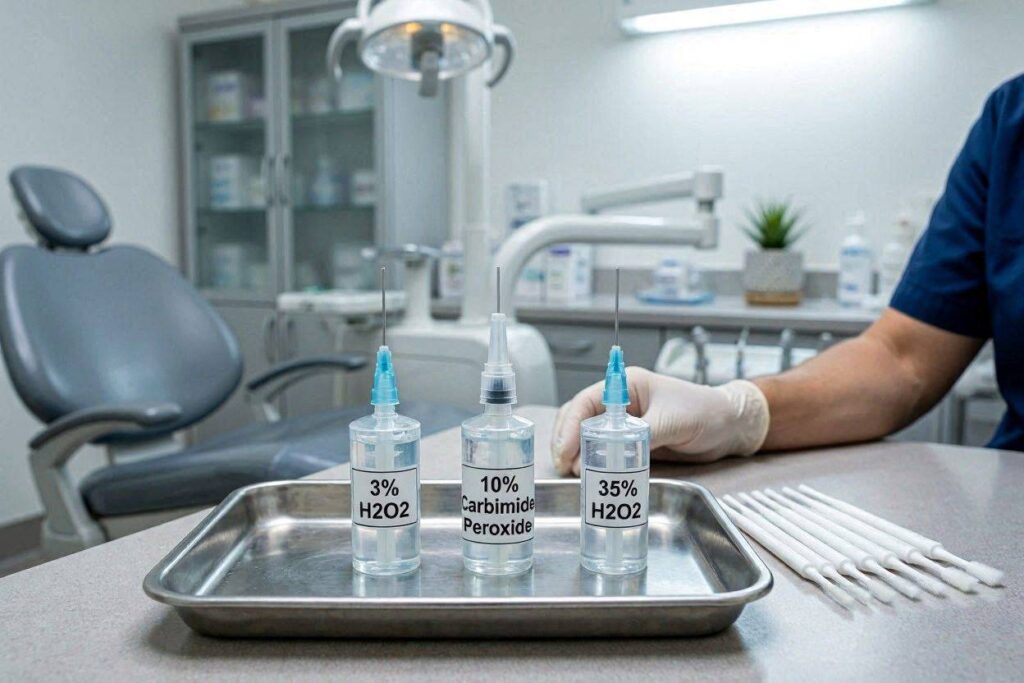
Hydrogen Peroxide represents the active workhorse. It breaks down quickly, releases oxygen fast, and delivers results in shorter contact times. Dental offices almost exclusively use hydrogen peroxide for in-office treatments. Many at-home gels now use it too.
Carbamide Peroxide acts as a slow-release delivery system. It breaks down into hydrogen peroxide over time, about one-third hydrogen peroxide and two-thirds urea. A 30% carbamide peroxide gel actually provides roughly 10% hydrogen peroxide activity. The urea component raises the pH of the gel slightly, which helps stabilize the formula for longer shelf life and slower release.
The choice between them comes down to contact time. Hydrogen peroxide works faster but depletes quickly. Carbamide peroxide works slower but maintains activity for hours. Overnight trays almost always use carbamide peroxide. Quick whitening sessions lean toward hydrogen peroxide.
How Manufacturers Actually Measure Concentration
The percentage on the package refers to the amount of active peroxide by weight in the total formula. A 10% hydrogen peroxide gel contains 10 grams of pure hydrogen peroxide for every 100 grams of gel.
That sounds straightforward. It gets tricky because products use different bases for comparison.
Some manufacturers list the hydrogen peroxide equivalent even when using carbamide peroxide. Others list the raw carbamide peroxide percentage without converting. A product labeled “30% carbamide peroxide” and a product labeled “10% hydrogen peroxide” actually deliver the same whitening power. Confusing packaging leads to misinformed choices.
The Mechanism That Determines Results
Concentration matters. Contact time matters more.
A low-concentration gel left on teeth for hours can outperform a high-concentration gel applied for minutes. The total oxygen exposure determines the whitening outcome. Dental researchers call this “total dose.”
Think of it like sun exposure. A pale person can get sunburned on a cloudy day if they stay outside long enough. Whitening works the same way. The percentage sets the speed limit. The duration sets the distance traveled.
Most consumer complaints about “weak” products come from insufficient contact time, not insufficient concentration.
Peroxide Levels in Professional Dental Treatments
The dental chair delivers results faster than anything you buy at the store. That speed comes from two factors: higher concentrations and complete isolation of the teeth.
Your dentist places a protective barrier over your gums before applying any gel. That barrier, called a gingival dam, allows the use of concentrations that would cause serious chemical burns if they touched soft tissue. The gel stays precisely on the enamel, away from everything sensitive.
The In-Office Power Range
Professional whitening gels range from 25% to 40% hydrogen peroxide. That concentration gradient serves different purposes depending on the system and the patient.
25% hydrogen peroxide represents the modern standard for most in-office whitening systems. Manufacturers reformulated their gels in recent years to use slightly lower concentrations with longer or repeated applications. The results stay comparable while sensitivity drops significantly.
35% hydrogen peroxide remains common in many established systems. This concentration delivers rapid whitening but requires meticulous isolation technique. Even a small leak onto the gum causes immediate discomfort.
40% hydrogen peroxide sits at the upper limit of what any dental professional should apply. Only experienced practitioners use this strength, and usually only on patients with stubborn staining and healthy, non-sensitive teeth.
Some systems use a catalyst to accelerate the reaction. A specialized light or laser activates the gel after application. The science behind light activation remains debated in dental literature. Many studies show no significant difference between light-assisted and non-light-assisted whitening at the same concentration. The light may help by warming the gel slightly, which speeds chemical reactions generally, but the effect appears modest at best.
The Time Factor in the Dental Chair
Professional treatments follow a specific protocol. The dentist applies the gel, leaves it in place for 15 to 20 minutes, then removes and reapplies. Most sessions include two to four application cycles.
Total peroxide contact time typically ranges from 45 to 80 minutes per appointment. Results often show immediately, with teeth appearing two to eight shades lighter after a single visit.
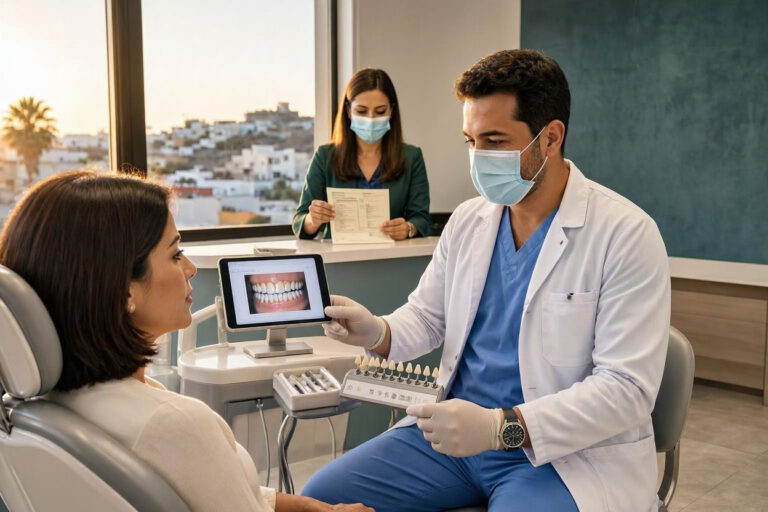
Some patients need multiple appointments spaced a week apart to achieve their desired shade. The dentist takes baseline photographs and uses a shade guide to track progress objectively.
Take-Home Kits From Your Dentist
Dental offices also dispense custom tray systems for home use. These kits bridge the gap between in-office power and drugstore convenience.
The custom trays fit your exact dental anatomy. No generic one-size-fits-most plastic. The precise fit prevents gel from leaking onto gums and allows a thinner layer of gel spread evenly across each tooth.
Dentist-dispensed take-home gels typically contain 10% to 22% carbamide peroxide. Converting to hydrogen peroxide equivalent gives you roughly 3.3% to 7.3% active hydrogen peroxide.
Higher-concentration take-home gels sometimes use 15% to 16% carbamide peroxide as the standard recommendation. That provides about 5% hydrogen peroxide activity with excellent safety and comfort profiles.
Patients wear these trays for 30 minutes to several hours daily, depending on the concentration. Treatment spans one to two weeks. Results match or exceed in-office whitening for many patients because the total dose delivered over two weeks often exceeds what a single in-office visit provides.
The Safety Controls You Don’t See at Home
Dental professionals control variables you cannot control in your bathroom. They check for decay before starting. Whitening gel on a cavity causes excruciating pain and can damage the nerve. They assess existing restorations because composite fillings and crowns do not whiten, so they can warn you about potential shade mismatches.
They also manage gum health. Inflamed gums absorb peroxide more readily and react more painfully. Dentists sometimes delay whitening until gingivitis resolves.
The protective dam, rubber cup isolation, or liquid dam material creates a seal that over-the-counter products simply cannot replicate. That seal enables the safe use of concentrations that would otherwise be dangerous.
Peroxide Levels in Over-the-Counter Whitening Products
The drugstore offers dozens of whitening options. Most consumers grab whichever product has the best reviews or the most appealing price. The actual active ingredient concentration varies wildly between product types, and the labeling rules don’t make comparison shopping easy.
Whitening Strips: The Category Leader
Whitening strips dominate the at-home market for good reason. They deliver peroxide directly against the enamel with a thin film that minimizes saliva contamination. Saliva contains peroxidase enzymes that break down hydrogen peroxide before it can penetrate the tooth. Less saliva means more effective whitening.
Crest 3D White Professional Effects uses 6.0% hydrogen peroxide (with a specification range of 5.25% to 6.75% to account for minor manufacturing variation). This product enjoys the most clinical research of any over-the-counter whitening system. Studies consistently show measurable whitening after 10 to 14 days of daily 30-minute applications.
Crest 3D White Glamorous White contains 9.5% hydrogen peroxide. The higher concentration allows a shorter wear time of 30 minutes once daily. Results appear faster than the 6% version but sensitivity increases proportionally.
Crest 3D White 1-Hour Express uses 10% hydrogen peroxide for a rapid single-session treatment. You wear these strips for 60 minutes and achieve results comparable to several days of lower-concentration strip use.
Generic store-brand strips typically contain between 6% and 10% hydrogen peroxide. The quality depends heavily on the adhesive technology, not just the peroxide concentration. Poorly adhering strips allow saliva infiltration that deactivates the peroxide before it can work.
Most strip manufacturers recommend 30 minutes of wear time. Leaving strips on longer does not improve results because the peroxide depletes after about 30 to 45 minutes of exposure to oral conditions.
Whitening Pens: Convenience With a Catch
Whitening pens contain a gel that you paint directly onto tooth surfaces. The gel contains a film-forming agent that theoretically keeps the peroxide in place after application.
Concentrations range from 3% to 12% hydrogen peroxide in most pen products. The higher-concentration pens can deliver noticeable results with consistent twice-daily use over two weeks.
The catch involves retention. Pen gels wash away easily with saliva movement and tongue contact. Even the best film-forming technology cannot hold peroxide against the tooth for more than 10 to 20 minutes in the mouth. That short contact window limits total dose regardless of the labeled concentration.
Pens work best for maintenance between other whitening treatments. They make poor primary whitening tools for anyone seeking dramatic changes.
Whitening Toothpaste: The Reality Check
The peroxide content in whitening toothpastes sits at the bottom of the concentration scale. Most contain 1% or less hydrogen peroxide by weight.
That number sounds useless compared to strips or professional gels. And for dramatic whitening, it largely is. Brushing deposits the peroxide for approximately two minutes before you rinse everything away. The total dose delivered over weeks of brushing often falls below the threshold needed to produce visible whitening beyond surface stain removal.
Whitening toothpastes rely primarily on abrasives to physically scrub surface stains, not on peroxide chemistry to change intrinsic tooth color. The peroxide component provides modest maintenance at best.
The abrasivity matters more than the peroxide in this category. Some whitening toothpastes use silica particles aggressive enough to wear enamel with long-term use. The American Dental Association recommends looking for their Seal of Acceptance on any toothpaste, which ensures the abrasivity falls within safe limits.
Whitening Mouthwashes and Rinses
Whitening mouth rinses contain between 1.5% and 2.5% hydrogen peroxide. The contact time is laughably short: 30 to 60 seconds of swishing before spitting.
The total oxygen dose per use barely registers. Manufacturers typically recommend twice-daily use for 12 weeks to see “subtle whitening.” Most consumers abandon the routine long before measurable results appear.
Mouthwashes make sense only as an adjunct to other whitening methods. Using a peroxide mouthwash after a tray or strip treatment might help oxidize residual stain particles, but the effect remains unproven in controlled studies.
Pre-Filled Trays and One-Size-Fits-All Systems
Generic trays sold in drugstores contain whitening gel pre-loaded into a flexible plastic tray you mold roughly to your teeth. The fit ranges from poor to acceptable depending on your dental anatomy.
Gel concentrations typically fall between 3% and 10% hydrogen peroxide. The critical variable here is tray fit, not gel concentration. Ill-fitting trays allow gel to squeeze onto gums, causing chemical burns. They also permit saliva to seep under the tray, deactivating the peroxide.
A well-designed generic tray system can work adequately for patients with relatively straight, average-sized teeth. Anyone with crowding, rotated teeth, or unusual anatomy should expect leakage and inconsistent results.
Detailed Comparison Table: Peroxide Concentrations by Product Type
The following table organizes the exact percentages you will encounter across the whitening landscape. Use it as a quick reference when evaluating any whitening purchase.
| Product Category | Active Ingredient | Typical Concentration | Hydrogen Peroxide Equivalent | Typical Application Time | Expected Results Timeline |
|---|---|---|---|---|---|
| In-Office Dental Treatment | Hydrogen Peroxide | 25% – 40% | 25% – 40% | 45-80 min (multiple cycles) | Immediate, 2-8 shades |
| Dentist Take-Home Trays | Carbamide Peroxide | 10% – 22% | 3.3% – 7.3% | 2-8 hours or overnight | 7-14 days |
| High-Strength Strips | Hydrogen Peroxide | 9.5% – 10% | 9.5% – 10% | 30-60 min | 5-10 days |
| Standard Strips | Hydrogen Peroxide | 6% | 6% | 30 min | 10-14 days |
| Whitening Pens | Hydrogen Peroxide | 3% – 12% | 3% – 12% | 5-20 min (retention limited) | 10-14 days |
| Pre-Filled Generic Trays | Hydrogen Peroxide | 3% – 10% | 3% – 10% | 15-60 min | 10-21 days |
| Whitening Toothpaste | Hydrogen Peroxide | 0.5% – 1% | 0.5% – 1% | 2 min (brushing) | 4-12 weeks (subtle) |
| Whitening Mouthwash | Hydrogen Peroxide | 1.5% – 2.5% | 1.5% – 2.5% | 30-60 seconds | 8-12 weeks (minimal) |
| DIY Natural “Whitening” | None or Unstable | Unreliable | Unreliable | Variable | Unpredictable |
This table reveals a clear pattern. The products with the highest hydrogen peroxide equivalent also involve professional supervision. The products with the lowest concentrations require weeks or months to produce changes most people would call subtle.
Safety Limits: How Much Peroxide Is Too Much?
Regulatory agencies around the world have studied peroxide safety in oral care products for decades. The limits they set reflect a balance between efficacy and risk.
The European Union Standard
The EU Cosmetics Regulation sets clear boundaries for over-the-counter whitening products. Products containing more than 0.1% hydrogen peroxide present or released require a dentist’s prescription. That’s 0.1%, not 10%.
This strict limit means that the whitening strips, pens, and gels available on drugstore shelves in the United States cannot legally be sold over the counter in Europe. European consumers can only access higher-concentration products through dental professionals.
The EU based this regulation on safety concerns about chemical burns, tooth sensitivity, and potential long-term effects on enamel and oral soft tissues. The regulation remains controversial among cosmetic dentists who argue that properly formulated 6% hydrogen peroxide strips show excellent safety profiles in decades of post-market surveillance.
The United States Regulatory Landscape
The FDA considers tooth whitening products as cosmetics rather than drugs when they make only cosmetic claims. This classification results in less stringent pre-market approval requirements.
The American Dental Association provides guidance rather than binding regulation. They recommend that dentists use no more than 35% hydrogen peroxide for in-office treatments and that at-home products stay below 10% hydrogen peroxide.
The market effectively self-regulates. Manufacturers settle around 6% to 10% for strips because higher concentrations reliably produce sensitivity complaints and gum irritation that generate negative reviews and returns. The 6% standard strip concentration emerged not from regulation but from the finding that this level balances efficacy with minimal side effects for most users.
The Gum Burn Threshold
Peroxide at any concentration damages soft tissue if contact continues long enough. The damage appears as white patches on the gum tissue, technically a superficial chemical burn that results from the oxidation of surface proteins. These burns typically heal within 24 to 48 hours without permanent damage, but they hurt and alarm patients.
Concentrations above 10% hydrogen peroxide cause visible gum blanching within seconds of contact. Concentrations around 6% take a minute or more to produce visible irritation. Concentrations below 3% rarely cause gum reactions with brief, incidental contact.
This is why professional treatments at 25% to 40% require the protective gingival dam. Without that barrier, those concentrations would immediately and severely burn gum tissue.
The Enamel Safety Question
A persistent myth claims that peroxide whitening weakens enamel. Extensive research, including electron microscopy studies of whitened enamel surfaces, shows that properly formulated peroxide gels at normal concentrations do not alter enamel microhardness in any clinically significant way.
The American Dental Association and the Journal of the American Dental Association have published multiple review articles confirming that peroxide whitening, when used as directed, does not erode, soften, or structurally compromise healthy enamel.
The real risk to enamel comes from overuse and misuse. Whitening too frequently, using ultra-high concentration gels without professional guidance, or combining multiple whitening products simultaneously can temporarily soften enamel through prolonged acid exposure. Most whitening gels have a slightly acidic pH to stabilize the peroxide. Normal use patterns allow remineralization between treatments. Excessive use overwhelms this recovery process.
Sensitivity and Concentration: What You Actually Feel
Tooth sensitivity during whitening comes from peroxide penetrating through enamel and dentin to reach the pulp chamber where the nerve lives. Higher concentrations drive peroxide deeper and faster, triggering more intense sensitivity responses.
The Nerve Response Mechanism
Hydrogen peroxide molecules are small enough to pass through enamel and dentin tubules. Once they reach the pulp, they create an inflammatory response. The nerve becomes temporarily hyper-responsive to stimuli: cold drinks, air, even breathing through your mouth.
This sensitivity is transient. The nerve calms down within 24 to 48 hours after peroxide exposure ends. Repeated daily exposure through strip or tray treatments can sustain the sensitivity throughout the entire two-week treatment period.
Concentration Sensitivity Correlation
Clinical studies consistently report a dose-dependent relationship between peroxide concentration and sensitivity incidence. Higher concentration equals more frequent and more intense sensitivity.
A study published in the Journal of the American Dental Association found that 39% of patients using 10% carbamide peroxide (3.3% hydrogen peroxide equivalent) reported sensitivity, while 67% of patients using 20% carbamide peroxide (6.6% equivalent) reported sensitivity. In-office treatments at 35% hydrogen peroxide produce sensitivity in the majority of patients, though the intensity varies widely.
Individual susceptibility varies enormously. Some patients whiten with 35% hydrogen peroxide and feel nothing. Others experience significant discomfort from 6% strips. The thickness of your enamel, the density of your dentin tubules, and your personal nerve sensitivity all contribute.
Strategies to Reduce Sensitivity Without Sacrificing Results
Lowering concentration is not the only way to manage sensitivity. Several evidence-based strategies preserve whitening power while reducing discomfort.
Potassium nitrate desensitizing agents work by calming nerve excitability. Many whitening products now include potassium nitrate in the formula. Using a potassium nitrate toothpaste for two weeks before starting whitening also reduces sensitivity incidence significantly.
Fluoride treatments before and during whitening help by temporarily occluding dentin tubules. This physical blockage slows peroxide penetration to the nerve.
Reducing application frequency while maintaining total dose often helps. Instead of daily 30-minute sessions, alternating days gives the nerve recovery time while still accumulating whitening benefit.
Shorter sessions with higher concentration sometimes produce less sensitivity than longer sessions with lower concentration. The total dose may be equivalent, but the nerve’s inflammatory response appears somewhat time-dependent beyond a certain threshold.
The Regulatory Gap and Misleading Labels
Walking through the whitening aisle in an American drugstore, you might reasonably assume all those products have passed rigorous safety testing and labeling review. The reality is more complicated.
The Cosmetic vs. Therapeutic Distinction
Products that claim only to whiten teeth fall under cosmetic regulations, which require less safety data than therapeutic products that claim to treat disease. A whitening strip that says “Removes stains for a brighter smile” faces different regulatory scrutiny than one claiming “Treats dental discoloration.”
This distinction creates opportunities for manufacturers to operate in regulatory gray zones. The burden of safety substantiation falls largely on the manufacturer rather than requiring pre-market approval from the FDA.
Label Accuracy Concerns
Independent testing of consumer whitening products has occasionally revealed discrepancies between labeled and actual peroxide concentrations. Some products contain less peroxide than claimed, presumably for stability reasons. Others degrade faster than expected, meaning the gel at the end of the package’s shelf life contains less active ingredient than the gel from a freshly manufactured batch.
Carbamide peroxide slowly breaks down at room temperature. Hydrogen peroxide degrades even faster when exposed to light and heat. A product shipped in a hot truck during summer might arrive at the store with lower peroxide activity than the label suggests. Most products include a slight overage to compensate for expected degradation, but the system is not perfect.
International Availability Differences
The stark regulatory divide between the US and EU creates confusion when consumers read international reviews or shop online. A European consumer raving about their dentist-prescribed 16% carbamide peroxide gel is discussing a product Americans can access through the same dental channels. A European shocked by American 6% over-the-counter strips is reacting to products that would require a prescription in their country.
Online marketplaces sometimes list products that violate regional regulations. Consumers should understand their local rules before ordering whitening products from international sellers.
How to Choose the Right Peroxide Concentration for You
The best concentration is the lowest one that still achieves your whitening goals within a timeframe you find acceptable. That sentence contains three variables: the concentration, your goals, and your patience.
Start Low, Go Slow
The principle of starting with lower concentrations applies to almost everyone. You can always increase the concentration or add sessions. You cannot undo chemical burns or severe sensitivity once they occur.
Begin with a 6% hydrogen peroxide strip or a 10% carbamide peroxide gel. Complete a full treatment cycle and assess your results and comfort level. If you tolerated it well and want more whitening, consider moving up in concentration for your next treatment or maintenance phase.
Assess Your Starting Shade Realistically
Teeth have a natural color range. Some people’s teeth are naturally more yellow. Others have grayish or brownish undertones. Peroxide whitening works best on yellowish stains and less well on grayish or bluish discoloration.
If your teeth have significant intrinsic staining from tetracycline antibiotics, fluorosis, or developmental conditions, even high-concentration peroxide treatments produce limited results. Consult a dentist for realistic expectations before investing time and money.
Consider Your Sensitivity History
If you wince when eating ice cream or drinking cold water, whitening will likely intensify that response. Start with the lowest available concentration and pair it with a desensitizing toothpaste regimen starting at least one week before you begin whitening.
If you have zero dental sensitivity and have whitened comfortably in the past, you can likely tolerate mid-range to higher concentrations without issue.
Factor In Your Timeline
An event in three days demands a different approach than a vague goal of “someday getting whiter teeth.” Professional in-office whitening delivers the fastest results at the highest cost and highest sensitivity risk. Drugstore strips at 10% can produce visible changes in 5 to 7 days. Lower concentrations or intermittent use stretch the timeline to weeks or months.
Natural and DIY Whitening: The Peroxide Reality
The internet overflows with recipes for homemade teeth whitening. Baking soda, activated charcoal, coconut oil pulling, strawberry mash, apple cider vinegar. The list grows every year.
The Peroxide Content of “Natural” Methods
Natural whitening methods contain zero peroxide. Zero. They cannot bleach intrinsic tooth stains because they lack the chemical mechanism to do so.
What they can do is remove surface stains through abrasion. Baking soda scrubs off extrinsic discoloration from coffee and tea. Charcoal does the same, sometimes too aggressively. These methods might make teeth appear brighter by revealing the unstained enamel underneath the surface gunk.
They do not whiten teeth in the chemical sense. The tooth’s intrinsic shade remains unchanged.
The Dangers of DIY Peroxide Mixing
Some DIY advocates recommend swishing with drugstore hydrogen peroxide, the 3% solution sold in brown bottles as an antiseptic. This practice carries risks.
Drugstore hydrogen peroxide contains no thickening agents or desensitizers. It flows freely across gum tissue, causing irritation. The 3% concentration, while low, still produces oxidative stress on oral soft tissues with repeated, prolonged exposure.
Mixing your own whitening pastes with baking soda and peroxide creates an uncontrolled, abrasive slurry with unpredictable peroxide concentration and pH. Some variations on this recipe produce mixtures acidic enough to etch enamel.
The dental profession universally advises against DIY peroxide whitening. The risks outweigh the modest, unpredictable benefits.
FAQ: How Much Peroxide Is in Teeth Whitening?
What is the highest peroxide concentration available without a dentist?
In the United States, consumer whitening strips and gels reach up to 10% hydrogen peroxide. Products labeled for home use above this concentration generally require dental supervision, though enforcement is inconsistent in online marketplaces.
Is 6% hydrogen peroxide strong enough for noticeable whitening?
Yes. Clinical studies consistently demonstrate statistically significant whitening with 6% hydrogen peroxide strips used daily for 10 to 14 days. Most users see two to three shades of improvement. The whitening is real, though slower than professional treatments.
How does 35% carbamide peroxide compare to 35% hydrogen peroxide?
They are completely different strengths. A 35% carbamide peroxide gel provides approximately 11.6% hydrogen peroxide activity. A 35% hydrogen peroxide gel is roughly three times more potent and should only be used with professional gingival protection.
Can I use professional-strength gel at home?
Dentists dispense prescription-strength gel for home use with custom trays, typically at 10% to 22% carbamide peroxide. Using true professional in-office gels (25% to 40% hydrogen peroxide) at home without gum isolation is dangerous and can cause severe chemical burns.
Do higher-concentration pens work as well as lower-concentration strips?
Generally no. A 12% pen gel sounds stronger than a 6% strip, but the pen’s contact time is measured in minutes while the strip maintains contact for 30 minutes. Total peroxide dose favors the strip in most cases.
How long does peroxide remain active on teeth?
Hydrogen peroxide in whitening products remains meaningfully active for 30 to 60 minutes in the mouth. Saliva enzymes gradually break it down. After about an hour, residual activity is negligible.
Is carbamide peroxide safer than hydrogen peroxide?
At equivalent hydrogen peroxide release, the safety profiles are similar. Carbamide peroxide releases more slowly, which may reduce the intensity of sensitivity for some users. The urea byproduct also raises pH slightly, potentially reducing enamel softening.
What peroxide concentration do dentists use for in-office whitening?
Most modern in-office systems use 25% to 40% hydrogen peroxide gel, applied in 15-20 minute cycles with gingival protection, for total contact times of 45 to 80 minutes.
Additional Resources
For independent, evidence-based information about teeth whitening safety and efficacy, visit the American Dental Association’s oral health topics page at ada.org. The ADA provides peer-reviewed guidance on whitening products, concentration guidelines, and safety recommendations without commercial influence.
Conclusion
Teeth whitening peroxide concentrations range from less than 1% in toothpastes to 40% in professional dental treatments, with each concentration level serving a specific purpose and carrying distinct risk profiles. The sweet spot for most people seeking at-home results with manageable sensitivity falls between 6% and 10% hydrogen peroxide, delivered through well-designed strips or custom trays. Understanding the relationship between concentration, contact time, and total peroxide dose empowers you to choose products that actually deliver on their promises while protecting your enamel and comfort.
Disclaimer: This article provides educational information about teeth whitening products and peroxide concentrations. It does not constitute medical or dental advice. Consult a licensed dentist before beginning any whitening treatment, especially if you have dental restorations, gum disease, tooth sensitivity, or are pregnant or nursing. Product concentrations listed reflect typical values and may vary by manufacturer, batch, and storage conditions. Always follow the manufacturer’s instructions and never exceed recommended application times.