How To Clean Dental Implants
You made a significant investment in your health, confidence, and quality of life when you chose dental implants. Now, you want to protect that investment. The good news is that cleaning dental implants is straightforward once you understand the core principles. The even better news is that with the right routine, your implants can last a lifetime.
This guide moves beyond generic advice. We will explore the specific tools, techniques, and daily habits that prevent complications and keep your titanium roots as solid as the day the surgeon placed them. Forget scraping information from forums; here, you will find a clinically sound, practical roadmap to implant hygiene. This is not just about having a bright smile. It is about ensuring the foundation underneath remains unshakable. Let’s begin your journey toward mastering the art of implant care, ensuring your smile remains as stable and radiant as you deserve.
Understanding the “Why” Behind Implant Cleaning
Before picking up a brush, you must shift your perspective. A natural tooth sits in a flexible hammock of periodontal ligament fibers. This ligament provides a dynamic, biological seal against bacteria. A dental implant has no such ligament. Instead, it fuses directly to the bone through a process called osseointegration. The soft tissue cuff that encircles the implant crown creates a seal that is fundamentally more vulnerable than the one around a natural tooth.
The Critical Difference: Peri-implant Tissues
The attachment between the implant surface and the surrounding gum tissue runs parallel to the implant, with collagen fibers forming a tight ring. In a natural tooth, the fibers insert perpendicularly into the cementum. This perpendicular insertion provides a stronger mechanical barrier. Because the seal around an implant is more delicate, managing bacteria requires meticulous daily effort. Ignoring this biological reality leads directly to trouble.
Peri-implant Mucositis and Peri-implantitis Explained
You need to know the names of your potential adversaries. The earlier you recognize the warning signs, the faster you can reverse course.
- Peri-implant Mucositis: This is the initial stage of trouble. Bacteria accumulate at the gumline, triggering inflammation. You might notice redness, swelling, or bleeding when you clean around the implant crown. Critically, this condition remains confined to the soft tissue. The underlying bone is not yet affected. With immediate and improved cleaning, this stage is completely reversible. Think of it as a warning light on your car’s dashboard. You would not ignore it; you would take action. Similarly, recognizing and treating peri-implant mucositis promptly averts a more serious breakdown.
- Peri-implantitis: This is the stage you must avoid at all costs. The bacterial infection progresses deeper, moving beyond the soft tissue and beginning to destroy the bone that supports your implant. Symptoms can include deeper probing depths during a dental exam, pus, bleeding, and sometimes gum recession, which might expose a portion of the implant’s metal threads. Bone loss around an implant often happens in a crater-like shape and can be painless in its early phases. This is why you might not feel anything until significant damage has occurred. Treatment becomes complex and may involve surgery. The destination is never guaranteed. Therefore, prevention through consistent home care is not just nice; it is a non-negotiable necessity.
| Feature | Natural Tooth | Dental Implant |
|---|---|---|
| Attachment to Bone | Suspended by periodontal ligament (PDL) fibers | Direct bone-to-implant contact (osseointegration) |
| Gum Tissue Attachment | Perpendicular collagen fibers into cementum; strong mechanical seal | Parallel, circular collagen fibers; a weaker hemidesmosomal seal |
| Blood Supply | Robust, from multiple sources including the PDL | Limited, primarily from the outer bone layer |
| Response to Bacterial Assault | Inflammation (gingivitis) is often contained; more resilient | More susceptible to rapid inflammation and progressive bone loss (peri-implantitis) |
| Sensation | Proprioception; you can feel fine pressure | No ligament; you feel pressure transfer to the bone, not the tooth itself |
Understanding this contrast shapes your entire home-care strategy.
The Core Toolbox: Selecting Your Implant Hygiene Arsenal
A standard brush and string floss will not suffice. You need specialized instruments designed to navigate the unique contours of implant-supported restorations. Building a complete toolkit empowers you to clean thoroughly and safely, reaching areas a toothbrush alone will always miss.
The Power Toothbrush: Your First Line of Defense
Manual dexterity has limits. An oscillating-rotating or sonic power toothbrush provides a mechanical advantage that your hand simply cannot match. The rapid bristle movements effectively disrupt biofilm beyond where the bristles physically touch, a phenomenon known as fluid dynamics.
- Choose Soft or Extra-Soft Bristles: Firm or medium bristles can traumatize the delicate gum tissue around an implant, which has a less robust blood supply and can recede more easily. Explain this to your pharmacy or online supplier when ordering. Soft bristles are also flexible enough to access the slight concavities on the implant crown’s base.
- Select a Compact, Small Brush Head: A smaller head provides precision. You can angle it to target the critical area where the crown meets the gum. Look for a head shape that allows you to reach the back of the very last implant without discomfort.
- Master the 45-Degree Angle: Direct the bristles precisely at the gumline, tilting the brush head to a 45-degree angle. Let the bristles gently sweep away debris from underneath the edge of the gum cuff. Work methodically, spending two to three seconds on each surface: the cheek side, the biting surface, and the tongue side. The entire task requires at least two minutes of uninterrupted focus.
Selecting an Implant-Friendly Toothpaste
Abrasive substances represent a hidden threat to your implant restoration. The crown attached to your implant—whether made of porcelain, zirconia, or composite—has a highly polished surface to resist bacterial adhesion. Whitening toothpastes, smoker’s toothpastes, or those containing baking soda and harsh silica can create microscopic scratches. Bacteria hide in these scratches, forming a protected biofilm. This micro-roughness also attracts more stain, creating a frustrating and damaging cycle.
Choose a low-abrasion, gel-based formula. Ingredients like fluoride or hydroxyapatite remain excellent for protecting any remaining natural teeth. Avoid anything labeled “whitening,” “tartar control” (which often uses harsh pyrophosphates), or “baking soda.” If the product feels gritty between your fingertips, it is too abrasive for your implant crown. A smooth, non-gritty gel preserves the glaze and keeps your restoration as bacteria-resistant as the day it left the lab.
The Essential Role of Interdental Brushes
Floss cannot get around the bullet-shaped contours of an implant crown as effectively as an interdental brush. Under the contact point with the adjacent tooth, the implant crown flares out, creating a triangular space, or embrasure. An interdental brush, often called a proxabrush, fills this space perfectly, dislodging debris and disrupting biofilm.
- Sizing is Everything: You will likely need different sizes for different spaces. The correct brush passes through the space with slight resistance, allowing the thin, coated wire to scrub the implant’s side and the adjacent tooth’s root. Do not force a large brush; you can traumatize the gum tissue, specifically the papilla.
- The Technique: Insert the brush from the cheek side or the tongue side—whichever provides the most direct access. Push it through and pull it back with a few gentle in-and-out strokes. Angle the brush slightly toward the implant’s base. This scrubs the critical area just below the gumline. Rinse the brush, and move to the next space.
- Look for Coated Wires: Uncoated wire can scratch the titanium implant abutment or the crown’s base if the abutment is exposed. A plastic-coated wire ensures you clean without inflicting microscopic damage.
Why You Need a Water Flosser
A water flosser, or oral irrigator, represents a paradigm shift in home care for implant patients. It combines pulsation and pressure to deliver a stream of water that cleans beyond the reach of any bristle. The water penetrates the pocket between the gum and the implant, flushing out loose bacteria, food particles, and bacterial byproducts.
Here is the critical directive: Use a low-pressure, non-jet tip setting. High pressure can detach the delicate hemidesmosomal seal where the gum attaches to the implant surface. You are not pressure-washing a driveway; you are irrigating living tissue. Use a specialized tip designed for implants or periodontal pockets, which features a soft rubber or plastic cannula. Aim the tip just at the gumline, lean over the sink, and trace the scalloped edge of the gum around each implant, pausing briefly between each tooth. The water will flow out, bringing contaminants with it. Warm water is often more comfortable for sensitive gums. This single tool, used correctly, dramatically lowers the inflammatory biomarkers associated with peri-implant disease.
Implant-Specific Floss and Alternatives
While an interdental brush excels in the main embrasure, floss remains important for the tightest areas and for wrapping around the implant’s back surface, and it’s tactically used for polishing. Traditional dental tape with a multi-filament nylon construction shreds and can leave fibers trapped around an implant. This creates a breeding ground for bacteria. You must select floss designed explicitly for implants or wide, smooth restorations.
- Unwaxed PTFE Floss: This monofilament floss, often marketed as “monofilament” or “PTFE,” slides easily through the tightest contacts without shredding. It is like a smooth, strong ribbon. You wrap it around the crown in a C-shape and gently slide it up and down the implant’s side, reaching just below the gumline in a sweeping motion. It acts like a fine polishing cloth, disrupting the biofilm layer.
- Fuzzy Floss/Super Floss: This product has three sections: a stiffened end threader, a spongy fuzzy segment, and regular floss. The fuzzy part is highly effective in wider spaces under implant bridges or in open embrasures. You thread the stiff end through the space, then pull the fuzzy section through to wipe the interior surfaces clean.
- Bridge and Implant Floss: This hybrid tool employs two stiff plastic ends connected by a fuzzy, reinforced central section. It is ideal for cleaning the underside of a full-arch implant bridge, where you slide the fuzzy floss horizontally along the gumline to debride the intaglio surface.
Daily Mastery: Your Step-by-Step Cleaning Routine
Consistency transforms complex theory into a simple, inviolable habit. Your daily routine is a non-negotiable sequence performed ideally after your evening meal, when salivation decreases, and bacteria become more concentrated. Think of this as your nightly reset.
Step 1: Pre-Rinse and Initial Irrigation
Start with a vigorous swish of plain water for 30 seconds. This simple act dislodges large food particles and provides immediate relief. After this initial rinse, fill your water flosser reservoir with lukewarm water. Using the implant or pocket tip on a low-pressure setting, trace the gumline of every implant. Lean over the sink to let the water cascade out. This pre-cleans the sulcus, creating a debris-free environment for your mechanical tools. Finish this first pass, empty the reservoir, and feel the immediate sensation of a cleaner mouth.
Step 2: Interdental Cleaning with Brushes and Floss
Now, you attack the interproximal zones mechanically. This sequence uses a dry, focused technique before introducing any toothpaste.
- For each space beside an implant, select the precisely sized interdental brush.
- Insert it from the cheek side, push it through, and gently scrub the implant’s side with 3-4 in-and-out strokes. Feel the slight resistance that confirms you are disrupting biofilm.
- For the tightest areas, or when the implant has no open space beside it, use the PTFE monofilament floss. Snap the thin ribbon through the contact. Form a C-shape, hugging the implant crown. Slide the floss down until you feel a gentle resistance from the gum cuff. With controlled pressure, scrape upward against the crown’s side, wiping the biofilm away. Repeat this scrape several times, moving to a clean section of the floss strand as you proceed. A unique but respectful quote captures the essence of why this matters:
“The goal is not a sterile environment, which is impossible, but a disrupted biofilm. A biofilm ecosystem that is constantly disturbed cannot organize itself to produce the acids and toxins that cause inflammation and bone loss.”
— Dr. S. Renvert, Professor of Periodontology
Step 3: Power Brushing with a Targeted Focus
Place a pea-sized drop of your low-abrasion gel toothpaste on your soft-bristled power brush head. Activate the brush only after it is inside your mouth and positioned against your teeth. This prevents splattering and gives you full control.
Focus on one implant at a time. Position the bristles at the 45-degree angle at the junction where the pink gum meets the white crown. Let the brush do the work. Count slowly to five for the cheek surface, then five for the tongue surface. Do not scrub. Let the bristles pulsate into the sulcus. The feeling should be a gentle tickle, not a harsh vibration. Proceed systematically: upper right, upper left, lower left, lower right. Ensure you cover the biting surface of each crown too. The entire brushing sequence should last a full two minutes.
Step 4: Finishing with a Therapeutic Rinse
This step is not a substitute for mechanical disruption; it is a chemical adjunct. Choose a non-alcoholic, chlorhexidine-free rinse for daily use. Chlorhexidine is a potent prescription rinse reserved for short-term therapeutic intervention after surgery or during an acute infection. For nightly maintenance, a formulation containing stabilized chlorine dioxide or essential oils is excellent for neutralizing volatile sulfur compounds and reducing bacterial load. Citrox mouthwash represents another powerful option, derived from natural citrus with proven anti-adherent properties against oral pathogens. Swish gently for 30 seconds and spit. Do not rinse with water afterward. The active ingredients need time to adhere to the tissues and provide residual protection through the night.
| Routine Step | Primary Tool | Target Area | Goal |
|---|---|---|---|
| Step 1: Pre-Cleanse | Water Flosser (Low Pressure) | Gumline (Sulcus) | Remove loose debris; hydraulic disruption |
| Step 2: Interdental | Interdental Brushes / PTFE Floss | Embrasure Spaces, Crown Sides | Mechanical biofilm scraping and polishing |
| Step 3: Surface | Soft-Bristled Electric Toothbrush | All Crown Surfaces, Gumline | Biofilm disruption; plaque removal |
| Step 4: Rinse | Non-Alcoholic Mouthrinse | Entire Oral Cavity | Chemical load reduction; residual protection |
Deep-Cleaning Protocols for Specific Restorations
Your daily routine forms the bedrock. However, specific implant restorations demand additional tools and enhanced protocols. A single crown, a bridge, and a full-arch prosthesis present unique architectural challenges. Your rescue toolkit must evolve to match the complexity of the case.
Cleaning Around Single Implants
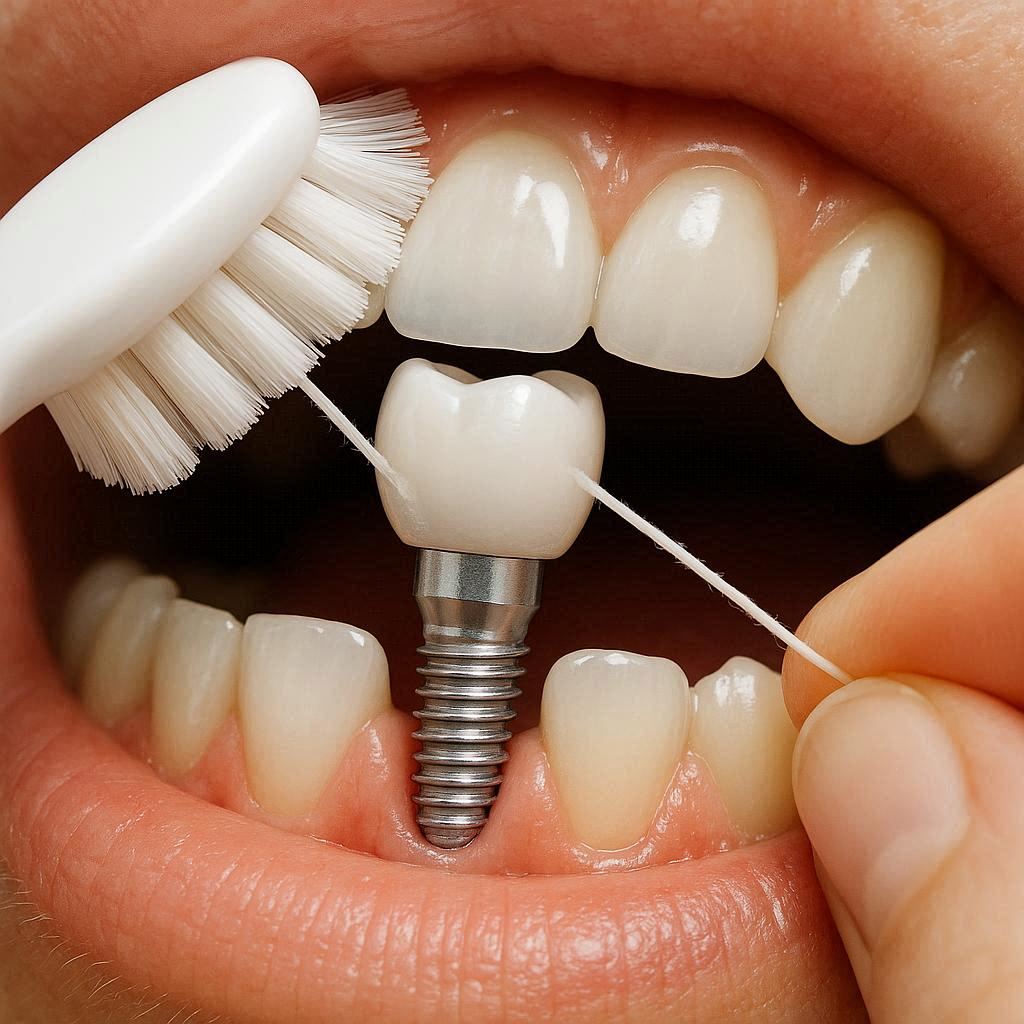
A single implant crown is the simplest to maintain, but its location can present specific challenges. The key instrument here is a curved interdental brush. The space between the implant and the natural tooth is often delicate. You must navigate the concavity on the implant crown’s side. A straight brush often misses this hidden zone of plaque accumulation. Select a brush with a bendable handle, allowing you to angle the bristle head to perfectly kiss the curved surface. Insert the brush, and after a few cleaning strokes, use a small dental mirror to inspect the back side of the implant. Access from the tongue side with the brush ensures a full 360-degree clean.
Maintaining Implant-Supported Bridges
Here, the challenge transforms dramatically. Beneath the span of false teeth connecting two implant crowns lies a void—the pontic area. This surface, resting against the gum ridge, becomes a magnet for food and bacteria. You cannot reach it with a toothbrush from any angle.
The Bridge Care Triad:
- Super Floss: Use this daily. The stiff end threads under the bridge. You then grab the fuzzy, textured portion and pull it into the space. Wrap the fuzzy floss around the undersurface of the pontic, creating a shoe-shine polishing motion. Gently glide it over the gum tissue covering the ridge. This removes the soft, slimy biofilm. Then, use the regular floss segment to clean the sides of the anchor crowns.
- Tapered Interdental Brush: Insert this from both the cheek and the tongue side to sweep the angles where the bridge’s base meets the gum. These corners collect debris that floss can easily miss.
- Irrigation Cannula: A water flosser with a specialized furcation tip gently flushes the entire area from both sides, removing particles liberated but not yet evacuated. The goal is a clean, smooth gum tissue surface, firm and pink, not red and spongy, underneath that bridge.
The Full-Arch, Screw-Retained Prosthesis
Cleaning a fixed, full-arch prosthesis (often called All-on-4 or All-on-6) is the most demanding home-care scenario. The entire arch of teeth, usually made of acrylic or zirconia, sits on a polished metal bar or framework, leaving a space between the prosthesis and the gum tissue. This space is a sanctuary for debris. You are not just maintaining a tooth; you are maintaining the entire polished gingival surface of the prosthesis and the bar.
Your daily weapons for this situation:
- A Variety of Interdental Brush Sizes: The horizontal space under the bridge varies in height. You need a set of brushes and the discipline to insert them from both the outside (cheek) and inside (tongue/palate) to sweep the entire length of the bar. YouTube videos often show a quick sweep of a large brush, but smaller brushes are needed to reach the nooks around small bar attachments.
- Soft-End Tuft Brush: This simple tool has an angled head with a tiny, pointed tuft of soft bristles. It is ideal for accessing the screw-access channels if they are open, or for polishing the facial surface of the prosthesis where it meets the gum.
- Pik Pocket Tip: This specialized tip for your water flosser is made of a soft, flexible rubber. It lets you safely irrigate under the full arch at a very low pressure, inserting the rubber tip slightly under the prosthesis edge to flush out debris. You must apply this meticulous routine every evening without fail. Skipping a day allows mature, calcified deposits to form, which you cannot remove at home. This leads directly to soft tissue inflammation and, over time, the silent, steady loss of the supporting bone.
“Patients with full-arch fixed prostheses must understand that their home care commitment is lifelong and daily. I can clean it perfectly in the office, but the bacteria reform within 24 hours. The patient is the primary care provider; I am simply their backup.”
— A Specialist Prosthodontist’s Honest Advice
Your Professional Maintenance Schedule: A True Partnership
Home care, however perfect, does not replace professional maintenance. Your hygienist has instruments and sightlines you lack. This partnership is your insurance policy.
The Critical Role of Professional Recall
During your professional maintenance appointment, a skilled clinician performs tasks that are impossible at home. They use a periodontal probe to measure the attachment levels around each implant, checking for bleeding or pus. This is the earliest detection system for peri-implant disease—often you will feel nothing. They then debride the area with instruments specifically designed to not scratch the implant abutment. These include plastic or graphite-fiber reinforced plastic scalers and ultrasonic tips with specialized plastic or carbon composite covers. The goal is to fracture and remove hard and soft deposits without altering the titanium surface. A scratched or roughened abutment attracts significantly more bacteria and can accelerate a problem.
After debridement, the hygienist polishes the crown and any exposed abutment with a unique, non-abrasive polishing paste. They then review your home care technique, often using a disclosing solution to show you precisely where you are missing. Your recall interval is not automatically six months. If you have a history of periodontitis or a full-arch prosthesis, a three- or four-month interval is far more prudent. This schedule disrupts the pathogenic bacterial ecosystem before it can inflict irreversible damage.
What Happens During Your Visit: A Transparent View
You arrive, and the hygienist begins with a visual exam of the soft tissues. Any redness, a lack of the characteristic stippling of healthy gum, or swelling is noted in your chart. Probing is performed with a light, controlled force. Recorded numbers and bleeding points establish your baseline. The team then uses the specialized non-metal scalers, often under magnification with loupes, to meticulously scale the implant collar. An air polisher with a subgingival nozzle, delivering a gentle spray of glycine powder and water, is an exceptional tool for removing biofilm below the gumline without harming the titanium. This is painless, rapidly effective, and completely safe for implants when performed correctly. The visit ends with a final polish and an open, honest discussion about any challenges you are facing at home. This is your time to ask for a demonstration or to request a different size interdental brush. Your feedback guides the professional’s guidance.
Lifestyle and Dietary Choices that Safeguard Your Investment
Your implant’s long-term health is not purely mechanical. What you consume and the systemic conditions you manage play a massive, direct role in the chemistry of peri-implant disease.
The Direct Impact of Nutrition
A diet high in refined carbohydrates and sugar fuels the bacteria that produce the acids and toxins directly responsible for inflammation. But the mechanism goes deeper. Chronic exposure to high blood glucose levels, even subclinical spikes, increases the levels of inflammatory cytokines in your gum tissue and sulcular fluid. This makes your peri-implant tissues far more reactive to a smaller quantity of bacterial plaque. Switching to a diet focused on lean proteins, healthy fats, and non-starchy vegetables changes the cellular environment around your implants.
Vitamin C is crucial for collagen synthesis. A deficiency directly weakens the collagen fibers that form the soft tissue seal. Vitamin D is equally critical, not only for bone health but for its role in the production of antimicrobial peptides that strengthen the innate immune response in your mouth. A diet rich in these micronutrients, or supplementation when medically advised, fortifies your defenses from the inside out. Your daily smoothie with greens and seeds acts as both a nutritional win and a meal that requires minimal chewing effort.
Unmasking the Enemy: Tobacco and Alcohol
This section must be blunt. Smoking and vaping are the single greatest risk factor for peri-implantitis. The vasoconstrictive effect of nicotine starves the gum tissue of oxygen and vital nutrients. The heat and chemical compounds physically alter the bacterial flora, selecting for more aggressive, disease-causing strains. Furthermore, nicotine suppresses your immune system’s ability to fight infection at the implant site. The data are stark and undisputed: smokers face a significantly higher implant failure rate, particularly in the upper jaw. Vaping, with its carrier fluids and nicotine content, creates an equally hostile environment, drying the mouth and reducing the protective flow of saliva.
A committed smoking cessation program is the most powerful single action a smoker can take to save their implant investment. Heavy alcohol consumption also compromises healing and defense. Alcohol dehydrates the oral cavity, decreasing salivary flow. Saliva is your mouth’s natural irrigant and buffering system. With less saliva, bacteria adhere more rapidly, and the pH drops into a dangerously acidic range that favors the growth of destructive microbes. While the occasional glass of wine may not cause direct harm, daily or heavy consumption chronically alters the intraoral environment for the worse. Moderation is not just a word; it is a protective strategy.
Condition-Specific Advice: Diabetes, Arthritis, and More
Diabetes: Uncontrolled blood glucose is a direct pipeline to peri-implant destruction. The relationship is linear; the higher your HbA1c levels, the greater the concentration of inflammatory markers in your gum fluid. This creates a highly accelerated, exaggerated response to even a small biofilm accumulation. Your strategy requires absolute dedication to your physician’s protocol for blood sugar management. During life events that cause stress or illness, your blood sugar may fluctuate. Increase your oral vigilance during these periods. A water flosser becomes an even more critical tool, and a four-month professional recall becomes a necessity, not a suggestion.
Rheumatoid Arthritis and Other Autoimmune Conditions: The medications for these conditions can be a double-edged sword. Steroids and disease-modifying antirheumatic drugs (DMARDs) can suppress the immune system, reducing the body’s ability to combat bacterial challenges at the implant site. Additionally, some patients with arthritis in the hands, knuckles, or shoulders struggle with manual dexterity. Simple adjustments are game-changing. A power toothbrush eliminates the need for fine motor control. Enlarging the handle of your interdental brushes with a foam tube or a bicycle handle grip provides the leverage needed to clean effectively. Rubber-handled floss holders pre-threaded with PTFE floss are a gift for those with difficulty reaching the back of their mouth.
Troubleshooting Common Implant Cleaning Challenges
You will face obstacles. The outcome depends not on avoiding them but on how you respond. These solutions tackle the most common issues head-on.
When Gum Tissue Bleeds Around an Implant
Do not stop cleaning the area. This is the most frequent and serious mistake. A common, intuitive reaction to bleeding is to avoid the site, thinking it needs to rest. The opposite is true. Bleeding indicates an accumulation of biofilm that has triggered an inflammatory response. The only cure is more meticulous, not less, disruption of that biofilm.
Immediately increase your use of the water flosser to flush the area twice daily for 7 to 10 days. Buy a smaller, finer interdental brush that can reach deeper into the pocket. After a week of this intensive, perfect cleaning, the bleeding will stop if the problem is mucositis. If it persists or if the gum is swollen, throbbing, or producing pus, you need an immediate professional assessment. This is a potential peri-implantitis flare-up that requires professional intervention.
How to Deal with Visible Metal Threads (Recession)
Exposed implant threads represent an aesthetic and health emergency. While the gum tissue on the bone side may have receded, this does not automatically mean the implant is failing. However, the roughened, microscopically detailed titanium surface designed for osseointegration is now exposed to the oral environment. This surface is a powerful magnet for bacteria and calcified plaque, and it is exceptionally difficult for you to clean. You cannot polish it smooth.
Your immediate task is to prevent calculus from forming on the threads.
- Wrap the exposed threads carefully with a piece of PTFE floss, using a delicate C-shape to wipe the surface from the gum downward to the crown edge.
- Use a soft, single-tuft brush to gently clean the area without aggressively traumatizing the tissue.
- Schedule a visit with your specialist. They may need to polish the threads in the clinic with a specialized diamond bur under irrigation, creating a smooth surface that resists plaque. In some cases, a soft tissue graft can re-cover the threads once the surface is decontaminated. Do not ignore this; it will not self-correct.
The Odor and Bad Taste Mystery
A persistent bad taste or odor around an implant, even after thorough cleaning, screams an anaerobic bacterial infection hidden deep within the pocket. Food impaction in the area around the implant connection—a micro-gap where the crown connects to the implant abutment—can also decompose, releasing sulfurous smells.
Your approach involves three steps. First, disrupt the reservoir. Fill your water flosser reservoir with an antimicrobial mouthwash diluted by one-quarter to one-half with water. Use the soft rubber tip on a very low setting to irrigate the pocket gently, aiming to flush out the sulfur-producing bacteria. Second, polish the hidden surface. A spiraled interdental brush coated in non-abrasive gel toothpaste can be slowly inserted and rotated to wipe the internal aspect of the crown margin. Third, seek an appointment for a possible assessment of a loose screw. A loose prosthetic screw creates a microscopic pump, drawing fluid and bacteria in and out during chewing, creating a persistent, unhygienic environment. The dentist tightens the screw to a specific torque value, a fix that provides immediate relief.
Comparative Product Analysis: Choosing Brands Wisely
The market is saturated with promises. Making an informed choice based on features and safety, not marketing, saves you money and protects your health. This is a practical breakdown of what to seek and what to sidestep.
Electric Toothbrush Showdown: Oscillating-Rotating vs. Sonic
Both technologies are superior to a manual brush. The choice often comes down to personal preference and specific anatomy.
| Feature | Oscillating-Rotating (e.g., Oral-B iO) | Sonic (e.g., Philips Sonicare) |
|---|---|---|
| Primary Action | The small, round brush head mechanically oscillates and pulsates to “micro-sweep” each tooth. | Oblong brush head vibrates at high frequency, creating fluid dynamic forces and shear stress. |
| Best Advantage for Implants | The 360-degree round head perfectly cups around a single implant, cleaning all sides of the crown simultaneously. | The fluid dynamics can disrupt biofilm up to 4mm beyond the bristle tips, an advantage for hard-to-reach narrow pockets. |
| Technique Requirement | Requires precise placement, pausing for seconds on each implant’s three surfaces. | More forgiving technique; the sweeping motion along the arch allows the fluid action to work. |
| Pressure Sensor | Critical models feature a light-up pressure sensor that slows the motor, preventing harmful over-pressure. | Many models have a pressure sensor that alerts you via sound and handle vibration. |
| Ideal Patient Profile | Those who want the feeling of targeted polishing on each crown and who prefer a systematic, tooth-by-tooth approach. | Those with dexterity issues or larger areas of gum recession, and those who prefer a smoother, less ticklish sensation. |
For implant patients, the most critical internal feature is a smart pressure sensor. Over-brushing, clinically known as abrasion, causes gum recession and notching of the crown’s margin. Let the sensor guide you to a light touch.
Water Flosser Feature Face-Off: Countertop vs. Cordless
A water flosser is not an optional luxury; it is vital equipment. This table dissects the format choice.
| Feature | Countertop Model (e.g., Waterpik Aquarius) | Cordless Model (e.g., Waterpik Cordless Advanced) |
|---|---|---|
| Power & Pressure Range | Higher power, with a wider, ultra-fine pressure dial for precise, gentle settings essential for peri-implant tissue. | Lower power ceiling; limited to a few pressure settings. Often requires recharging more frequently. |
| Reservoir Size | Large tank allows for a continuous, uninterrupted 90-second+ cleaning session without refilling. | Small internal reservoir; may require a pause and refill for a full-mouth clean, losing your meditative flow. |
| Portability | Stationary unit designed for the bathroom counter. | Portable and waterproof, ideal for travel or small bathrooms. |
| Tip Selection | Comes with a full suite of specialized tips including the all-important Pik Pocket and Plaque Seeker tips. | Includes essential tips, but the full range of specialized implant and periodontal tips must often be purchased separately. |
| Verdict | Best for a serious, non-negotiable nightly protocol. The full power control makes it the gold standard for home periodontal care. | A solid secondary unit for travel and midday use. Not as powerful or controllable for the primary deep clean. |
The Interdental Brush Brand Gauntlet
Your choice here comes down to wire coating, bristle retention, and handle ergonomics.
- TePe: This brand is frequently cited in clinical studies for good reason. The bristles are firmly set in a plastic-coated wire core, eliminating the risk of scratching titanium. The long, flat handle provides excellent grip for those with dexterity challenges. Their new “TePe EasyPick” is a silicone-coated marvel, combining the cleaning power of a brush with the flexibility and comfort of a rubber pick, particularly useful for tight spaces.
- GUM Proxabrush Go-Betweens: Recognized for their tapered “triangular” bristle shape, which many find intuitively cleans the triangular implant embrasure space more thoroughly than a conical brush. The wire is also coated.
- Curaprox CPS: Known for their ultra-fine, dense bristle filaments. This high-density design means more individual filaments are contacting the implant surface per stroke, increasing the efficiency of biofilm removal. The surgical steel wire core is insulated with a thick surgical wire coating.
Avoid store-brand brushes with uncoated, twisted wire. A simple test: run the wire against the side of a hard plastic cup. If it makes a slight scratching sound, it is too abrasive to use on a metal or ceramic implant abutment.
Debunking Myths and Avoiding Fatal Mistakes
Misinformation destroys more implants than neglect. These persistent myths, disguised as common sense, must be corrected.
Myth: “The implant is artificial, so I can’t get cavities and don’t have to clean as much.”
This is the most destructive falsehood. You are correct that the crown cannot develop a cavity. However, the biofilm that forms around the implant root devastates the living bone and gum tissue that hold it in place. The word “cavity” is absent; the condition is “peri-implantitis,” and its consequence is not a filling but the catastrophic mechanical loss of the entire implant. You clean an implant more meticulously than a natural tooth because it lacks the biological defenses of a natural tooth.
Myth: “Hard tools are fine for a thorough job.”
You must never use a metal scaler, a darning needle, a safety pin, or any other metallic household object to clean around an implant. The titanium oxide surface layer is biocompatible and passive. Scratching it with steel or a hard plastic exposes reactive titanium, creates microscopic ledges for calculus, and permanently compromises the seal. Your tools are soft: nylon bristles, PTFE floss, plastic-coated wires, and rubber stimulators. Leave the curative hard instruments to your clinician.
Myth: “Bleeding means I should floss less.”
As discussed earlier, the bleeding gum is like a fire alarm. The correct response is not to disconnect the alarm but to put out the fire. Bleeding is a clinical sign of biofilm left undisturbed. You must methodically, gently, and thoroughly clean the affected area every day until the tissue becomes pink and resilient again. Retreat is not an option; refined technique is.
Myth: “A strong, alcohol-based mouthwash provides the best clean.”
An alcohol-containing mouthwash dries the mouth by causing epithelial cell desquamation. This creates a superficial layer of dead, sloughing cells that serve as a food source for bacteria, leading paradoxically to more bad breath and a higher plaque index. The daily burn you feel is not cleaning; it is tissue damage. A non-alcoholic, pH-neutral rinse supports, rather than destroys, the biological environment you work so hard to maintain.
Your Long-Term Maintenance Calendar
Predictable care relies on a rhythm—a structured schedule that removes the burden of guessing. Use this calendar as your template.
Daily (Non-Negotiable):
- AM: Gentle water floss, light brushing.
- PM (Main Event): Pre-rinse, full water floss with sulcus-tracing, interdental brushing and flossing sequence, systematic two-minute power brushing, therapeutic rinse.
Weekly:
- Inspect your interdental brushes for frayed bristles or bent wires. Replace them. A worn tool is a useless tool.
- Deep clean your water flosser reservoir to prevent fungal and mineral buildup. Run a solution of one part white vinegar and one part water through the unit, followed by a clear water rinse cycle.
Monthly:
- Replace your power toothbrush head. If the indicator bristles have faded, do it immediately. An efficient brush is defined by its bristle stiffness and resistance to splaying.
- Check your floss supply and ensure you are not down to your last few shreds of Super Floss. Anticipate your needs.
Quarterly (Every 3 Months):
- Professional hygiene appointment if you are a heavy builder of calculus or have a history of peri-implantitis.
Biannually (Every 6 Months):
- Minimum professional hygiene appointment and implant integrity check, including a full periodontal charting and radiographic comparison if indicated.
- Review and replenish your entire home-care toolkit. Old plastics can become brittle and harbor bacteria in micro-cracks.
Conclusion
Mastering the art of cleaning dental implants transforms a complex medical device into a seamless, lifelong part of your body. The daily ritual of soft-bristled precision, specialized interdental tools, and gentle irrigation builds an impenetrable fortress against the bacterial invasion that causes peri-implant disease. This commitment, conducted with patience in your own bathroom, is the single most powerful variable determining whether your bone support remains stable for decades or crumbles silently away. In the end, your investment of just a few focused minutes each day rewards you not just with a beautiful smile, but with the profound confidence of a foundation that is truly permanent.
FAQ: Your Pressing Implant Cleaning Questions Answered
Q1: Can I use a whitening toothpaste on my implant crown?
No. Whitening toothpaste contains abrasive silica and chemical agents designed to scrub stains from enamel. On an implant crown, these abrasives create micro-scratches, causing the porcelain or zirconia to lose its polished glaze and attract more stain and bacteria over time. Choose a low-abrasion gel toothpaste instead.
Q2: My implants feel fine, and my gums don’t hurt. Can I extend my professional cleaning visits to once a year?
This is a dangerous strategy. Peri-implantitis is often a “silent” disease in its early stages, meaning it causes no pain until significant bone loss has occurred. The probing and radiographic assessment during a professional 6-month (or 3-month) visit detects these changes when they are still manageable.
Q3: Is it safe to use a water flosser if my implant was just placed last week?
No. You must follow your surgeon’s specific post-operative protocol. In the initial healing phase of osseointegration (typically the first 3-4 months), you must avoid directing any pressure onto the gums above the healing implant. Cleaning during this phase often involves a soft brush and prescribed chlorhexidine rinses. Wait for your dentist’s clearance before initiating water flossing.
Q4: Can I use a regular electric toothbrush head, or must it be a special implant brush head?
You generally do not need a special “implant” brush head label. The universal criteria are: soft or extra-soft bristles and a small, compact head. These two features are sufficient. The pressure sensor on your brush body is more critical than the head’s marketing name.
Q5: There is a small, dark gap between my implant crown and the gum. Is this normal?
This space, known as the sulcus, is normal and necessary to a depth of 2-3mm. However, if it appears dark because calculus is accumulating, if the space has suddenly deepened, or if it bleeds or weeps fluid, it is not normal. This requires a professional evaluation to measure the cuff depth and assess for early peri-implantitis.
Additional Resource:
For a deeper scientific dive into the current gold-standard treatment of peri-implant diseases, visit the European Federation of Periodontology (EFP) resource page: https://www.efp.org/for-patients/gum-disease-general-health/peri-implant-disease/
Disclaimer: This article provides an educational guide on maintaining dental implants. The techniques and product recommendations are for general informational purposes and do not constitute professional dental advice. Cleaning protocols may require modification based on your specific restoration type and medical history. Always follow the customized home-care plan prescribed by your dentist or periodontist. Do not deviate from post-operative instructions provided by your surgical team.