How To Create Flap In Dental Implant?
Dental implant placement is a surgical procedure that requires precision and skill. One of the critical steps in the procedure is creating a flap, which involves making an incision in the gum tissue to expose the underlying bone. This step provides the surgeon with access to the implant site.
This guide explains how a flap is created during dental implant surgery. While this information is educational, it is important to understand that dental implant surgery should only be performed by trained professionals.
Understanding Flaps in Dental Implant Surgery
A flap is a section of gum tissue that is surgically lifted to expose the underlying bone. Creating a flap allows the surgeon to see the implant site clearly and place the implant accurately.
Why Flaps Are Used
Flaps provide several advantages during implant surgery. They allow direct visualization of the bone, which helps the surgeon avoid important structures like nerves and blood vessels. Flaps also provide access for bone preparation and implant placement.
Flap vs. Flapless Surgery
Some implant procedures use a flapless technique, where the implant is placed through a small hole in the gum without making a large incision. Flapless surgery is less invasive but requires precise planning and is not suitable for all cases.
The Flap Creation Process
Creating a flap involves several precise steps. Here is what happens during the procedure.
Step One: Anesthesia
Before the incision is made, the area is thoroughly numbed with local anesthesia. This ensures the patient feels no pain during the procedure.
Step Two: Incision Design
The surgeon plans the incision carefully. The incision is designed to provide adequate access to the implant site while preserving blood supply to the gum tissue. Several incision designs are used, depending on the location and complexity of the case.
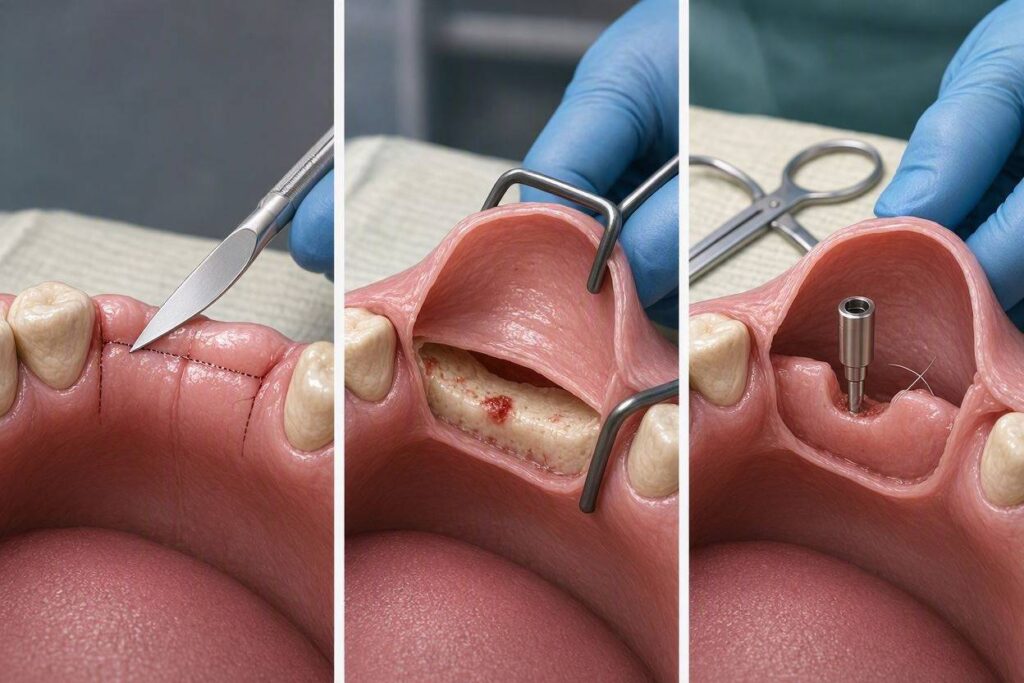
Step Three: Making the Incision
Using a scalpel, the surgeon makes a precise incision through the gum tissue. The incision typically follows the contour of the ridge where the implant will be placed.
Step Four: Elevating the Flap
After the incision, the surgeon uses a periosteal elevator to gently lift the gum tissue away from the bone. This creates a flap that can be folded back to expose the surgical site.
Step Five: Exposing the Bone
With the flap elevated, the underlying bone is now visible. The surgeon can assess the bone quality and proceed with implant site preparation.
Types of Flaps Used in Implant Surgery
Several types of flaps are used in dental implant surgery, depending on the specific case.
Crestal Incision
A crestal incision is made along the top of the bony ridge where the implant will be placed. This is the most common type of incision for implant placement.
Sulcular Incision
A sulcular incision is made in the gum sulcus, the space between the tooth and the gum. This type of incision is used when teeth are adjacent to the implant site.
Vertical Releasing Incisions
Vertical releasing incisions are made perpendicular to the main incision. They provide additional access for larger flaps. These incisions are used when more exposure is needed.
Full-Thickness Flap
A full-thickness flap involves lifting the gum tissue along with the periosteum, the thin layer covering the bone. This provides complete exposure of the bone.
Partial-Thickness Flap
A partial-thickness flap lifts only the gum tissue, leaving the periosteum attached to the bone. This type of flap is used in specific situations.
After the Flap Is Created
Once the flap is created and the bone is exposed, the surgeon proceeds with the implant placement.
Implant Site Preparation
The surgeon drills a hole into the bone at the precise location for the implant. The hole is gradually enlarged to the correct size.
Implant Placement
The implant post is inserted into the prepared site. The surgeon checks the position and stability of the implant.
Flap Closure
After the implant is placed, the flap is repositioned over the surgical site. The surgeon uses sutures to close the incision.
Healing
The gum tissue heals over the following weeks. If the implant was placed using a two-stage technique, the implant is left covered and a second surgery is needed to expose it later.
Why Precision Matters
Creating a flap is a delicate procedure that requires precision and skill.
Blood Supply Preservation
The flap must be designed to preserve blood supply to the gum tissue. If the blood supply is compromised, the tissue may not heal properly.
Avoiding Important Structures
The surgeon must avoid important structures like nerves and blood vessels when making the incision. This requires detailed knowledge of the anatomy.
Proper Flap Closure
The flap must be closed properly to ensure good healing. Improper closure can lead to complications like infection or implant exposure.
Flapless Implant Surgery
As mentioned earlier, some implant procedures use a flapless technique.
How Flapless Surgery Works
In flapless surgery, the surgeon uses a small punch to create a hole in the gum tissue. The implant is placed through this hole without making a large incision.
Advantages of Flapless Surgery
Flapless surgery is less invasive, causes less bleeding, and has a faster recovery time. It also preserves more of the gum tissue.
Limitations
Flapless surgery requires precise planning using 3D imaging. It is not suitable for cases where bone grafting is needed or where the bone anatomy is complex.
Important Notes for Patients
- Dental implant surgery should only be performed by trained professionals.
- Creating a flap is a delicate step that requires precision.
- The type of flap used depends on the specific case.
- Flapless surgery is less invasive but not suitable for all patients.
- Proper flap closure is essential for good healing.
- Follow your dentist’s post-operative instructions carefully.
Frequently Asked Questions
Is creating a flap painful?
No, the area is numbed with local anesthesia before the incision is made. You should feel no pain during the procedure.
How long does it take for the flap to heal?
The gum tissue typically heals within two to four weeks after surgery. Full healing may take longer.
Can I eat after flap surgery?
You should stick to soft foods for the first few days after surgery. Avoid hot, spicy, or hard foods that could irritate the surgical site.
What is the difference between a full-thickness and partial-thickness flap?
A full-thickness flap includes the periosteum, while a partial-thickness flap leaves it attached to the bone. The choice depends on the specific case.
Is flapless surgery better than traditional flap surgery?
Flapless surgery is less invasive and has a faster recovery, but it is not suitable for all cases. Your dentist will determine the best approach for your situation.
What happens if the flap does not heal properly?
Improper healing can lead to complications like infection or implant exposure. Contact your dentist if you notice signs of problems.
How are sutures removed after flap surgery?
Sutures are typically removed one to two weeks after surgery. The removal is quick and painless.
Can I brush my teeth after flap surgery?
You should avoid brushing the surgical site for the first few days. Your dentist will provide specific instructions on oral hygiene during healing.
Conclusion
Creating a flap is an essential step in dental implant surgery. It involves making a precise incision in the gum tissue and elevating it to expose the underlying bone. Several types of flaps are used depending on the case. The flap provides access for implant placement and is then closed with sutures. Flapless surgery is an alternative for some patients. Dental implant surgery should only be performed by trained professionals who understand the anatomy and techniques involved.
Additional Resource
For more information on dental implant procedures, visit the American Academy of Implant Dentistry at www.aaid.com. This professional organization offers patient education resources on implant treatment.