Is Infuse Bone Graft Human Tissue?
You sit in the dental chair, and your periodontist or oral surgeon explains that you need a bone graft before an implant can be placed. The bone in your jaw has resorbed since your tooth was lost, and there is not enough volume to support the implant securely. The surgeon recommends a product called Infuse Bone Graft. You nod, but a question forms in your mind: what exactly is this material, and where does it come from? Is it human tissue, taken from a donor? Is it something synthetic, manufactured in a laboratory? The answer matters for your peace of mind, your religious or ethical considerations, and your understanding of the procedure you are about to undergo.
Infuse Bone Graft is not human tissue. It is a manufactured product that combines a genetically engineered human protein with a bovine-derived collagen sponge carrier. No human donor tissue is used in its production. Understanding what Infuse is, how it works, and how it differs from other bone graft materials helps you make an informed decision about your treatment.
What Is Infuse Bone Graft?
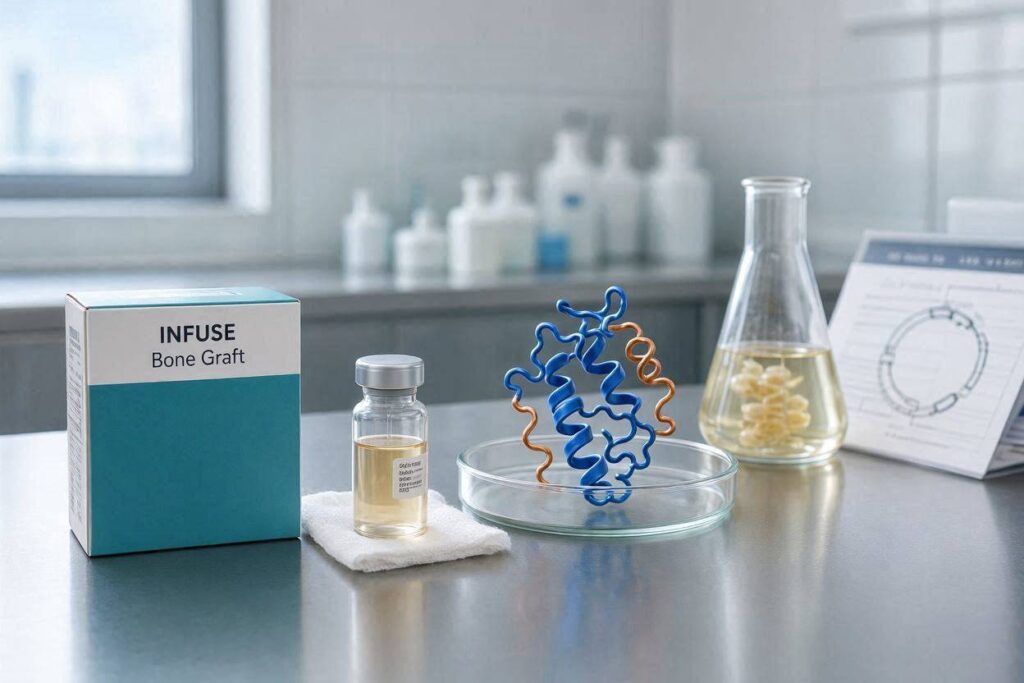
Infuse Bone Graft is a medical device used to stimulate bone growth. It consists of two components that work together: recombinant human bone morphogenetic protein-2, abbreviated as rhBMP-2, and an absorbable collagen sponge carrier. The product is manufactured by Medtronic and has been approved by the U.S. Food and Drug Administration for specific spinal, orthopedic, and dental applications.
The Active Ingredient: rhBMP-2
Bone morphogenetic proteins are a family of naturally occurring proteins in the human body that play a central role in bone formation and healing. They are involved in the developmental processes that form the skeleton before birth and in the repair processes that heal fractures and surgical sites throughout life.
BMP-2 is one specific member of this protein family. It is a powerful signaling molecule that instructs nearby stem cells to become bone-forming cells called osteoblasts. When BMP-2 is present at a sufficient concentration, it triggers a cascade of cellular events that results in the formation of new, living bone.
The rhBMP-2 in Infuse is recombinant human BMP-2. “Recombinant” means the protein is produced using genetic engineering techniques. Scientists insert the human gene that codes for BMP-2 into cultured cells, typically Chinese hamster ovary cells. These cells then act as miniature factories, producing the BMP-2 protein. The protein is harvested, purified, and processed into the final product.
This manufacturing process means the BMP-2 is human in the sense that it is chemically identical to the protein your own body produces, but it is not sourced from human tissue. No human donors are involved. The protein is made in a laboratory under controlled conditions, ensuring purity, consistency, and freedom from the risks associated with donor tissue.
The Carrier: Absorbable Collagen Sponge
BMP-2 on its own would quickly wash away from the surgical site if simply injected as a liquid. It needs a carrier to hold it in place and release it gradually over time. Infuse uses an absorbable collagen sponge as this carrier.
The collagen in the sponge is derived from bovine, meaning cow, sources. It is highly purified Type I collagen, the same type of collagen that forms the organic framework of human bone. The sponge is biocompatible, meaning the body accepts it without a significant immune reaction. Over time, the sponge is resorbed and replaced by the patient’s own tissue.
The sponge is soaked with the rhBMP-2 solution at the time of surgery. The surgeon places the saturated sponge at the site where bone growth is desired. The sponge holds the protein in place, and as the sponge gradually breaks down, the BMP-2 is released, stimulating the patient’s own cells to form new bone.
How Infuse Differs from Other Bone Graft Materials
Bone graft materials fall into several categories based on their source. Understanding these categories clarifies why the question of human tissue origin matters and how Infuse compares to alternatives.
Autograft
Autograft is bone taken from the patient’s own body. It is harvested from one site, such as the hip, the tibia, or the chin, and transplanted to another site where bone is needed. Autograft is considered the gold standard because it contains the patient’s own living bone cells, growth factors, and a mineral scaffold. It is human tissue, but it is the patient’s own, eliminating any risk of disease transmission or immune rejection.
The disadvantages of autograft include the need for a second surgical site, which means additional pain, longer recovery, and the potential for complications at the donor site. There is also a limited amount of bone that can be harvested.
Allograft
Allograft is bone taken from a human donor, typically a cadaver. It is processed by tissue banks to remove cells and reduce the risk of disease transmission. Allograft provides a mineral scaffold that the patient’s own cells can populate and remodel. It is human tissue from another person.
Allograft has the advantage of being available in unlimited quantities without a donor site in the patient. The disadvantages include a very small risk of disease transmission despite rigorous screening and processing, the absence of living bone cells, and for some patients, religious or personal objections to receiving tissue from a deceased donor.
Xenograft
Xenograft is bone or bone-derived material taken from another species. The most common xenograft materials in dentistry are derived from bovine bone. These materials are processed to remove all organic components, leaving a mineral scaffold that is biocompatible and gradually replaced by the patient’s own bone.
Xenografts eliminate the risk of human disease transmission and provide an unlimited supply. Some patients object to the use of animal-derived materials on religious or ethical grounds, though others prefer xenografts specifically because they avoid human donor tissue.
Alloplast
Alloplasts are synthetic bone graft materials manufactured entirely in a laboratory. They include calcium phosphates, hydroxyapatite, bioactive glasses, and polymers. These materials contain no human or animal tissue. They serve as a scaffold for the patient’s own bone to grow into and are gradually resorbed or integrated.
Alloplasts eliminate all concerns about disease transmission and donor sourcing. Their disadvantage is that they lack the growth factors present in autografts and some allografts, which limits their ability to actively stimulate bone formation.
Where Infuse Fits
Infuse occupies a unique category. It combines a recombinant growth factor, which actively stimulates bone formation, with a bovine collagen carrier, which provides a scaffold. It is not human tissue. It is a manufactured product that uses human-identical protein produced in a laboratory. The protein itself is the active signal for bone formation. The collagen carrier is animal-derived and serves as the delivery vehicle.
| Graft Type | Source | Contains Living Cells? | Contains Growth Factors? | Disease Transmission Risk |
|---|---|---|---|---|
| Autograft | Patient’s own body | Yes | Yes | None |
| Allograft | Human donor | No | Minimal | Extremely low |
| Xenograft | Animal (usually bovine) | No | No | None (prion risk theoretical) |
| Alloplast | Synthetic | No | No | None |
| Infuse | Recombinant protein + bovine collagen | No | Yes (rhBMP-2) | None |
The Dental Applications of Infuse Bone Graft
Infuse is used in oral and maxillofacial surgery for several specific indications. Understanding these applications helps you understand why your surgeon might recommend it.
Sinus Floor Augmentation
When upper posterior teeth are lost, the maxillary sinus, an air-filled cavity above the roots of those teeth, often expands downward into the space where the roots used to be. This leaves insufficient bone height for implant placement. Sinus floor augmentation, also called a sinus lift, raises the sinus membrane and places bone graft material into the space created.
Infuse is FDA-approved for sinus augmentation. The rhBMP-2 stimulates the patient’s own cells to form bone within the sinus, eliminating the need for harvesting autogenous bone from a second surgical site. Studies have shown that Infuse can produce bone of sufficient quality and quantity to support dental implants.
Alveolar Ridge Augmentation
After tooth extraction, the alveolar ridge, the bony ridge that holds the teeth, resorbs over time. When the ridge has lost significant height or width, it must be rebuilt before implants can be placed. Infuse can be used to stimulate bone formation in these deficient ridges, either at the time of extraction to preserve the ridge or later to augment an already resorbed ridge.
Other Oral and Maxillofacial Uses
Infuse has been used in other oral surgical procedures, including the reconstruction of large jaw defects resulting from trauma, tumor removal, or congenital conditions. Its ability to stimulate robust bone formation makes it valuable in situations where large volumes of bone are needed and harvesting the patient’s own bone would be impractical or excessively morbid.
Safety and Regulation
Infuse Bone Graft is a regulated medical device. The FDA approved it for specific indications after reviewing clinical trial data on safety and effectiveness. The manufacturing process is subject to rigorous quality control to ensure the purity and potency of the rhBMP-2 and the sterility of the collagen sponge.
Known Risks and Controversies
Infuse has been the subject of controversy, particularly in spinal surgery, where it has been used extensively. Complications reported with spinal use include excessive bone growth, swelling, and in rare cases, serious adverse events related to inflammation. The dental applications use much smaller doses of rhBMP-2, and the complication profile appears to be different and generally less severe.
The primary risks associated with dental use of Infuse include swelling and inflammation at the surgical site, which can be significant in the first few days after surgery. There is a potential for ectopic bone formation, bone growing where it is not desired, if the material migrates. The surgeon’s technique in containing the material is important to minimize this risk.
Infuse is contraindicated in patients with known hypersensitivity to any component of the product, including bovine collagen. It should not be used in patients with active infection at the surgical site or in patients who are skeletally immature, as the effects on growing bone are not known.
Addressing Patient Concerns
Patients considering bone graft surgery often have specific concerns about the materials that will be placed in their bodies. These concerns deserve respect and clear answers.
Religious and Ethical Considerations
For patients whose religious beliefs prohibit the use of human cadaveric tissue, Infuse may be an acceptable alternative because it contains no human donor tissue. The recombinant BMP-2 is a laboratory-manufactured protein, not material harvested from a deceased person.
For patients who follow vegetarian or vegan lifestyles, or whose religious beliefs prohibit the use of bovine products, the bovine collagen sponge component of Infuse may be problematic. In these cases, alternative graft materials, such as fully synthetic alloplasts, may be more appropriate. Patients should discuss these concerns openly with their surgeon, who can recommend a graft material that aligns with their values.
Disease Transmission Concerns
Patients who are concerned about the transmission of infectious diseases from donor tissue may prefer Infuse over allograft because the recombinant protein and bovine collagen carry no risk of human disease transmission. The manufacturing process for the recombinant protein occurs in controlled laboratory conditions, and the bovine collagen is sourced from herds maintained for medical product production and tested for safety.
Cost Considerations
Infuse is more expensive than many other bone graft materials. The cost of the product reflects the complexity of manufacturing a recombinant human protein. Insurance coverage for Infuse varies. Some plans cover it for FDA-approved indications, while others consider it investigational for off-label uses. Patients should discuss the cost and their insurance coverage with their surgeon and their insurance provider before surgery.
The Surgical Procedure with Infuse
Knowing what to expect during and after surgery with Infuse helps reduce anxiety and prepare for recovery.
During Surgery
The surgeon prepares the Infuse at the time of surgery. The vial of rhBMP-2 powder is reconstituted with sterile water. The collagen sponge is cut to the appropriate size and soaked with the reconstituted solution. The sponge is then placed at the graft site. The surgical site is closed with sutures, and the sponge remains inside, held in place by the overlying soft tissue.
Post-Operative Course
Swelling is a predictable response to rhBMP-2. The protein induces an inflammatory reaction as part of its mechanism of stimulating bone formation. Patients should expect more swelling than they would experience with a graft that does not contain growth factors, such as an allograft or xenograft alone. The swelling peaks within the first few days and then gradually subsides.
Pain management with appropriate medications, cold compresses, and head elevation helps manage the post-operative period. The surgeon provides specific instructions tailored to the procedure and the patient’s needs.
Bone Formation Timeline
The rhBMP-2 begins stimulating the patient’s stem cells to become bone-forming cells immediately. New bone formation is visible on radiographs within several months. The collagen sponge is gradually resorbed over weeks to months. The new bone continues to mature and strengthen over the course of six to twelve months. Dental implants are typically placed after the graft has matured sufficiently, which is usually four to nine months after the grafting procedure.
Conclusion
Infuse Bone Graft is not human tissue. It is a manufactured medical device consisting of recombinant human bone morphogenetic protein-2, a genetically engineered protein produced in a laboratory, delivered on an absorbable collagen sponge derived from bovine sources. No human donor tissue is used in its production. Infuse stimulates the patient’s own cells to form new bone, offering an alternative to autograft harvested from the patient’s body and to allograft sourced from human donors. Its use in dental applications, including sinus augmentation and ridge augmentation, is supported by clinical evidence, though patients should discuss the benefits, risks, costs, and material sourcing with their surgeon to ensure the graft choice aligns with their medical needs and personal values.
FAQ
Is Infuse Bone Graft made from cadavers?
No. Infuse contains no human cadaveric tissue. The active ingredient is a recombinant protein manufactured in a laboratory, and the carrier is bovine collagen. No human donors are involved in the production of Infuse.
Can Infuse Bone Graft transmit diseases?
The risk of disease transmission from Infuse is negligible. The recombinant protein is produced under controlled laboratory conditions, and the bovine collagen is sourced from herds maintained for medical production. There is no risk of transmitting human infectious diseases because no human tissue is used.
Is Infuse safe for dental use?
Infuse is FDA-approved for specific dental applications, including sinus augmentation and alveolar ridge augmentation. When used by a qualified surgeon for approved indications, it has a favorable safety profile. The primary side effect is post-operative swelling, which is an expected part of the bone-formation process.
How long does it take for bone to form with Infuse?
New bone formation begins within weeks of the procedure. The bone becomes sufficiently mature for dental implant placement typically within four to nine months, though this timeline varies based on the size of the graft and individual healing factors.
Does Infuse contain animal products?
Yes. The collagen sponge component of Infuse is derived from bovine sources. Patients who avoid animal products for religious, ethical, or dietary reasons should discuss this with their surgeon, who may recommend alternative graft materials.
What is the difference between Infuse and other bone grafts?
Infuse actively stimulates the patient’s own cells to form bone through the action of BMP-2. Most other bone graft materials, such as allograft, xenograft, and alloplast, serve as passive scaffolds that the patient’s bone grows into and replaces over time. Autograft is the only other graft type that contains active growth factors and living cells.
Will my insurance cover Infuse Bone Graft?
Coverage varies by insurance plan. Many plans cover Infuse for its FDA-approved indications, including sinus augmentation. Patients should verify coverage with their insurance provider before surgery. The surgeon’s office can assist with pre-authorization.
Can Infuse be used if I have an allergy to certain materials?
Patients with known hypersensitivity to bovine collagen should not receive Infuse. Patients with allergies to any component of the product should inform their surgeon. Alternative graft materials are available for patients with specific allergies.
Additional Resource
For more information about bone grafting procedures and materials used in dental implant surgery, visit the American Academy of Periodontology at perio.org. The AAP provides patient education resources on periodontal procedures and dental implant preparation.