Is There Discomfort When Implant Fuses With Jaw?
The healing phase after dental implant surgery is a time of anticipation and, often, anxiety. You know a titanium post is in your jawbone. You’ve been told it needs to “fuse to the bone” before you can get your new tooth. Then the question arises, often late at night when you’re alone with your thoughts: Is this fusion painful? Will I feel the bone growing into the implant? The short and reassuring answer is no. The process of osseointegration, the direct structural and functional connection between living bone and the implant surface, is a silent, painless biological event. You do not feel the fusion happening. However, the post-surgical healing of the tissues around the implant does involve some discomfort, and it’s crucial to distinguish this normal, expected soreness from a pain that signals a problem. This article provides a complete guide to what you will and won’t feel while your implant integrates.
The Sensation of Osseointegration: A Silent Symphony
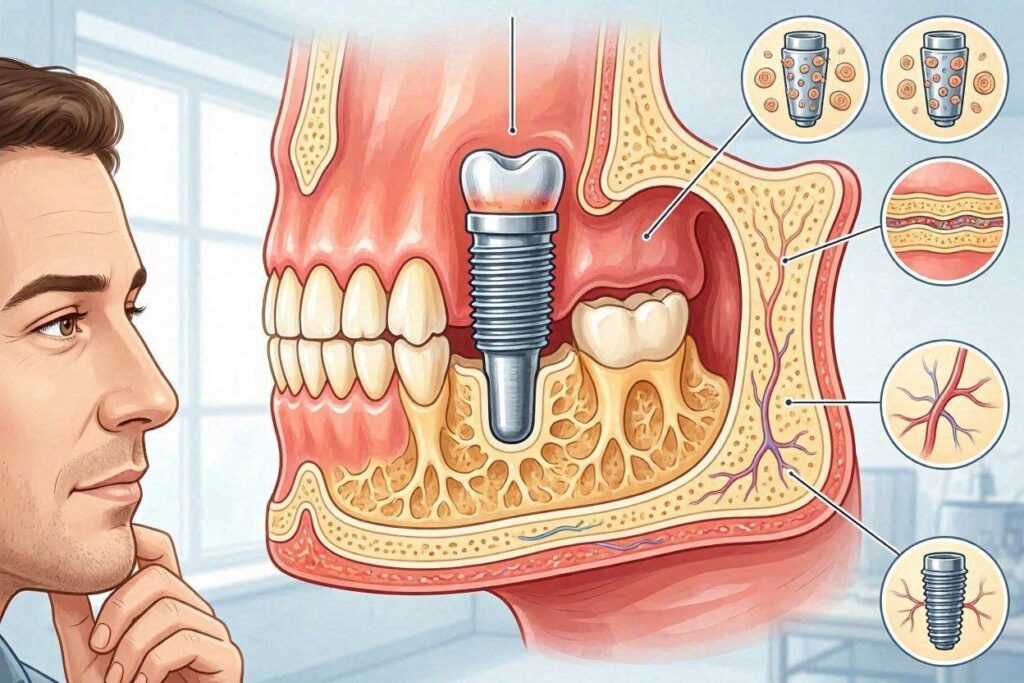
Osseointegration occurs at a cellular and microscopic level. Osteoblasts, the bone-forming cells, migrate to the titanium surface. They lay down a matrix of proteins, which then mineralizes into solid bone. This biological construction project does not involve nerve endings that would send pain signals to your brain. The nerve fibers in bone primarily sense pressure, vibration, and injury, not the slow, orderly deposition of new mineralized tissue. You are no more aware of your implant integrating than you are of your femur remodeling itself after a jog. It is a silent, internal process. The absence of sensation during the fusion phase is one of the hallmarks of a successful, uncomplicated healing period. When everything is going well, you simply forget the implant is there.
Why the Post-Surgery Period Can Be Uncomfortable
If osseointegration itself is painless, what causes the discomfort in the days and weeks after surgery? The answer lies in the soft tissue and bone that were surgically manipulated to place the implant. To insert the post, the surgeon made an incision in your gum, lifted a flap of tissue, and precisely drilled a hole into your jawbone. This is a controlled surgical trauma. The pain and tenderness you feel originate from this incision, the underlying bone healing from the drilling, and the sutures pulling on the gum tissue. This is acute surgical discomfort. It follows a predictable trajectory, peaking within the first 48-72 hours and then steadily declining. It is managed with standard post-operative protocols: ice packs, rest, and prescribed or over-the-counter analgesics like ibuprofen or acetaminophen.
Normal Healing Discomfort: A Timeline of Sensation
Knowing what is “normal” prevents unnecessary worry. Here is a realistic timeline of what a patient typically feels after an uncomplicated single implant surgery.
The First 24 to 72 Hours
This is the acute inflammatory phase. You will feel a dull ache, throbbing, or soreness at the surgical site. The gum tissue is swollen, and there may be minor bleeding. This pain is directly proportional to the extent of the surgery. A flapless, guided surgery on a single site will produce minimal discomfort, often described as mild tenderness. A surgery that required raising a large flap, multiple implants, or bone grafting will produce more significant soreness, swelling, and possibly some bruising of the cheek or jaw. This pain is well-controlled with pain medication. You protect the site, eat a soft diet, and rest. The feeling of tightness from the sutures is normal. This is the peak of the discomfort, and it has nothing to do with the implant integrating; it is pure wound healing.
Days 3 to 7: The Transition
The acute sharpness of the pain subsides. It transitions to a dull, background tenderness, like a bruise. The swelling begins to resolve. The site may feel a bit itchy, which is a classic sign of healing tissue. You become more aware of the physical presence of the implant, especially if a healing cap protrudes through the gum. Your tongue will be drawn to it. This is not pain, but an awareness of a new, hard object in a previously empty or tooth-crowned space. This “tongue awareness” fades as the brain adapts, a process called sensory adaptation, and usually disappears completely within a week or two. By the end of the first week, most patients are off all pain medication and feel largely back to normal, with only localized tenderness to firm pressure over the site.
Weeks 2 to 6: The Quiet Phase
This is the true osseointegration window. The gum has healed over the implant or has sealed tightly around the healing cap. You should feel nothing. The area should not be painful to light touch. There should be no throbbing, no swelling, and no sensation of pressure from within. The site becomes uneventful. You can eat a wider variety of soft foods, being careful not to chew directly on the implant. The absence of any sensation from the implant itself is a very good sign. It signals that the gum is sealed, the bone is stable, and the biological process of fusion is progressing without interference.
Red Flags: Pain That Signals a Problem
While a quiet site is a happy site, certain types of pain are warning signals. They indicate that something is interrupting the healing process and demand immediate professional evaluation.
Persistent, Throbbing Pain (Days 5-10+)
Pain that does not follow the expected trajectory of decreasing intensity is a red flag. If your pain levels were dropping, but then suddenly plateau or increase again around day 4 or 5, this is suspicious for an infection. A true post-operative infection presents as a deep, unrelenting throbbing ache that is not relieved by pain medication. The gum may be more swollen than before, hot to the touch, and you may notice a bad taste or pus discharging from the gum line. This is a bacterial infection, possibly at the bone-implant interface or in the soft tissue. It is not normal healing and requires immediate drainage, debridement, and antibiotics.
Pain on Percussion or Pressure (After Week 2)
Once the initial surgical wound has healed, the implant should not be tender to firm pressure. If, after the second week, you tap gently on the healing cap with a clean finger or your toothbrush, it should feel solid and produce no sharp pain. Pain on axial pressure (pushing down on the implant) or lateral pressure (pushing from the side) is a classic sign of a failing osseointegration. The pain is generated by the movement of the implant within the bone socket, compressing the inflamed fibrous tissue that has formed instead of solid bone. This is a diagnostic sign used by dentists. If an implant is tender to touch and you feel a dull ache when you accidentally bite down in that area, it may be failing to fuse.
Mobility and Associated Pain
A successfully integrating implant is absolutely rigid. Any perceived movement, even a tiny wiggle, is a catastrophic sign. If you can move the implant with your tongue or finger, and this movement is accompanied by a sickening, deep ache, the implant has a fibrous encapsulation. It is a clinical failure. This is often not a sharp, electric pain, but a specific, dull, nauseating sensation of something unstable in the bone. This requires immediate removal.
Neurological Pain: Nerve Impingement
A completely different type of pain is a persistent tingling, burning, electric shock sensation, or complete numbness that extends to the lip, chin, or tongue. This is not bone pain. This is a sign of nerve impingement or injury, usually involving the inferior alveolar nerve in the lower jaw. If the implant drill or the implant itself encroaches on the nerve canal, it can cause neuropathic pain or paresthesia. This pain is often constant, not related to chewing, and can be psychologically distressing. Immediate assessment with a CBCT scan is mandatory. The implant may need to be partially backed out or removed entirely to relieve pressure on the nerve and give the nerve the best chance to heal.
Differential Diagnosis: Discomfort from Other Sources
Sometimes, the discomfort around a healing implant has nothing to do with the implant’s fusion to bone. The source is elsewhere.
Adjacent Tooth Pain
A patient can mistake a toothache in an adjacent tooth for implant pain. The adjacent tooth might have an undiagnosed crack, deep decay, or a dying nerve that was traumatized by the surgery. The pain is sharp to hot and cold, or it is a dull ache that lasts. The way to distinguish is localization. If tapping the adjacent tooth, not the implant, reproduces the pain, the problem is the tooth. A vitality test and X-ray of the adjacent teeth can confirm the diagnosis.
Gum Tissue Irritation and Food Impaction
The tissue around a healing cap can be a food trap. If a small particle of food gets lodged between the healing cap and the gum, it causes localized inflammation. This feels like a sore, bruised spot at the gum line. It is not a deep bone ache. Rinsing gently with warm salt water or using a cotton swab to dislodge the particle brings immediate relief. A loose healing cap can also wiggle and irritate the soft tissue, causing a dull, specific discomfort. The fix is for the dentist to tighten or replace the cap.
Sinus Congestion and Pressure (Upper Jaw)
For an implant in the posterior upper jaw, the implant apex is close to the maxillary sinus floor. If the implant site is healing, any sinus congestion from a cold or allergy will increase pressure in the area. The patient can feel a dull, heavy ache that mimics implant discomfort. The key distinction is that the discomfort fluctuates with sinus symptoms and is relieved by decongestants. An X-ray confirming no sinus membrane perforation and healthy bone around the implant apex confirms the sinus, not a failing implant, is the pain generator.
Managing the Minimal Discomfort of Normal Healing
The goal of post-operative care is to support the body’s silent, painless osseointegration by managing the surgical wound discomfort and preventing complications.
Pharmacologic Management
For routine single implant cases, over-the-counter analgesics are often sufficient. Non-steroidal anti-inflammatory drugs (NSAIDs) like ibuprofen (600mg every 6 hours) are particularly effective because they address both pain and inflammation. A combination therapy of ibuprofen alternating with acetaminophen (650-1000mg every 6-8 hours) provides synergistic pain relief without the sedation of narcotics. For more complex surgeries, your doctor may prescribe a short course of opioid analgesia. These should be used sparingly and only for breakthrough pain, as they cause constipation and can be addictive.
Non-Pharmacologic Comfort Measures
The most effective pain modulation tools are simple and physical.
- Cold Therapy: Applying an ice pack to the cheek over the surgical site, 20 minutes on and 20 minutes off, for the first 24-48 hours dramatically reduces swelling and pain by vasoconstricting blood vessels.
- Head Elevation: Sleeping with your head elevated on two pillows reduces hydrostatic pressure and throbbing pain.
- Soft, Cool Diet: Yogurt, smoothies, and cold soups are nourishing and soothing. Avoid hot foods, which increase bleeding and inflammation. Chew on the opposite side, if possible.
The Role of the Temporary Crown or Bridge
In some protocols, a temporary crown is placed on the implant immediately after surgery. This is a non-functional temporary, meaning it is shaped so it does not touch the opposing teeth when you bite. The entire purpose is to avoid loading the implant. If a temporary is placed and it is too high, even a slight contact during light chewing or clenching can transmit force to the implant. This creates micro-motion, which triggers a dull ache and leads to osseointegration failure. If you feel a sharp, localized pain every time your teeth come together, the temporary is bearing load and is the source of the pain. You must see your dentist immediately to adjust it out of occlusion.
Important Note: The concept of “no pain, no gain” does not apply to dental implants. Pain is an alarm system. A completely pain-free healing phase after the first few days is the desired and expected norm. If you have a quiet, comfortable implant site, you are not healing slowly; you are healing perfectly. Do not worry that a lack of sensation means the implant is not “working.”
When to Contact Your Surgeon Immediately
You have a direct line to your implant surgeon. Do not hesitate to use it. Call immediately if you experience:
- Severe, increasing pain not controlled by your prescribed medication.
- Swelling that increases after day 3, making it difficult to swallow or breathe (a sign of spreading infection).
- A sudden, sharp, electric pain in your lip or chin.
- The sensation that the implant is loose or “clicking.”
- A constant foul taste with pus draining from the gum.
Conclusion
The actual fusion of a dental implant to the jawbone, osseointegration, is a silent and painless cellular process that produces no conscious sensation. Any discomfort after surgery originates from the surgical wound in the gum and bone, peaks within the first few days, and resolves predictably. Pain that increases, persists, or is triggered by pressure on the implant is not normal and requires immediate professional evaluation to rule out infection or failed integration.
FAQ
1. Can I feel the implant vibrate or resonate when I speak?
No, a successfully integrated implant is rigid and does not vibrate. During the first week, the loose tissue around a healing cap might sometimes feel a strange sensation when you make certain sounds, but this disappears as the tissue tightens. A truly mobile implant is a failure.
2. Is a dull ache around the implant normal after I’ve started chewing normally again?
Once the implant is loaded with a final crown and you start chewing on it, a transient dull ache is possible as the bone adapts to the new forces. This is called an “adaptive phase” and should subside in a few days. Persistent ache on chewing that doesn’t go away may indicate occlusal overload and requires a bite adjustment by your dentist.
3. Will I feel the temperature of hot or cold drinks through the implant?
No, the implant post itself has no nerve supply and does not transmit thermal sensation. You will feel the temperature with the surrounding gum tissue. If you feel a sharp, cold sensitivity on an implant crown, it’s likely coming from an adjacent natural tooth with a root exposure or cavity, not the implant.
Additional Resource
For more information on post-operative complications and when to seek help, visit the American Association of Oral and Maxillofacial Surgeons: https://www.aaoms.org/