Plantation Florida Dental Implants: What Are They?
Tooth loss is a deeply personal experience. It affects your ability to enjoy a meal at your favorite Plantation restaurant, to speak clearly in a business meeting, and to smile with unguarded confidence. For residents of Plantation, Florida, dental implants represent the most advanced and biologically sound solution to this problem. But the term “dental implant” is often used without a true explanation of what this remarkable technology actually is.
This article provides a comprehensive, patient-centered guide to dental implants for the Plantation community. You will learn the precise definition of a dental implant system, the materials and biological principles that make it work, and the detailed, phased process of receiving one. We will explore the different types of restorations and the profound health advantages that have made implants the gold standard in tooth replacement.
The Hidden Consequence of Losing a Tooth
To appreciate what a dental implant does, you must first understand the full extent of what is lost when a tooth is removed. A natural tooth has a visible crown—the hard, white enamel structure you see—and an invisible root that is anchored within the jawbone. The root’s job is not simply to hold the tooth in place. It has a vital biological function.
Every time you chew, the root transmits mechanical forces into the surrounding bone. This stimulation triggers the body’s natural process of bone regeneration. The bone cells sense the pressure and respond by renewing themselves, keeping the jaw dense, strong, and voluminous. When a tooth is extracted, this pressure stops completely. The body interprets the lack of signal as a sign that the bone in that area is no longer needed. A slow, progressive process of bone resorption begins. The jawbone shrinks in width and height. Over years, this bone loss can alter the fundamental shape of the lower face, creating a sunken, prematurely aged look.
A dental implant is the only tooth replacement technology that directly addresses and halts this biological process.
The Dental Implant: A Complete Anatomical Replacement
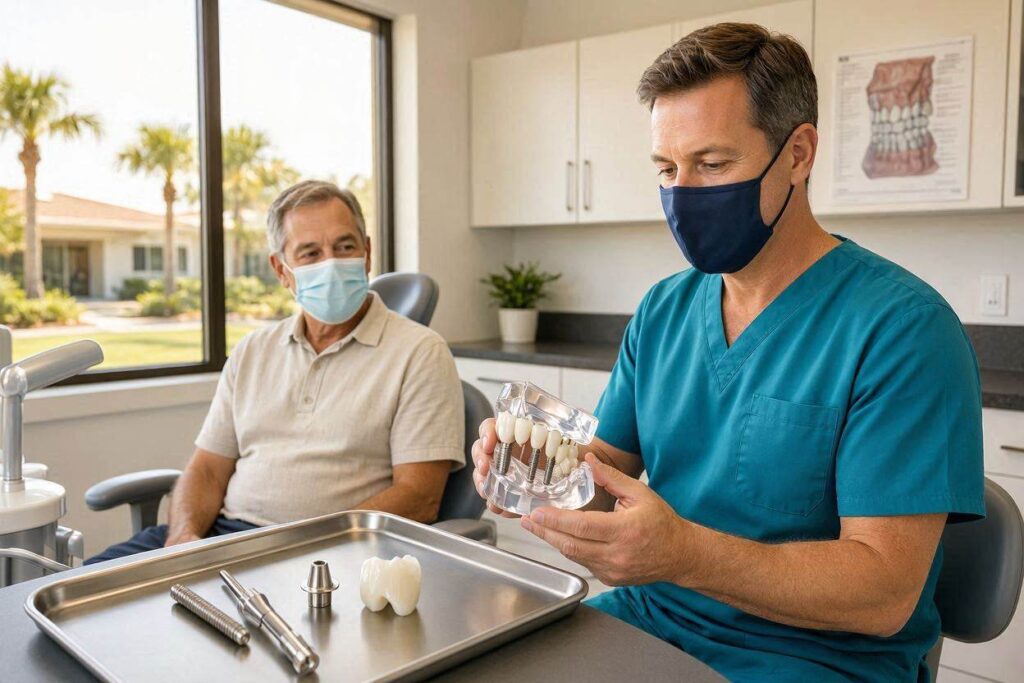
A dental implant is not a single object but a sophisticated, three-part medical device designed to recreate the full structure of a natural tooth.
Component One: The Implant Fixture
The implant fixture is the foundation of the system. It is a small, precision-manufactured post, typically shaped like a screw or a cylinder. It is made from medical-grade titanium or a titanium alloy. Titanium is used because it possesses a rare and essential property called biocompatibility. The human body does not reject titanium. It does not trigger an allergic response or a chronic inflammatory reaction. Instead, living bone cells recognize the titanium surface as a suitable structure to attach to.
When a surgeon places this titanium post into a carefully prepared site in the jawbone, a natural healing process called osseointegration begins. The patient’s own bone cells actively grow and adhere to the microscopic roughness on the implant’s surface. Over several months, the implant becomes structurally and biologically fused to the jaw. It effectively becomes a synthetic tooth root.
Component Two: The Abutment
Once the osseointegration period is successfully completed, a second piece is connected. The abutment is a small connector post that attaches to the implant fixture. It extends from the fixture, through the gum tissue, into the mouth. Its function is to serve as the precision anchor for the final tooth. In a modern, high-quality restoration, this abutment is custom-designed using digital CAD/CAM technology to perfectly support the gum tissue and provide an ideal shape for the final crown.
Component Three: The Prosthetic Crown
The third and final component is the part you see and use to chew—the implant crown. This is a custom-crafted dental restoration. Using a digital intraoral scan of the patient’s mouth, a skilled laboratory ceramist designs and mills the crown from a solid block of high-grade ceramic, such as layered zirconia or lithium disilicate. These materials are chosen for their exceptional strength and their ability to replicate the translucency, color, and texture of natural tooth enamel. The crown is then secured to the abutment, completing the restoration.
The Dental Implant Process in Plantation, FL
The journey from tooth loss to a fully restored, functional smile follows a precise, biologically driven sequence. A reputable implant practice in Plantation will never rush this timeline.
Phase 1: The Diagnostic and Planning Session
The first appointment is the most intellectually important. The implant dentist conducts a comprehensive oral examination and reviews your complete medical history. The centerpiece of this diagnostic phase is a 3D Cone Beam Computed Tomography (CBCT) scan. Unlike a traditional flat dental X-ray, a CBCT scan provides a three-dimensional virtual model of your jaws, teeth, nerves, and sinuses. The dentist uses this scan to measure the exact height, width, and density of the available bone and to precisely locate the inferior alveolar nerve and the maxillary sinuses. Using specialized software, the surgeon performs the entire procedure virtually on a computer screen before any actual surgery is performed.
Phase 2: Preparatory Bone Grafting (If Indicated)
If the CBCT reveals that the jawbone has insufficient volume to securely house an implant, a preliminary procedure is required. A bone graft is a surgical procedure to regenerate lost bone. The surgeon places a bone grafting material into the deficient area. This material acts as a scaffold, stimulating the body’s own regenerative cells to create new, living, vascularized bone. In the upper posterior jaw, if the sinus floor is too low, a sinus augmentation (sinus lift) is performed to create the necessary vertical bone height. These foundational procedures add several months to the overall treatment time but are essential for long-term success.
Phase 3: Surgical Implant Placement
The surgery is performed in the dental office under local anesthesia. Patient comfort is managed with a level of sedation appropriate for the individual—from nitrous oxide to oral conscious sedation or IV sedation. The surgeon makes a small incision in the gum to expose the bone. Using a sequence of precisely calibrated surgical drills, guided by the digital plan, the surgeon creates a channel in the bone and places the titanium implant fixture. The gum is then sutured closed, and a temporary tooth or protective cover is placed.
Phase 4: Osseointegration—The Biological Healing Period
This is the phase that defines implant dentistry. Over the next 3 to 6 months, the patient heals. Beneath the gum, the body is actively engaged in osseointegration. New bone cells are laying down a solid, mineralized connection to the implant surface. The patient wears a temporary prosthesis. No final restorative work is done until the dentist confirms, through a stability test and imaging, that the implant is fully integrated.
Phase 5: Final Restoration
Once healing is confirmed, the patient returns for the restorative appointments. The abutment is attached to the implant. The restorative dentist captures a digital scan of the implant’s exact position. This digital file is sent to a high-end dental laboratory where the custom crown is fabricated. At the final visit, the dentist checks the fit, the bite, and the aesthetics, and permanently secures the crown.
Types of Implant Solutions for Plantation Residents
The implant platform is versatile and can be adapted to any degree of tooth loss.
- Single Tooth Implant: One implant fixture and one custom crown. The gold standard for replacing a single missing tooth.
- Implant-Supported Bridge: Two or more implants support a multi-unit fixed bridge, replacing several teeth in a row without relying on a removable partial denture.
- Full-Arch Fixed Restoration (All-on-4): For patients with a fully edentulous arch, as few as four strategically angled implants can support a complete, non-removable set of prosthetic teeth. This often provides same-day teeth.
- Implant-Retained Overdenture: Two to four implants with specialized snap-attachments secure a removable denture, providing vastly superior stability compared to a traditional denture.
The Health and Quality-of-Life Benefits
The advantages of dental implants over traditional bridges and dentures are rooted in biology and biomechanics.
- Bone Preservation: Only an implant transmits the functional forces of chewing to the jawbone, stopping the resorption process and preserving facial structure.
- Protection of Adjacent Teeth: A traditional bridge requires destroying the enamel of the two healthy teeth next to the gap to support it. An implant is a standalone unit that does not touch or damage neighboring teeth.
- Restored Function and Confidence: Implants restore a bite force close to that of natural teeth. They allow patients to eat all foods and speak without anxiety. There is no slipping, no clicking, and no need for messy adhesives.
Am I a Candidate for Dental Implants?
Most adults with good general health and one or more missing teeth are candidates. The primary requirement is the presence of adequate jawbone, or the medical ability to undergo bone grafting to achieve it. Conditions that impair healing, such as uncontrolled diabetes, and habits like smoking are significant risk factors and must be discussed openly with your Plantation implant surgeon during the medical history review.
Conclusion
Dental implants are a three-part medical device—a titanium root, a connector abutment, and a ceramic crown—that completely and permanently replaces a missing tooth. They function through a biological process called osseointegration, where the jawbone fuses to the titanium surface, providing a stable anchor that also halts the bone loss that follows tooth extraction. For residents of Plantation, Florida, the implant process is a meticulously planned, multi-phase journey of 3D imaging, potential bone preparation, surgical placement, a months-long biological healing period, and final custom restoration. The result is a tooth that feels, functions, and looks completely natural.
FAQ
1. Is the surgery painful?
No. The procedure is performed under local anesthesia. Post-operative soreness is normal and is typically managed with standard pain relievers for a few days.
2. How long does it take to get a full implant tooth?
From surgery to final crown, a straightforward single implant case typically takes 3 to 6 months. If bone grafting is needed, the total timeline is longer.
3. How do I care for my dental implant?
You care for an implant exactly like a natural tooth: brushing twice daily, flossing with implant-specific tools, and attending regular professional maintenance cleanings every 3-6 months.
4. What is the long-term success rate?
In healthy patients with good oral hygiene, the documented success rate is over 95%.
5. Will my dental insurance cover this?
Many dental insurance plans provide a benefit toward the implant crown under major restorative services. The surgical phase is often not covered, but your Plantation dentist’s office will help verify your exact benefits.
Additional Resource
To understand the rigorous standards for the materials used in your implant, review the detailed safety and regulatory information from the U.S. Food and Drug Administration (FDA) – Dental Implants.