What Materials Are Used To Make Dental Implants?
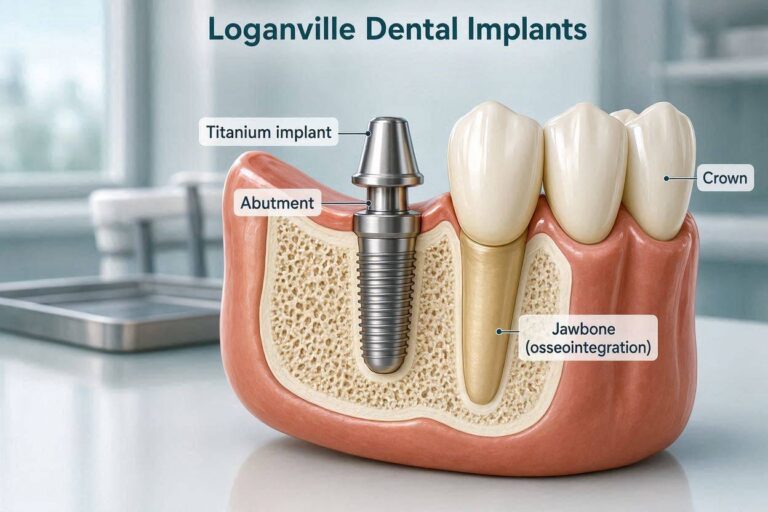
A dental implant is a medical device that is surgically placed into the human body. It is intended to remain there, under constant functional load, for decades. This demanding clinical reality means that the materials chosen to fabricate the implant system are not arbitrary. They are the result of decades of rigorous scientific research, materials engineering, and clinical testing. The selection of a material is based on its biocompatibility, its mechanical strength, its resistance to corrosion, and its ability to integrate with living bone.
This article provides a comprehensive, deep-dive exploration of the materials used in modern dental implant systems. You will learn about the composition of the implant fixture, the abutment, and the crown. We will examine the science behind why titanium remains the gold standard, the emerging role of ceramic alternatives like zirconia, and the detailed properties that make each material suitable for long-term function in the oral environment.
The Overarching Principle: Biocompatibility
Before examining specific materials, you must understand the non-negotiable principle that governs all implant material selection: biocompatibility. A biocompatible material is one that can exist in contact with living tissue without causing harm. It does not trigger a chronic inflammatory response. It does not cause an allergic or hypersensitivity reaction. It is not toxic to the body’s cells. It does not get rejected by the immune system like a transplanted organ.
The oral cavity is a particularly hostile environment. Materials are constantly bathed in saliva, subjected to temperature fluctuations, attacked by bacterial acids, and placed under hundreds of pounds of cyclic chewing force. The materials that succeed in this environment are a very short, elite list of metals and ceramics that the body tolerates without a fight.
The Implant Fixture: The Root Material
The implant fixture, the part that is embedded in the jawbone, is the most critical component from a material science perspective. It must integrate with hard tissue.
Commercially Pure Titanium (CP Titanium)
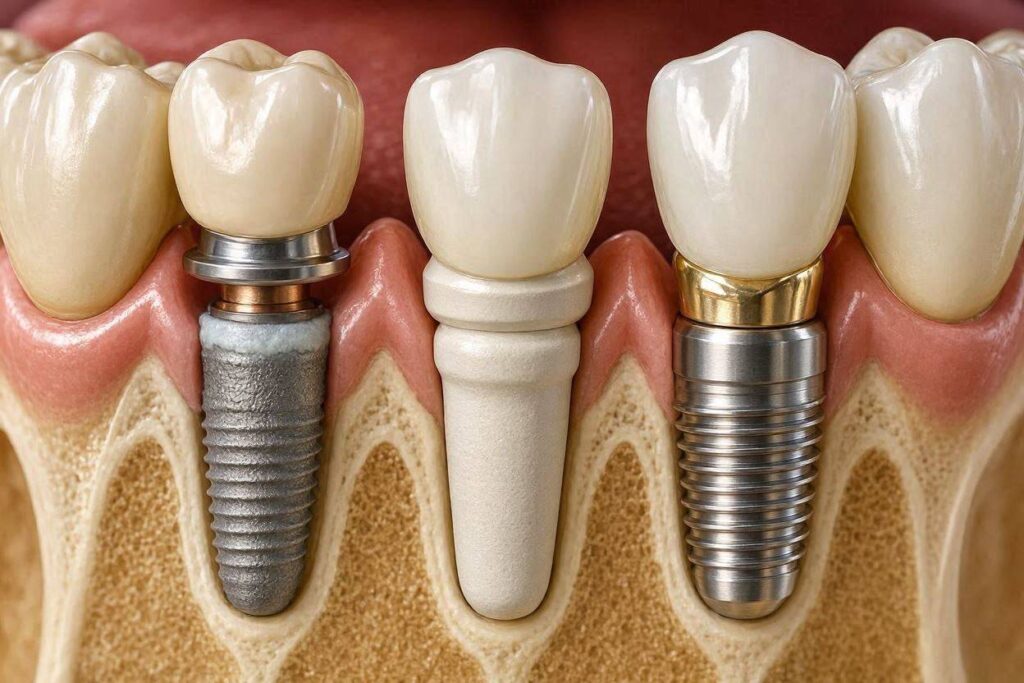
The most historically significant and still widely used material is commercially pure (CP) titanium. CP titanium is an unalloyed form of the metal with trace amounts of elements like oxygen, iron, and carbon. It is graded from Grade 1 to Grade 4, with Grade 4 being the strongest of the unalloyed grades. CP titanium offers a combination of excellent biocompatibility and a lower modulus of elasticity compared to other metals, meaning it is slightly more flexible and transmits forces to the bone in a more natural way.
The bone-to-titanium connection was discovered by accident by Swedish orthopedic surgeon Per-Ingvar Brånemark in the 1950s. He found that bone would fuse so tightly to titanium that it could not be separated. This phenomenon, osseointegration, is the biological basis of all modern implant dentistry. The key to this bond is the titanium dioxide (TiO2) layer. Titanium instantly oxidizes when exposed to air. This creates a stable, inert, and highly biocompatible ceramic-like oxide layer on the surface of the metal. It is this oxide layer that the bone cells attach to, not the pure metal underneath.
Titanium Alloy (Ti-6Al-4V)
Today, the most common material for dental implant fixtures is a titanium alloy, specifically Ti-6Al-4V ELI. This stands for Titanium-6% Aluminum-4% Vanadium, Extra Low Interstitial. This alloy provides significantly higher tensile strength and fatigue resistance compared to CP titanium. This is critical for implants with small diameters, for patients with heavy bite forces, or for full-arch restorations where angled abutments place high bending stresses on the implant. The biocompatibility of this alloy is excellent, essentially equivalent to CP titanium, while its mechanical properties are superior for demanding applications.
Surface Modifications: The Micro-Architecture
Modern implants are not smooth machined screws. Their surfaces are engineered at the microscopic level to accelerate and strengthen osseointegration. The material science here is as important as the base metal.
- Sandblasting and Acid-Etching (SLA): The surface is blasted with grit (like aluminum oxide) and then dipped in a strong acid. This creates a highly complex, three-dimensional landscape of peaks and valleys at the micron and sub-micron level. This dramatically increases the surface area for bone cell attachment.
- Anodization: The implant is placed in an electrolytic bath, and a current is passed through it. This thickens and colors the titanium oxide layer while also creating a porous surface topography.
- Hydroxyapatite (HA) Coatings: Hydroxyapatite is a calcium phosphate compound that is the primary mineral component of natural bone. Coating a titanium implant with HA creates a surface that is chemically highly attractive to bone cells, accelerating the initial healing phase. However, concerns about the long-term stability of the coating’s bond to the titanium have made this less common than the roughened, additive-free surfaces.
The Abutment Material
The abutment is the connector that links the implant fixture to the crown. It sits partially below and partially above the gum. Material choice here impacts both strength and aesthetics.
Titanium Abutments
Titanium is the default and strongest abutment material. It is particularly indicated for posterior molars where the forces are highest. Its dark, metallic gray color is the only downside. If the patient has thin, translucent gum tissue, a titanium abutment can show through as a gray shadow at the gum line, compromising aesthetics in the “smile zone.”
Zirconia Abutments (Ceramic)
For anterior (front) teeth, where aesthetics are paramount, customized abutments milled from yttria-stabilized zirconia (a white ceramic) are now a standard of care. Zirconia is tooth-colored. It eliminates the risk of a gray gum line shadow. It has high flexural strength, and when combined with an all-ceramic crown, it allows for the most natural, vital light transmission. The potential downside was historically a risk of fracture, but modern grades of dental zirconia have largely overcome this issue when used appropriately.
Hybrid Abutments
A recent innovation combines a titanium base (for a strong, precise metal-to-metal connection with the implant fixture) with a zirconia or lithium disilicate ceramic superstructure bonded to it. This provides the strength of a titanium connection with the superior aesthetics of a white ceramic emergence profile.
The Implant Crown Materials
The crown is the visible tooth. Its material must withstand the destructive forces of chewing while mimicking the optical properties of natural enamel.
Layered Zirconia
Zirconia (zirconium dioxide) is the strongest ceramic used in dentistry. For posterior molars, full-contour or monolithic zirconia is often used. It is virtually unbreakable. For anterior teeth, a high-strength zirconia framework is layered with more translucent, glassy porcelains by a master ceramist. This combines a strong core with a natural-looking outer layer. The primary advantage is extreme durability.
Lithium Disilicate (E-max)
Lithium disilicate is a glass-ceramic material that offers the highest level of aesthetics available today. It can be milled as a solid, monolithic block and offers an unparalleled combination of translucency and light diffusion that is extremely close to natural enamel. It is strong (around 400 MPa flexural strength), making it suitable for single crowns in both the front and back of the mouth. For the most cosmetic implant restorations in the aesthetic zone, lithium disilicate is often the material of choice.
Porcelain-Fused-to-Metal (PFM)
This is the traditional, older crown technology. A metal substructure provides strength, and layers of porcelain are baked onto it. The aesthetic limitation is the metal core, which blocks light transmission and can create an opaque, lifeless look. A dark metal margin line can also become visible at the gum line if the gums recede slightly over time. This is still used but has been largely superseded by all-ceramic alternatives in high-end implant dentistry.
The Emerging Role of Metal-Free Zirconia Implants
While titanium remains the dominant material for the fixture, there is a growing demand for completely metal-free implant solutions. Zirconia ceramic implants are now a viable, scientifically backed alternative. These one-piece or two-piece implants are fabricated from yttria-stabilized zirconia, the same high-strength ceramic used for crowns.
The advantages are threefold. They are white and will not cause any gray gum show-through, a definitive advantage for patients with thin gum biotypes. They satisfy the demands of patients who have a strong preference for metal-free treatments. They demonstrate very low bacterial plaque affinity; bacteria may adhere less readily to a highly polished zirconia surface than to titanium.
The clinical considerations are different. Zirconia implants are typically made as a single piece (implant and abutment combined), which limits their use to cemented restorations and requires a very specific surgical placement. Their long-term clinical data, while very strong, does not yet have the 40-year track record of titanium. They are a specialized tool for a specific indication, best used by surgeons with specific training in the zirconia system.
Material Safety, Allergies, and Regulations
All implant materials used in the United States are regulated by the FDA as Class II or Class III medical devices. They must meet stringent international standards (such as ASTM and ISO) for chemical composition, mechanical strength, and biocompatibility before they can be legally marketed.
True allergy to titanium is considered to be extremely rare. However, sensitivity to nickel or other metals is a common patient concern. Standard titanium and titanium alloy implants do not contain nickel. If a patient has a documented, severe metal allergy or a strong history of multiple allergic reactions, a referral to an allergist for specific titanium patch testing can be done, or the clinician can elect to use a zirconia implant.
Conclusion
The materials that make up a modern dental implant system are a combination of medical-grade titanium alloy for the root fixture, customized titanium or tooth-colored zirconia for the connector abutment, and high-strength aesthetic ceramics like layered zirconia or lithium disilicate for the final crown. These materials are selected for their proven biocompatibility, which allows for the process of osseointegration, their exceptional corrosion resistance in the oral environment, and their ability to withstand years of functional stress. Advances in material science, including ceramic implants and digitally milled restorations, continue to expand the options for achieving a strong, durable, and completely natural-looking tooth replacement.
FAQ
1. Is there nickel in dental implants?
No. Standard dental implant fixtures are made from commercially pure titanium or a titanium alloy (Ti-6Al-4V). Neither material contains nickel, which is the metal most commonly associated with allergic reactions.
2. What is the difference between a titanium and a zirconia implant?
A titanium implant is a two-piece system with a separate root and abutment, made of metal. A zirconia implant is a one-piece ceramic device that is tooth-colored. Both are highly biocompatible, but titanium has a longer clinical track record.
3. What material is the tooth on top of the implant made of?
The visible crown is typically made of a high-strength dental ceramic, most commonly either layered zirconia or lithium disilicate (e.max). Both provide excellent aesthetics and strength.
4. Can the body reject the material of a dental implant?
A true immunologic rejection does not happen with titanium or zirconia. Implant failure is almost always due to a failure of the bone to heal to the surface (biologic failure) or a bacterial infection (peri-implantitis), not a material allergy or rejection.
5. Is zirconia as strong as titanium for an implant fixture?
Modern, fully dense yttria-stabilized zirconia is a very strong ceramic, but titanium alloy has higher tensile strength and fracture toughness. Zirconia implants require careful case selection and a slightly different surgical protocol.
Additional Resource
For a scientifically detailed understanding of the regulatory standards applied to implant materials, visit the official device information page at the U.S. Food and Drug Administration (FDA) – Dental Implants.