The Cost Of A Teeth-Whitening Procedure?
A bright, white smile is one of the most desired features in modern society. It signals health, youth, and confidence. But life takes its toll on our teeth. Coffee, tea, red wine, smoking, and even aging can leave our teeth looking dull and yellow. That is why teeth whitening has become one of the most popular cosmetic dental procedures in the world.
If you are considering whitening your teeth, you probably have one big question: how much does it cost? The answer ranges from $20 for a drugstore kit to $1,500 for a premium in-office treatment. That is a huge range, and it can feel overwhelming. But don’t worry. This guide will break it all down for you.
We will look at every teeth-whitening option available. We will compare in-office professional treatments, custom take-home kits, and over-the-counter products. We will explain what affects the price, whether insurance covers it, and how to get the best results for your money. By the end, you will know exactly what to expect and how to choose the right option for your smile.
Understanding Teeth Whitening
Before we talk about money, let’s understand what teeth whitening actually is.
What Is Teeth Whitening?
Teeth whitening is a process that removes stains and discoloration from your teeth. It uses bleaching agents, usually hydrogen peroxide or carbamide peroxide, to break down stain molecules. The result is a lighter, brighter smile.
Why Do Teeth Change Color?
There are two types of staining: extrinsic and intrinsic.
- Extrinsic Stains: These are on the surface of your teeth. They come from coffee, tea, wine, smoking, and certain foods. They are easier to remove.
- Intrinsic Stains: These are inside the tooth. They come from aging, trauma, certain medications (like tetracycline), or genetics. They are harder to remove and may require professional treatment.
Types Of Teeth Whitening Procedures
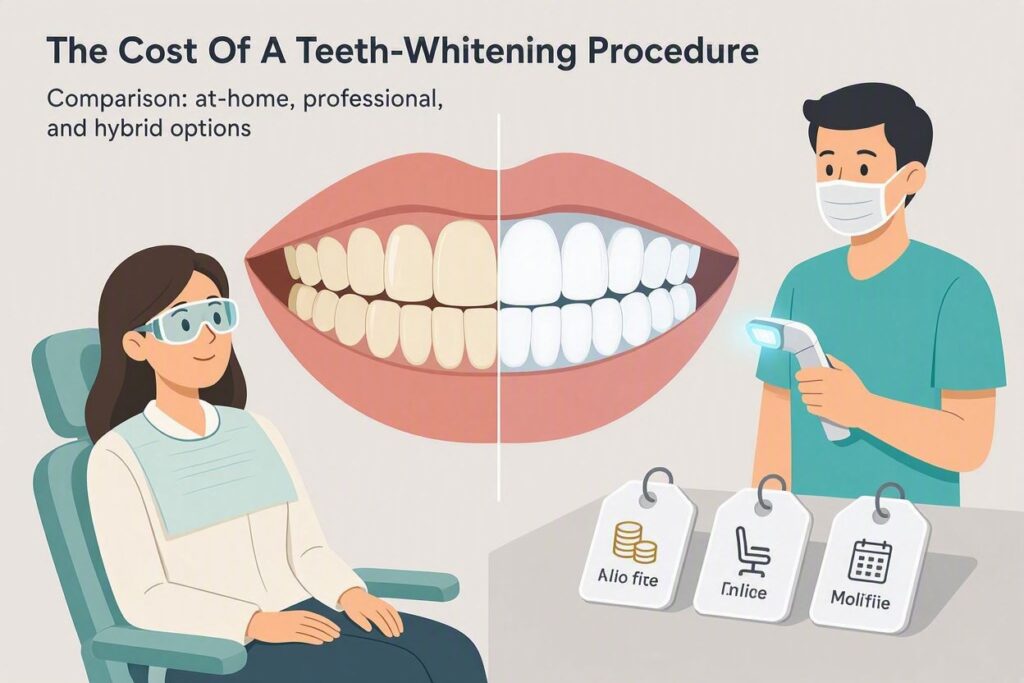
There are three main categories of teeth whitening: professional in-office, professional take-home, and over-the-counter.
1. Professional In-Office Whitening
This is done at your dentist’s office. The dentist applies a high-concentration bleaching gel to your teeth. They may use a light or laser to activate the gel. The procedure takes about 1 to 2 hours. You see results immediately.
Cost: $500 – $1,500 per session.
2. Professional Take-Home Whitening
Your dentist takes an impression of your teeth and makes custom-fitted trays. You get a professional-strength bleaching gel to use at home. You wear the trays for a few hours a day or overnight, depending on the gel.
Cost: $300 – $800 for the kit.
3. Over-The-Counter (OTC) Whitening
These are products you buy at drugstores or online. They include whitening strips, gels, pens, toothpaste, and mouthwash. They use lower concentrations of bleaching agents.
Cost: $20 – $150.
Comparison Table: Teeth Whitening Options
| Method | Average Cost | Treatment Time | Results | Durability |
|---|---|---|---|---|
| In-Office Professional | $500 – $1,500 | 1-2 hours | Immediate, dramatic | 1-3 years |
| Custom Take-Home | $300 – $800 | 1-4 weeks | Gradual, good | 1-2 years |
| OTC Whitening Strips | $20 – $80 | 1-2 weeks | Moderate | 3-6 months |
| Whitening Toothpaste | $5 – $15 | Ongoing | Minimal | Days |
| Whitening Pens | $20 – $50 | 1-2 weeks | Mild | Weeks |
| Whitening Mouthwash | $5 – $15 | Ongoing | Minimal | Days |
Professional In-Office Whitening: Cost Breakdown
In-office whitening is the most expensive option, but it also gives the best results. Here is a detailed breakdown of what you pay for.
The Procedure
- Consultation: The dentist examines your teeth and determines if you are a good candidate. They check for cavities, gum disease, and sensitivity.
- Preparation: The dentist isolates your teeth and protects your gums with a barrier.
- Application: The bleaching gel is applied to your teeth.
- Activation: A light or laser may be used to speed up the process.
- Repeat: The gel is usually applied in 2 to 3 cycles of 15 to 20 minutes each.
- Fluoride Treatment: A fluoride gel is applied to reduce sensitivity.
The Cost
- Average Cost: $500 – $1,500
- Cost Per Tooth: $50 – $100 (for single-tooth whitening)
- Additional Fees: X-rays ($50 – $150), consultation ($50 – $100)
Factors That Affect The Price
- Your Location: In big cities like New York or Los Angeles, prices are higher. In smaller towns, they are lower.
- The Dentist’s Experience: A cosmetic dentist with years of experience will charge more.
- The Technology: Laser whitening costs more than light-activated whitening.
- The Number Of Sessions: Some dentists include multiple sessions in the price. Others charge per session.
Pros Of In-Office Whitening
- Fast results in a single visit.
- Professional supervision ensures safety.
- Stronger bleaching agents than OTC products.
- Customized treatment for your needs.
Cons Of In-Office Whitening
- Most expensive option.
- Can cause temporary tooth sensitivity.
- Results are not permanent.
Professional Take-Home Whitening: Cost Breakdown
This is a popular middle-ground option. You get professional-grade materials but do the treatment at home.
The Procedure
- Consultation: The dentist examines your teeth and takes impressions.
- Tray Fabrication: Custom trays are made in a dental lab. This takes 1 to 2 weeks.
- At-Home Use: You fill the trays with bleaching gel and wear them for a prescribed amount of time. This could be 30 minutes a day or overnight for 1 to 2 weeks.
The Cost
- Average Cost: $300 – $800
- Refill Gel: $50 – $150
Pros Of Take-Home Whitening
- Less expensive than in-office.
- You control the pace of whitening.
- You can touch up whenever you want.
- Custom trays fit better than OTC products.
Cons Of Take-Home Whitening
- Takes longer to see results.
- Requires discipline to use regularly.
- Can cause sensitivity if overused.
Over-The-Counter Whitening: Cost Breakdown
OTC products are the cheapest option. They are convenient and easy to use. But they are less effective than professional treatments.
Types Of OTC Products
1. Whitening Strips
These are thin, flexible strips coated with bleaching gel. You apply them to your teeth for 30 minutes a day.
- Cost: $20 – $80
- Brands: Crest Whitestrips, Lumineux, SmileDirectClub
- Pros: Easy to use, affordable, noticeable results.
- Cons: Can slip, may not reach all teeth, can cause sensitivity.
2. Whitening Toothpaste
These contain mild abrasives or small amounts of bleaching agents.
- Cost: $5 – $15
- Pros: Cheap, easy to find, helps remove surface stains.
- Cons: Minimal whitening effect, does not change intrinsic color.
3. Whitening Pens
These are small pens with bleaching gel that you paint onto your teeth.
- Cost: $20 – $50
- Pros: Portable, good for touch-ups.
- Cons: Results are temporary, can be messy.
4. Whitening Mouthwash
These contain low concentrations of bleaching agents.
- Cost: $5 – $15
- Pros: Easy to use, freshens breath.
- Cons: Very minimal whitening effect.
5. Whitening Kits With LED Lights
These kits include a bleaching gel and a small LED light that you hold in your mouth. The light is supposed to activate the gel.
- Cost: $30 – $100
- Pros: More effective than strips alone.
- Cons: Results vary, LED lights may not be powerful enough.
Comparison Table: OTC Whitening Products
| Product | Cost | Effectiveness | Ease Of Use |
|---|---|---|---|
| Whitening Strips | $20 – $80 | Moderate | Easy |
| Whitening Toothpaste | $5 – $15 | Minimal | Very Easy |
| Whitening Pens | $20 – $50 | Mild | Easy |
| Whitening Mouthwash | $5 – $15 | Minimal | Very Easy |
| LED Whitening Kits | $30 – $100 | Moderate | Moderate |
Does Insurance Cover Teeth Whitening?
This is a common question. The answer is almost always no. Teeth whitening is considered a cosmetic procedure. Dental insurance plans do not cover cosmetic treatments. They only cover procedures that are medically necessary.
Exceptions
There are a few rare exceptions:
- If whitening is needed because of a medical condition (e.g., staining from a medication), medical insurance might cover it.
- Some dental plans offer a discount on whitening as a perk.
- Some dentists offer whitening as part of a larger treatment package.
How To Check
Call your insurance company. Ask:
- Is teeth whitening covered under my plan?
- Is there any coverage for cosmetic dental procedures?
- Do you offer any discounts for whitening?
What About Dental Savings Plans?
Dental savings plans (like Aetna Dental Access or Careington) are not insurance. You pay an annual fee to join a network of dentists. You get discounted rates on treatments, including cosmetic procedures. A savings plan might reduce the cost of whitening by 20% to 50%.
Factors That Affect The Cost Of Teeth Whitening
Several factors determine what you will pay for whitening.
1. The Type Of Treatment
In-office whitening is the most expensive. Take-home kits are in the middle. OTC products are the cheapest.
2. Your Location
Prices vary by region. In a big city, you will pay more. In a rural area, you will pay less.
3. The Dentist’s Experience
A cosmetic dentist who specializes in smile makeovers will charge more than a general dentist.
4. The Technology Used
Laser whitening costs more than LED whitening. Some dentists use advanced systems like Zoom or Philips Zoom.
5. The Severity Of Staining
If your teeth are heavily stained, you may need multiple sessions. This increases the cost.
6. Additional Services
Some dentists include a cleaning, fluoride treatment, or take-home touch-up kit in the price. Others charge extra.
Is Teeth Whitening Safe?
Yes, when done correctly. Professional whitening is safe and effective. OTC products are also safe if used as directed.
Potential Side Effects
- Tooth Sensitivity: This is the most common side effect. It is usually temporary and goes away after treatment.
- Gum Irritation: If the bleaching gel touches your gums, it can cause irritation. Professional treatments use a barrier to protect the gums.
- Enamel Damage: Overuse of whitening products can damage enamel. Always follow instructions.
Who Should Not Get Teeth Whitening?
- Children under 16 (their teeth are still developing).
- Pregnant or nursing women.
- People with cavities or gum disease (treat these first).
- People with sensitive teeth or receding gums.
- People with crowns, veneers, or fillings (whitening does not work on these).
How To Make Your Whitening Last Longer
Whitening is not permanent. The results last 1 to 3 years, depending on your habits. Here is how to make it last.
1. Avoid Staining Foods And Drinks
Coffee, tea, red wine, cola, and dark berries can stain your teeth. Use a straw when drinking and rinse your mouth afterward.
2. Quit Smoking
Smoking is a major cause of tooth staining. Quitting will help your teeth stay white.
3. Practice Good Oral Hygiene
Brush twice a day, floss daily, and use a whitening toothpaste.
4. Get Regular Cleanings
Professional cleanings remove surface stains and keep your smile bright.
5. Touch Up
Use a take-home whitening kit or whitening strips every few months to maintain your results.
How To Save Money On Teeth Whitening
You do not have to pay full price. Here are some tips.
1. Start With OTC Products
If you have mild staining, try OTC strips or toothpaste first. They are cheap and might be enough.
2. Ask For A Discount
Some dentists offer promotions or discounts on whitening. Ask if they have any specials.
3. Go To A Dental School
Dental schools offer whitening at reduced costs. The work is done by supervised students.
4. Use A Dental Savings Plan
If you do not have insurance, a dental savings plan can reduce the cost.
5. Combine With A Cleaning
Some dentists offer a discount if you get a cleaning and whitening on the same day.
6. Consider Take-Home Kits
Professional take-home kits are cheaper than in-office treatments and give good results.
Quotes From People Who Whitened Their Teeth
“I got in-office whitening for $600. It took about an hour. My teeth were noticeably whiter. I am happy with the results.” — Jennifer, California
“I used Crest Whitestrips. They cost $40. My teeth got a little whiter, but not as much as I hoped. I might try professional whitening next time.” — Mark, Texas
“I got custom take-home trays from my dentist. It cost $400. I used them for two weeks. My teeth look great. I still use them for touch-ups.” — Lisa, Florida
Quotes From Dentists
“In-office whitening gives the best results because we use stronger gels and protect the gums. But take-home kits are a great option for maintenance.” — Dr. Smith, Cosmetic Dentist
“I always tell patients to get a cleaning before whitening. The gel works better on clean teeth, and we can check for cavities.” — Dr. Johnson, General Dentist
Important Note For Readers
Prices for teeth whitening change over time. The ranges in this article are estimates based on current market data. Always get a personalized quote from a licensed dentist. Do not rely solely on online information for your treatment decisions. Your specific needs may result in a different price.
Frequently Asked Questions (FAQ)
1. How much does professional teeth whitening cost?
Professional in-office whitening costs $500 to $1,500. Custom take-home kits cost $300 to $800.
2. Does insurance cover teeth whitening?
No. Teeth whitening is considered cosmetic. Dental insurance does not cover it.
3. How long do whitening results last?
Results last 1 to 3 years, depending on your diet and habits.
4. Is teeth whitening painful?
Some people experience temporary sensitivity. This usually goes away within a few days.
5. Can I whiten my teeth at home?
Yes. You can use OTC products or custom take-home kits from your dentist.
6. Do whitening toothpastes work?
They can remove surface stains, but they do not change the intrinsic color of your teeth.
7. Can I whiten my teeth if I have crowns or veneers?
Whitening does not work on crowns or veneers. You may need to replace them to match your whitened teeth.
8. How white can my teeth get?
The results vary. Most people can get 2 to 8 shades whiter.
9. Is laser teeth whitening better?
Laser whitening can be faster and more effective, but it costs more. LED whitening is also effective.
10. Can I whiten my teeth too much?
Yes. Over-whitening can damage enamel and cause severe sensitivity. Follow your dentist’s instructions.
Conclusion
The cost of a teeth-whitening procedure ranges from $20 for a drugstore kit to $1,500 for a premium in-office treatment. The best option for you depends on your budget, your desired results, and your tolerance for sensitivity. Professional treatments give the best and longest-lasting results. OTC products are cheaper but less effective. Insurance rarely covers whitening, so most people pay out of pocket. By understanding your options and following aftercare tips, you can achieve a brighter smile without breaking the bank.
Additional Resource:
For more information on teeth whitening and oral health, visit the American Dental Association: